Despite its predictability, Mamdani’s campaign unsurprisingly attracted massive international attention. This marks the peak of political activism for Generation Z, which literally carried the 34-year-old regional legislator into the New York mayor’s residence. Despite last year’s predictions of the imminent demise of wokism, radical progressives are gradually returning to the agenda.
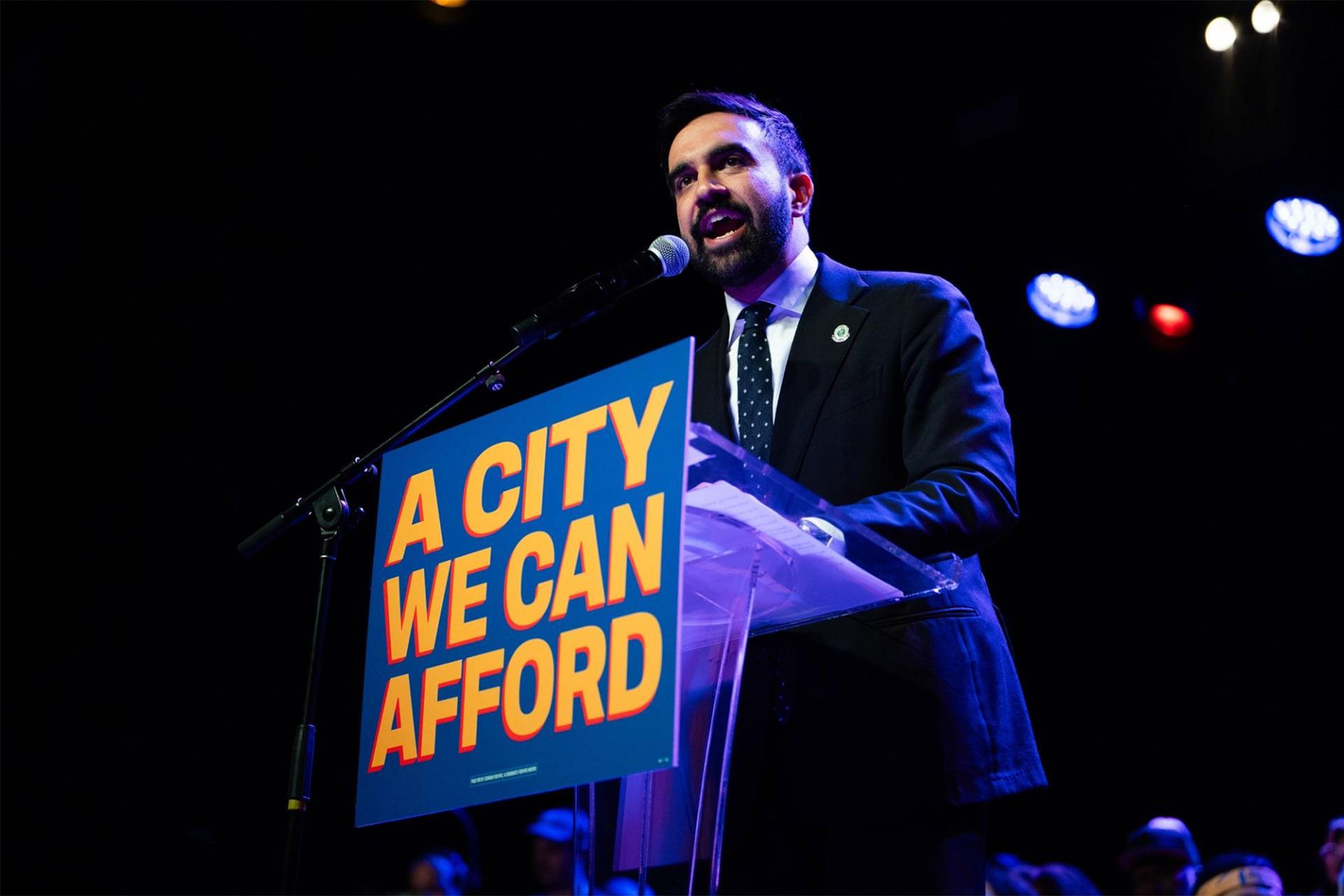
Photo: Madison Swart via zohranfornyc.com
In terms of intrigue, the recent New York mayoral election was almost comparable to Russia’s unified voting day. Young charismatic Zohran Mamdani, favored by the media and the creative class, competed against former governor Andrew Cuomo, who has a highly controversial reputation, and Curtis Sliwa — an eccentric outsider in a burgundy beret who was soundly defeated by the Democratic candidate in the previous mayoral race. The situation was worsened by the fact that Cuomo and Sliwa were seen as a moderately conservative opposition to socialist Mamdani, creating a spoiler effect and causing the former governor’s chances of victory to vanish entirely due to the efforts of electoral nihilists who supported Sliwa (about 150,000, or 7% of voters).
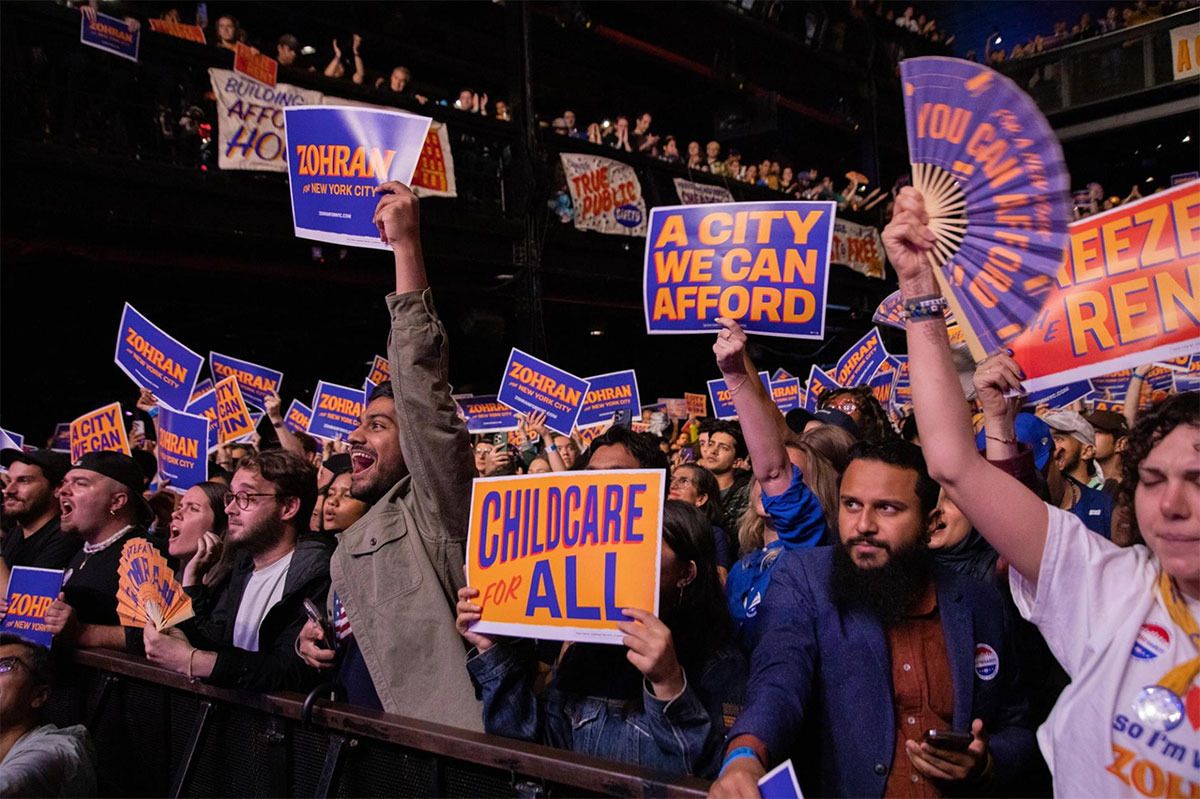
Despite the campaign’s predictability and strictly regional nature, it attracted enormous international attention for a reason. It can be seen as the pinnacle of Generation Z’s political activism, which literally carried Zohran into the Gracie Mansion. According to CNN exit polls, an astounding 78% of New Yorkers aged 18 to 29 voted for the democratic socialist, while millennials (ages 30-44) were slightly less active at 66%, and those over 45 mostly preferred Andrew Cuomo.
Not long ago, much more modest figures from European Parliament and Bundestag elections sparked media discussions about worryingly far-right European youth, but what does Mamdani’s phenomenal success tell us?
We are looking at a politician whose public image is masterfully crafted to appeal to the tastes of progressive urban youth.
Imagine a hypothetical twenty-year-old resident of East Village or Bushwick, renting a room in a shared apartment with four roommates, paying off a liberal arts college loan, and carrying the latest MacBook with a pro-Palestinian sticker on the lid in a rainbow tote bag to work in a specialty coffee shop. This is a somewhat caricatured but universal archetype, also relevant for other major American cities and European capitals — which, incidentally, explains why representatives of German and French left-wing parties recently traveled en masse to New York to learn from the experience amid a “newfound sense of optimism.”
This optimism is also bolstered by last week’s parliamentary election results in the Netherlands, where the left-liberals from “D66” defeated the right-wing populists from the “Party for Freedom.” Apparently, the 2024 forecasts that woke politics is dying (notably voiced most actively from the “progressivecamp“) were somewhat premature, and radical progressives are gradually returning to the agenda. Not least as a direct reaction to the ”right turn“: Mamdani’s platform includes a separate point dedicated to “protecting New York from Donald Trump,” whom he called a traitor to the nation in his victory speech.
Among those who cited antipathy towards Trump as their reason for choosing a candidate, 76% voted specifically for Mamdani. Paradoxically, he is typologically quite similar to the current American president.
Both Trump and Mamdani can be described as “anti-politicians” who built careers on anti-establishment populism and personal charisma.
Like Trump, Mamdani has almost no political background or relevant management experience (unless you count his four-year membership in the New York State Assembly as relevant experience for leading a gigantic metropolis with a 300,000-strong public workforce), and for both, this became a major advantage. Because neither was associated at the time of election with the corrupt, out-of-touch establishment and were perceived as a breath of fresh air.
Photo: zohranfornyc.com
In Mamdani’s case, he also gained points from having no ties to business. This allowed the candidate to fully exploit the image of a “man of the people” and make the core of his program a critique of the 1% ultra-wealthy New Yorkers, calling for them to “pay their fair share” to fund numerous socialist promises: free buses, subsidized stores for the poor, a minimum wage of $30/hour, and other initiatives.
Among Mamdani’s critics, a common surprised refrain is how someone with such openly Marxist-Leninist rhetoric and ambitions can be mayor of New York, the citadel of capitalism and neoliberalism — but they answer their own question. A recent article titled “Zohran Mamdani Will Destroy New York” in the conservative British weekly The Spectator begins:
“The city that considered itself grown-up has just elected a mayor who seems to embody the American student: ignorant, pretentious, and self-satisfied, enjoying a royal lifestyle parasitically dependent on a civilization he knows nothing about but looks upon with pure contempt.”
This bluntly judgmental statement contains an interesting perspective on New York’s situation, which is often the subject of jokes for its self-absorption and resulting narrow-mindedness. There is no doubt that a significant portion of those who voted for Mamdani — as was the case with elite college students at the 2011 Occupy Wall Street protests — are, like Zohran himself, people from wealthy beneficiary families of the current system, who unsurprisingly live in a city far from a socialist utopia.
However, precisely because of this pervasive capitalist realism, New York since the days of Patti Smith, Martha Rosler, and intellectual parties with the “Black Panthers” in the spirit of “radical chic,” described by Tom Wolfe, has had, first, a need for countercultural relief, and second, the means to finance these experiments and dedicate time and attention to their collective reflection. This is also true, for example, for Paris or Berlin — it’s just that until recently, this need hadn’t translated into electing a city government head.
Over the past year, my Instagram feed was flooded with viral promo videos of Mamdani showing how he, an “ordinary person,” rides the subway, chats with passersby in New York’s disadvantaged neighborhoods, or insists that a halal plate should cost $8, not $10. These videos gained traction primarily because my friends at universities in the US actively liked and enthusiastically commented on them. Often, they belong to the segment of American society that would find a $100 price for that halal plate perfectly reasonable — if only they knew what it was and weren’t reluctant to buy food from trucks in the Bronx. The appeal isn’t about concern over rising Middle Eastern street food prices, but the charm of Mamdani’s style and approachable simplicity. The ever-smiling Bowdoin College graduate had the courage to “go to the people” and, through viral social media content, construct an image of New York as a city of honest, hardworking, and friendly people whose aspirations and dreams would have long been fully realized — if not for racists, fascists, stingy people, and traitors from the Trump administration, the tax service, and Andrew Cuomo’s team, who consider it bad manners to ride buses and eat Muslim street food.
This deliberate simplification and forced optimism are quite atypical for the political realities of the 2020s, when calls to build walls at borders and repatriate immigrants are much more common than Mamdani’s slogans welcoming migrants. Against this backdrop, Cuomo appeared extremely dull with his arguments about the need to expand the police department, while his opponent immersed the audience in egalitarian utopias with free transport and frozen rent. This contrast resonated well with collective disillusionment in traditional politics — much like the 1997 UK parliamentary elections that brought the “New Labour” to power.
Mamdani’s mythologized New York has successfully fulfilled its electoral function — and now the reputation of the entire progressive movement in the West depends on how successfully Zohran can relocate his voters to this still entirely fictional city. If this relocation ultimately involves the notorious “stop and frisk” practices, increased law enforcement, and additional taxation of the other 99% of New Yorkers, the next mayor could be another “anti-politician” campaigning on criticizing Mamdani’s dictatorship and elitism.
If you enjoyed this article, consider making a donation — one-time or, even better, monthly. Your support helps us motivate our authors and become better with every article.
Our organization is recognized by the Internal Revenue Service (IRS) as a 501(c)(3) tax-exempt, charitable organization, which means that all contributions made to us are tax-deductible to the fullest extent permitted by U.S. law. Individuals may generally deduct charitable contributions of up to 60% of their Adjusted Gross Income (AGI) for cash donations made to qualifying 501(c)(3) organizations. For donations of appreciated assets (such as stocks or other long-term capital assets), the deduction is typically limited to 30% of AGI, based on the fair market value of the asset. C-corporations may deduct charitable contributions of up to 10% of their taxable income for donations made to eligible charitable organizations.
By submitting a donation, you confirm that you have read and accept the following documents: Privacy Policy and User Agreement, and also give consent to the processing of your personal data.
If you would like to unsubscribe from a monthly donation, please email us at: [email protected]