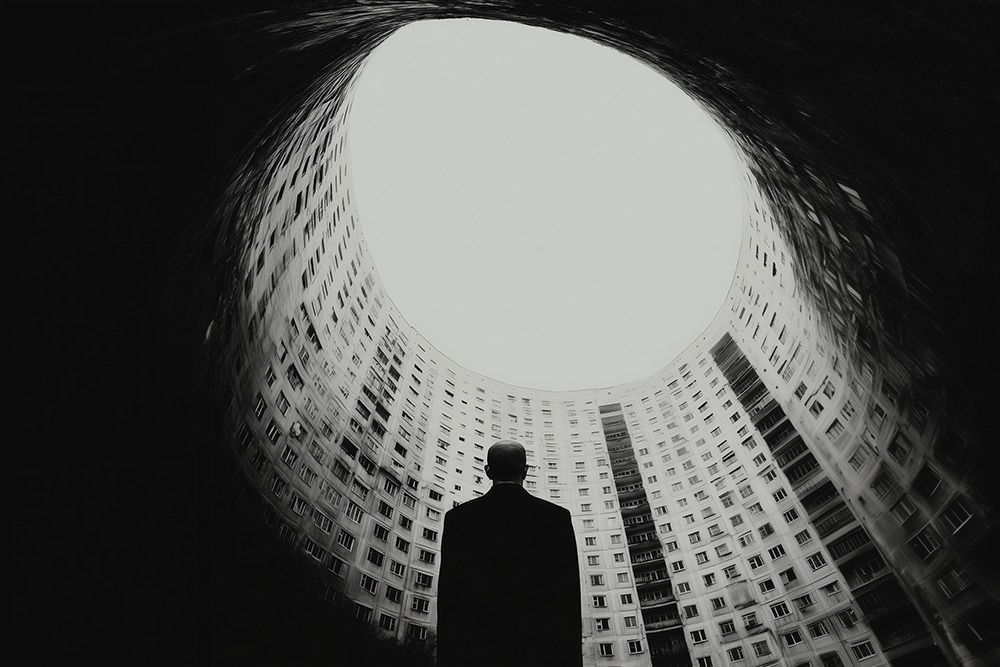
Recently, the Russian project “Word of the Year — 2025” summed up the results of the interim voting. In the nomination “National Word,” the leader was “anxiety” (25%). Why has this happened only now?
Image: Maria Pokrovskaya / Midjourney for Most.Media
Anxiety disorders today are the most common type of mental illness worldwide. According to WHO data, in 2019 over 300 million people suffered from them; among them — 58 million children and adolescents. Anxiety disorders and depression account for about two-thirds of all mental disorders in Russia, and according to a study by the U.S. National Institute of Mental Health, more than 31% of Americans experience varying degrees of anxiety during their lifetime.
It is important to understand that these concepts – anxiety and worry – despite seeming similarity, are not identical.
If worry is a quite understandable and natural emotional reaction to a threatening or simply unpleasant situation (or its likelihood), then anxiety is a destructive, almost unending state; strong, excessive, and constant concern literally over anything. In other words, anxiety is an overwhelming feeling that a person experiences, which is almost impossible to cope with without the help of a psychotherapist. No medication can completely eliminate anxiety, but they can significantly improve the condition.
The mind and body are interconnected. What happens in the head can have devastating consequences for the entire body. “The body tends to respond to psychological stress much like it does to physical stress,” says Dr. David Spiegel from Stanford University School of Medicine. Almost constant emotional tension sooner or later leads to cardiovascular diseases and other problems.
A study involving 1,204 elderly men and women from Korea showed: only a quarter of the participants with anxiety had reasonably good health considering their advanced age. The spectrum of diseases in the others was unusually broad – from ischemic heart disease, heart attacks, and past infarctions to serious hearing and vision impairments.
Anxiety can be a personality trait: in particular, German psychiatrist Karl Leonhard identified the so-called anxious-suspicious personality type. Even in childhood, such a child fears falling asleep alone, worries when left alone, has difficulty establishing contact with peers, and as an adult is shy, if not cowardly, tries to avoid conflict situations, cannot defend their point of view, and tends to conform. Such employees are highly valued at work: they are distinguished by friendliness, responsibility, and diligence.
“Anxiety disorders can manifest in different ways, but currently the most common form is the so-called office syndrome,” believes Konstantin Ovsyannikov, professor at the Department of Hospital Therapy at the Russian University of Medicine of the Ministry of Health of Russia. “It includes symptoms such as constant fatigue, headaches, sleep disturbances, and decreased concentration. However, in a broader sense, office syndrome characterizes a sedentary lifestyle, indicating an imbalance between physical activity and mental workload.“
However, evolutionary psychologists, who, when examining mental disorders, try to answer not the question “why?” but “what for?”, are convinced: perhaps anxiety as a personality trait helped preserve the species. Indeed: an anxious-suspicious hunter is unlikely to be at the forefront of hunting the next mammoth, will be cautious and prudent, and therefore will live somewhat longer than his too bold and decisive peers and most likely leave more offspring behind.
It is logical to assume that the events of the past three-plus years should seriously increase the level of anxiety among Russians. At first, this was indeed the case.
The level of anxiety (although in this case it is more accurate to speak of worry, fear, and concern), according to the results of a survey conducted from September 23-25, 2022 by the Public Opinion Foundation, was almost 70%. Only 26% of respondents said they felt calm. According to the opinionof Viktor Poturemsky, director of political analysis at the Institute of Social Marketing INSOMAR, the rise in anxiety and fear was primarily linked to the partial mobilization announced on September 21, 2022.
However, already the following year the level of anxiety halved and nearly returned to pre-war values. Anxiety indicators related to the course of the special military operation, calculated by the communications company CROS, dropped sharply, and in several regions the top three concerns were attacks by stray dogs, alcohol poisoning, and legislative initiatives regarding abortions.
In the third quarter of 2024, the main cause for concern remained the situation in the Kursk region and border areas. Second place was taken by problems with YouTube – this topic was very actively discussed on social networks. “Users expressed anxiety that they had to change their habits and look for video channels they used to watch on other hosting platforms or learn to use tools to bypass restrictions,” the report “National Anxiety Index” states.
Image: Maria Pokrovskaya / Midjourney for Most.Media
The shock reaction on social media was unexpectedly caused by the divorce of Yaroslav Dronov. At first glance, this seems incredibly wild. But perhaps users were more concerned not so much about Shaman’s personal life, but about the blow to their own moral orientations and preferences – after all, he seemed to always stand for so-called traditional values.
Overall, people have become increasingly worried about the intrusion of the state into private life.
“YouTube, quadcopters, childfree – it’s all about that,” explained the results of the study, Ksenia Kasyanova, vice president of CROS.
In the first quarter of this year, among military topics, users only noted drone attacks. In the second quarter of 2025, for the first time, “economic cooling” entered the top 10 anxieties of Russian residents – this is how CROS politely termed financial problems. On social media, some are frustrated by the unavailability of mortgages, others by taxi prices, some find it harder to get loans due to high rates or to repay already accumulated debts to banks. Mass problems with mobile internet, which the authorities have not clearly explained, and on social media people write that “it’s being jammed,” but who and why – no one seems to understand; traditional summer hot water shutdowns, the situation with migrants in the context of “who will work on construction sites now,” a little and not for long – about Iran and Israel (but that is far away and therefore doesn’t concern everyone)... Just, please, no Ukraine and “special military operation.”
“External factors, such as the military conflict between Israel and Iran and drone attacks, are rather on the periphery of the anxiety field, as they are not so close in nature to the lives of ordinary Russians. Obviously, this is also a sign of the routinization of attitudes toward armed conflicts,” noted CROS experts.
Does this mean that the ongoing Russian-Ukrainian conflict has ceased to be a cause for concern? It seems not quite.
The almost complete absence of discussion of the special military operation on social media can only mean one thing: users avoid this topic, fearing to write or repost something “wrong” and come under the scrutiny of controlling authorities.
In short, the radically changed focus of anxieties indicates that the main reasons for concern have become personal safety and well-being. This is worrying, but calmer.
If you enjoyed this article, consider making a donation — one-time or, even better, monthly. Your support helps us motivate our authors and become better with every article.
Our organization is recognized by the Internal Revenue Service (IRS) as a 501(c)(3) tax-exempt, charitable organization, which means that all contributions made to us are tax-deductible to the fullest extent permitted by U.S. law. Individuals may generally deduct charitable contributions of up to 60% of their Adjusted Gross Income (AGI) for cash donations made to qualifying 501(c)(3) organizations. For donations of appreciated assets (such as stocks or other long-term capital assets), the deduction is typically limited to 30% of AGI, based on the fair market value of the asset. C-corporations may deduct charitable contributions of up to 10% of their taxable income for donations made to eligible charitable organizations.
By submitting a donation, you confirm that you have read and accept the following documents: Privacy Policy and User Agreement, and also give consent to the processing of your personal data.
If you would like to unsubscribe from a monthly donation, please email us at: [email protected]