When we try to understand why Russia, after the turbulent democratization of the late 1980s and early 1990s, arrived where it is now, we usually look for the answer in politics: weak institutions, the 1993 Constitution, presidential power, oil, wars, the security services, Putin. All of that matters. But with this perspective, we miss something no less, and perhaps even more, significant — institutional inertia.
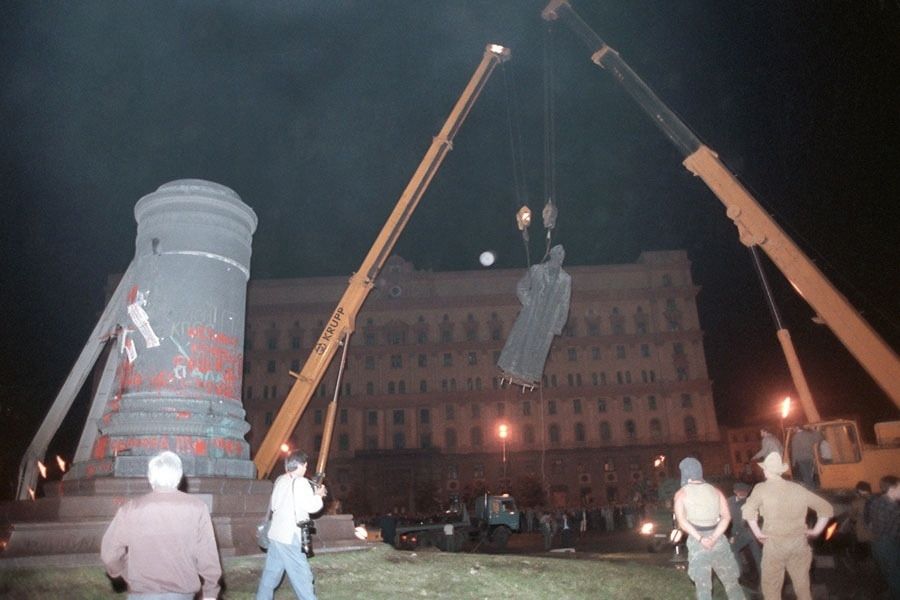
Dismantling of the Dzerzhinsky monument on Lubyanka, August 23, 1991
“If Rome is truly destroyed,
then where do the roads lead?“
Alexander Gorodnitsky
The Soviet Union really did collapse. Moreover, the upper part of its structure disappeared almost instantly by historical standards. The CPSU disappeared, compulsory communist ideology disappeared, and the system of centralized planning broke down. Elections, private property, new parties, and independent newspapers appeared. If we look at what was happening from above, the gap between 1988 and 1993 seems enormous.
But if we descend one floor lower, the picture looks different. The Soviet Union disappeared, but the Soviet school remained, universities remained, the army remained, prisons remained, and the state apparatus remained. The KGB was formally abolished and divided into several organizations, but the people, professional skills, and ideas about the state could not disappear along with the signboard. The church remained — an institution with a far more complex history, simultaneously persecuted, controlled, and used by Soviet power. Scientific institutes remained. Finally, millions of people remained who had worked for decades inside all these organizations.
It turned out to be something like a chicken with its head cut off. The head is already gone, but the body keeps moving. Only a chicken moves for a few minutes, while social institutions can keep moving for decades.
The Similar Creates Its Like
An institution is not only a law, a charter, or a job description. To a large extent, an institution is the people who tell the next people how things are done here. A young lecturer comes to a department where there is already a chair, professors, and associate professors. They explain what to read to students, how to conduct an exam, which textbooks are considered serious, and which topics are important. A young official comes to a ministry and gradually learns how decisions are really made, what can be written to superiors, what should not be written, when an instruction matters, and when a phone call matters more. A lieutenant arrives at a military unit and learns from senior officers not only the regulations but also how the army is actually organized. The same thing happens in school, in a hospital, in prison, in a research institute.
The main mechanism can be stated simply: the similar creates its like.
In organizational psychology there is a close model, Attraction-Selection-Attrition, developed by Benjamin Schneider. According to this model, organizations attract a certain type of people, select suitable ones, and incompatible ones are more likely to leave. As a result, the organization becomes increasingly similar to itself. Schneider explicitly noted the unpleasant consequence: the more successfully it reproduces its “own” human material, the harder it is for it to change [1].
I remember this mechanism well from the Soviet Union itself. I saw how young university graduates were assigned as instructors to district and city party committees or Komsomol committees, where after some time a rather interesting selection process began. A significant share of the most lively people understood that real life was happening somewhere else and left for enterprises, science, economic structures — places where one could do something real. And inside the apparatus, those who fit the system more often remained. Some perhaps believed in it, some were sufficiently cynical, some liked administrative work itself and the ability to move within a hierarchy.
The system, therefore, did not merely train personnel. It sorted people according to their degree of compatibility with itself.
After the disappearance of communist ideology, this mechanism did not go anywhere. Moreover, ideology itself was not even necessary for it to exist. A teacher could be a sincere anti-Stalinist and a supporter of democracy, yet still consider it completely natural that the teacher is always right, that the student must obey, that the principal has the final word, that parents should not interfere, and that the school’s task is not so much to help the child become independent as to form the “right kind of person”. The ideological content disappears, but the technology of relations remains.
Perhaps that is precisely why Soviet ideology disappeared much faster than the Soviet notion of normality. This was especially visible in higher education. In the Soviet Union there were entire departments and faculty units devoted to the history of the CPSU, scientific communism, Marxist-Leninist philosophy, and the political economy of socialism. After the collapse of the USSR, a significant part of these disciplines almost instantly lost their former meaning. But the teachers did not disappear.
At the level of organizational structure, the problem was solved surprisingly easily. A department of scientific communism could be renamed a department of political science, Marxist-Leninist philosophy simply philosophy, and the political economy of socialism economic theory. In 1990, when I entered graduate school, I took an exam in Marxist-Leninist philosophy, and a couple of years later practically the same people examined me in the history of philosophy. At Moscow State University, in that same year of 1990, the department of scientific communism was transformed into a department of socio-political sciences, and further organizational transformations fairly quickly led to the emergence of political science in a new capacity [2].
Of course, people are capable of learning and changing their views, and many did exactly that. But if a department’s name can be easily replaced by an order, professional culture is preserved across generations: it is the old teachers who still decide for a long time whom to hire next. Therefore, culture itself can outlive both ideology and the institution’s own name.
A high level of continuity was also observed in the state apparatus. Robert Brym and Vladimir Gimpelson, who studied the Russian bureaucracy of the 1990s, found very slow personnel renewal, especially at the upper levels. According to data as of January 1, 2001, almost 60% of federal-level officials had been hired back in Soviet times (before 1990), and only about a quarter became officials in the period from 1995 to 2000 [3].
So a young person who took a job in a Russian ministry in the early 2000s entered an environment formed a quarter of a century earlier, in a completely different era. The state was formally new, but the person who met them was a boss who had long known how an official should work, how to speak to superiors, and what it meant to “solve a matter properly”. The later history of Russian technocrats shows well what was happening inside this environment. In her excellent book *Accomplices*, Alexandra Prokopenko describes how officials with liberal economic views gradually turned from participants in policy-making into executors of decisions, retaining professional competence but losing political autonomy [15].
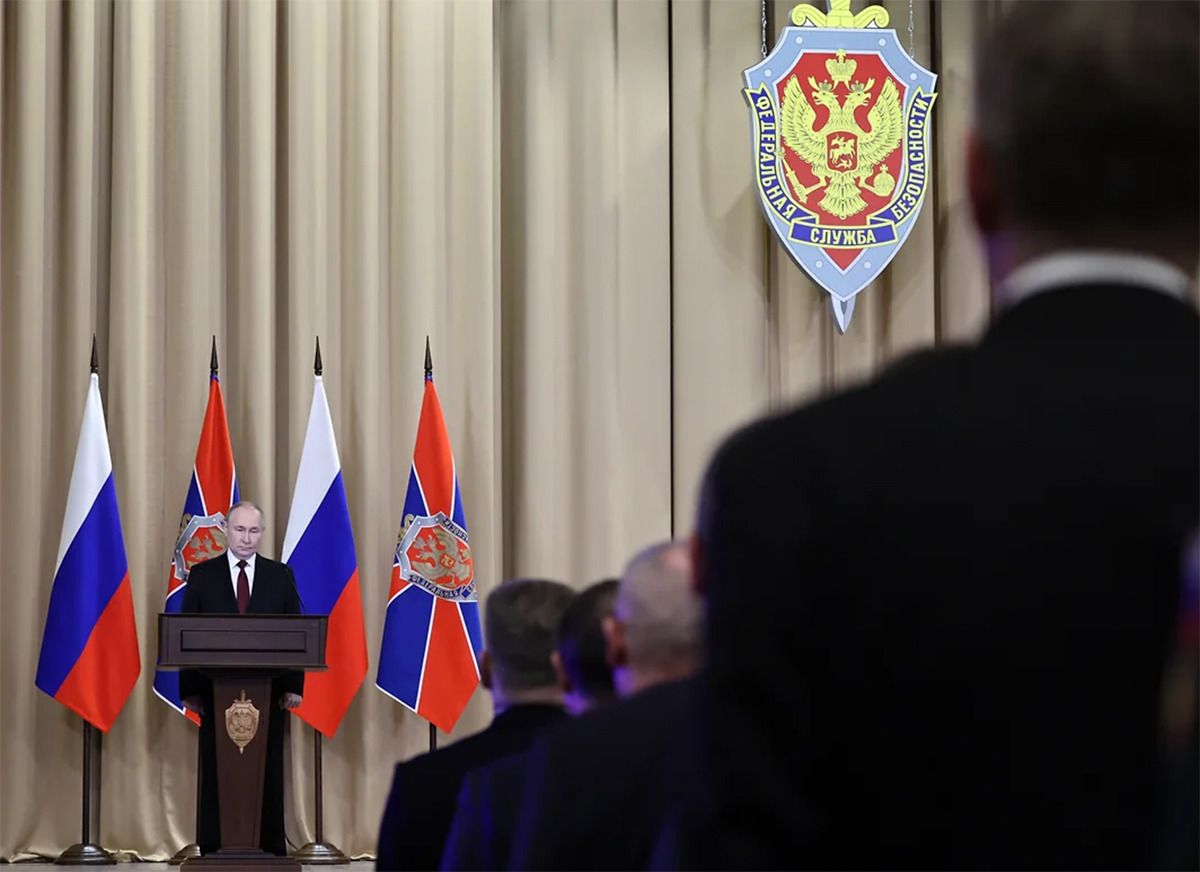
Vladimir Putin at a meeting of the FSB board. Photo: Press Service of the President of the Russian Federation
Prokopenko calls this depoliticization and links it to the structure of Putin’s power. But here one can also see the mechanism of socialization within an organization (this is already my interpretation of her material). One does not necessarily enter the state apparatus with ready-made ideas of the old-style bureaucrat. Inside, a person learns which questions are considered professional and which are better left unasked, to whom they owe loyalty, and where their own responsibility ends. Not only does the range of tasks change, but so does the habitual notion of acceptable behavior. In such a chain, even noticeable personnel renewal does not yet lead to institutional renewal: new employees quickly become carriers of the old culture.
A School That Tried to Change
For the preservation of systemic continuity, the ordinary secondary school is especially important, because only part of the population passes through university, the army, or prison, while practically everyone passes through school.
It would be wrong to say that after the collapse of the USSR no one seriously tried to change the Russian school. It was precisely here, at the end of perestroika, that one of the most interesting projects of institutional rupture emerged. A group of reformers around Eduard Dneprov tried to change not so much individual school programs as the very notion of what a school is and for whom it exists.
The temporary research collective “School”, created in 1988, proposed a program built around democratization, humanization, variability, decentralization, and openness of education. In December 1988, this concept was approved by the All-Union Congress of Public Education Workers. When Dneprov became Russia’s Minister of Education in 1990, these ideas turned into state policy, and the 1992 Law on Education закрепил the rejection of the state monopoly, the pluralism of educational programs and methods, the autonomy of educational institutions, and an orientation toward the child’s personality [4-6]. This reform was not just about new textbooks: school was supposed to move from reproducing a person subordinate to the state toward child-centred learning, critical thinking, and civic responsibility [6].
If the Soviet school were simply a set of bad instructions, it would have been enough to write good instructions. But school is a huge machine made up of hundreds of thousands of teachers, principals, methodologists, district education departments, and pedagogical universities. You can change the law, but you cannot replace in two years all the people who open the classroom door every day.
Dneprov himself later titled one of his books “School Reform Between ‘Yesterday’ and ‘Tomorrow’” [4]. The title describes the problem with astonishing precision. “Tomorrow” had already been invented. The question was who was supposed to carry it out. It was to be done mainly by people formed by that very old school that was supposed to be reformed.
This does not mean that teachers were against reform. On the contrary, at the end of the 1980s there was a powerful social-pedagogical movement, and the VNIC “School” program received almost unanimous support at the congress of education workers. Dneprov later specifically emphasized that teachers at the time were настроены on change [7]. But the desire for change and the transformation of everyday organizational culture are completely different things.
School does not merely pass knowledge on to children. Every day it shows millions of people how relations between a person and power are organized.
Can you argue with someone above you? Must a superior explain a decision? Does the weak have the right to a voice? Is a mistake a crime? Should one show initiative, or is it safer to wait for instructions? A child learns all this long before they start taking an interest in politics. That is why school culture is politically important even when politics is not discussed there at all.
That is precisely why school not only preserved Soviet practices within itself, but also began to transmit them outward. It was no coincidence that authoritarian power began to falsify elections through teachers [17]. They did this not out of professional inclination, but out of dependence on the administration and the habit of carrying out orders within a rigid hierarchy.
Why the New Often Had to Be Built from Outside
Caste-like corporate practices also existed in universities, where the new had difficulty breaking through. And this was not limited to the social sciences. In the early 1980s, for example, at the geological exploration faculty of the institute where I studied, they successfully continued to ignore the concept of lithospheric plate tectonics, which had already been recognized worldwide for more than ten years. So it is no coincidence that many of the most visible attempts to create modern higher education in the 1990s emerged, as it were, from outside the old university system. NES, HSE, Shaninka, and the European University at St. Petersburg were created as new organizations. Their founders did not receive the old university whole and then gradually remake it. They built a new institution alongside it, with different hiring rules, different literature, different international ties, and, most importantly, a different idea of what a teacher should be.
The history of HSE is very revealing in this sense. Its future founders first tried to introduce modern economic theory into existing university programs, but fairly quickly came to the need to create a separate school. One of the first tasks was literally “training the teachers”: if the country does not have enough teachers of modern economics, they must first be created [8].
It turned out that in Russia it was entirely possible to create modern institutions. The explanation in the spirit of “these are the kind of people here, and they still won’t be able to do anything else” does not work. It worked. But first — on a small scale.
Perhaps that is why the most successful new academic projects were initially relatively small. While an organization is small, it can carefully choose people and pass on its own culture to them. When it turns into a huge university or a system with thousands of employees, it inevitably has to hire people en masse from the surrounding institutional environment. And then there is a risk that it will not be the new institution changing these people, but the surrounding system gradually changing the new institution. The history of the huge HSE or the even larger RANEPA in this sense provides a very good example of such changes. In both cases, by 2020 there remained separate enclaves of new education, carefully sealed off from the rest of the organism and practically not interacting with it at all.
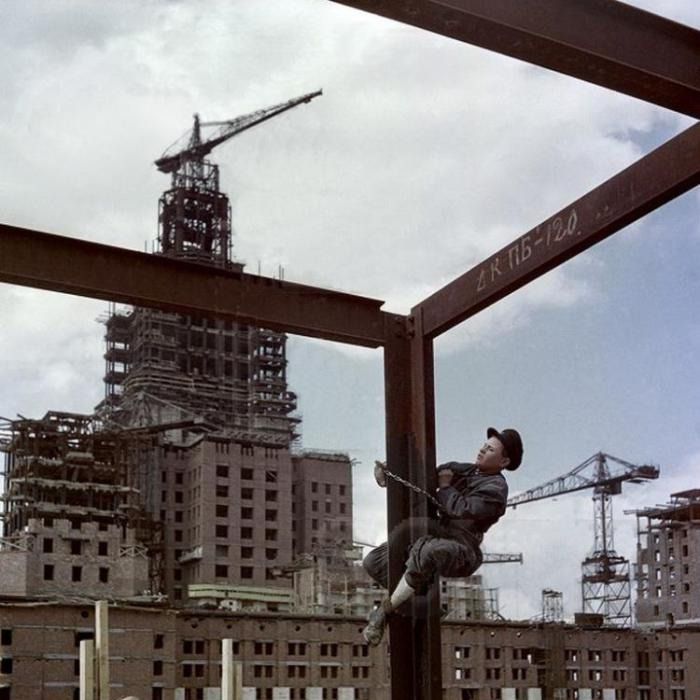
Construction of the main building of Moscow State University in Moscow in 1951–1952
On the other hand, we have the example of Moscow State University. Its conservative corporate culture, unchanged throughout the 1990s and 2000s, ultimately became its advantage when the political system again began to move toward centralization. Therefore, Moscow University did not have to adapt to the new direction of movement, and its more advanced faculties did not look as alien as, for example, the Liberal Arts faculty at RANEPA.
Passing on new knowledge beyond these new institutions turned out to be much harder. I felt this mechanism especially clearly at the seminars of the Russian School of Economics for teachers from regional universities in the early 2000s. The idea was excellent. It is impossible to create NES in every Russian city, but you can gather teachers from across the country, introduce them to modern economic theory, give them new literature and teaching methods, and then send them back. One trained teacher returns home and begins teaching dozens and hundreds of students. A modernization multiplier emerges.
For me personally, these seminars were extremely useful. They greatly changed both my teaching level and my understanding of modern economics. But I remember two episodes that make one look at this model quite differently.
At one of the seminars, a young lecturer from a regional university said that after returning home he began to have problems teaching. As far as I remember, he was effectively no longer allowed to teach serious courses. The reason was quite predictable: he began teaching differently from the old professorial staff. There were familiar textbooks, a familiar set of topics, and a familiar idea of what an economics teacher should say. But the specialist returned from NES as a different person and began to act differently.
The new institution changed the teacher, but he returned to the old organization, and it began to defend itself against the changes he brought. Institutional immunity began to operate. New knowledge enters the organization through a specific person, but instead of changing under the influence of the new knowledge, the organization limits the bearer’s possibilities and thereby restores its own equilibrium.
The second case happened directly to me. I was offered the chance to organize, in Pereslavl-Zalessky, on the basis of a small university created there, a platform where, with the participation of NES, one could train university teachers and perhaps schoolteachers. For a small provincial town, this could have been especially interesting: instead of waiting for individual people to make their way to Moscow on their own, create a local channel for transmitting new knowledge. But a representative of an old economic research institute that had existed since Soviet times strongly opposed this. The problem was that he was an important figure in the university and his opinion carried weight. He effectively set a condition for the leadership: if cooperation with NES continued, he would stop cooperating with us. And the university administration, where I worked at the time, chose him.
And the longer I think about it, the less I want to blame the administration. Its decision was entirely rational. On one side was the young NES, still not yet known what it would become and offering some kind of experiment. On the other was a person they had known for a long time, trusted, and worked with for many years. Of course they chose him.
As we can see, old institutions had an advantage not only because they had more people. They had connections. Rectors knew institute directors, department chairs knew other department chairs. People studied together, worked together, did projects together. There was accumulated credit of trust. A new organization could have better knowledge, but the old system had social infrastructure. Bridges already existed between the old islands, while between the new ones they still had to be built.
What Happens if the Chain Is Truly Broken
This makes the radical nature of the Georgian police reform after the Rose Revolution easier to understand. It is usually cited as an example of the fight against corruption, but for our reasoning another side of this story is more interesting. The reformers feared that if they simply hired a few new police officers and placed them inside the old organization, the old organization would very quickly remake them. The World Bank describes this logic almost literally: partial replacement of personnel seemed insufficient because new employees could quickly absorb the norms of the former corrupt environment. Therefore the old traffic police were disbanded, about 16,000 employees were dismissed, and the new patrol service was recruited and trained from scratch [9].
This is almost a laboratory illustration of the same mechanism. If you leave the old institution in place and replace ten percent of the people in it, there is a high probability that the old ninety percent will train the new ten. So sometimes, to create a new institution, one has to break the chain of reproduction itself.
I recall a similar logic in the creation of modern Russian retail. As far as I remember, when some new retail chains were being formed, they preferred not to hire people with extensive Soviet trade experience, because along with experience a person brought an idea of what a store is, who is in charge there, and how a salesperson should treat a customer.
This also shows the weakness of explanations based on an unchanging “national culture”. The same people, under different rules of selection, training, promotion, and accountability, quite quickly begin to behave differently.
In most major Russian state institutions, the Georgian break did not happen. This is clearly seen in the example of the Russian army. As early as 2004, Alexander Golts and Tonya Putnam wrote that despite enormous changes in the Russian economy and politics and numerous attempts at military reform, the armed forces continued to retain a significant part of the organizational structures and ideas inherited from the USSR [10]. And here the issue was not weapons or how the army was structured — in armies or divisions. More important is who trains the next officer and sergeant. If a new lieutenant is introduced into the profession by an officer formed by the previous army culture, that culture gets another cycle of life.
That is why the comparison with Ukraine after 2014 is interesting, where, while preserving a significant Soviet legacy, a conscious restructuring of the mechanisms reproducing military culture began — from a professional corps of sergeants to a new system of instructor training and professional military education [11]. Again, the question is not only a new charter. The question is who teaches the next sergeant and the next officer.
The history of the security services is even more complicated. The USSR’s KGB was indeed liquidated and divided into several structures, so it would be wrong to write that it simply continued to exist under another name. But it would be just as wrong to consider formal liquidation a complete institutional break. Amy Knight already in the mid-1990s showed in detail the significant personnel and organizational continuity of the post-Soviet security services [12]. It is easy to change the signboard, but impossible to quickly change organizational culture.
Dismantling of the Dzerzhinsky monument on Lubyanka, August 23, 1991
The same mechanism is especially clearly visible in the history of the Russian Orthodox Church. Its current administrative form was to a large extent reassembled by Stalin in 1943: the state-approved patriarchate received a rigid vertical structure and a limited space for activity in exchange for manageability and political loyalty. After 1991, the party overseers disappeared, but the apparatus, the episcopate shaped by them, and the learned rules of relations with power remained [13].
In the 2000s, the state and the church hierarchy returned to a familiar exchange: privileges, property, and public status in exchange for loyalty and religious justification of power. Such an outcome was not predetermined: there was resistance within the Church itself. But the established vertical structure consistently encouraged some types of behavior and pushed others out, until the “Russian world”, the cult of Victory, and the justification of war became part of public religion.
A System Without a Head
After 1991, Russia’s power system lost its top, but the lower floors remained almost unchanged. At the same time, each of them had its own understanding of what a normal order is.
For the army, such an order is unconditional obedience to authority. For the bureaucracy, administrative regulations. For the security services, secrecy, corporate solidarity, division into insiders and outsiders, and the special role of professionals who know the state’s interests better than the uninitiated. For the old school, a clear hierarchy of principal, teacher, and student. For prison, obedience and control. The church hierarchy also had its own experience of vertical organization and relations with the state.
There was no secret conspiracy. Each of them simply, relying on its own past experience, began to restore a “normal” order within its own small world — the army, the school, the ministry, the church.
The preserved practices created conditions and resources for different political projects; which one would prevail also depended on the decisions, conflicts, and circumstances of the 1990s.
A system without a head eventually had to receive a head produced by one of the surviving parts of that very system.
For example, if Yuri Luzhkov had come to the head of the country, we would have gotten a system of a corrupt construction trust with a crooked boss, only stretched across the entire country. If Gennady Zyuganov had come to power, we would probably have gotten a country of “red directors”. And if, for instance, Yevgeny Primakov had been at the helm, the system might have taken on a more cautious, bureaucratic-diplomatic character: the vertical would have remained, but it would have been built in the language of stability, balance of interests, and cautious state pragmatism. Of course, all three of these variants are not very good, but they are definitely better than the one that actually emerged.
But Vladimir Putin ended up at the head of the state, having undergone professional socialization in the closed world of the KGB and completing his formation in the 1990s in the St. Petersburg mayor’s office, where the line between official and criminal authority was blurred to the limit.
If Rome Is Destroyed
So, the head has been restored. But where is it supposed to lead the system?
The Soviet Union had an answer to this question. One may consider the communist project utopian, false, and monstrously expensive, but it was indeed a project of the future. Communism, the new man, the new society, industrialization, the transformation of nature, space, scientific and technological progress. In this sense, the communist project was modernizing: it did not propose a return to the past, it promised to violently push society into an invented future.
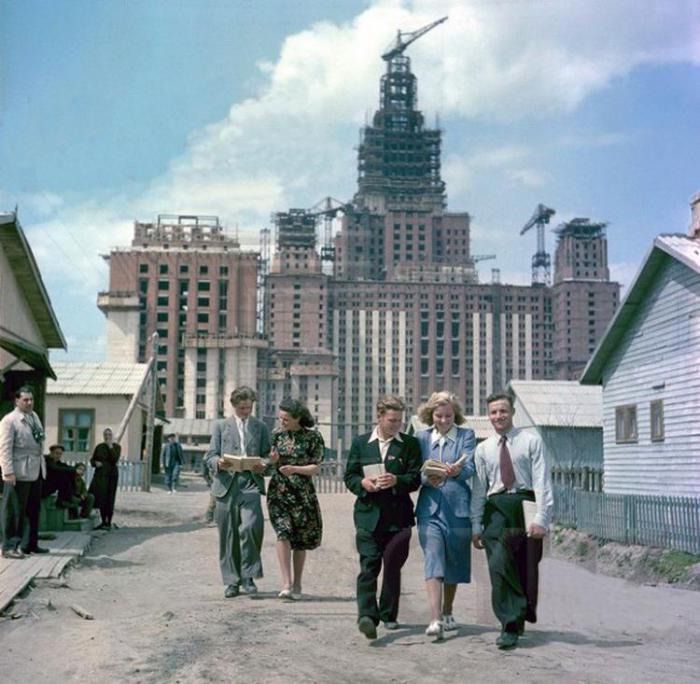
Students of a school for working youth against the backdrop of the under-construction main building of Moscow State University, 1951
And here a fundamental difference of the post-Soviet construction becomes apparent. The country retained institutions, vertical relations, and the ability for administrative mobilization. But it no longer had a project of the future. The power vertical remained, but communism disappeared. The machine remained, but the destination disappeared. There was not a single vertical left in the country that was a bearer of ideology.
And then the institutions began to seek support in the past. But this happened not because someone consciously set themselves the task of restoring the old order, but because the past remained for them the only model of a well-functioning organization.
True, the return to the past, under whatever flags it occurred, inevitably led to the archaization of society [14]. And again it must be emphasized that practically no one who created the current system wanted the country to become archaic. On the contrary, each of them sincerely tried to make their own part of the system better, clearer, and more workable.
That is the paradox. At the micro level, we see many quite rational decisions. The head of the university in Pereslavl chooses an old reliable partner instead of the unknown NES. The department chair chooses the lecturer with whom it is easier to work. The school principal prefers a teacher capable of maintaining discipline. The official promotes the employee who “understands the system”. But the sum of these decisions creates a macro effect that none of the participants individually planned.
Archaization from below began in the country. It would be wrong to say that “the people wanted totalitarianism”. Old models of relations were reproduced daily by millions of small interactions long before the state consciously began to use them politically. But when political demand for a vertical emerged from above, these two processes began to reinforce each other.
The result is a system of totalitarian relations that has lost its modernizing idea. “Totalitarianism without ideology” describes the form, while archaization describes the direction of movement. It should be said that in the last decades of its existence, the Soviet project also lost its modernizing potential, as best shown by the anecdote from those years about a train with closed windows that is rocked to create the illusion of movement.
Of course, the current regime also has a set of doctrines and myths — the “Russian world”, traditional values, the cult of Victory. But they do not form a project of the future: they justify hierarchy, name enemies, and sacralize the return to the past.
Old Institutions Were a System, New Ones an Archipelago
However, this picture would be too simple if post-Soviet Russia had only old institutions. From the first years of the new independent Russia, new projects began to emerge. Among the most successful and well-known one can name NES, Shaninka, and the European University. A new HSE emerged practically from nothing. Independent research centers, good faculties, new schools, independent media, and civic organizations were created. It was possible to create a modern institution in Russia in the 1990s and 2000s. The problem turned out to be different.
The old institutions formed a system, the new ones an archipelago. A good university cannot displace a bad one simply because it is better and more modern. The old one has many competitive advantages — it has a building, a budget, positions, and, above all, a place in the network of other old institutions. In the country, it is not individual institutions that compete with each other, but their structures. New organizations learned to reproduce themselves within their own boundaries, but they did not create an environment that would protect them as a system. Therefore, each of them could be weakened separately.
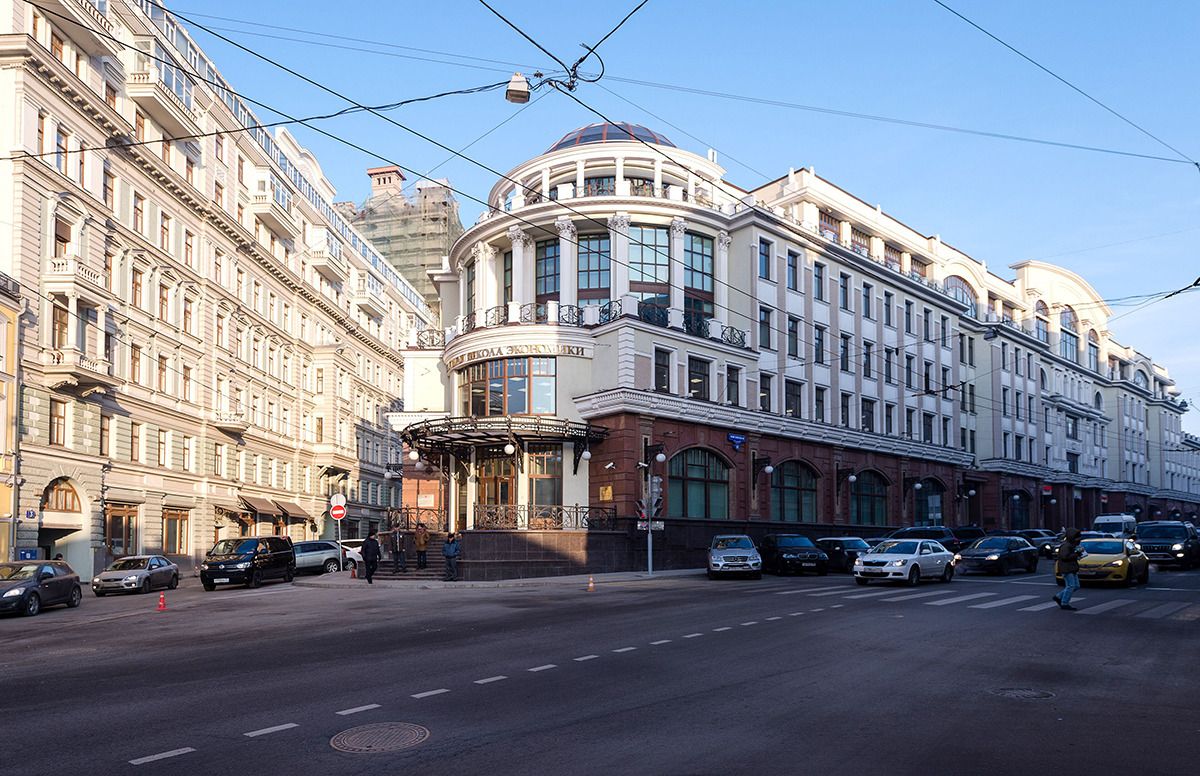
Building of the Higher School of Economics on Myasnitskaya. Photo: Mos.ru
In this sense, the 2000s were in some ways a missed opportunity. The country had both resources and growing prosperity, and relatively high openness to the outside world. But economic success worked in two ways. On the one hand, it provided resources for institutional modernization. On the other, it reduced the sense of necessity for this modernization. If incomes are growing, cities are changing, new cars, shops, restaurants, foreign trips, mortgages, and consumer credit are appearing, then the political structure itself begins to look functional.
For many people, the strengthening of the power vertical and the growth of prosperity simply coincided in time. To form the idea that there is a causal connection between them, one does not need to read political treatises. It is enough to compare one’s own life in 1998 and 2007. The country modernized fairly quickly in consumer and technological terms, but much more slowly institutionally.
And the fragmented modernization projects and institutions gradually fell under the pressure of the reconstituting system of Soviet institutions.
Nothing said here implies that Russia is doomed to move backward forever. Here, I think, it is very important not to confuse the archaization of institutions with the archaization of society.
Russia in the mid-2020s is not at all Russia of the late 1980s. Over thirty-five years, millions of people have traveled abroad, worked in foreign companies or with foreign partners. There are more people who know foreign languages. A new generation of scientists, teachers, programmers, and managers has appeared. People know much better what life is like outside the country. The information situation is simply incomparable with the Soviet one.
In the early 1990s, *Slave Isaura* could be perceived almost as a window into an unknown foreign life. Today a young person watches the same series, listens to the same music, and plays the same games as their peer in Berlin or New York. This, of course, does not automatically make them a democrat. But it makes a return to the Soviet level of ignorance about the outside world extremely difficult.
That is why I think the picture in which all of Russia slowly sinks into a single archaic darkness is wrong. Rather, a gap is emerging between society and institutions. A person uses a modern bank, works in a technology company, participates in several online communities, watches a foreign series via VPN, and then brings a child to school and finds themselves in a completely different era of social relations.
And the current archaization largely consists in the attempt of old institutions to pull the person back toward themselves. But a person who has worked for ten years in a modern international company does not forget how that company was organized on the day it left Russia, and a scholar who has worked in an international academic environment knows that there are other rules for academic work.
Therefore today there is no longer just one institutional memory, but at least two: the memory of old vertical institutions and the memory, accumulated over the post-Soviet decades, of alternative ways of organizing things.
There is another thing that is easy to underestimate: apartment-building chats, parent groups, professional communities, volunteer organizations, interest-based communities. In the context of the state, all this seems minor, but from an institutional point of view it is a constant school of horizontal interaction. People learn to negotiate without a boss, raise money, distribute responsibilities, replace an administrator, verify information, quarrel and make up, and formulate common rules.
I have already tried to explain the resilience of such ties through repeated interaction. Then I formulated the conclusion this way: “the resilience of society depends on how strongly it is permeated by ongoing long-term games” [16]. People are more willing to follow common rules and help each other when they expect to meet again both tomorrow and in a year. This model does not describe the whole life of a community, but it shows why a network cannot be created by decree. It needs time, trust, and the ability to continue working together even when political leaders change.
Even war, paradoxically, gave rise to many military volunteer organizations. And although the political goals of many of them are far from democratic, what matters for the country’s future is the organizational skill: people independently build logistics, gather resources, look for suppliers, and create networks. And this skill gradually becomes social capital.
The Next Attempt Will Not Start from Zero
When a window of institutional change opens again, the starting conditions will be different from those of 1991. Much will have to be built anew. But it will not begin from zero: there are people with experience in modern universities, schools, international science, global companies, independent media, and horizontal self-organization — and there is memory of the failure of the previous attempt.
Campus of the Russian School of Economics in Skolkovo. Photo: nes.ru
This experience leads to a rather simple conclusion. Separate good institutions are necessary — as the first islands of a different practice, where people, rules, and experience accumulate. But we already know that a good NES, a good faculty, or a dozen good schools can exist for quite a long time inside a bad institutional environment without changing it. If we stop at creating islands, the old environment retains a huge advantage.
Therefore it is very important to move as quickly as possible to the next stage — connecting these islands. A good school should be linked to a university that trains teachers for it; the university — to research centers and international science; research centers — to media capable of translating professional knowledge into the language of society; civic organizations — to local communities, student clubs — to trade unions. Connections should run between disciplines, professions, and social groups. The more diverse and dense they are, the less the network depends on the fate of any single node and the higher its capacity for self-development — creating new nodes and connections without a single center. All its participants must be protected by law and have independent sources of resources.
Then a new chain of reproduction will gradually emerge. A new school creates a different student, a different student comes to a different university, the university trains a different teacher, and the teacher creates the next school. And the principle “the similar creates its like” finally begins to work not against modernization, but for it.
But here the final difficulty arises. An authoritarian system can quite easily connect institutions: it turns a network into a vertical, appoints a boss, creates a ministry, sends down instructions, and checks execution. A democratic system cannot use the same mechanism, because then it will destroy precisely the autonomy it was meant to protect.
Therefore the task is much more difficult: to create a network without creating a vertical. Not a ministry of proper universities, but associations of autonomous universities. Not a single proper school, but different schools linked by professional standards and a teacher-training system. Independent foundations, professional associations, teacher exchanges, joint research, independent funding, international ties, a court that protects the rules of the game. What is needed is not a vertical of institutions, but their ecosystem.
The current archaization does not seem irreversible to me. Archaization is not a time machine. Organizations can be closed, international ties restricted, censorship restored, school curricula changed, and institutions forced to reproduce ever older models of relations. But it is impossible to make the previous thirty-five years simply not have happened. People have already seen other institutions, worked in them, studied in them, created them — and were themselves created by them.
If Rome is destroyed, the roads really do continue for some time to lead where they used to lead. They may outlive both the state that built them and the people who got used to thinking it eternal. But the roads themselves do not choose a new Rome and do not decide where one should go now. They can be connected differently — if there are people and institutions capable of agreeing on the direction.
Literature and Sources
[1] Schneider B. The People Make the Place // Personnel Psychology. 1987. Vol. 40, no. 3. P. 437-453. DOI: 10.1111/j.1744-6570.1987.tb00609.x
[2] Chronicle of Moscow University. Chronicle of the Faculty of Political Science. Source
[3] Brym R. J., Gimpelson V. The Size, Composition, and Dynamics of the Russian State Bureaucracy in the 1990s // Slavic Review. 2004. Vol. 63, no. 1. P. 90-112. DOI: 10.2307/1520271
[4] Dneprov E. D. School Reform Between “Yesterday” and “Tomorrow” / Russian Academy of Education, Federal Institute of Educational Planning. Moscow: [s. n.], 1996. 432 pp. RSL catalog
[5] Rust V. D. School Reform in the Russian Republic: An Interview with Edward Dneprov // Phi Delta Kappan. 1992. Vol. 73, no. 5. P. 375-377. HSE bibliography
[6] Khokhlova D., Klimentov V. Almighty Soros? Education Reform and Foreign Influence in Post-Soviet Russia // Contemporary European History. 2026. Vol. 35. Art. e57. P. 1-18. DOI: 10.1017/S0960777326101544
[7] Dneprov E. D.; interviewed by Lebedev S. Time. School. Person. Five Eras of Russian Education // First of September. 2006. December 9. No. 23. P. 2-3. Publication text
[8] National Research University “Higher School of Economics”. History of HSE. Source
[9] World Bank. Fighting Corruption in Public Services: Chronicling Georgia’s Reforms. Washington, DC: World Bank, 2012. DOI: 10.1596/978-0-8213-9475-5
[10] Golts A. M., Putnam T. L. State Militarism and Its Legacies: Why Military Reform Has Failed in Russia // International Security. 2004. Vol. 29, no. 2. P. 121-158. DOI: 10.1162/0162288042879968
[11] NATO. Building a Corps of Professional Non-Commissioned Officers in Ukraine. 18 April 2016. Source
[12] Knight A. Spies without Cloaks: The KGB’s Successors. Princeton, NJ: Princeton University Press, 1996. 318 p. DOI: 10.2307/j.ctt15sk83q
[13] Luchenko K. With Good Intentions: The Russian Church and Power from Gorbachev to Putin. Almaty: Echo Books, 2025. ISBN 9786018225765. Book page
[14] Kulbaka N. Origins of Russian Archaization and Strategies to Combat It // JOSHA Journal. 2025. Vol. 12, no. 1. DOI: 10.17160/josha.12.1.1032
[15] Prokopenko A. Accomplices. Why the Russian Elite Chose War. Carnegie Berlin Center for Russian and Eurasian Studies, 2026. Book page
[16] Kulbaka N. Game Theory and the Practices of Revolution // Vedomosti. November 20, 2017. Publication text
[17] Forrat N. Shock-Resistant Authoritarianism: Schoolteachers and Infrastructural State Capacity in Putin’s Russia // Comparative Politics. 2018. Vol. 50, no. 3. P. 417-434. DOI: 10.5129/001041518822704908
If you enjoyed this article, consider making a donation — one-time or, even better, monthly. Your support helps us motivate our authors and become better with every article.
Our organization is recognized by the Internal Revenue Service (IRS) as a 501(c)(3) tax-exempt, charitable organization, which means that all contributions made to us are tax-deductible to the fullest extent permitted by U.S. law. Individuals may generally deduct charitable contributions of up to 60% of their Adjusted Gross Income (AGI) for cash donations made to qualifying 501(c)(3) organizations. For donations of appreciated assets (such as stocks or other long-term capital assets), the deduction is typically limited to 30% of AGI, based on the fair market value of the asset. C-corporations may deduct charitable contributions of up to 10% of their taxable income for donations made to eligible charitable organizations.
By submitting a donation, you confirm that you have read and accept the following documents: Privacy Policy and User Agreement, and also give consent to the processing of your personal data.
If you would like to unsubscribe from a monthly donation, please email us at: [email protected]