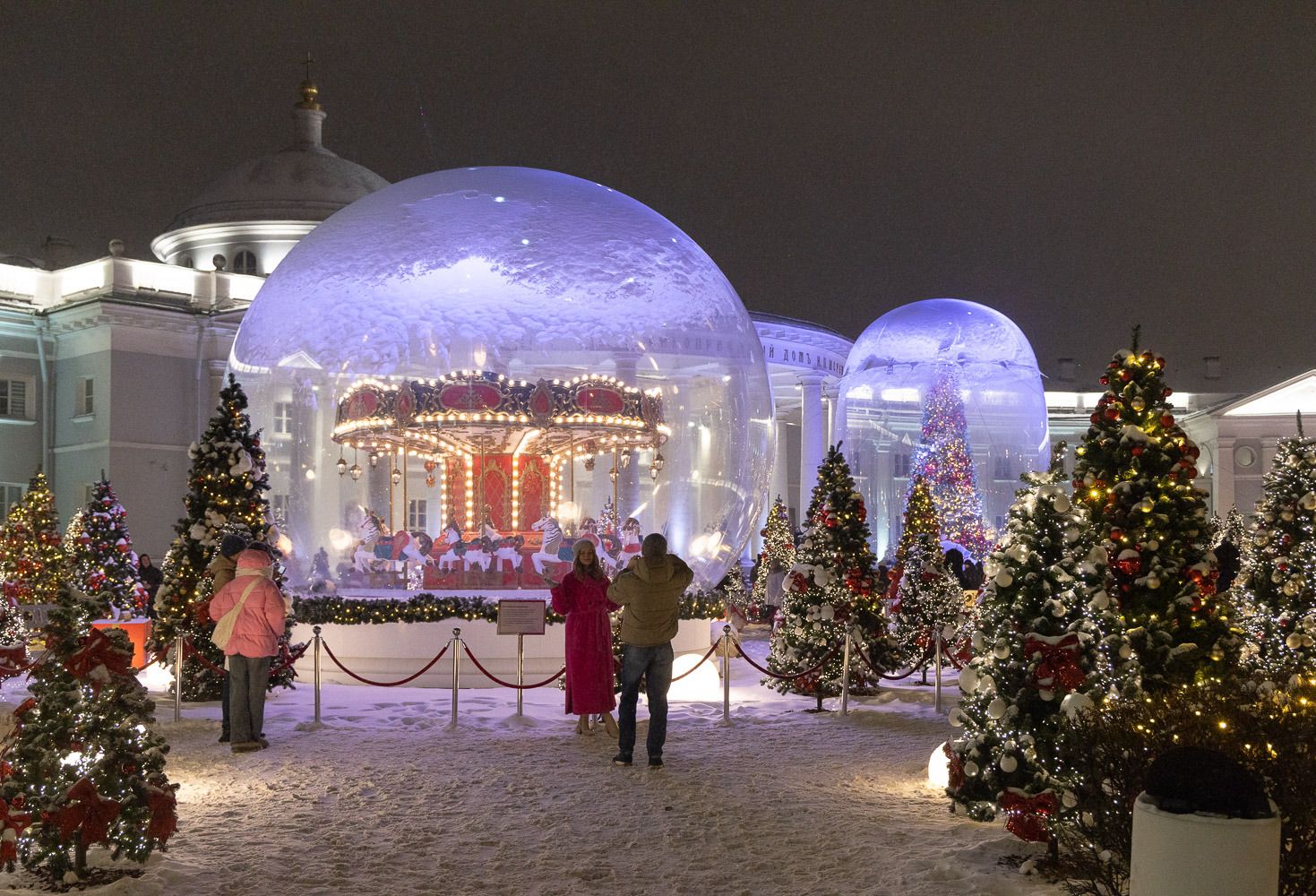
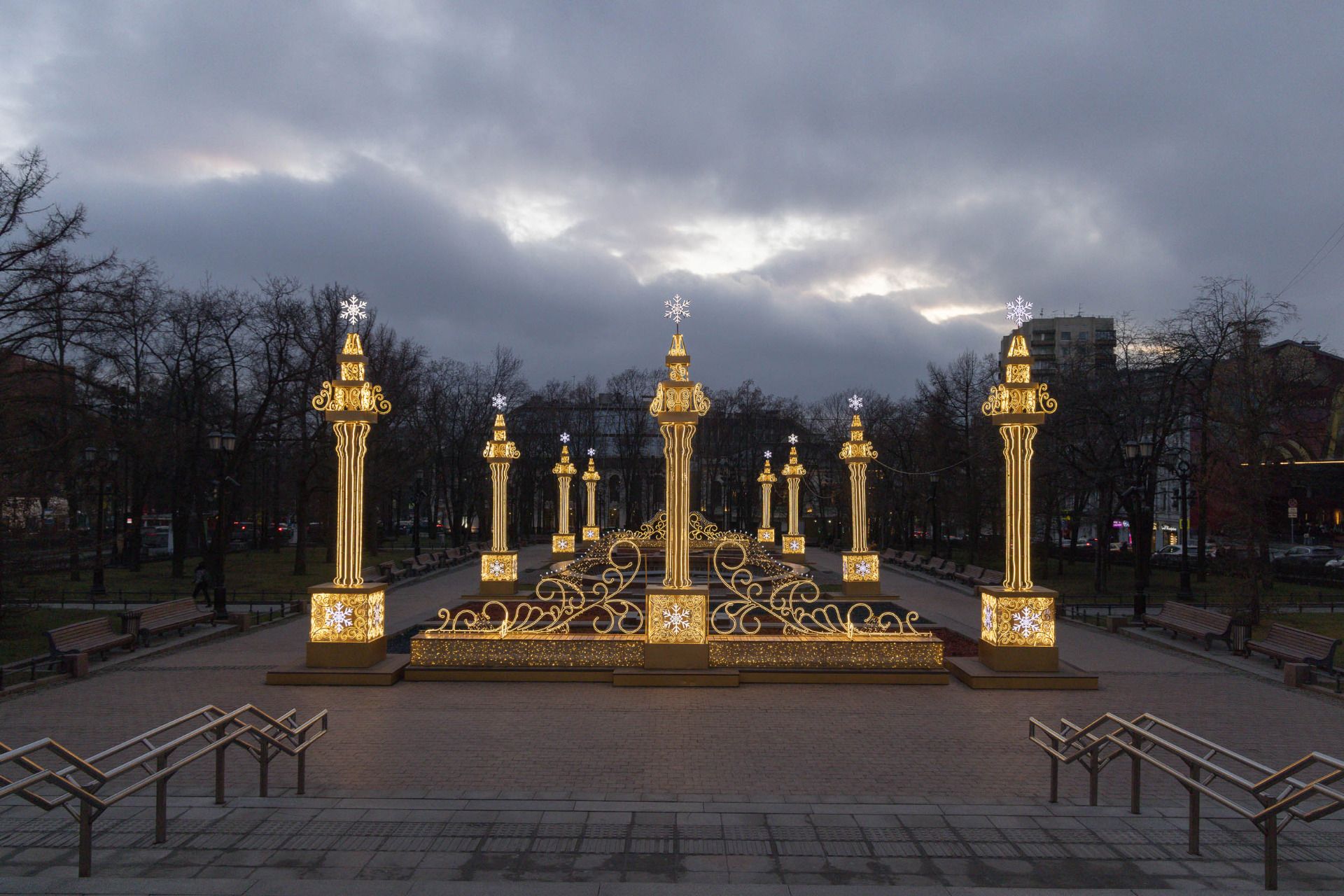
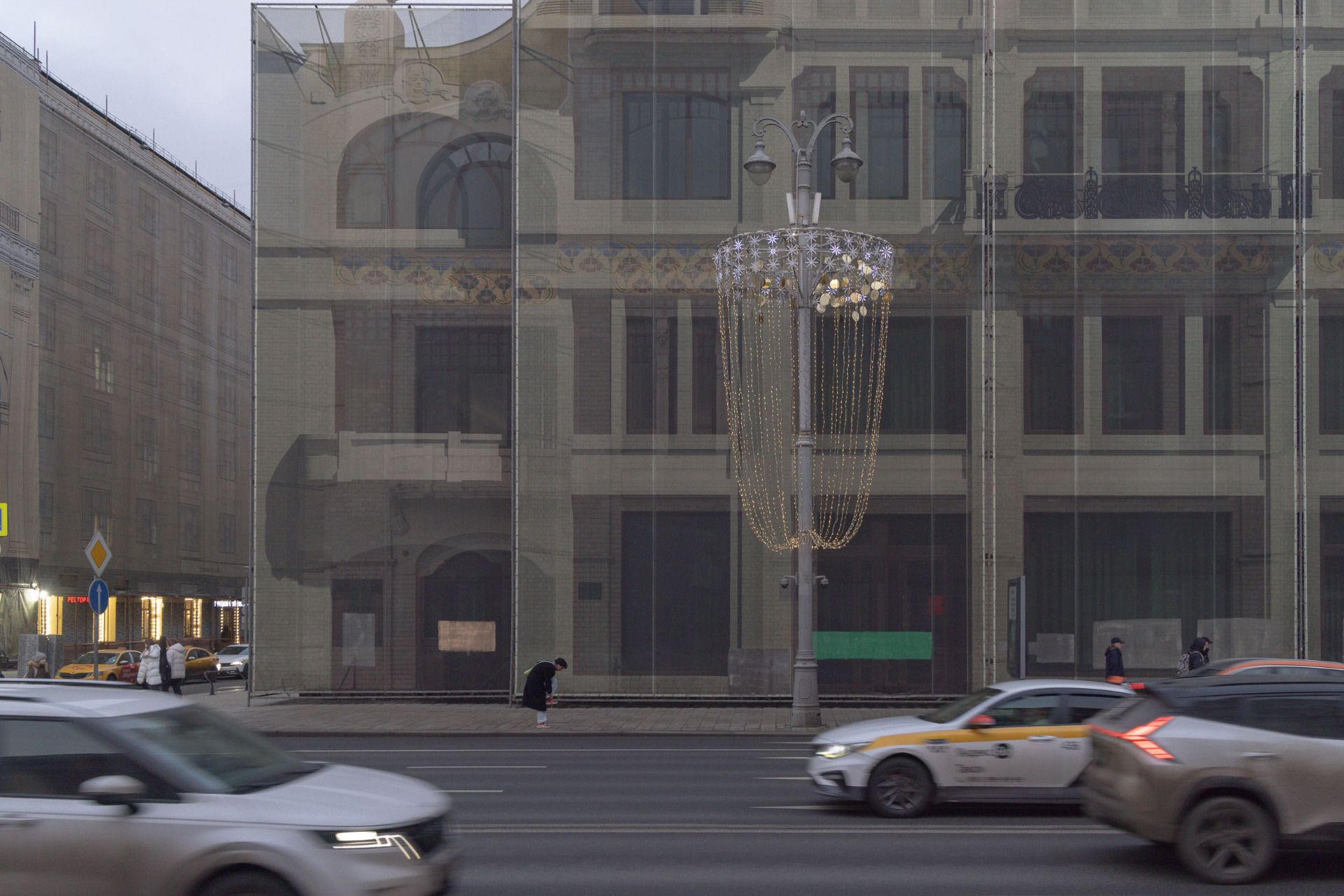
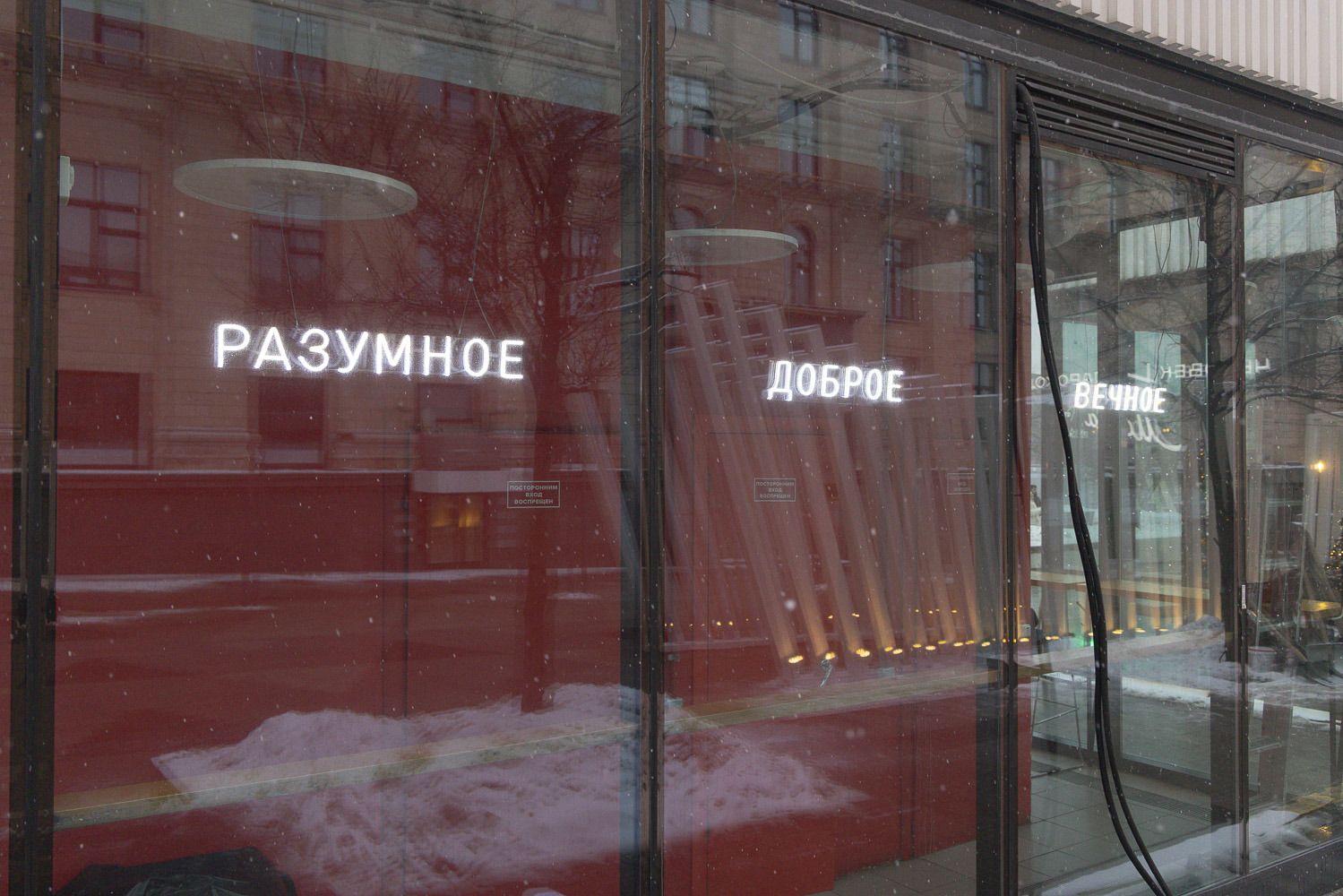
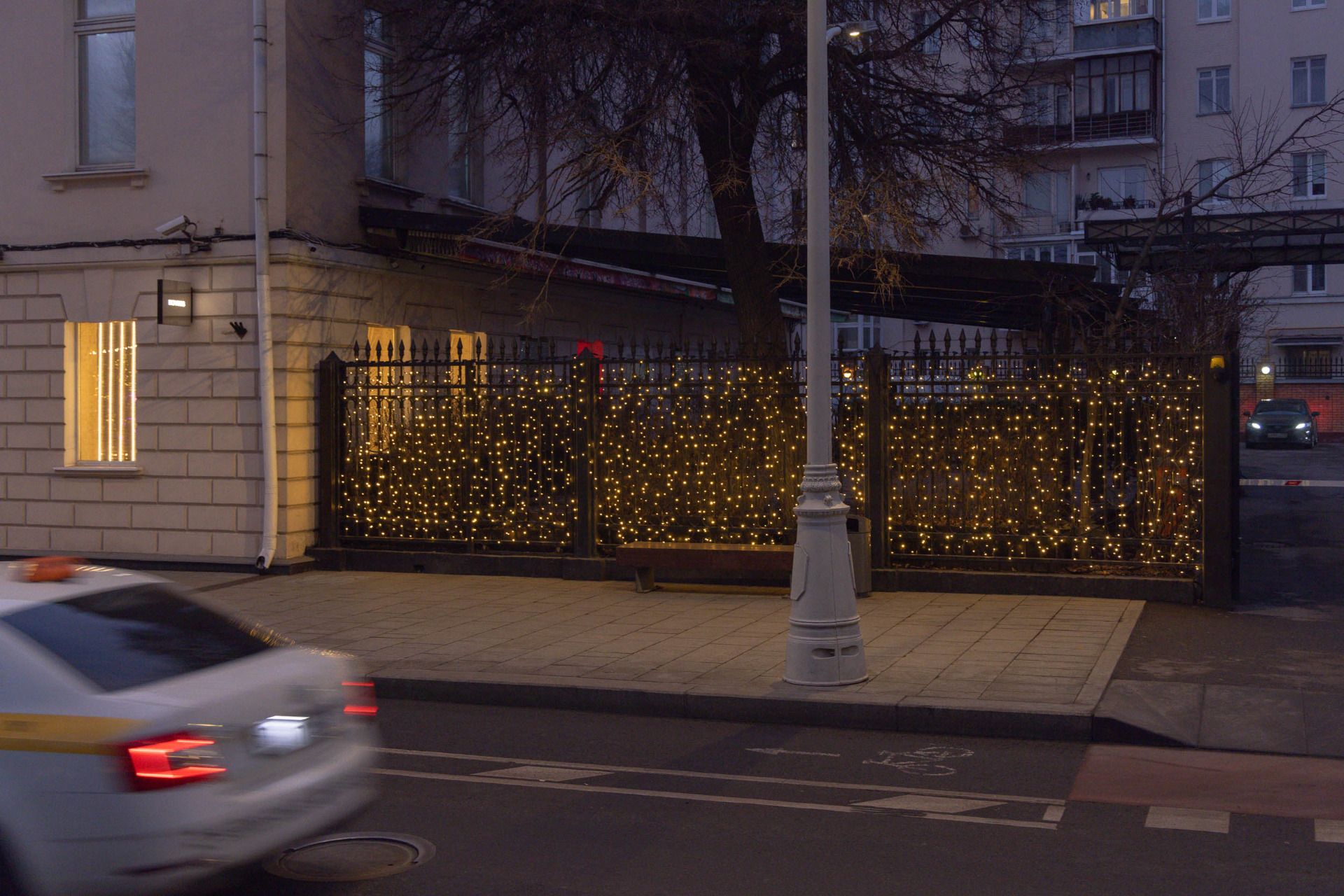
In December 2025, Moscow began to be actively decorated for the New Year as part of the “Journey to Christmas” festival. Its prototype was the Strasbourg Christmas Market on Manezhnaya Square, which in December 2012 made a splash among Muscovites and visitors to the capital. After that, city hall decided to include the city’s Christmas celebration in the ongoing mega-festival “Moscow Seasons.” By 2026, however, little remained of Strasbourg and its Christmas traditions. But an imaginary Europe, now almost out of reach, still peeks through the New Year’s tinsel—just like other realities of recent years.
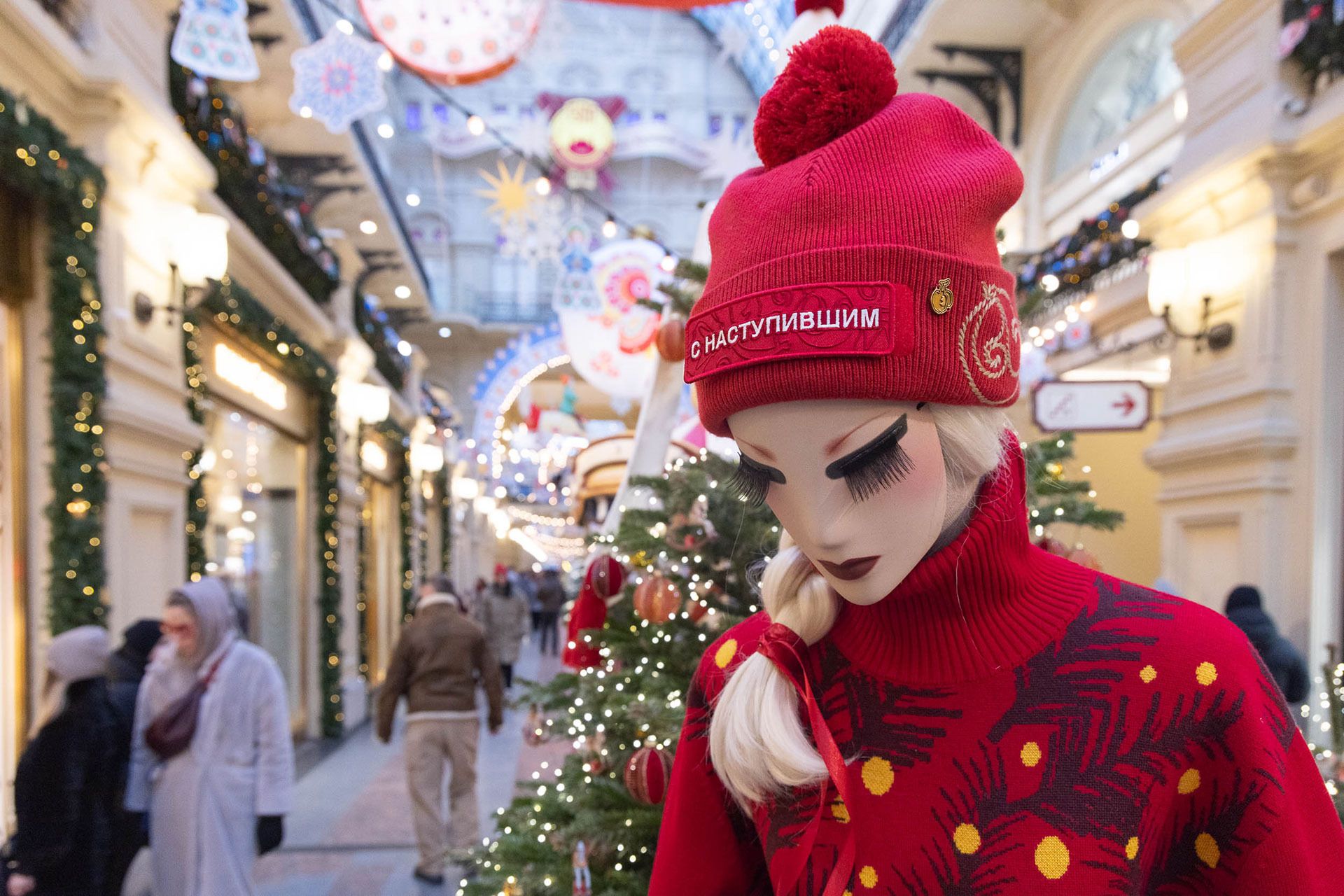
“Happy New Year” written on a hat decorating a mannequin in GUM. Photo: Stanislav Pyatyorik
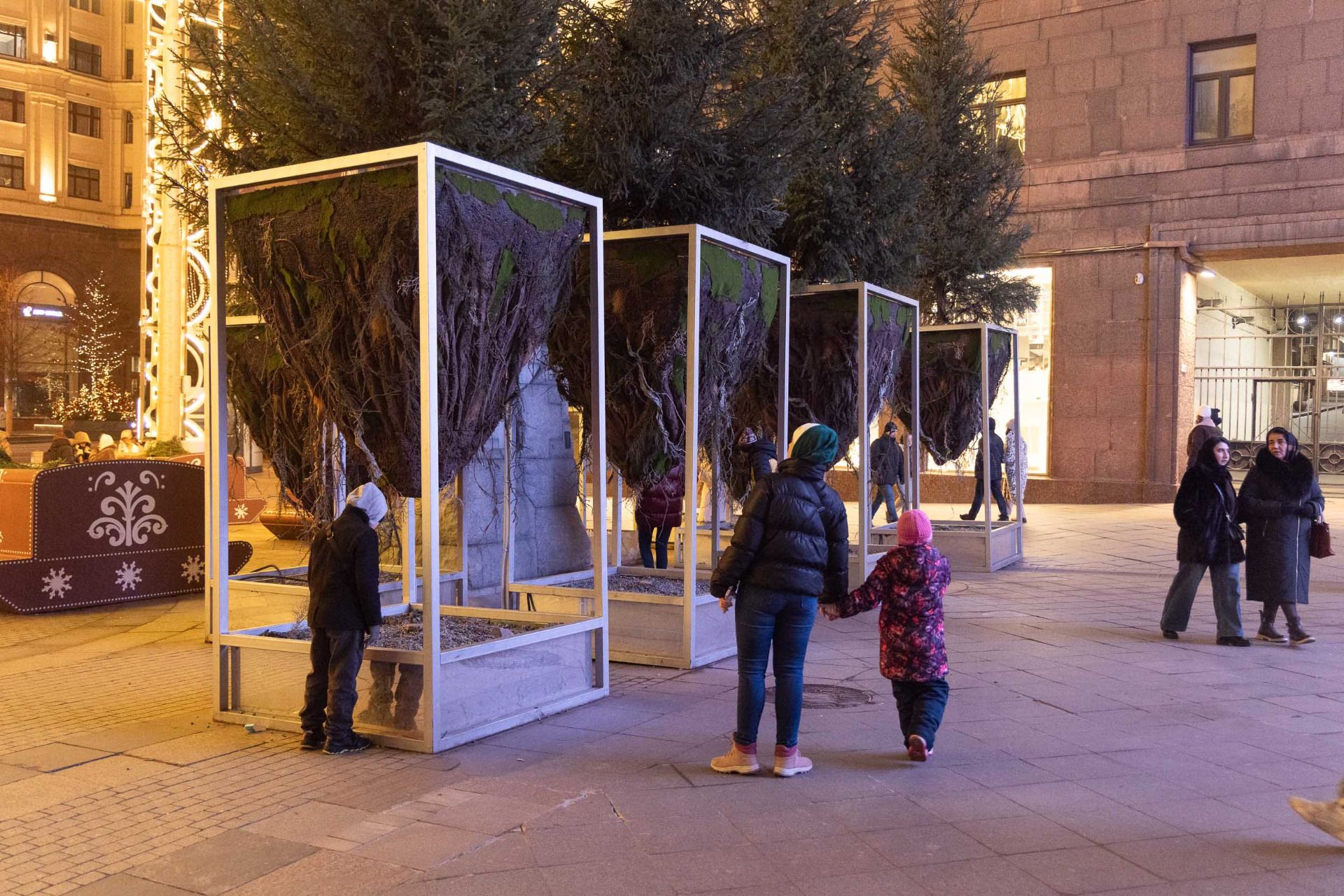
At the intersection of Kamergersky and Tverskaya, fir trees are suspended overhead. If you don’t come close, it looks like they’ve just been yanked out of the ground and put on display. People stop and look at them with surprise, many take photos, and some touch them to suddenly realize the roots are fake—it’s a stylish planter shaped like roots. “Original, of course, you can do it once, but it would be better if they just stood there,” says a middle-aged woman.
But overall, people on the streets don’t have questions about Moscow’s New Year’s decorations, and they don’t see much difference from previous years. “It’s all the same as always—everything’s big,” summarizes a housing services worker in her sixties wearing an orange uniform.
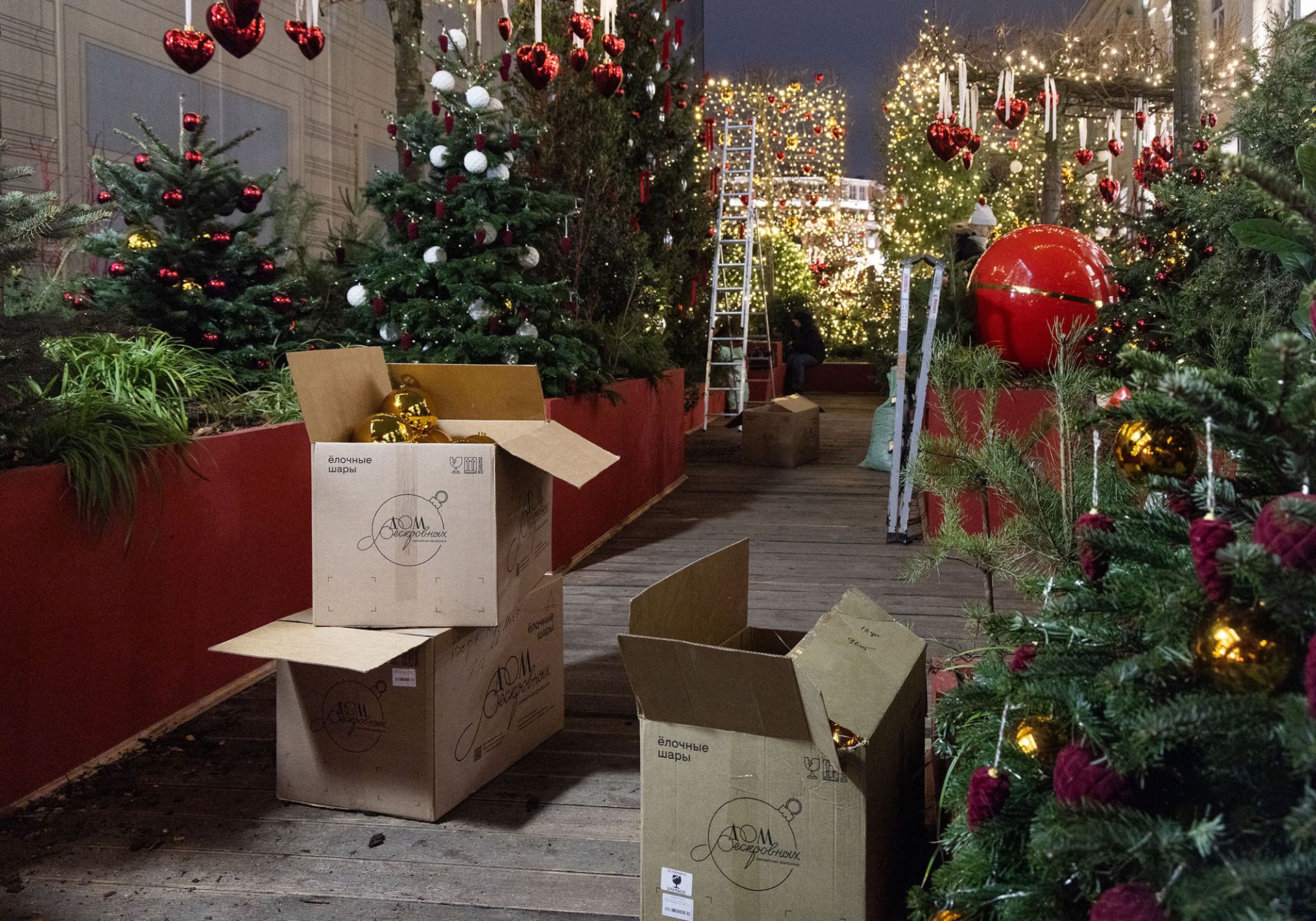
The logo on the decoration boxes says: “House of the Bloodless”
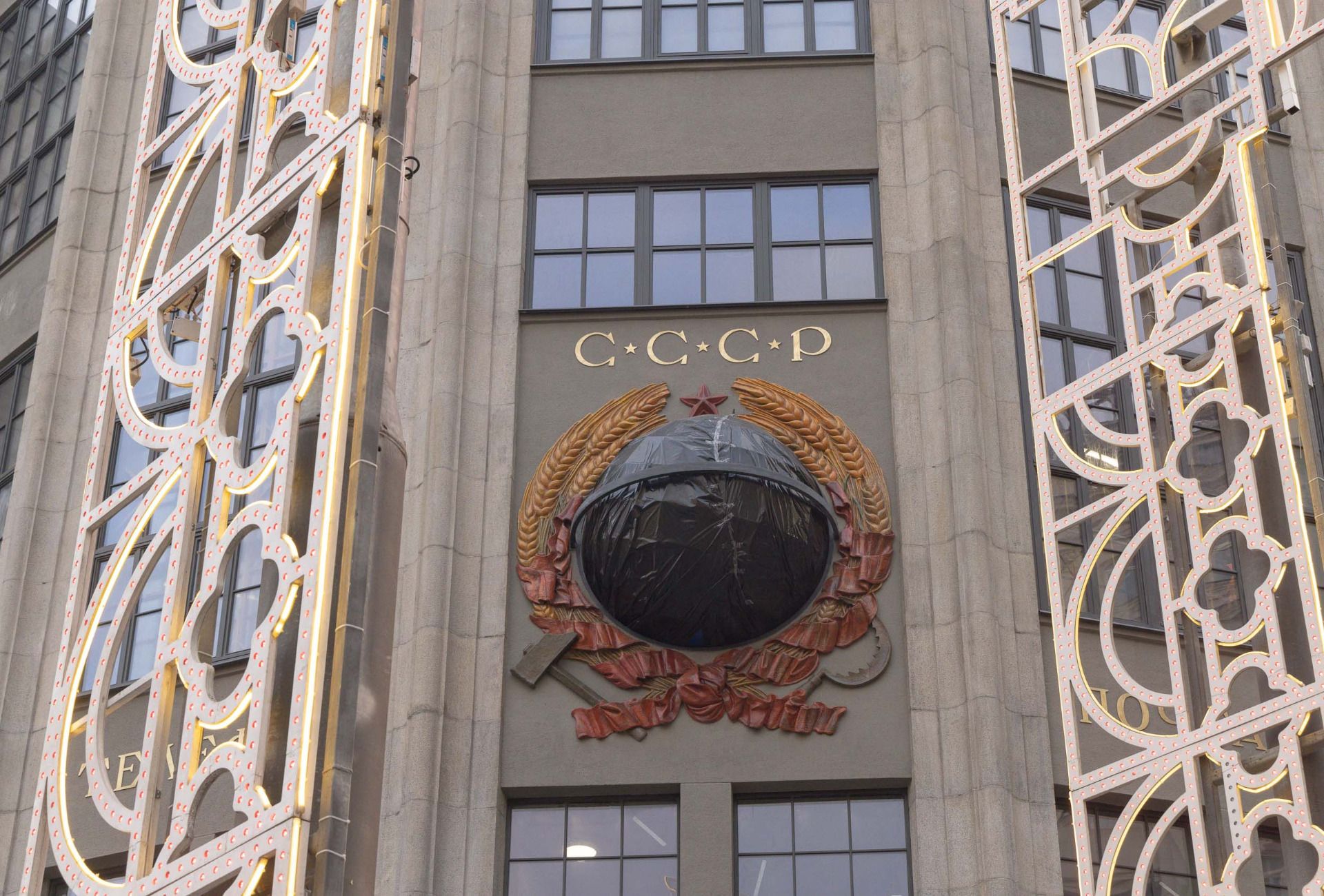
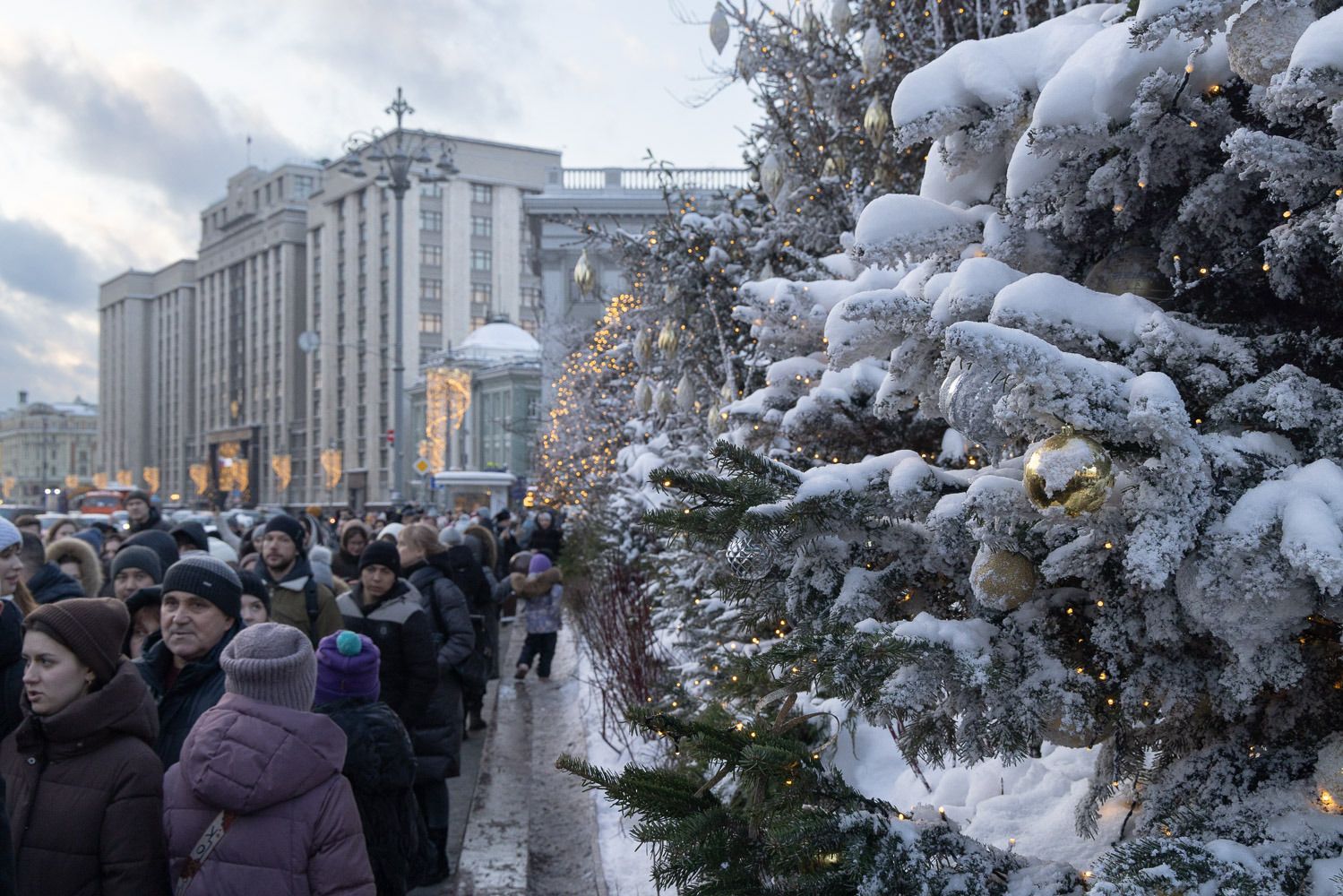
The renovated Central Telegraph building is gradually being revealed: the facade is almost fully open, the sides are partially uncovered, while the rear is still completely draped in netting. The globe on the emblem is symbolically wrapped in black plastic. Along Tverskaya Street all the way to Pushkin Square, there are multi-tiered granite planters with many decorated fir trees: here, the trees are alive and planted in the ground.
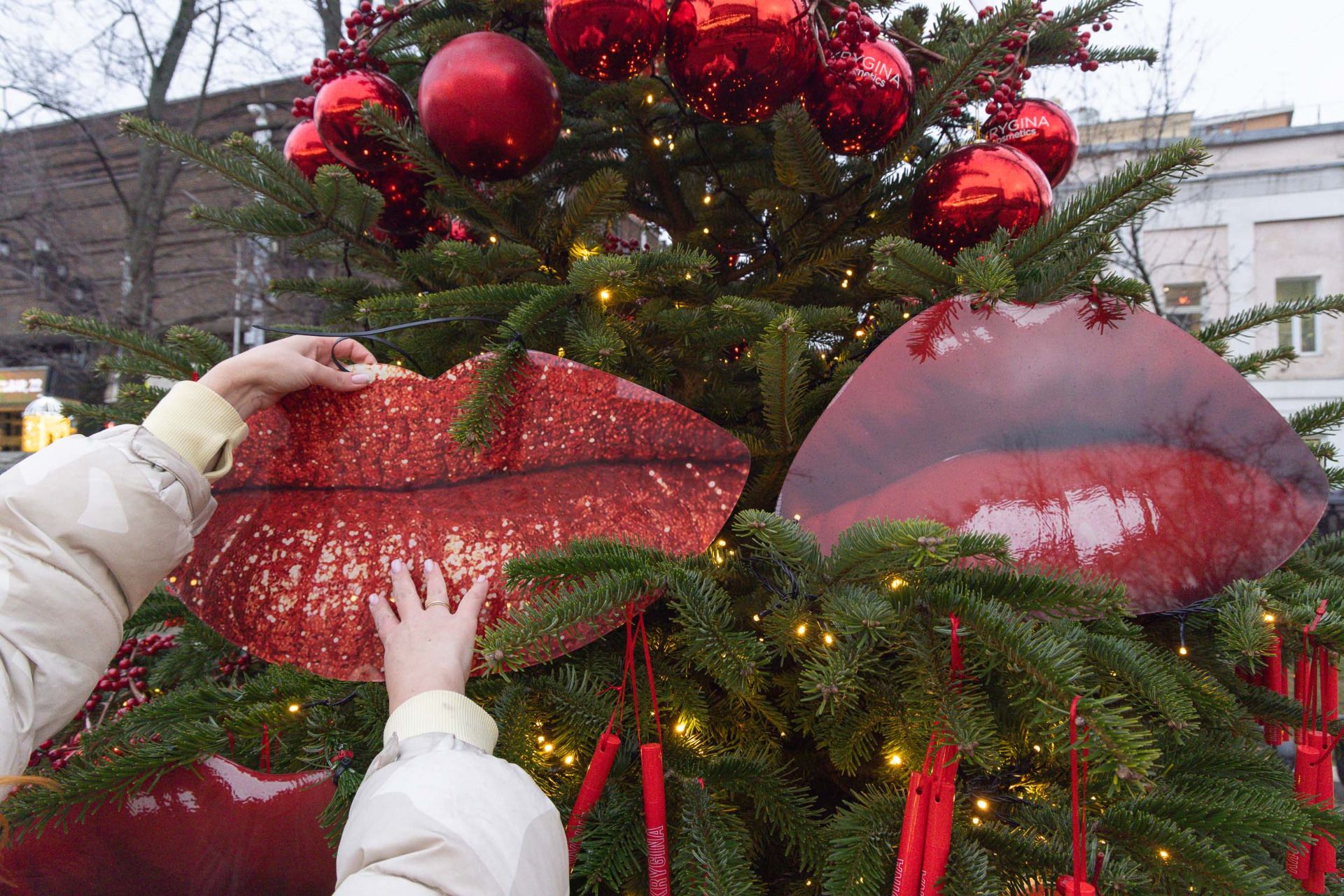
“Tverskoy Boulevardpresents a large gallery of Christmas trees decorated in collaboration with Russian fashion houses and cosmetic brands. It’s the perfect place to create bright and stylish winter photos,“ says the official city portal. The design of Tverskoy Boulevard is dominated by red and pink. Every 50 meters there are furry umbrellas with benches underneath. Next to each umbrella are a couple of small booths, which from afar look like red birdhouses. In one, you can warm your hands, and in the neighboring one, you can send your wish to someone. I ask the girl at the kiosk who is responsible for making wishes come true—she says they haven’t been told. The light poles are also wrapped in pink fur, and if you run your finger against the grain, it leaves a clear mark. Many people use this feature, leaving mostly simple love messages and drawings.
Right here on the boulevard you can play pétanque or bowling. According to a girl working at the pétanque area, there aren’t many people on weekdays, most visitors come on weekends. At the end of the boulevard stands a pink and fluffy train that doesn’t go anywhere. There are no traditional Russian games or amusements to be seen on the boulevard.
Closer to New Year’s, “Winter Stories #9” replaces the photo exhibition“Qatar. Where the Light Lives” on Tverskoy Boulevard. By this time, at least some snow has fallen in Moscow, and the change of exhibition looks timely. The exhibitions are organized by the Russian Peace Foundation.
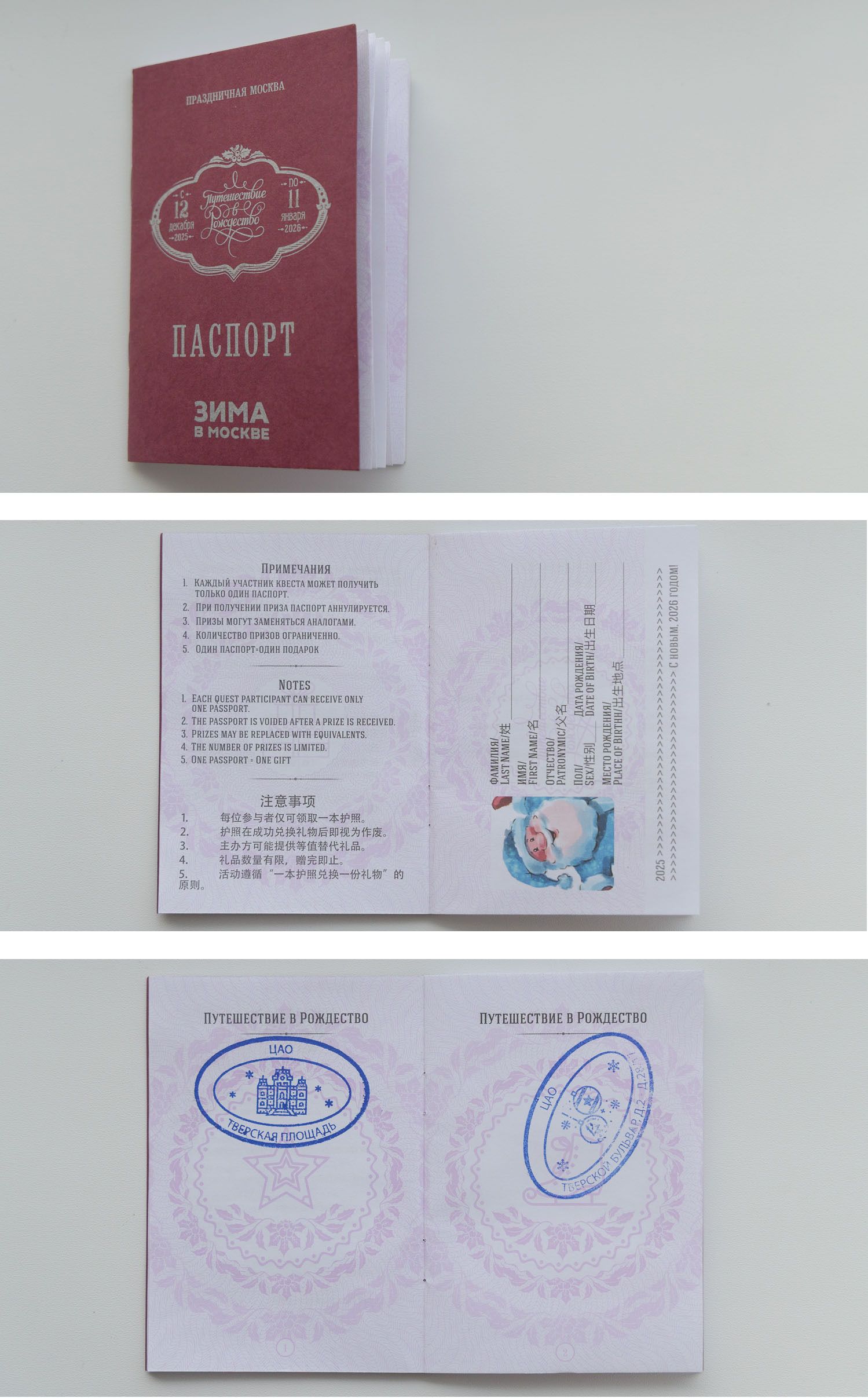
On the last weekend of the outgoing year, the boulevard is crowded. Here, “traveler’s passports” from the Moscow city hall are being handed out. Security directs me to a red booth behind the furry train. There’s already a small queue, and the man at the window is energetically doing squats. It turns out, such challenges were designed by the Moscow government for “travelers” visiting New Year’s attractions. The girl at the window decisively punches the squatter’s passport with a hole punch—that’s the rule for handing out prizes to prevent cheating.
- 10 stamps gets you a movie ticket or a gift; if you cover the districts, you can collect 20 stamps—that’s a scarf or a hat, and if you get 30 stamps, you get a sweatshirt! If you go to the districts, as soon as you see a carousel, go straight to it—they usually stamp passports there, a polite woman in the queue shares helpful tips with me.
There’s no point leaving Moscow—you can’t get stamps outside the city, and not everywhere has carousels anyway.
My turn comes, I don’t have to do squats, but I get a cognitive task—to count the number of days until New Year’s. I answer correctly and receive the coveted document with the first stamp. The “traveler’s passport” is surprisingly similar to a real foreign passport. The size matches to the millimeter, the data layout is the same, and the burgundy color is identical to the real thing.
On Tverskaya Square, a person in a Grinch costume sits on a pedestal, inviting passersby to take a photo with him while loudly singing “Sky of the Slavs” by the band Alisa. Payment for a photo can be made in cash or by card; the Grinch deftly pulls out a payment terminal and holds it out for Muscovites and guests to tap their bank cards. “I have a good deeds fund. This money goes to the guys,” says the Grinch, possibly winking (though it’s hard to tell behind the mask), “you know, for the border and all that. And I get a little for myself—I’m no altruist.”
A bit away from the Grinch stands Galina Nikolaevna, a homeless woman. I’ve met her in the center before. Galina Nikolaevna is from the Far East. There, she says, a drug addict tricked her, evicted her from her apartment, and even took out a microloan in her name “so she wouldn’t make a fuss.” She clearly distinguishes herself from “bums”: she says she doesn’t drink or smoke, graduated from the philology department, worked as a journalist, and dreams of returning home to the Far East. A couple stops nearby; the man actively gets involved and plans to buy her a ticket home. I leave them, hoping it works out and Galina Nikolaevna will make it home for New Year’s.
On Arbat, the main decorative element is tangerines—they’re everywhere: all the fir trees are decorated with them, and they’re sold by weight at stalls. Twice along the street, there are enormous scales, with lines of people wanting to weigh themselves. One side of the scale holds tangerines, and you can stand on the other—alone or with friends—to see your weight, naturally, in tangerines. People are delighted.
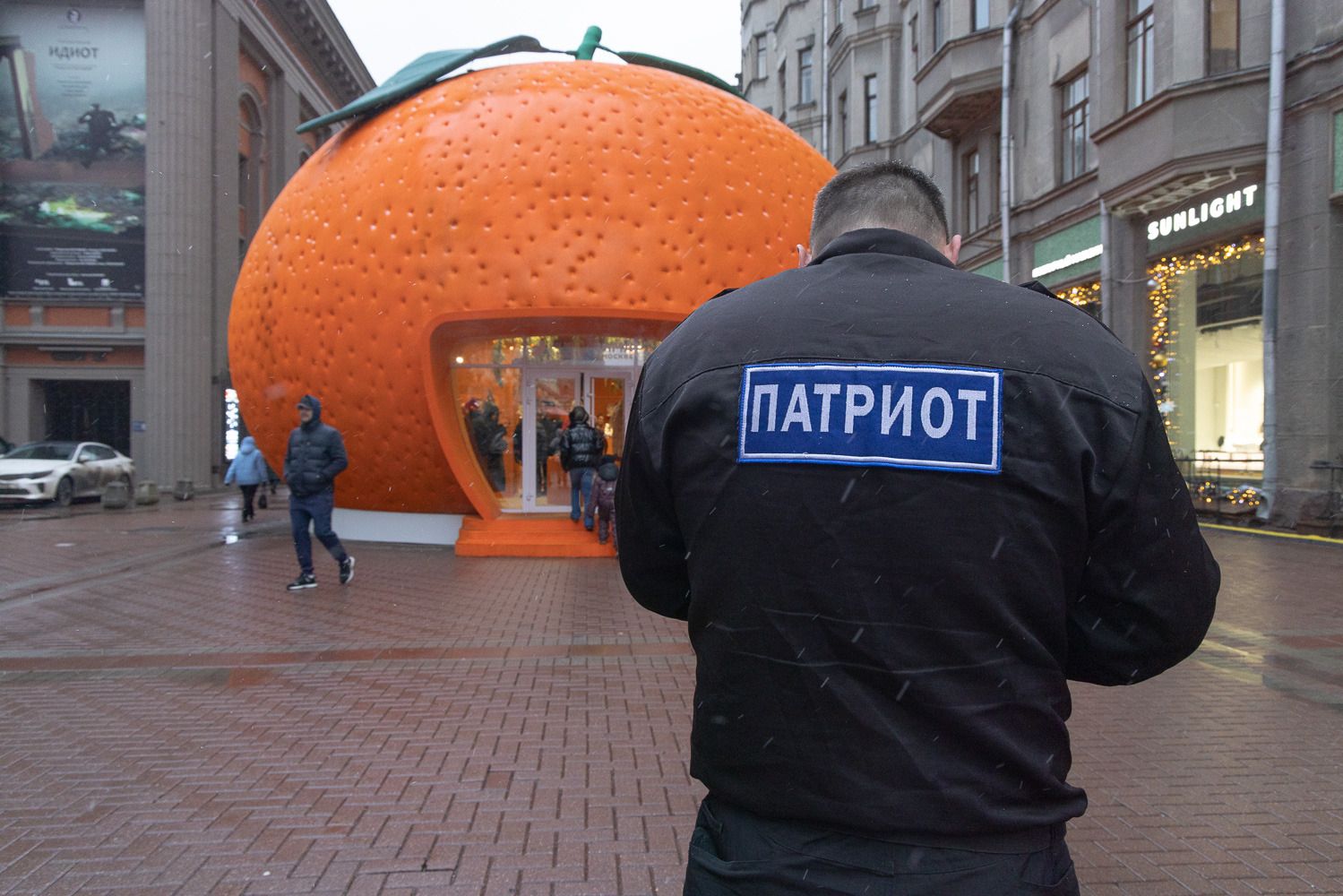
At the beginning of Arbat stands a huge pavilion shaped like a samovar, and in the middle, opposite the Vakhtangov Theatre, is a giant Tangerine. You can go inside both pavilions and buy branded souvenirs, presumably made in Moscow. Here and there, Avtodor workers keep the streets almost perfectly clean. Since their uniforms are also orange, it creates an almost complete visual idyll—spoiled only by passersby dressed in all sorts of ways. Everywhere, unmanned delivery robots scurry about, trying to avoid people and the lines at the scales. The riot of orange ends as abruptly as it began: beyond Old Arbat, the decorations are much more modest.
The metro keeps running all New Year’s night. On the evening of December 31, the turnstiles are switched off, and I instinctively hesitate in front of them—the sudden openness of such a strictly regulated space is surprising. Metro employees tell passengers there’s no need to pay, but many still tap their tickets out of habit.
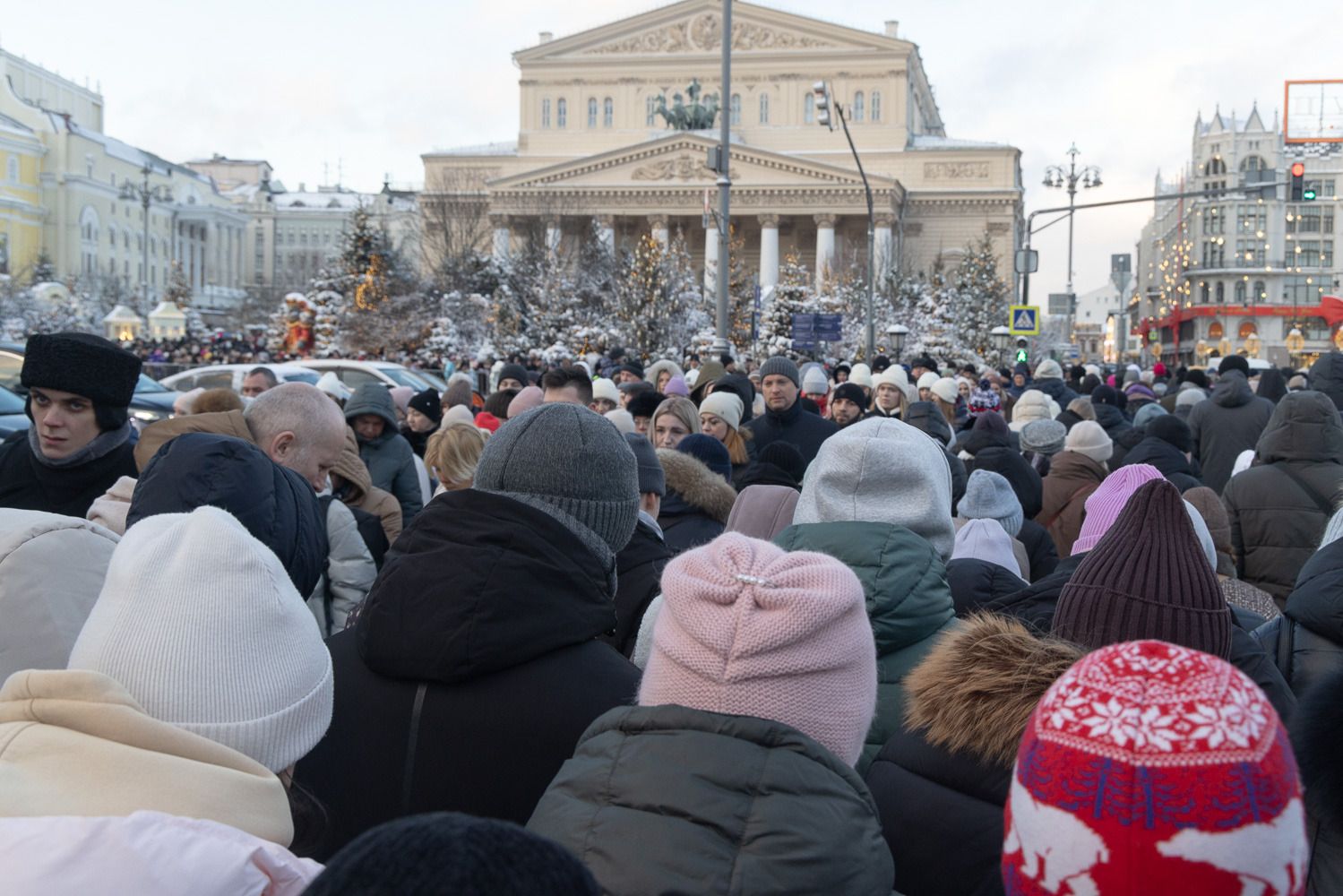
In the first days of 2026, police patrols and metal detector gates appear on Moscow’s central streets. You have to forget about traveling and collecting stamps: there are huge lines everywhere. The lucky ones who get through and receive a stamp in their passport run out joyfully, waving the document to dry the ink. Near the “floating fir trees,” children have claimed a pile of snow left by the city workers and are methodically building a fortress.
Tverskaya Street is closed off, there’s smoke and a crowd of onlookers. It turns out a car suddenly caught fire. According to police, the passengers are safe and unharmed, probably just an electrical short. “Chinese car, they all burn,” says a man passing by (the burned car was a Japanese make).
I start wondering whether Galina Nikolaevna managed to get home. At the church where she says she often goes, they say she stopped by just this morning. So, no miracle happened and she didn’t make it home, I say aloud. “Or maybe she just didn’t want to,” adds a woman from the church shop.
The “Journey to Christmas” continues on the streets of Moscow. Until the 11th, you can still collect stamps in your fake foreign passport and get various prizes without leaving the city. And where could you even go now, anyway?
“What happiness it is that we live in this city,” suddenly comes from the crowd of revelers.
If you enjoyed this article, consider making a donation — one-time or, even better, monthly. Your support helps us motivate our authors and become better with every article.
Our organization is recognized by the Internal Revenue Service (IRS) as a 501(c)(3) tax-exempt, charitable organization, which means that all contributions made to us are tax-deductible to the fullest extent permitted by U.S. law. Individuals may generally deduct charitable contributions of up to 60% of their Adjusted Gross Income (AGI) for cash donations made to qualifying 501(c)(3) organizations. For donations of appreciated assets (such as stocks or other long-term capital assets), the deduction is typically limited to 30% of AGI, based on the fair market value of the asset. C-corporations may deduct charitable contributions of up to 10% of their taxable income for donations made to eligible charitable organizations.
By submitting a donation, you confirm that you have read and accept the following documents: Privacy Policy and User Agreement, and also give consent to the processing of your personal data.
If you would like to unsubscribe from a monthly donation, please email us at: [email protected]