The Russian regime can only voluntarily end such a large-scale conflict as the war in Ukraine with a victory. But what exactly counts as a victory—capturing another Donbas district center, reaching the borders of the “new regions,” or the public execution of Zelensky—after almost 1,400 days of carnage, the Kremlin and Ostankino still haven’t decided.
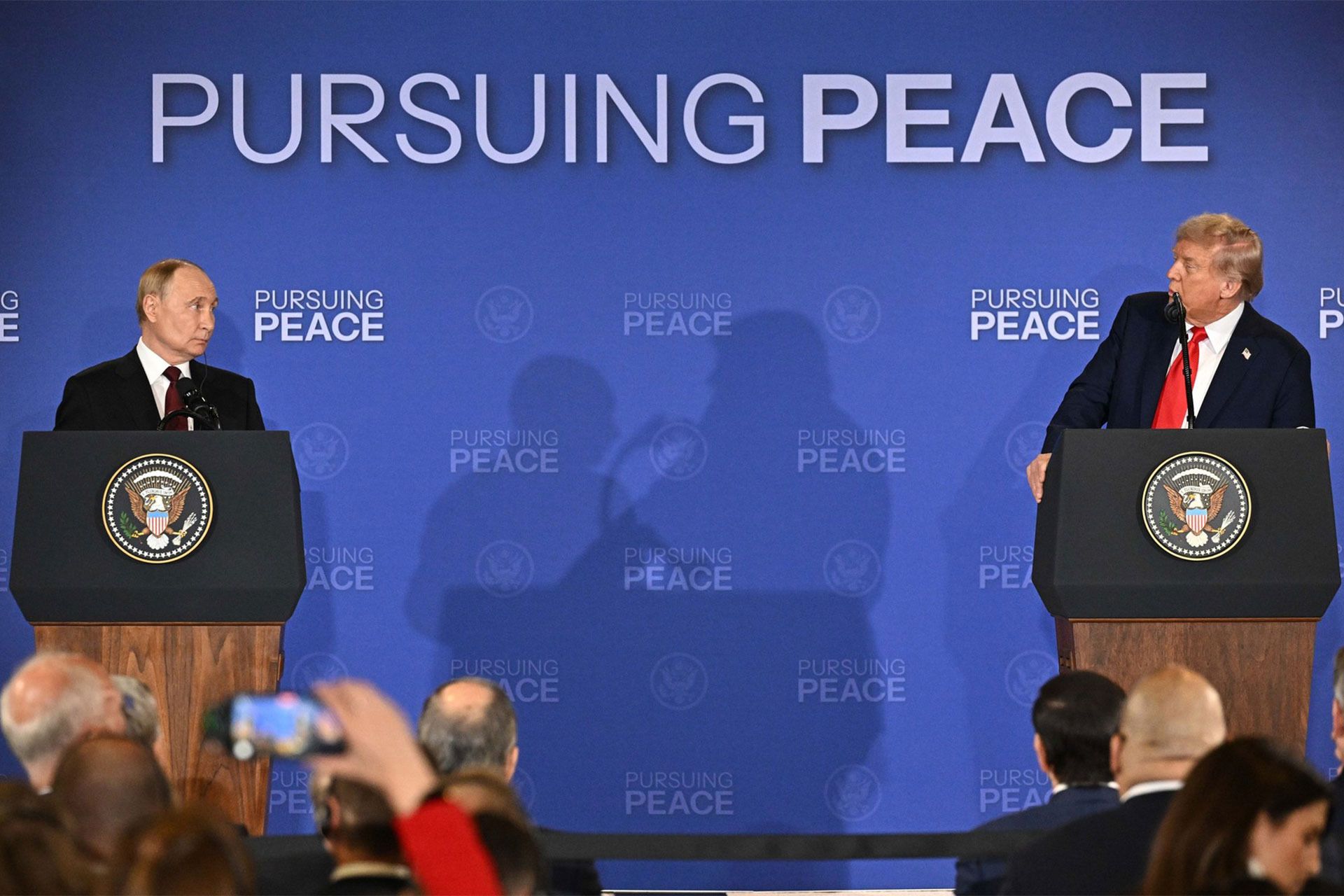
Meeting between Donald Trump and in Anchorage, August 16, 2025. Photo: kremlin.ru
Nightmare and absurdity often go hand in hand. Over almost four years of the Russia-Ukraine war, we have all seen this more than once. There’s no need to remind anyone how, against the constant flow of news about destroyed cities, broken lives, and shattered destinies, comic episodes like Yevgeny Prigozhin’s “march for justice” or the pointless summit in Alaska would appear.
It seemed that the latest saga around a peace plan for Ukraine with Russia was more of the same. Hapless Steve Witkoff simply fell for another Kremlin ploy and brought it to Donald Trump. Some would sigh, others would laugh, a third group would be outraged—but everyone would soon forget, since the strange games of aging men have no bearing on realities on the ground. But unexpectedly, the ploy took on a life of its own and acquired the features of a tool potentially capable of ending the war.
On November 25 in Abu Dhabi, Trump’s not-so-Trumpian plan was discussed with the Russian delegation by none other than U.S. Army Secretary Dan Driscoll, and with participation from the Ukrainian side. So what is this document, how was it written and rewritten, and what does its short history tell us?
Excuse My English
The original “28 points” supposedly from Trump went public on the night of November 20. The leak was published by Axios, allegedly with the involvement of Putin’s special representative Kirill Dmitriev. In any case, his eternal negotiation partner—Trump’s special envoy Steve Witkoff—named as his source on Twitter Axios specificallya certain “K.”. Witkoff later deleted the post, but a screenshot spread across the internet.
The document itself, as expected, caused a big stir worldwide. Some interpreted it as the infamous “Munich Agreement“—a capitulation and betrayal of Ukraine. Others, however, reasonably noted that its terms for Kyiv were much softer than what Russia had previously offered during the first and second rounds of negotiations in Istanbul.
However, most commentators equally ignored something more important: the document was neither pro-Ukrainian nor pro-Russian—it was simply poor in quality.
Some provisions made no clear sense. Consider point #3 (“It is expected (sic!) that Russia will not invade neighboring countries“) and #9 (“European(?) fighter jets will be stationed in Poland“). Or #20-21, which determines the fate of certain “territories” with names like “Donetsk,” “Luhansk,” “Kherson,” and “Zaporizhzhia”, as well as #25, which obliges Ukrainians to hold elections 100 days after peace is established—without specifying which elections.
Other points contradicted existing regulations, such as #7—a direct ban on Ukraine’s NATO membership, which would have to be enshrined in the organization’s charter. The very premise violates Article 10 of the North Atlantic Treaty, which allows any European country to join the Alliance. Still others duplicated existing agreements—such as #18, which repeats Ukraine’s nuclear-free status as established in the 1994 Budapest Memorandum. Or #16, which obliges Russia to legally commit to not attacking Europe and Ukraine—despite the existing Article 353 of the Russian Criminal Code.
The comic effect of the original English-language document was heightened by its poor style. The characteristic turns of phrase revealed that the text was written by a Russian speaker—someone who knows English, but not at a high enough level.
This is particularly evident in the third point of the plan, which states: “It is expected (It is expected) that Russia will not invade neighboring countries, and NATO will not expand further.“ [The Guardian correspondent Luke] Harding notes that the phrase “It is expected” is an “awkward passive construction” in English. Other Russicisms that apparently made it into the text include “ambiguities” (“ambiguities”) and “to enshrine” (“to enshrine”), Harding adds, noting that these features “raise questions about the authorship of the text.”
One can imagine the following scenario. After a recent fruitless tour of the U.S., Kirill Dmitriev clearly wanted to raise his KPI in the eyes of the Kremlin. So his staff hastily drafted a “peace agreement” project, counting on Witkoff’s pliability. The old partner didn’t let them down, meekly approved the poorly drafted list of points, and a satisfied Dmitriev sent the dubious product to journalists.
Most likely, the Kremlin negotiator hoped to revive in the West Moscow’s favorite export narrative about the war. Supposedly, the Russians—taking their legitimate interests into account—would be happy to end the bloodbath in the neighboring country, but peace is prevented by dictator Zelensky and his corrupt junta. If so, Dmitriev’s calculations clearly didn’t work.
This version is supported by the scandalous leak last night. Bloomberg published the transcript of a phone call between Steve Witkoff and Vladimir Putin’s advisor Yuri Ushakov. Here, the American is less representing his country’s interests than advising the Russian on how to build a dialogue with Trump to sabotage U.S.-Ukraine negotiations. The conversation also confirms that the infamous “28 points” were initially written by the Russian side as a tactical ploy. Donald Trump has already called his special envoy’s behavior “business as usual” for a negotiator.
“This plan was originally developed in Russia’s interests, not Ukraine’s”
Ironically, the original “28 points” can’t be called completely anti-Ukrainian. The document allowed Kyiv to have an army of 600,000 soldiers—seven times more than the Istanbul proposal allowed during negotiations in April 2022. Dmitriev and Witkoff also left Ukraine with vague security guarantees from the U.S. and NATO, and mechanisms for postwar recovery—partly at the expense of Russia’s frozen overseas assets.
Nevertheless, the plan was met negatively in the warring country. The reaction was influenced less by specific points (including the complete surrender of Donetsk region) than by the overall framing. Initially, the pact—drafted without Ukrainian involvement—was supposed to be accepted by Kyiv within a tight deadline—by November 27, just so Trump could present himself as a peacemaker by Thanksgiving. Vladimir Zelensky promptly addressed the nation in a rather apocalyptic tone: “Either loss of dignity, or the risk of losing a key partner. Either the difficult 28 points, or a very hard winter.”
The “28 points” received no more enthusiasm from European leaders. Like the Ukrainians, they were dismayed that Washington and Moscow had settled everything behind closed doors. By denying the EU any agency, Dmitriev and Witkoff simultaneously designated Brussels as the key sponsor of Ukraine’s postwar recovery—assigning Europeans a $100 billion contribution to a special fund. Unsurprisingly, the heads of key EU countries, supported by the UK, Canada, and Japan, stated with rare unanimity: the proposed plan needs more work.
The infamous plan was also not appreciated in the U.S. Outrage came not only from opposition Democrats but also from ruling Republicans—especially after Secretary of State Marco Rubio admitted the document did not reflect the administration’s position. Lawmakers responded by calling for the dismissal of those responsible for “that disgusting clown show we’ve seen for the last four days.”
It’s obvious that this plan, at least initially, was developed solely in Russia’s interests, not Ukraine’s. Then they said Ukrainian participation was involved. Now the president is again changing his mind about whether this proposal is final or not. Ultimately, we all want peace, but we don’t want a peace that benefits.
In the end, Trump allowed the document to be rewritten. Last weekend in Geneva, the “28 points” were reduced to nineteen—with representatives from Ukraine and the EU participating. Not only did the number of theses change, but also their substance.
Peace Is War?
How does the revised document differ from the original? In short, the peace plan became more concise and got rid of the initial pro-Russian imbalance. Journalistic leaks suggest several shifts:
- Size of the Ukrainian Armed Forces: effectively abandoning the reduction of the Ukrainian army;
- Territorial concessions: Kyiv is not required to give up the remaining part of Donetsk region under its control;
- Frozen Russian assets: funds should go entirely to Ukraine’s recovery, with no side projects between Russia and the U.S. (as the original Dmitriev-Witkoff plan envisioned);
- Ukraine’s NATO accession: the legal possibility remains—on general terms, by consensus (which is unlikely in the foreseeable future).
Equally important is what’s not on this list.
De facto, the Ukrainian authorities and their allies have abandoned two once-principled demands—the restoration of the country’s constitutional borders and prosecution of the Russian military-political leadership.
At the same time, the authors of the revised version recognized the inevitability of “Russia’s reintegration into the world economy”—in other words, the gradual lifting of sanctions.
It’s hard to shake the sense of déjà vu here. In essence, the collective Putin is being offered exactly what he was offered in August in Anchorage—to exit a deadlocked, monstrous war with his face saved. And it’s being offered not just by Trump, known for his unpredictability, but by a broad coalition of much more predictable and negotiable politicians. Yes, some points may not look entirely “victorious.” But, after all, that’s what diplomats are for—to smooth out the rough edges of international relations through negotiation.
On the other hand, we have no new information that would allow us to hope that this time the Russian leadership will choose peace. In fact, they already have “peace”—in the most Orwellian sense, as endless war. Continuing the fighting means keeping it; stopping the fighting means creating too many problems. Problems ranging from a fundamental overhaul of propaganda to the no less radical “reset” of an entire economy built around war.
The Russian regime can only voluntarily end such a large-scale conflict with a victory. But what exactly counts as a victory—capturing another Donbas district center, reaching the borders of the “new regions,” or the public execution of Zelensky—after almost 1,400 days of carnage, the Kremlin and Ostankino still haven’t decided.
Even more so, we can’t know how the narrow circle responsible for war and peace in Moscow sees what’s happening. Perhaps, in their view, everything is going great: the West is in disarray, Trump is being hounded by his own party, Kyiv has a corruption scandal, and our guys have almost completely liberated Kupyansk and Pokrovsk. If so, then edits to some silly plans, as well as gloomy economic news, are relegated to the background—it’s business as usual.
First commentsfrom Russian diplomatic officials set a rather pessimistic tone—successful treaty signings rarely begin with such rhetoric. So the prospects for real peace remain as distant as ever.
If you enjoyed this article, consider making a donation — one-time or, even better, monthly. Your support helps us motivate our authors and become better with every article.
Our organization is recognized by the Internal Revenue Service (IRS) as a 501(c)(3) tax-exempt, charitable organization, which means that all contributions made to us are tax-deductible to the fullest extent permitted by U.S. law. Individuals may generally deduct charitable contributions of up to 60% of their Adjusted Gross Income (AGI) for cash donations made to qualifying 501(c)(3) organizations. For donations of appreciated assets (such as stocks or other long-term capital assets), the deduction is typically limited to 30% of AGI, based on the fair market value of the asset. C-corporations may deduct charitable contributions of up to 10% of their taxable income for donations made to eligible charitable organizations.
By submitting a donation, you confirm that you have read and accept the following documents: Privacy Policy and User Agreement, and also give consent to the processing of your personal data.
If you would like to unsubscribe from a monthly donation, please email us at: [email protected]