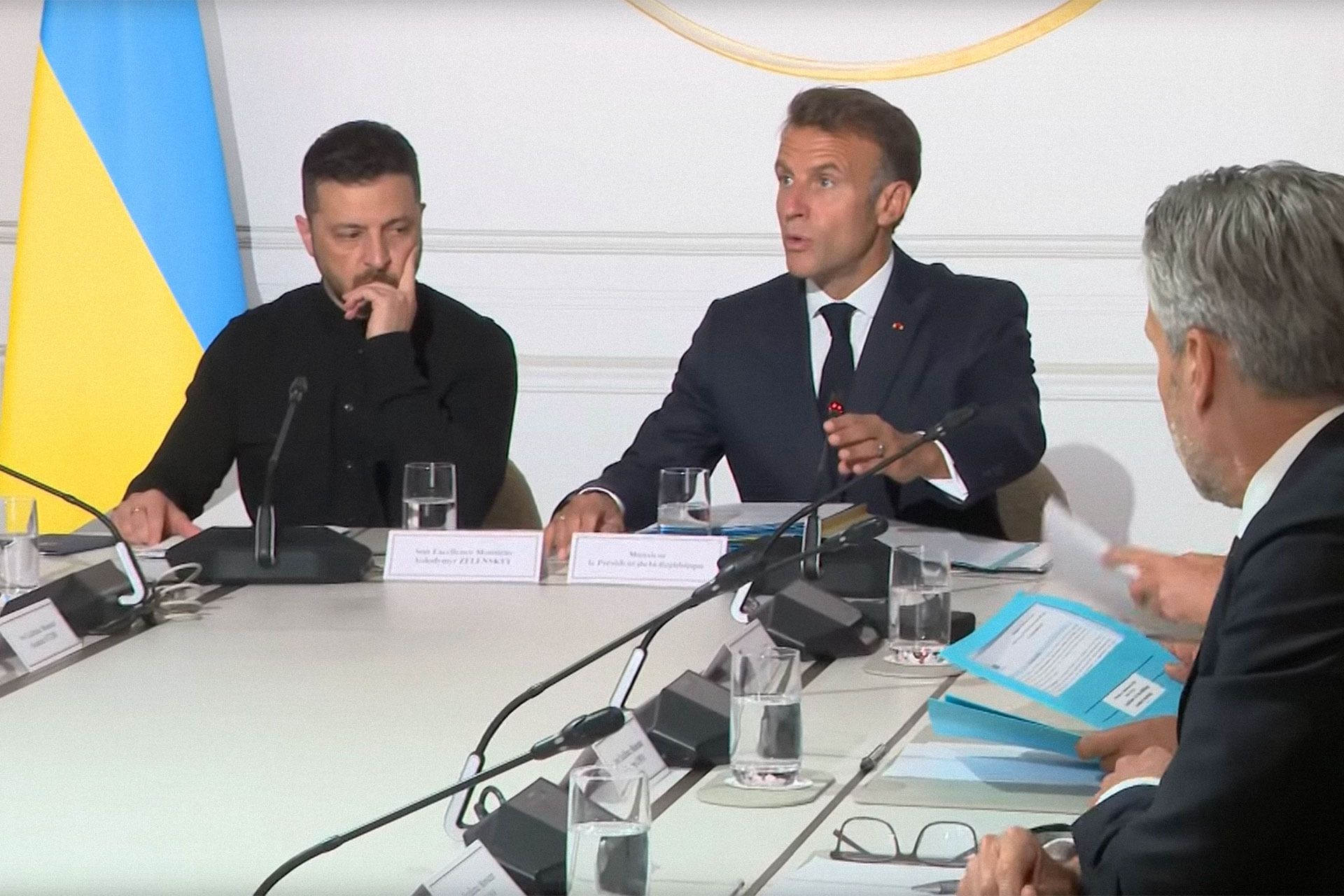
At the beginning of September, a meeting took place in Paris with representatives from 35 countries interested in the activities of the “Coalition of the Willing.” The essence of this peacekeeping idea, conceived six months ago, is to station troops from Ukraine's allied countries on its territory.
Summit of the “Coalition of the Willing,” September 4, 2025. Frame from video: Élysée Palace via YouTube
One of the most difficult obstacles to achieving a ceasefire, or even a truce, is security guarantees for Ukraine. What mechanisms should be put into action to ensure that Russian aggression does not resume shortly after peace agreements are reached? It is clear that trust in Moscow in Kyiv is zero, but promises from Western allies, whether verbal or written, are met with skepticism after the painful experience of the Budapest Memorandum. Ukraine would like to have security guarantees that would serve as a convincing deterrent to Russia in the event of a truce. Everyone understands that any set of measures has its flaws, and absolute confidence in the reliability of even the strongest military alliances is impossible, but the degree to which the risk of renewed Russian aggression can be reduced matters and should be discussed.
The position of the new American administration was formulated from its first days and was that European affairs, including the war in Ukraine, should be handled by Europeans, and therefore the question of security guarantees for Kyiv falls within their responsibility. According to statements from Trump, the US wants to stop the war and focus on what truly matters to them.
Under these circumstances, Europe found what they thought was a good solution: after a ceasefire is concluded, armed forces of Kyiv’s allies will be deployed on Ukrainian territory. They will be positioned not on the front line but somewhat behind it, and their mere presence is intended to deter Russia from new aggression. These forces are formed on a voluntary basis, which gave the project its name as the “Coalition of the Willing” (or even “Coalition of Volunteers”).
These are not NATO units (since the US opposes this format, as do some other NATO countries) and not UN peacekeepers (since there is no consent from the parties or a corresponding UN Security Council resolution).
This concerns, therefore, Ukraine’s allies (who are also NATO members) ready to deploy their troops on its territory as a deterrent against potential Russian aggression, but only after a ceasefire is reached, not now while fighting continues.
The “Coalition of the Willing” quickly found its leaders in France and the United Kingdom, which immediately declared their readiness to send their soldiers for a peacekeeping mission in Ukraine without waiting for the consent of other EU and NATO partners. At the same time, the idea predictably faced a variety of criticism.
First, the coalition was criticized for rushing and not being ready to consider Moscow’s interests, since Russian officials, including President Putin, repeatedly spoke out against the unacceptable military presence of NATO countries in Ukraine.
Second, the project did not generate much enthusiasm in most European capitals, and outside the initiatives of Paris and London, the real capabilities of the “Coalition of the Willing” left many questions.
Third, the prospects for a ceasefire remain hypothetical, so any post-war plans have relative value while fighting continues.
Fourth, there were always suspicions that this initiative was meant to impress Donald Trump rather than to be implemented.
Finally, all coalition meetings were accompanied by a special position from many participants and constant appeals to Washington for support, which did not convince observers of the seriousness of these plans.
Nevertheless, the idea of the “Coalition of the Willing” not only did not die out during 2025 but even strengthened somewhat and took on new contours. The meeting in Paris on September 4 was intended to demonstrate the project’s realism and confirm European solidarity.
Notably, it took place immediately after the grand events in China, where Chairman Xi gathered satellites around him, including President Putin, as a demonstration of the power of the new global superpower, which left President Trump unusually pensive.
What Was Decided at the Paris Meeting
The results of the meeting were summed up by French President Emmanuel Macron. Six countries were named that are ready to provide their units for military presence in Ukraine within the Coalition of the Willing: naturally, France and the United Kingdom, as well as Belgium and the three Baltic countries. Another 20 countries are not yet ready to go that far (they might reconsider later) but agree to support the project in some other form. Meanwhile, NATO Secretary General Mark Rutte stated, with his characteristic bluntness, that there is no need to consider Russia’s opinion regarding the deployment of coalition troops in Ukraine, as “it’s not their business.” Some clarifications followed, particularly concerning the mission content of the Coalition of the Willing.
It primarily concerns deterring Russia’s aggressive plans and supporting the Ukrainian army, which must maintain and strengthen its combat capability. Macron also spoke about the possibility of controlling the situation in the air, on land, and at sea, which implies, militarily, deploying units in the format of full brigades with autonomous command and logistics.
It can be assumed that both France and the United Kingdom are capable of sending one brigade to Ukraine, whose standard size is about 5,000 personnel. The capacities of Belgium and the Baltic countries are obviously more modest, but even if, for example, Germany, which has already begun deploying its own brigade in Lithuania, joins them, then
the total size of the Coalition of the Willing contingent is unlikely to exceed 20,000 personnel.
The operational capabilities of these forces should not be underestimated, but by themselves, they do not match the scale of the Russia-Ukraine war ongoing before our eyes—and are unlikely to prevent the resumption of fighting if Moscow launches a new offensive. However, that would be another story: neither France nor the UK will abandon their soldiers to fate.
These plans leave a contradictory impression. On one hand, the Coalition of the Willing project, often portrayed as a set of fantasies from irresponsible Europeans who only talk but do nothing, does not deserve such dismissal and may eventually be realized. On the other hand, it remains conditioned by many external circumstances that make it highly hypothetical. These include uncertain prospects for a ceasefire, Russia’s categorical objections, European disunity—and arguably the most significant obstacle is the somewhat ambiguous position of the American administration.
What Role Does the US Play?
No one talks about deploying US army units in Ukraine. Trump clearly stated he would not send American soldiers to Ukraine. But from an operational standpoint, European brigades under allied obligations count on US support in matters such as satellite intelligence provision, strategic coordination with NATO headquarters, and others. Otherwise, the potential of the “Coalition of the Willing” will not meet the level of the tasks set, which is why Europeans are persistently seeking American administration consent for such cooperation if achieving peace in Ukraine is truly important to Trump.
There is also a political aspect to this issue. From the start of his second presidential term, Donald Trump questioned the fundamental principles of transatlantic solidarity. According to him, Europe is full of cheats who have constantly deceived naive Americans, and now Europe must pay the US compensation for all real or imagined inconveniences.
The Coalition of the Willing’s appeal to Washington aims to obtain a clear political answer: is this project suitable as a security guarantee for post-war Ukraine? If yes, then it is logical to agree to reasonable US support for European efforts. If not, then something else should be proposed.
It is no surprise that the Macron-Trump conversation following the Paris meeting was tense. The American president allegedly demanded new tariffs on China and India from Europeans, as well as a complete ban on purchasing Russian oil. Without going into the details of these demands, even if they were justified, it is impossible to understand what they have to do with the discussed project. If there is a problem with security guarantees for Ukraine, why link it to the EU’s trade relations with the rest of the world? And even if American conditions are accepted, why wouldn’t Trump make new demands tomorrow if he believes Europe should pay for everything? But there is great doubt that a clear answer can be obtained from the American president.
In this sense, the Coalition of the Willing project indeed seems overly ambitious and multitasked. On the one hand, it plans a concrete military operation with clear goals and resources to achieve them. On the other hand, a complex political game with unclear prospects is unfolding simultaneously. It is difficult to predict the outcome of these contradictions.
Russia’s Reaction
President Putin issued direct threats, declaring troops of any NATO countries (and therefore of the six-nation coalition) a “legitimate military target” in Ukraine. This hardly surprised anyone. At the same time, accelerating events was not part of Europeans’ immediate plans as they wanted to better prepare for military confrontation with Russia. The slow negotiations around the Coalition of the Willing project seemed to satisfy everyone in Europe. But life does not stand still.
The intrusion of Russian drones into Polish airspace was perceived in Europe as a new level of military threat from Russia, whatever the reasons for this action. Military exercises in Belarus, which began on September 12, further intensified these ominous feelings. No one knows how far Moscow is willing to escalate.
It cannot be ruled out that the Russian provocation involving drone incursions into Poland, which has no direct connection to the Coalition of the Willing, will give it a new impetus. Preparations aimed at a distant post-war security system in Ukraine may prove useful much sooner and under different circumstances. The Coalition of the Willing, likely in another form and composition, within NATO or in cooperation with Alliance structures, may be reconfigured as a separate project to strengthen the EU’s eastern borders. Without Moscow’s consent and without Washington’s leading role.
If you enjoyed this article, consider making a donation — one-time or, even better, monthly. Your support helps us motivate our authors and become better with every article.
Our organization is recognized by the Internal Revenue Service (IRS) as a 501(c)(3) tax-exempt, charitable organization, which means that all contributions made to us are tax-deductible to the fullest extent permitted by U.S. law. Individuals may generally deduct charitable contributions of up to 60% of their Adjusted Gross Income (AGI) for cash donations made to qualifying 501(c)(3) organizations. For donations of appreciated assets (such as stocks or other long-term capital assets), the deduction is typically limited to 30% of AGI, based on the fair market value of the asset. C-corporations may deduct charitable contributions of up to 10% of their taxable income for donations made to eligible charitable organizations.
By submitting a donation, you confirm that you have read and accept the following documents: Privacy Policy and User Agreement, and also give consent to the processing of your personal data.
If you would like to unsubscribe from a monthly donation, please email us at: [email protected]