Relatives of the deceased and surviving comrades-in-arms, many of whom are still in captivity, continue the fight to establish the truth. However, the prospects for justice remain unclear. No international tribunals have been established for Olenivka, and all collected evidence remains part of broader investigations into Russia’s war crimes in Ukraine. Ukrainian investigators promise to bring the case to court – if not now, then after the war.
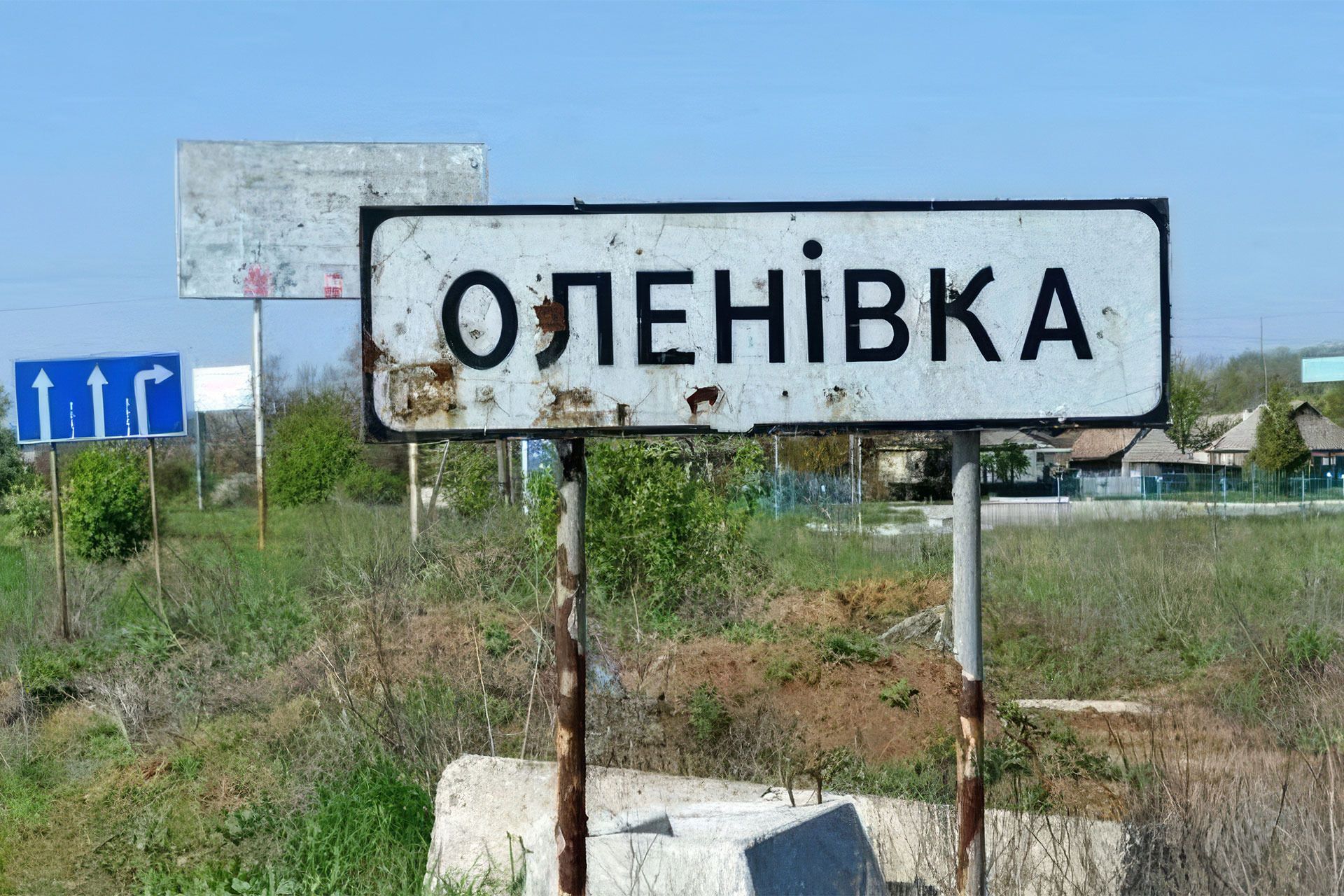
On the night of July 29, 2022, a powerful explosion occurred in a barrack at a correctional colony near the village of Olenivka (Donetsk region, controlled by pro-Russian forces), where Ukrainian prisoners of war were held. As a result, more than 50 prisoners died, and dozens were injured. Most of the victims were fighters of the “Azov” regiment, who had surrendered two months earlier after a prolonged defense of the Azovstal plant in Mariupol. In Ukraine, these soldiers were considered national heroes and expected to be exchanged under the guarantees of the Geneva Conventions. Their death in the Olenivka colony is one of the most brutal war crimes committed by Russia.
Three years after this tragedy, the circumstances of the prisoners’ deaths have not been fully investigated by official bodies, and the perpetrators have not been punished. Nevertheless, during this time independent journalists, international organizations, and Ukrainian investigators have gathered a wealth of evidence and testimonies shedding light on what happened. Here is what is known about the attack on the Olenivka colony three years later.
The Night of Explosions and Contradictory Versions
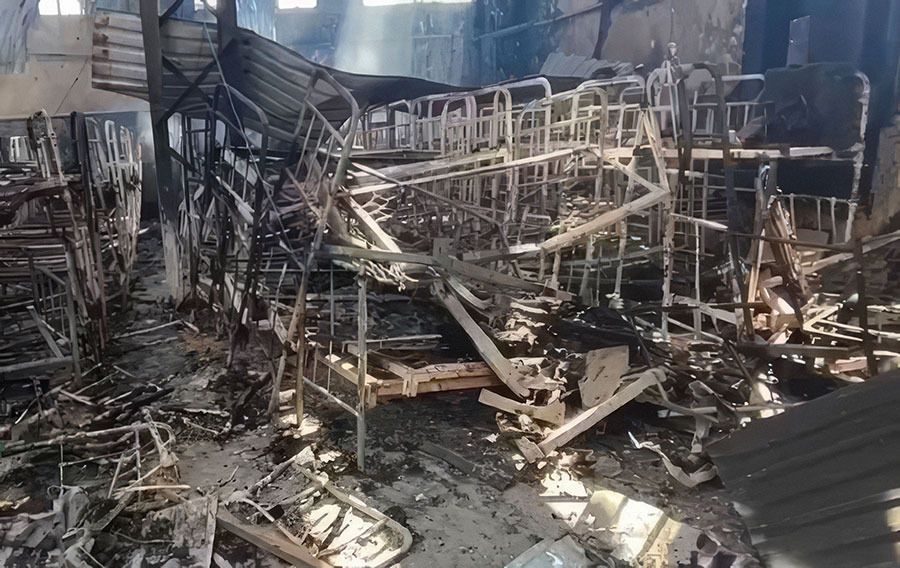
Late in the evening of July 28, 2022 (or around midnight on July 29), explosions rang out at the colony, causing a fire in one of the barracks. According to witnesses’ accounts, first there was an explosion outside the territory, then one or two inside the barracks, which was instantly engulfed in flames. Nearly 200 Ukrainian prisoners of war were confined in the cramped space. Most of them died immediately in the fire and from the shockwave. Initial casualty estimates varied: reports mentioned about 40-50 dead and more than 70-130 wounded. In the following days, Ukrainian authorities confirmed the identities of 53 deceased (nine of whom did not die immediately but succumbed to wounds due to a lack of timely medical aid). The Russian side also cited figures of 50-53 killed. Thus, the death toll exceeded fifty, making it one of the deadliest deliberate killings of prisoners in the modern history of war.
Photo: t.me/pgo_gov_ua
Russia’s Version. Within hours after the incident, the Russian Ministry of Defense claimed that the Olenivka colony was shelled by the Ukrainian Armed Forces using the American HIMARS rocket system. Moscow accused Ukraine of “striking its own prisoners of war,” alleging that Kyiv was trying to intimidate its soldiers or cover up certain facts. Russian state media released footage of a destroyed hangar with burnt beds and bodies, and presented fragments of HIMARS rockets allegedly found at the scene. These images were intended to support the version of an external missile strike. Furthermore, on the day of the explosion, the official X (formerly Twitter) account of the Russian Embassy in the UK cynically stated that captured “Azov” fighters “deserve the death penalty, not by shooting, but by hanging, because they are not real soldiers.” A few days later, the Russian Supreme Court designated the “Azov” regiment as a “terrorist organization,” which, according to Ukrainian intelligence, was meant to justify the execution of prisoners in Olenivka and other violations of prisoners’ rights.
Ukraine’s Version. Kyiv categorically rejected the accusations of shelling and blamed Russia. According to the statement of the Ukrainian General Staff, Russian forces deliberately destroyed Ukrainian prisoners of war to conceal evidence of torture and inhumane conditions that existed in the colony. Even before the tragedy, the Ukrainian side pointed to numerous reports of brutal treatment of prisoners in occupied territories. In the days following the explosion, the Security Service of Ukraine (SBU) published intercepted phone calls of pro-Russian fighters indicating that the explosion was set by the colony’s own guards – explosives had been planted inside the building. The SBU noted that some windows in the hangar survived on video footage, and witnesses did not hear the sound of an incoming projectile – all incompatible with a HIMARS rocket strike and pointing to an internal detonation. According to Ukraine’s Main Intelligence Directorate (GUR), the direct perpetrators of the prisoners’ execution may have been Wagner Group mercenaries acting with the knowledge of Russian command. Ukrainian authorities immediately classified the incident as a war crime and appealed to international bodies, including the ICC, to conduct an investigation.
Traces of a Planned Crime
Numerous pieces of evidence and circumstantial proof gathered from various sources effectively disprove the external shelling version and confirm suspicions that the barracks’ destruction was staged by Russia. Here are the key facts established through independent investigations:
Strange guard behavior the day before. Two days before the tragedy, some Ukrainian prisoners were suddenly moved from the main colony buildings to a separate industrial hangar on the outskirts of the territory. This long warehouse barrack with thin walls was not previously intended for housing people. Survivors reported that on July 27-28, Russian guards feverishly equipped it with multi-tiered metal beds placed so tightly that there was barely any space between them. On the same days, the guards dug trenches, relocated the guard post further from the hangar, and suddenly began wearing bulletproof vests and helmets—something they had never done before. These preparations looked like anticipation of an attack – in hindsight, witnesses interpret them as signs that the explosion was planned in advance.
Distraction fire. Shortly before midnight on July 29, just minutes before the explosions, Russian troops began artillery shelling in the colony’s vicinity. According to the UN, BM-21 “Grad” systems were firing around the prison perimeter—likely to mask their own explosions and create the appearance of combat. The sudden roar of salvos may have served as an auditory cover, distracting attention from the internal detonation.
Nature of the damage. Experts noted that the destruction inside the hangar did not correspond to a powerful external missile strike. There was no funnel-shaped crater or characteristic penetrations from a HIMARS warhead. International military specialists (including in CNN’s analysis) concluded that the likelihood of a HIMARS hit was close to zero, and the most probable cause of the fire was a thermobaric or incendiary charge inside the building. Video analysis from the scene showed that metal beds inside the barracks were completely burned out, yet the building’s frame remained intact—a typical effect of a volumetric thermobaric explosion, not a directed missile strike. Additionally, many windows survived, which is hard to explain by external shelling but consistent with a low-power internal explosion (source).
Lack of aid to the wounded. After the explosions, the near-total inaction of the Russian side in rescuing people is striking. The fire was extinguished by the prisoners themselves; Ukrainian prisoner-medics were forbidden to help the injured. Ambulances and rescuers were not allowed inside the colony for several hours. Many wounded who could have survived with timely medical help died before morning. Effectively, the severely injured were left to die, increasing the death toll.
Isolation of witnesses. Immediately after the incident, surviving prisoners were isolated from the rest of the camp. All witnesses of the explosion were removed from the colony and placed in a separate hangar under guard, deprived of contact with other inmates. Later, the UN found that this was done to prevent information leaks about the real circumstances, since some prisoners had access to phones to communicate with relatives. While these survivors were isolated, the Russian side put forward the official version of a “Ukrainian strike,” without fearing direct refutation by eyewitnesses.
Crime scene staging. Evidence indicates that Russian military fabricated evidence at the scene. Hours after the explosion, Russian investigators and propagandists arrived at the destroyed barracks. Prisoners were forced to clear debris and carry out bodies, then quickly taken away. Afterwards, according to witnesses, boxes of ammunition were brought to the ashes and HIMARS rocket fragments were laid out in a visible spot (on a blue bench near the ruins). These images—burnt bunks, torn shells, lined-up bodies—immediately appeared in Russian media broadcasts. However, after the “film crew” left, all the props were swiftly packed back into boxes and taken away by unknown people in camouflage. Later, the US White House stated it had data on Russian attempts to plant false evidence at the explosion site. This episode clearly shows a desire to conceal the true cause of the explosion by fitting the picture to Moscow’s official version.
Investigation Attempts
Immediately after the tragedy, both Ukraine and Russia publicly appealed to the UN to send a mission to Olenivka to investigate what happened. On August 3, 2022, UN Secretary-General António Guterres announced the creation of a special fact-finding mission. However, in practice, the work of international experts was never ensured. The Russian side delayed negotiations on access, and no UN observers were allowed at the explosion site. In early January 2023, after several months of fruitless attempts, the UN mission was officially disbanded due to the inability to access Olenivka.
Meanwhile, other UN bodies already present in Ukraine continued their work.
The UN Human Rights Monitoring Mission collected open-source data: analyzed Russian media videos, official statements, and testimonies of 16 surviving prisoners who were conspicuously treated in hospital by the occupiers. Based on this evidence, in March 2023 the UN Human Rights Office published conclusions effectively holding Russia responsible.
The report noted suspicious guard preparations (removal of sentries, digging trenches, firing “Grad” salvos for masking), timing coincidence with the “Grad” salvo, and absence of signs of air strikes. The UN also pointed out that placing prisoners near the front line (Olenivka is only 20 km from frontline Donetsk) violates their rights and exposes them to unjustified risk. One year after the tragedy, on July 25, 2023, UN representatives officially rejected Russia’s HIMARS version as inconsistent with the collected evidence. In one internal UN analytical document obtained by journalists, it is explicitly concluded that the attack was planned and carried out by Russian forces.
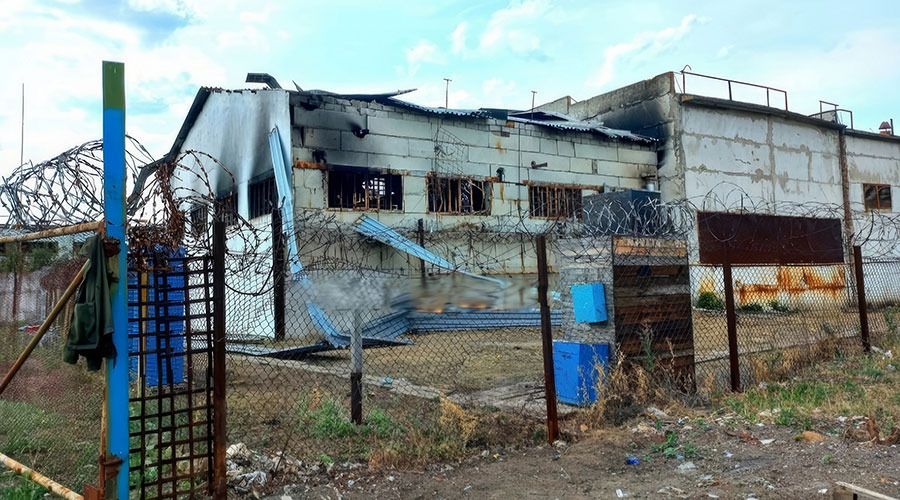
The building of the correctional colony in Olenivka where Ukrainian prisoners of war were held after the explosion Photo: Wikipedia / Wlados1991 / CC BY-SA 4.0
Despite public promises to admit international organizations, Russia has not provided independent observers access to the crime scene or the opportunity to communicate with surviving prisoners. The International Committee of the Red Cross (ICRC), which guaranteed the safety of Azov fighters upon their surrender and registered their status, received neither an invitation nor a response to a visit request to Olenivka. By October 2022, no neutral organization had been allowed on the colony’s territory or to the surviving prisoners. Moreover, Russian authorities have never published a complete official list of the dead and wounded nor individually notified the families of the deceased. Relatives of the inmates remained in the dark for months, some hoping their loved ones were alive until DNA analysis identified the remains. This information blockade deepens suspicions that Moscow sought to hide the truth about what happened and minimize evidence leaks.
Journalistic investigations and UN data have established that the version of a “Ukrainian shelling” was false, and the explosion was very likely orchestrated by Russian forces themselves. Despite this, Russian authorities continue to deny responsibility and refuse to cooperate with investigators.
Relatives of the deceased and surviving comrades-in-arms continue to fight to establish the truth. However, the prospects for justice remain unclear. No international tribunals have been established for Olenivka, and all collected evidence remains part of broader investigations into Russia’s war crimes in Ukraine. Ukrainian investigators promise to bring the case to court – if not now, then after the war.
Sources and Evidence
Associated Press (AP News) – Investigative article by Hanna Arhirova (July 2024) with interviews of survivors, internal UN analysis data, and details of the Olenivka staging. AP established that all evidence points to a planned Russian operation, and the HIMARS strike version is untenable.
Radio Free Europe/Radio Liberty (RFE/RL) – Anniversary article (July 29, 2023) with accounts from families of the deceased and RFE/RL Russian Service news about the death of former colony head Sergey Yevsyukov (December 2024). RFE/RL cites confirmations from UN experts rejecting the HIMARS version and information on accusations against Yevsyukov for torturing prisoners.
Report of the UN High Commissioner for Human Rights – March 2023 report on the treatment of prisoners of war in Ukraine, including conclusions on Olenivka. The report lists suspicious guard actions (removal of sentries, digging trenches, “Grad” salvo masking) and concludes Russia’s responsibility. Officially, the UN stated that the nature of the damage does not correspond to a HIMARS missile strike but rather indicates an explosive device detonated from the eastern side (controlled by Russia).
Wikipedia – “Olenivka prison massacre” – A summary overview of events with links to primary sources and investigations. It mentions CNN data (damage analysis excluding the HIMARS version), InformNapalm investigation (hypothesis of a “Shmel” thermobaric charge), SBU intercepts and accusations against Wagner Group, as well as the Russian authorities’ reaction (controversial tweet from the Russian embassy about execution by hanging).
Media Initiative for Human Rights (MIHR) – Ukrainian human rights outlet that conducted its own investigation. In July 2023, MIHR published a chronology of events in Olenivka with detailed survivor testimonies. The report confirms that the explosions were heterogeneous (first outside, subsequent inside the barracks) and describes the absence of medical aid to prisoners for six hours after the blast. MIHR, together with ZMINA, revealed the names of the suspected organizers of the massacre in 2025.
If you enjoyed this article, consider making a donation — one-time or, even better, monthly. Your support helps us motivate our authors and become better with every article.
Our organization is recognized by the Internal Revenue Service (IRS) as a 501(c)(3) tax-exempt, charitable organization, which means that all contributions made to us are tax-deductible to the fullest extent permitted by U.S. law. Individuals may generally deduct charitable contributions of up to 60% of their Adjusted Gross Income (AGI) for cash donations made to qualifying 501(c)(3) organizations. For donations of appreciated assets (such as stocks or other long-term capital assets), the deduction is typically limited to 30% of AGI, based on the fair market value of the asset. C-corporations may deduct charitable contributions of up to 10% of their taxable income for donations made to eligible charitable organizations.
By submitting a donation, you confirm that you have read and accept the following documents: Privacy Policy and User Agreement, and also give consent to the processing of your personal data.
If you would like to unsubscribe from a monthly donation, please email us at: [email protected]