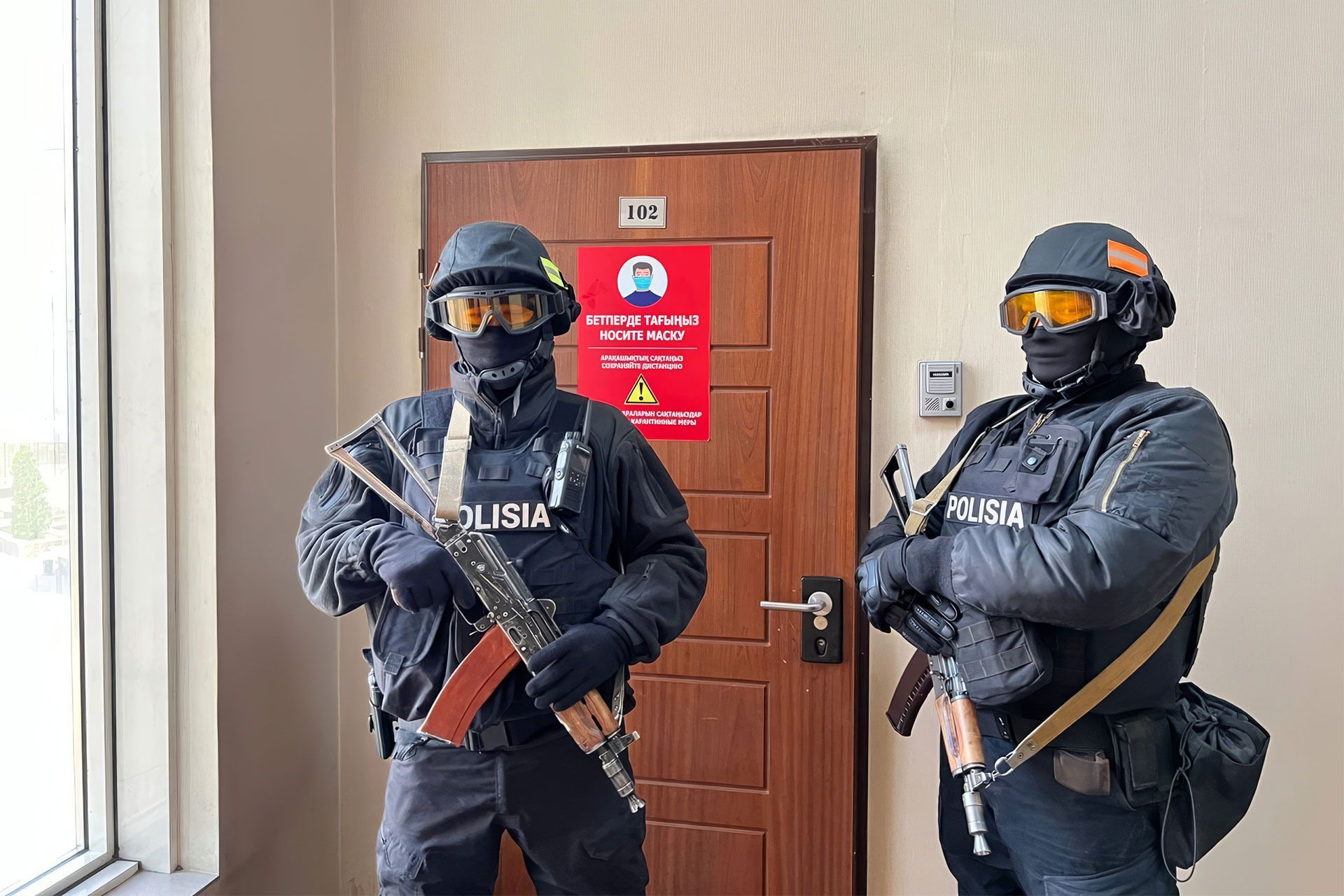
A “mask show” took place at the editorial office of Kazakhstan's largest independent media outlet, Orda.kz—just like in Russia in the 2000s. Let's figure out what happened: was it a private case of a “business conflict,” or a systematic attack on freedom of speech?
Photo: ORDA via Telegram
On the first day of winter, Kazakhstan became the center of a major news story for the entire post-Soviet space. In Almaty, security forces came with search warrants to the editorial office of the Orda.kz project and to the apartment of its head, Gulnara Bazhkenova. Soon, the country's media reported that several criminal cases had been opened against the journalist. In the evening, it became known that Bazhkenova was placed under house arrest for two months.
The Almaty police did not deny that the arrest was connected to the detainee’s professional activities. “Preliminary findings show that one of the 2024 publications spread knowingly false information about the alleged arrest of a law enforcement officer for taking a bribe. In fact, it was reliably established that this did not happen.” — said the authorities. They also hinted that other similar episodes from previous years might come to light, when Orda.kz and its chief published false information.
In addition to Bazhkenova, on December 1, the editor-in-chief Dmitry Kim and several other staff were detained; eventually, they were released without charges. Those employees who were at their desks in the morning were held for several hours—lawyers were not allowed in, and they were not allowed to use the restroom. Documents, office equipment, and cash were confiscated from the newsroom. By Kazakh standards, such actions against an independent media outlet—even considering all the scandals in recent years involving Orda.kz and its chief—appear harsh. What’s really behind this case?
Orda and Akorda
For most Russians, the word “orda” (horde) carries strictly negative connotations and is associated with hordes of enemies. In Kazakhstan, it’s the opposite: orda is one of the most important concepts in local history and culture. Depending on the context, it can mean a khan's headquarters, an alliance of tribes, a majestic palace, or the state itself. By the way, contrary to a common Russian stereotype, the Kazakhs had their own statehood long before the USSR—in distant 1465, earlier than Moscow subordinated Tver, Pskov, and Novgorod.
In modern Kazakhstan, it’s easy to find many “ordas.” Ordabasy (“Main Orda”) is a historical and cultural reserve in the south and also a football club from nearby Shymkent. Kyzylorda (“Red Orda”) is another important southern city, the administrative center of the Kazakh ASSR in the 1920s. Or Akorda (“White Orda”) is the president’s residence in today’s capital, Astana. Finally, in September 2020, the same name was chosen by a new media outlet led by one of Kazakhstan’s most famous journalists, Gulnara (Gulshat) Bazhkenova.
In five years of operation, Orda.kz has become one of the most widely read Kazakhstani media outlets, both in the country and abroad. Bazhkenova has often been invited as a Kazakhstan expert by Russian emigrant media like “Dozhd.” It’s also telling that in May 2024, she was among a group of Central Asian journalists who interviewed President Volodymyr Zelensky in Kharkiv, Ukraine, in Russian.
At the same time, Orda.kz has earned itself a reputation as bright as it is controversial. The outlet and its chief have often been accused of both plagiarism and publishing unverified information.
In November 2023, the first narrative turned into a court case. Kazakh journalist Dmitry Shishkin accused Orda.kz of copying material from his Telegram channel; Bazhkenova sued him but lost. In July 2024, the judges rejected her claim and ordered her to pay 200,000 tenge (about $425 at the time).
The second line was much more complicated. Only in 2025, Orda.kz was twice involved in conflicts, publishing information that was later denied by the state or loyal media. In May, this happened with the false death of Sara Alpysovna, wife of the first president Nursultan Nazarbayev, and in September—with the alleged simultaneous arrest of Foreign Minister Murat Nurtleu and major businessman Gadji Gadzhiev (though the prediction partly came true—the minister was soon dismissed). Many in Kazakhstan believe it was then that Gulnara Bazhkenova crossed invisible red lines in her uneasy relationship with the authorities.
Founders’ Confrontation
The journalist herself has a different view. According to Bazhkenova, pressure on her media began back in the summer of 2024, when Orda.kz showed too much interest in a very special topic—the mysterious murder in Kyiv of Kazakh oppositionist Aidos Sadykov. And things only got worse when, a year later, the outlet tried to link the Kyiv incident to an equally mysterious suicide—in Astana—of a security officer.
Gulnara Bazhkenova managed to talk about this and much more just days before her arrest on the YouTube channel Elmedia. In particular, she admitted that Orda.kz originally had a dual nature. The outlet always strove for editorial freedom but for most of its history was financially dependent on one of Kazakhstan’s system-forming banks. The contradiction led to conflicts: she was allegedly constantly pressured, asked to block negative stories, join the quasi-state media bloc, and more. According to Bazhkenova, she managed to leave the toxic partnership for a while, but former partners eventually launched a hostile takeover through Orda.kz co-founder Maksat Ganiyev, who was connected to the bankers.
Ganiyev himself later appeared on the same Elmedia broadcast—a kind of remote debate. He interpreted much of what his opponent said in a completely different way. First of all, Ganiyev stated that he had nothing to do with the mentioned bank and was just an honest businessman. Previously, he was in the security and real estate business, and in COVID-hit 2020 decided to diversify his assets by launching a new media outlet, hoping advertising revenue would recoup the investment. But the plan failed due to Bazhkenova’s financial unreliability as executive director and numerous scandals involving the outlet. So Ganiyev wanted to reclaim the asset—to correct the mistakes.
Moreover, the businessman insisted that he was not a “co-” but the sole founder of the media outlet. He backed up his words with documents from egov.kz (Kazakhstan’s analogue of “Gosuslugi”). Interestingly, Bazhkenova, in her part of the broadcast, warned viewers about this, explaining that the necessary files had been backdated. Ganiyev, in turn, asked the audience to take this argument with humor—as with much of what the editor-in-chief Orda.kz said. Finally, the businessman (somewhat illogically) accused the journalist of buying premium real estate in Almaty with other people’s money and at the same time preparing to flee to the USA.
It’s worth noting that the two speakers contrasted sharply not only in content but also in tone.
Bazhkenova’s rambling, nervous speech was nothing like Ganiyev’s calm, ironic answers. All the more interesting, then, that most commenters on Elmedia sided with the journalist, not the businessman. Many clarified: they were not fans of either Orda.kz or the editor-in-chief’s personal style. It’s just that in this case, they trusted Bazhkenova more.
Wrong Place, Wrong Time
Another notable thing: among other accusations, Ganiyev reproached his opponent for being insincere. He claimed that now she plays the victim of the regime, but before she actively used her connections among powerful people. Otherwise, how to explain that Bazhkenova was allowed both sharp publications and “insider” leaks from above, and in 2022 was even permitted to hold a whole legal protest rally? It’s hard not to feel this is a hint: that the chief of Orda.kz once had her own “orda” near Akorda, but then it fell apart—because of the journalist's own missteps.
Perhaps this refers to Gulnara Bazhkenova’s October trip to Warsaw. There, in her characteristic peremptory style, she spoke at an OSCE conference. In the Polish capital, the media founder told foreigners about many things: demands that she transfer 70% of Orda.kz to outsiders, hostile takeover schemes, and, in general, about human rights problems in Kazakhstan. Was she not forgiven for airing dirty laundry? It’s possible.
For those familiar with Kazakhstan’s political scene, this feels like déjà vu. In autumn 2025, something similar happened with the law banning “LGBT propaganda.” The bill had been lying dormant in the Mazhilis (lower house of parliament) for a year and a half, until feminist activist Zhanar Sekerbayeva in Lithuania criticized homophobia among her compatriots. Right after her speech, MPs passed the long-stalled law—in just over a month.
A working hypothesis arises: Akorda is willing to tolerate dissenting voices—with caveats—but only as long as they don’t speak out in foreign capitals.
In this context, it’s worth recalling the words of Kazakh human rights activist Galym Ageleuov: the country is entering an electoral cycle, and in a very unstable foreign policy environment. In just over two years, citizens will elect a new Mazhilis, and a year later—a new head of state. So the authorities’ desire to neutralize potential troublemakers in the information space is understandable. Especially if there are real violations of the law behind them.
However, none of this justifies yesterday’s “mask show” at the Orda.kz newsroom, which itself violates legal norms and sets a dangerous precedent. Notably, Kazakhstan’s journalistic community—including both pro-government media and Bazhkenova’s long-time opponents—in today’s statement cautiously stood up for their colleagues. There is still hope that the crisis around this popular media outlet, both in Kazakhstan and abroad, will be resolved differently than has become the norm in Russia.
If you enjoyed this article, consider making a donation — one-time or, even better, monthly. Your support helps us motivate our authors and become better with every article.
Our organization is recognized by the Internal Revenue Service (IRS) as a 501(c)(3) tax-exempt, charitable organization, which means that all contributions made to us are tax-deductible to the fullest extent permitted by U.S. law. Individuals may generally deduct charitable contributions of up to 60% of their Adjusted Gross Income (AGI) for cash donations made to qualifying 501(c)(3) organizations. For donations of appreciated assets (such as stocks or other long-term capital assets), the deduction is typically limited to 30% of AGI, based on the fair market value of the asset. C-corporations may deduct charitable contributions of up to 10% of their taxable income for donations made to eligible charitable organizations.
By submitting a donation, you confirm that you have read and accept the following documents: Privacy Policy and User Agreement, and also give consent to the processing of your personal data.
If you would like to unsubscribe from a monthly donation, please email us at: [email protected]