The verdict for former French President Nicolas Sarkozy was announced at the end of September in a Paris court and naturally sparked a storm of emotions and commentary. For the first time in history, a French president has been found so guilty that, according to the court, he deserved a punishment of imprisonment without the possibility of reduction to a suspended sentence or application of other leniency measures.
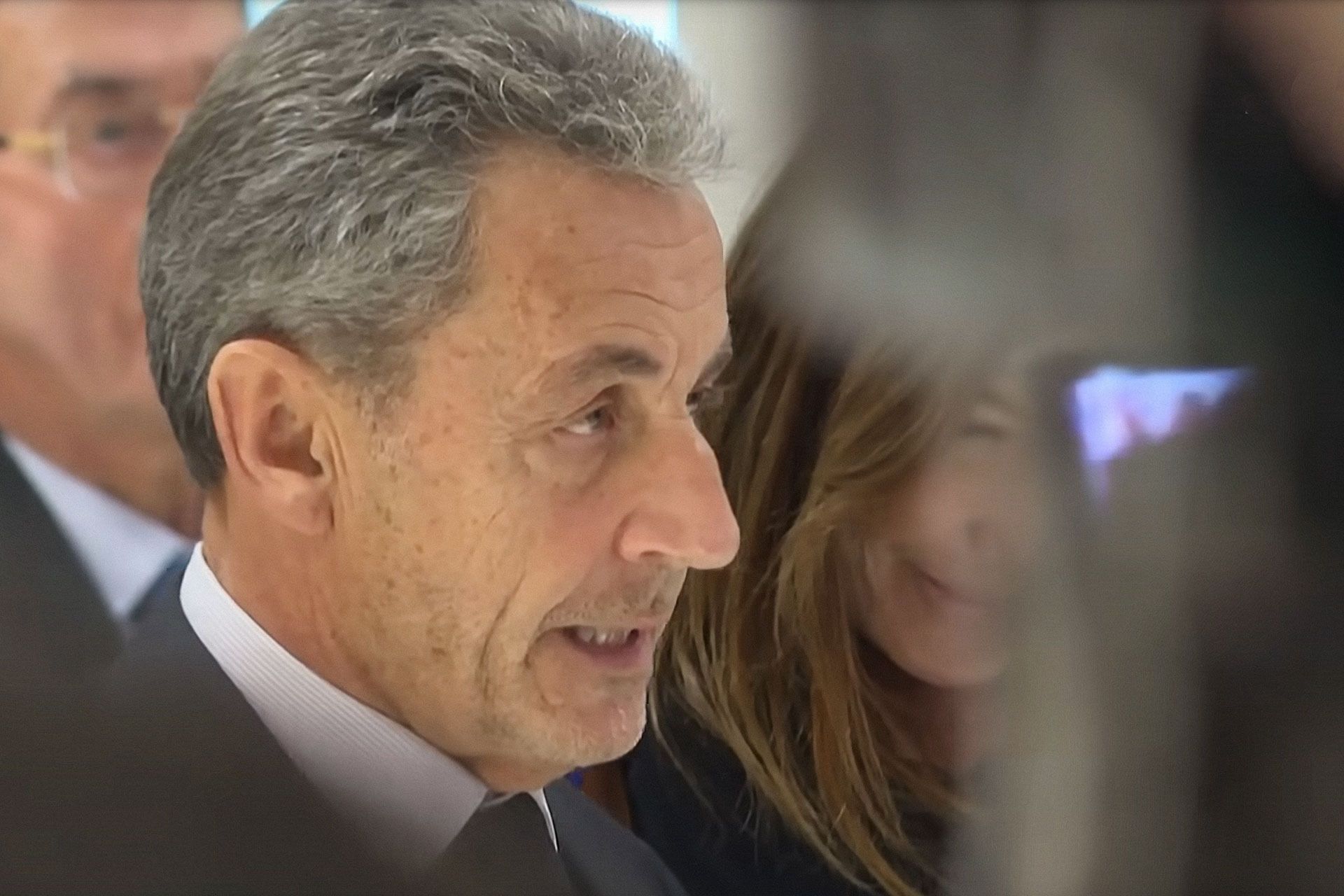
Nicolas Sarkozy speaks to journalists in the courthouse after the verdict announcement. Photo: Le Parisien / YouTube
Very soon, on October 13, Sarkozy must appear at the prosecutor’s office to agree on the date of his imprisonment, and he has no more than four months from that visit to settle all his affairs while free and go behind bars. Filing an appeal with a higher court does not change anything, as the court ruled the verdict to come into immediate effect regardless of whether it will be contested or not. Such a measure is widely used in French legal practice and was not invented specifically for Sarkozy, although it sparks debates that have intensified recently. Indeed, there is some contradiction in a situation where the accused contests the court’s decision at the Court of Cassation and, thus, seemingly remains innocent according to the well-known presumption, yet the punishment is already applied. Marine Le Pen faced a similar situation, where her judicial ban on running in elections also came into force before the outcome of the appeal.
However, these features of French justice, very important for the parties involved, should not overshadow the essence of the matter, according to which the court found proven only one count of the charges: participation in a “criminal conspiracy.” This concerns the old story of Sarkozy’s strange relations with the Libyan regime of Gaddafi, starting from 2005, allegedly not altruistic. Other prosecution claims, such as “passive corruption,” “illegal financing of the election campaign,” and “concealment of abuses in the use of Libyan budget funds,” were not confirmed. However, the criminal intent and preparation for its execution are sufficient on their own for a conviction under French law, even if the prosecution failed to prove in court the realization of the sinister plans. If Sarkozy and his associates indeed devised schemes for illegally obtaining money from Gaddafi for the election campaign or other purposes, the crime lies in these intentions alone.
Thus, to briefly summarize the trial, according to media sources, the fact of negotiations by the “criminal conspiracy” with the Libyan regime can be considered proven, but tracing the entire chain of financial transactions from Gaddafi to Sarkozy was not possible.
Political career on the edge of risk
Nicolas Sarkozy won the 2007 presidential election by uniting moderately right-wing forces around himself and winning over voters with his bright charisma and energetic style of communication. The French wanted a renewal of the political elite, refusing to entrust the country's leadership to seasoned veterans of traditional parties. It seemed that the young and assertive president would confidently lead France into the global and rapidly changing world of the 21st century.
All the more surprising was the swift end to this promising career when Sarkozy lost the 2012 election to the unremarkable François Hollande and permanently left the political stage despite desperate attempts to return. Afterwards, he only lost, including in his party’s primaries, signaling strong rejection even among his own supporters.
Gradually, Sarkozy acquired a new stable image as a man of the past, albeit one who retained some influence and offers Macron advice over lunch.
At the same time, a slow series of legal proceedings was launched, whose prospects did not look encouraging for the retired president.
The history of the Fifth Republic counts only two presidents who have convictions against them. The first was Jacques Chirac, sentenced in 2011 to two years suspended imprisonment in the case of fictitious jobs in the Paris city hall during the period when he was not yet president. However, at the time of the trial, Chirac was very ill and unable to physically participate, making harsher sanctions impossible both for his health and the case’s substance.
Then came Nicolas Sarkozy’s turn. First, in 2020, there was the Bismuth case trial. Sarkozy was sentenced to three years in prison (two suspended) for corruption and influence peddling, but the prison sentence was replaced with wearing an electronic bracelet. The appeals court upheld the first court’s decision, so this case is closed.
Then in 2021 came the Bygmalion case trial concerning illegal financing of the 2012 campaign, resulting in a one-year prison sentence, again replaced by an electronic bracelet. The appeals court somewhat softened the sentence to one and a half years suspended, but the conviction remained.
Thus, at the last trial over the illegal receipt of Libyan money, Nicolas Sarkozy appeared as a repeat offender, already carrying two convictions behind him, relatively mild, which allowed him to avoid imprisonment but seriously damaged his reputation.
As in previous cases, he maintained his innocence and spoke of political persecution. This time the court’s decision was very harsh, but upon leaving the courtroom, Sarkozy told journalists he would go to prison “with his head held high.“
The case of illegal Libyan financing
In March 2012, Mediapart published a document allegedly signed by the former head of Gaddafi’s intelligence services, mentioning financing of Sarkozy’s 2007 presidential campaign to the tune of 50 million euros. Sarkozy’s lawyers always denied its authenticity, while Mediapart journalists insisted on it. Nevertheless, following these publications and statements from Gaddafi’s son and some high-ranking regime officials, the French judiciary began an investigation in 2013 that led to the unfortunate court decision for Sarkozy.
Nicolas Sarkozy speaks to journalists in the courthouse after the verdict announcement. Photo: Le Parisien / YouTube
This story was always surrounded by many rumors, conflicting statements, and fluctuating witness testimonies, but it is important to emphasize that the court primarily relied on the correspondence between Sarkozy and his associates and documents whose authenticity was unquestioned. Thus, revelations from the circle of the deposed Libyan dictator were taken into account but did not form the basis of the charges. Nevertheless, some information arising during the investigation and trial deserves mention as it helps understand how Nicolas Sarkozy conducted his affairs.
Noteworthy is the figure of Ziad Takieddine, one of the most astonishing witnesses who was not present at the trial because he died in Beirut two days after it began. However, he would not have been able to come to Paris anyway, as he was hiding in Lebanon from French investigators’ questions about his many other dubious dealings. Essentially, he was an international swindler involved in various scandals.
He claimed to have personally taken in Libya in 2006 three suitcases with 50 million euros in cash and handed them over in France to Claude Guéant, one of Sarkozy’s most trusted aides. Later, he withdrew these statements. Both Sarkozy and Guéant vehemently denied Takieddine’s testimony, claiming that such a person was not credible. But whether or not the suitcases existed, the fact of acquaintance and dealings between Guéant and Takieddine, including meetings in Libya, is indisputable.
It is also necessary to mention the remarkable relationship between Sarkozy and Gaddafi. It is important to note that the Libyan dictator’s regime was under international sanctions due to the Lockerbie case starting in 2000, and after acknowledging responsibility in 2003, it sought all possible ways to restore its former reputation.
It can be assumed that here the interests of Sarkozy, who needed money, and Gaddafi, who sought an influential lobbyist in the West, coincided.
However, there is also a history of official interstate contacts between France and Libya in the 21st century. It began with a six-day visit by the Libyan dictator to Paris in December 2007, when, at the guest’s request, a Bedouin tent was set up in the city center to the horror of Parisians — and ended with the 2011 military intervention involving French special forces, during which Gaddafi was killed.
It is obvious that for some reason Sarkozy spent a lot of energy and personal charm first building an alliance with the dictator’s regime, which for some reason seemed promising to him, and then for its elimination. Meanwhile, the whole combination of the Bedouin tent in Paris, the military overthrow of Gaddafi, numerous testimonies about Libyan money, and the corresponding court decision cannot be refuted by a mere declaration of innocence.
What is wrong with Sarkozy’s defense line
It is obvious that any influential politician, active or retired, can always declare legal proceedings against them as political persecution, which Sarkozy certainly did. Nevertheless, looking at the substance of the three cases with convictions, regardless of the assessment of evidence and trust in French justice, there is an impression that the former president is very prone to shady dealings.
It’s hard to say why – perhaps some stylistic personality traits. But questions about financing his election campaigns keep arising.
Finally, a character like Ziad Takieddine should not have been anywhere near the president of the Fifth Republic simply by the criteria of basic discernment.
Can one say, based on the results of the latest trial and previous ones, that this is a degradation of France’s political elite? To answer, it is appropriate to compare the biographies of Sarkozy and his successful opponent in the 2012 election, François Hollande. Both failed to be re-elected for a second presidential term and were extremely unpopular among the French. Nevertheless, whatever one thinks of Hollande’s presidency, no scandals are linked to his name, except for a few risky love affairs. But there was no evidence of financial abuse, no shady dealings with dictatorial regimes, no revelations from international swindlers.Still, legal claims against politicians do not arise out of nowhere.
Nicolas Sarkozy has every chance to occupy a unique place among the presidents of the Fifth Republic as the champion of convictions — and it is unlikely this flamboyant man expected to end his political career this way.
If you enjoyed this article, consider making a donation — one-time or, even better, monthly. Your support helps us motivate our authors and become better with every article.
Our organization is recognized by the Internal Revenue Service (IRS) as a 501(c)(3) tax-exempt, charitable organization, which means that all contributions made to us are tax-deductible to the fullest extent permitted by U.S. law. Individuals may generally deduct charitable contributions of up to 60% of their Adjusted Gross Income (AGI) for cash donations made to qualifying 501(c)(3) organizations. For donations of appreciated assets (such as stocks or other long-term capital assets), the deduction is typically limited to 30% of AGI, based on the fair market value of the asset. C-corporations may deduct charitable contributions of up to 10% of their taxable income for donations made to eligible charitable organizations.
By submitting a donation, you confirm that you have read and accept the following documents: Privacy Policy and User Agreement, and also give consent to the processing of your personal data.
If you would like to unsubscribe from a monthly donation, please email us at: [email protected]