Last week, during the Eastern Economic Forum, acknowledged problems with the slowdown of the Russian economy but added that victory over inflation is more important – supposedly, it's better for the people. However, the issue is not the welfare of the citizens. The continuation of the war requires increased spending on it. And here, strict monetary policy is unavoidable. This will result in the labor of the majority of Russian citizens becoming cheaper.
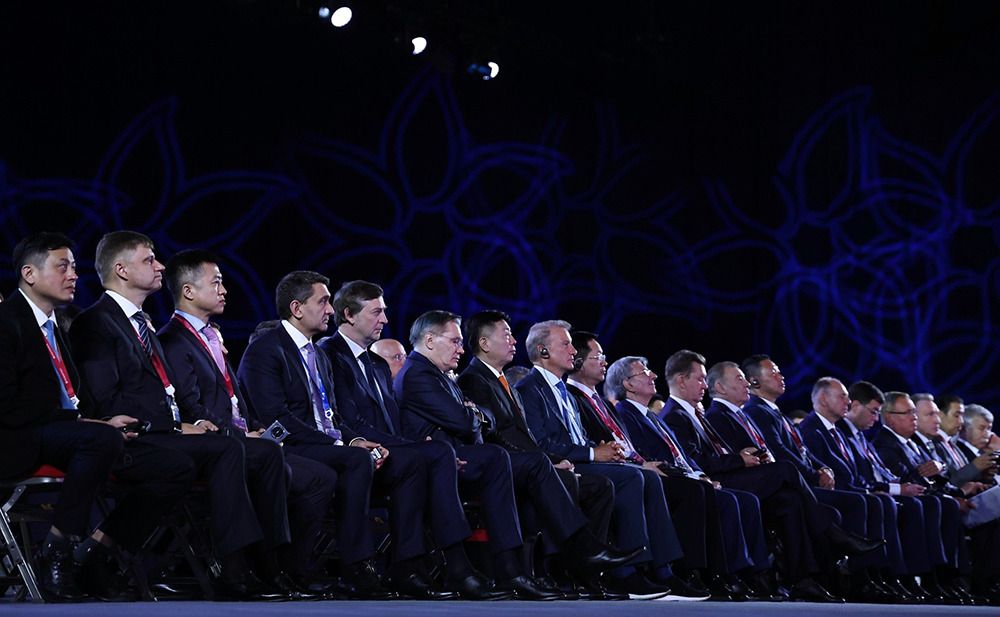
Plenary session of the 10th Eastern Economic Forum. Photo: kremlin.ru
Before the start of the Eastern Economic Forum, reports came one after another that a recession had begun in Russia – at least a technical one, when GDP falls for two consecutive months. This was stated by VEB’s chief economist Andrey Klepach – who just a couple of months ago promised there would be no recession in Russia. The Minister of Economic Development, Maxim Reshetnikov, no later than two weeks after Klepach’s promise, declared that the economy is on the verge of recession – and his department’s release “On the current situation in the Russian economy” based on July data recorded a serious economic slowdown. The subsequent macroeconomic forecast by CEMAC until 2028 noted stagnation (GDP growth of 1-2%) for the entire period – and in their analytical note, they predicted that recession next year is inevitable, even if the Central Bank lowers the key rate. The climax was the speech of Sberbank’s head Herman Gref at the EEF, where he confirmed Klepach’s assessment: Russia has entered a technical recession.
After such assessments, it was logical to expect at least a hint of an imminent easing of the Central Bank’s monetary policy. Especially since recently, at a meeting with Nizhny Novgorod Governor Gleb Nikitin, Putin reassured him about a rate cut. And suddenly, during a small talk with the host before his speech at the Eastern Economic Forum, Putin said literally the following:
“You mentioned prices. Price growth is basically inflation. The Central Bank is fighting this inflation and trying to return to known and necessary indicators, no more than 4-5 percent. But this is linked to a high key rate, which raises questions among those engaged in real production, and surely many here in the hall will say: yes, this is an outrage, it's impossible, the key rate must be sharply lowered. But then prices will rise.”
Before the plenary session of the 10th Eastern Economic Forum. Photo: kremlin.ru
He concluded: “In general, the only thing I can say is that I want to assure you that the Russian financial authorities, the Government of the Russian Federation, and the Central Bank are acting professionally.” Too bad the operator didn’t show Gref’s face at that moment – it would have been interesting to see.
Overall, one could almost tear up at such concern for citizens’ wallets – if not for a few “buts.”
An unprecedented generosity show
In his official speech, the text of which, unlike Putin’s answers to the moderator’s questions, was written by speechwriters and approved by several instances, Putin promised many pleasant perks to the Far East – from business benefits to expanded Far Eastern mortgages (2% per annum!) on secondary housing where there are no new buildings. And overall, he was very generous with promises to finance various national projects. And this somehow doesn’t quite match the Central Bank’s praise for strict monetary policy. Funding all kinds of projects, preferences, benefits – all this means pumping money into the economy. More money means higher inflation, it’s a law. Meanwhile, even under the current strict monetary policy, the money supply (M2 aggregate) has been growing recently at a rate of up to 20% per year. That’s a lot.
How can such contradictory statements be reconciled? On one hand, yes, the economy is “going into a stall,” on the other, the Central Bank is rightly “tightening,” and on the third, generous advances? There is no contradiction if you understand that economic policy is currently changing.
From the very beginning of the war, the Central Bank’s policy, followed by the entire economic policy, was subordinated to survival. And, as Nabiullina put it back in 2022, to the “structural transformation” of the economy.
Experts long speculated what the Russian economy would transform into – Iran, North Korea, Turkey, or Venezuela. Over time, it became clear it is transforming into a Stalin-type “industrialization” – of course, with adjustments for current conditions.
Nevertheless, this was unlikely the original plan. At first, during the confident times of “Kyiv in three days,” at most two weeks, but definitely by March 8 and ironclad by autumn, all economic policy was based on the principle “stand the day and hold the night.” The idea was: yes, sanctions, restrictions, foreigners are leaving – but where will they go? We will win – they will recognize “the realities on the ground,” and if sanctions are not lifted, they will gradually treat them carelessly, as in 2014 after the Crimea occupation. By 2023, when it was obvious this was not a quick raid but a full-fledged war, thanks to “military Keynesianism,” there was hope that the military economy, like the raw materials economy once, would lift all other sectors – like a tide lifting all boats.
But already in the second half of 2024, it became clear that “military Keynesianism” is a short-term thing. The economy began to noticeably slow down – while the war demanded more and more money.
Then the first shift happened – it was decided to tighten belts and literally outlast Ukrainian stubbornness. The idea was: while the fat one dries up, the thin one will die, where are Ukrainian resources against Russia, Biden is leaving, and Trump is ours, Europeans are only capable of loud statements. But Ukrainian resources did not run out, Trump did not stop the war on terms favorable to Putin, and Europeans showed unexpected stubbornness. But the Russian economy turned out to be resilient, though that resilience has limits. And those limits became clearly visible.
Everything for the front
During “military Keynesianism,” the state stimulated demand – hence the stories about families of contract soldiers suddenly getting rich from war payments, and the irritation with Muscovites living their pre-war lives with café visits, street gatherings, and attending premieres. According to calculations by investment banker Evgeny Kogan, the fiscal impulse amounted to 1.0% of GDP in 2023 and another 0.9% in 2024, while the credit impulse reached 5% of GDP. But everything comes to an end. When direct war expenses alone make up 40% – and by some estimates have already exceeded 50% – oil and gas revenues are falling, and increasing the profit tax rate only led to a decrease in tax collection, sacrifices have to be made. Either military spending has to be cut – or feeding the population so that it forgets about the war must stop. Of course, the exact choice will only be clear after at least a preliminary budget draft for next year appears. But judging by recent statements and, most importantly, Putin’s actions, the choice was not made in favor of “dad fighting less.” Which means belts will have to be tightened.
Plenary session of the 10th Eastern Economic Forum. Photo: kremlin.ru
How does Putin’s expressed concern about store prices fit with this? It doesn’t, because it’s not about caring for prices at all. Even the Central Bank in its monetary policy scenarios has stopped aiming for 4% inflation – next year’s forecast is 6-7%. That’s overall inflation, meaning consumer inflation will be higher, possibly double digits. Maintaining strict monetary policy – and now there is little doubt the Central Bank will lower rates very sparingly and slowly – means the following.
First,the final shift of the civilian sector into decline. It already feels unhealthy: a third of enterprises overall are unprofitable, and if you look purely at civilian businesses, only the services and catering sector still feel somewhat okay. It’s simple: strict monetary policy and expensive loans apply to them, the civilian sector and population. For the defense industry and those fulfilling state orders – preferential loans, advance financing up to 80% of the contract, and other perks. Moreover, government spending on national projects or promised perks to the Far East may start being funded very slowly – if there’s again not enough money for the war. So no illusions here.
This leads to secondly – a sharp decline in the civilian sector’s attractiveness as an employer. It’s not just that businesses won’t be able to raise salaries – they won’t even be able to pay properly. So soon people will face a choice: take low-paid, unstable jobs in the private civilian sector; low-paid but stable jobs in the public sector; or high-paid, stable jobs in the defense industry and related fields. And this will not be a bug but a feature of strict monetary policy. Just as Stalin and his government made peasants’ lives unbearable, pushing them to build factories and then work in those war-focused factories, so the Russian government, following Putin’s doctrine of eternal war, will drive people from peaceful private business to the same military factories.
Third, ordinary citizens working for the war effort will not be allowed to get rich either. Real wages will decrease everywhere: due to ruble devaluation, inflation, increased tax and non-tax burdens (many have noticed how many fines must now be paid), growth in utilities tariffs, and more. Also, many educational, medical, and other services will be “pushed” into the paid private sector – now you understand where the reduction of English lessons to 2 hours a week and the ban on abortions in state clinics come from? The most demanded services!
It’s a macroeconomic law: when there is no possibility of attracting capital (financial, equipment, technology, etc.) to increase efficiency and production growth, labor must be made cheaper. And the government will now start making Russian citizens’ labor cheaper by all means.
Unevenly, so that some go to contract service, some to factories, and wherever else is needed for the continuation of the war. Gradually, with explanations that real Russians are harmed by exotic fruits or that chocolate will soon become as much a luxury as caviar. After all, Putin said at the same EEF: “Money is important, but not the most important thing.”
Previous leaders spoke about improving the Soviet person’s welfare both during Stalin’s industrialization and during the shortage of goods at the end of the USSR. Nothing prevents the current authorities from doing the same. Especially since, as the Brezhnev-era joke goes, “we all know this man” – and today we know these people by name, face, and even the size of their wealth. But what won’t be done for the great goal – to take three more destroyed Ukrainian villages.
If you enjoyed this article, consider making a donation — one-time or, even better, monthly. Your support helps us motivate our authors and become better with every article.
Our organization is recognized by the Internal Revenue Service (IRS) as a 501(c)(3) tax-exempt, charitable organization, which means that all contributions made to us are tax-deductible to the fullest extent permitted by U.S. law. Individuals may generally deduct charitable contributions of up to 60% of their Adjusted Gross Income (AGI) for cash donations made to qualifying 501(c)(3) organizations. For donations of appreciated assets (such as stocks or other long-term capital assets), the deduction is typically limited to 30% of AGI, based on the fair market value of the asset. C-corporations may deduct charitable contributions of up to 10% of their taxable income for donations made to eligible charitable organizations.
By submitting a donation, you confirm that you have read and accept the following documents: Privacy Policy and User Agreement, and also give consent to the processing of your personal data.
If you would like to unsubscribe from a monthly donation, please email us at: [email protected]