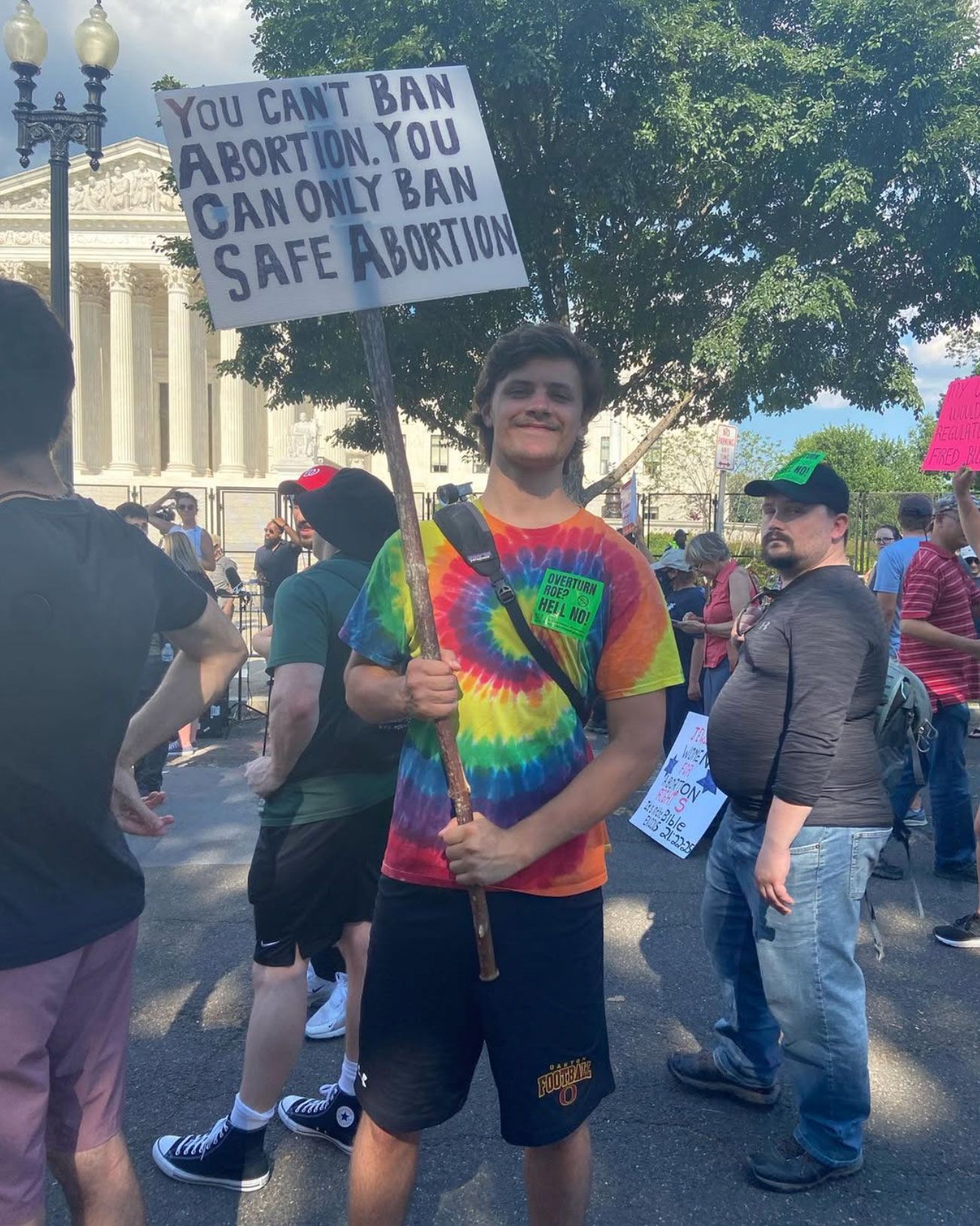
Let's put aside the “professionalism” of the Russian special services, who couldn't even identify a valuable asset and simply disposed of him in yet another offensive on the Ukrainian front. Nevertheless, this situation itself is quite telling. Of course, not every left-wing radical agrees to fight on Russia's side, but Michael Gloss's case as a whole illustrates rather problematic trends in Western society (and not only Western).
Journalists from “Important Stories” managed to trace Michael Gloss's life path almost up to his death. From what the press was able to find out, it seems that Michael was quite an unbalanced young man, and his views were a bizarre mix of radically leftist ideas, occult-religious worldview, and conspiracy theories.
He perceived death as a transition to the “next incarnation,” indicating his religion as “Islam” (which, it should be reminded, does not recognize reincarnation). Apparently, Michael did this out of solidarity with Palestine, whose flag was on his page on the Russian social network “VKontakte.” He invented Muslim names for himself, spent time at international gatherings of modern hippies, and dreamed of fighting the American military-industrial complex. No less than Palestine, the young man loved Russia, although the reasons for such love are not entirely clear. In any case, Michael Gloss, being a convinced pacifist concerned about environmental issues, signed a contract with the Russian Ministry of Defense and was sent to the “meat assault,” from which he never returned.
Let's put aside the “professionalism” of the Russian special services, who couldn't even identify a valuable asset and simply disposed of him in yet another offensive on the Ukrainian front. Nevertheless, this situation itself is quite telling. Of course, not every left-wing radical agrees to fight on Russia's side, but Michael Gloss's case as a whole illustrates rather problematic trends in Western, and not only Western, society.
It cannot be said that young people like Michael Gloss have no reasons to rebel. America has plenty of its own problems, including sharp wealth inequality, harsh business environment, abuse by law enforcement, especially against vulnerable groups, and quite serious corruption in its upper echelons—just recall the case of Jeffrey Epstein and similar ones. But Michael's way of responding to social injustice fits perfectly into a rather dangerous trend that can be defined as the cult of collective identity.
Photo: Instagram
In America, and consequently worldwide, the concept of the individual and their rights is increasingly dissolving. The rights of an individual are being replaced by the rights of some category of people, whether women, Black people, migrants, or transgender individuals. There is nothing wrong with helping vulnerable groups, but when individual identity is completely replaced by collective identity, people become convenient targets for any totalitarian regime.
What is the main problem with such identity? Firstly, its cult imposes on a person a certain way of perceiving themselves and others. Yes, of course, each of us has a certain gender, citizenship, skin color, sexual orientation, and other attributes. However, in a normal situation, a person has the right to decide for themselves what they value most in themselves and what they consider most important. I remember how, at the peak of the BLM movement, my Black acquaintances complained to me that they did not want to be perceived by their skin color again, as decades ago, even if this time it was in a positive connotation.
Of course, one should not think that the problem of collective identity belongs only to radical liberalism. It is even more pronounced in right-wing fundamentalism. The difference is that in totalitarian states, the substitution of the individual by the collective surprises no one, while for Western countries it symbolizes a serious crisis.
The second problem with this approach is assigning each identity certain characteristics, reactions, and views. We know this well from the concept of the “Russian world,” which basically asserts: if you were born in Russia or speak Russian, you simply must support the policies of the Russian authorities; otherwise, you are a traitor. Your behavior and views must be predetermined by your place of birth, and you have no right to change them, like a serf from the 19th century.
However, a similar tendency to link a specific identity to certain attributes is observed in the West as well. Attempts by some American school psychologists to impose hormone therapy on children whose behavior shows traits of another gender is not a progressive approach but follows a rather archaic, “domostroy” thesis that behavior must necessarily correspond to gender—although humanity seemingly abandoned this stereotype about a hundred years ago.
Even more dangerous is when certain nations or races are declared “oppressors” and “oppressed” a priori, and the individual simply dissolves into the mass. Their rights are not protected if they do not fall into the “oppressed” category. Their real views and specific situation are generally ignored if they contradict stereotypes. This coincides quite well with Michael Gloss's worldview, who, as his relatives note in the obituary, was ready to defend vulnerable people, animals, or streams.
It is quite telling that in this list, living people and inanimate nature stand side by side. Like many of his peers and compatriots, Michael believed that Palestine and Putin's Russia were among the “oppressed,” and this formal label was more important to him than the death of real people in Ukraine. Another motive for Michael, as he told his friends, was the desire to obtain a Russian passport and develop environmental projects with it. This is yet another extreme example of how the abstract idea of “protecting nature” turns out to be above human life.
Photo: Michael Gloss's VKontakte page
The second problem leads to the third, namely—all such categories and their attributes are very easy to manipulate. It is enough to convince a person that as a member of a particular group, they are supposed to have certain views, and those who belong to another group have specific characteristics. Somehow, in Gloss's mind, Palestine became linked with Putin's Russia (either on its own or with someone's help), and the war in Ukraine—with the embodiment of his environmental plans.
Yes, as already noted, Michael Gloss is an extreme case of this trend, but even more psychologically stable people fall for the trap of collective identities. By the way, the construct of “collective guilt” is just as artificial and unrealistic a phenomenon that helps criminals avoid real, personal guilt by hiding it behind passport color. In practice, the Kremlin employs various people from different countries, and it is precisely they who do not want to face very specific legal responsibility.
Collective constructs most often do not reflect reality, directing a person's positive or negative energy at an “unworthy object.” It seems humanity is now making a serious step backward, after which it will have to painfully return to the category of human rights, which not long ago seemed inviolable.
If you enjoyed this article, consider making a donation — one-time or, even better, monthly. Your support helps us motivate our authors and become better with every article.
Our organization is recognized by the Internal Revenue Service (IRS) as a 501(c)(3) tax-exempt, charitable organization, which means that all contributions made to us are tax-deductible to the fullest extent permitted by U.S. law. Individuals may generally deduct charitable contributions of up to 60% of their Adjusted Gross Income (AGI) for cash donations made to qualifying 501(c)(3) organizations. For donations of appreciated assets (such as stocks or other long-term capital assets), the deduction is typically limited to 30% of AGI, based on the fair market value of the asset. C-corporations may deduct charitable contributions of up to 10% of their taxable income for donations made to eligible charitable organizations.
By submitting a donation, you confirm that you have read and accept the following documents: Privacy Policy and User Agreement, and also give consent to the processing of your personal data.
If you would like to unsubscribe from a monthly donation, please email us at: [email protected]