In ancient times, it took the Jews forty years to mentally overcome slavery and enter the Promised Land. How long will it take us to overcome the Soviet past?
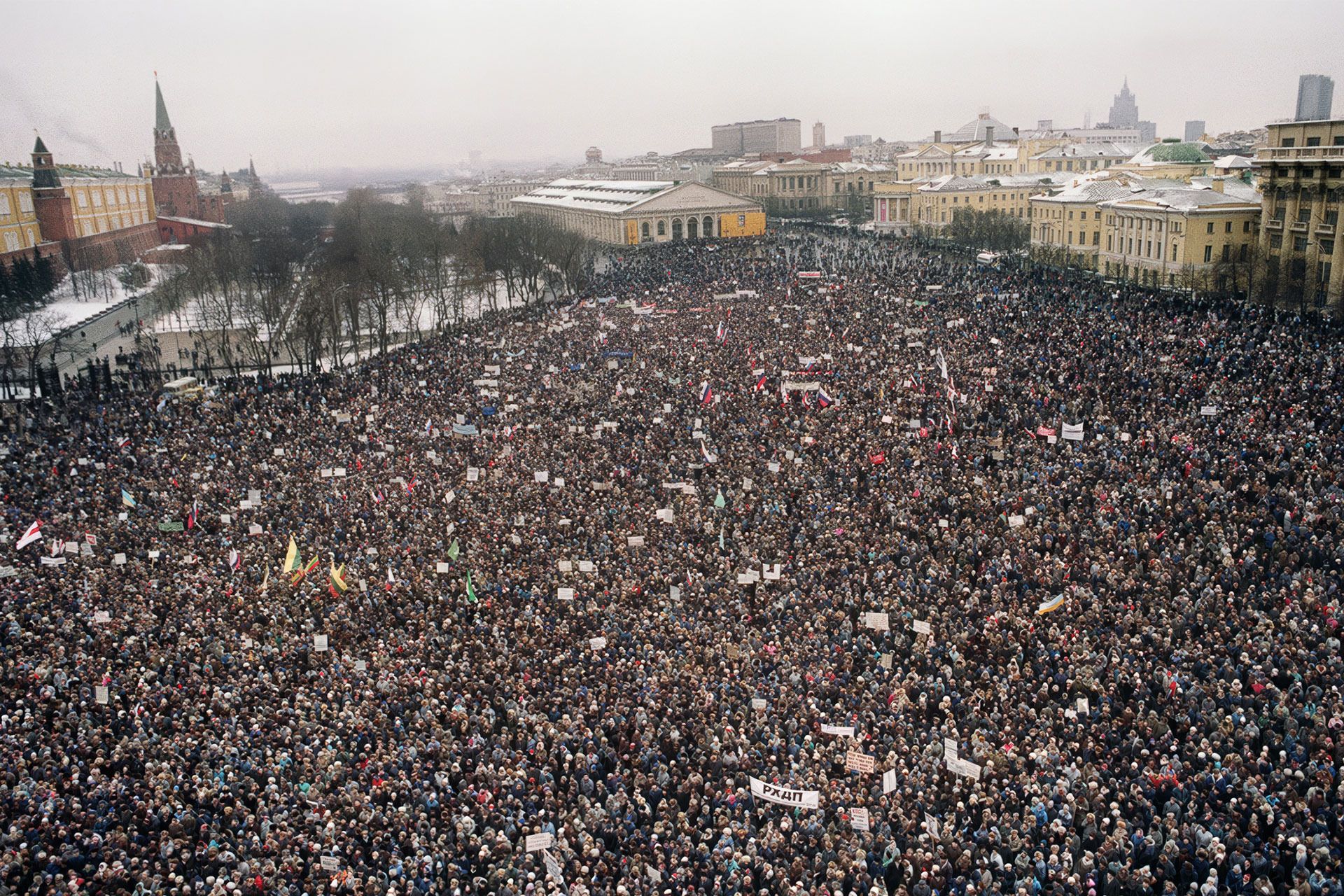
Rally at Manezhnaya Square against the use of military force by the Soviet army in Lithuania. Moscow, January 20, 1991. Photo: DR
Sometimes the post-Soviet era is discussed in terms of the Exodus of the Jews from Egypt. Some, like Metropolitan Anthony of Sourozh, as early as the 1990s predicted that the exit from the Soviet past would not be quick or easy; it would resemble the long journey of the biblical Moses with his people through the desert. Now, as it becomes increasingly clear that, in a strategic sense, the country has reached a dead end, it is even harder to disagree with such a comparison. How did it happen that instead of moving toward an open society, toward freedom, human rights, and international integration, we turned back to isolationism and stagnation, to old imperial patterns dominated by militarism?
Thoughtful people try to answer this question on different levels. Some look for the reasons for failure in the fact that the political reforms of the Yeltsin era failed, so democratic institutions did not function as they should. Some say that the people were not ready for freedom and therefore turned back and easily accepted new bondage. Some blame the West for not extending a helping hand and not supporting the formation of a free state at the very beginning, continuing to see an enemy and military competitor—and therefore not aiding reforms.
Probably, all these approaches have merit. Nevertheless, the exploration of the exodus mythologeme, highlighted in the title of this text, requires additional interpretive effort. In ancient times, it took the Jews forty years to mentally overcome slavery and enter the Promised Land. How long will it take us to overcome and comprehend the Soviet past? And what will this overcoming look like? As someone once said: “We can leave Egypt, but how do we get Egypt out of ourselves?”
But first, let us ask another question: why did the biblical Moses, along with most of the people, not enter the Promised Land?
There is an obvious answer. It is given in the biblical books of Numbers and Deuteronomy. According to Scripture, Moses and Aaron were punished for “not believing” God and striking the rock (rather than speaking to it) to bring forth water (Numbers 20:7-13). This happened in the fortieth year of wandering. The people sinned because, due to the “sin of the scouts,” they were afraid to conquer the land, even though it was God's will (Numbers 13:1-34). The “sin of the people” occurred thirty-eight years before the “sin of Moses.” It was after the scouts’ story that Israel set out on a thirty-eight-year journey through the wilderness.
However, Pinchas Polonsky, a contemporary Jewish commentator, says that there is another, hidden interpretation of these events. The reason Moses did not enter the Promised Land is different, and the story of the “waters of Meribah” is only a cover for the real reason. The real reason is that Moses, at the beginning of the Exodus, was a spiritual leader of an authoritarian type. He did not know how to communicate, but mostly commanded. His leadership was based on obedience, not dialogue, on miracles, not on thorough discussion of decisions made. This type of leadership was appropriate during the transition, when it was necessary to move quickly, but for life in the Promised Land, it was unsuitable. Free people need different leaders.
Of course, there was no Moses as a person in Russia in the second half of the 20th century. But it is probably appropriate to speak of a certain “collective Moses.”
Let us try to look at what intellectual elites existed in our society during the Soviet and post-Soviet times, and consider how their worldview and principles of life influenced the people's choices.
Intellectual Elites and the Anti-Project
Perhaps the loudest proponent of an anti-communist project was one of the most uncompromising critics of the Soviet regime, Alexander Solzhenitsyn. An exile under the USSR, but triumphantly returned after, author of the monumental works “The Gulag Archipelago” and “The Red Wheel,” Nobel laureate Solzhenitsyn advocated the revival of the Russian people in its pre-Soviet form.
Solzhenitsyn’s “project,” in the ideological-political sense, was opposed by the “Sakharov project,” that of another Nobel laureate. The debate between Sakharov and Solzhenitsyn began back in the 1960s–70s. Both even presented their own versions of constitutions. It must be said that neither project was fully implemented. However, their ideas were discussed by the intellectual community and, in one way or another, taken into account by those in power.
Sakharov proposed building the country on the principles of convergence, internationalism, democracy, and the idea of a World Government, popular among physicists and also advocated by Albert Einstein. The idea was to combine and adopt the best from the capitalist West and the socialist Soviet system. In the long term, the expectation was to unite all people on Earth, regardless of race, nationality, or religion.
Solzhenitsyn was critical of Sakharov’s idea. In Western society, he saw its own flaws: “Two societies suffering from vices, gradually converging and turning into each other, what can they give?—a society immoral at the crossroads,” he wrote about the vices of East and West, addressing Sakharov, as early as 1968. Solzhenitsyn proposed developing the country based on Russian nationalism, patriotism, moderate authoritarianism, and traditional Russian Orthodoxy. At the same time, it was proposed (importantly, this proposal was made even before the collapse of the USSR) that the future state would be based on three Slavic peoples: Russians, Ukrainians, and Belarusians. Other peoples (the Caucasus, Volga region, Siberia) could join them. The issue of human rights and building democratic institutions mattered little to Solzhenitsyn, though his project did allow for local self-government—“democracy of small spaces.”
In essence, following Dostoevsky, Solzhenitsyn used the “myth of the Russian people” in his reflections, in which spiritual strength is hidden. Grigory Pomerants, another participant in this “debate of giants,” tried to oppose Solzhenitsyn's myth of the people with the myth of the intelligentsia. If the people need a leader, a prophet who takes full responsibility and points to a single direction for all, the intelligentsia needs thinkers as participants in dialogue, during which there is a daily turn to depth and height. Pomerants could not accept the one-sidedness of Solzhenitsyn’s ideas. He said, “The devil begins with the foam on the angel’s lips,” and evil can recur in other forms and in another ideological wrapper.
Anti-communism does not guarantee freedom from evil. In its one-sidedness, it can itself become the beginning of new evil if it does not find an appropriate internal counterbalance. In fact, that is what happened. The Soviet dictatorship of the Communist Party was replaced by the dictatorship of a personality, relying on the security services and a close circle of those near power.
In his reflections on subecumens, Pomerants compares Russia with Indonesia and Japan, pointing out similar problems. Indonesia is a state with a derivative culture in relation to India; in Indonesia, there is an eclectic mixing of Indian, Muslim, and animist patterns without their synthetic transformation. Hence the hidden chaos, which the police state machine is forced to restrain. Japanese culture is derivative from Chinese. For centuries, periods of openness and integration in Japan alternated with self-isolation.
In Russia, Russian culture is derivative of Byzantine culture; as in Indonesia, Christian, Muslim, Buddhist, and animist patterns are mixed without synthetic transformation, which also generates hidden chaos restrained by political terror. Russia, like Japan, is a country where periods of closedness and self-containment alternated with periods of openness. But a derivative culture also has its plus: it may not carry with it the obsolete relics of the past, as American culture, derivative of European culture, does not. American culture, for example, is foreign to feudalism.
According to Pomerants, a dialogue of cultures and a dialogue of social forces is necessary. Dialogue as a first principle, smoothing contradictions. Since the culture of dialogue in the country has not taken root, a police system takes its place, addressing the same contradictions but by force.
Practical Implementation
In the 1990s, the desire to break away from the communist idea was so strong, and the fear of returning to the Soviet past so significant, that people wanted to quickly eliminate even the possibility of going back. In fact, it was with this slogan that Boris Yeltsin came to power. Rapid privatization and the launch of market mechanisms by Prime Minister Yegor Gaidar were intended to make a return to a planned economy and property confiscation impossible. The new Russian Constitution largely copied the pre-Soviet Tsarist Constitution, in which the role of autocrat was assigned to the president. It seemed, especially after the victory over the communists in the elections, that the door back to the USSR was securely barricaded.
But already on this side of the door, it became clear that many were dissatisfied with the “Yeltsin” reforms. One of the most consistent critics of the “Yeltsin-Gaidar reforms,” Grigory Yavlinsky, said that criminal privatization led both to the collapse of democratic institutions (elections, free media, and an independent judiciary) and to military expansion beyond the country’s borders.
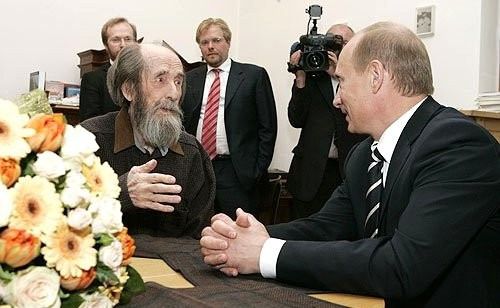
Meeting of Alexander Solzhenitsyn with Vladimir Putin, June 12, 2007. Photo: kremlin.ru
In Putin’s ideological narratives, the “Russian World project” has unofficially triumphed, which contains much from Solzhenitsyn’s ideas (although, of course, these ideas did not justify any military path, since they were formulated before the collapse of the USSR). One can say that the “Russian World project” is still an anti-project, based on the destruction of the communist past and a partial restoration of the monarchic pre-predecessor, but not aimed at searching for a complex future.
Is the Church Awakening?
The monotheistic worldview, according to which various phenomena in the world are caused by a single living personal Force, implies the connection of church and socio-political life as the “upper” and “lower” floors of a single spiritual-material social “building.” Of course, political life cannot be a direct projection of church life (and vice versa), but a certain connection between the two can still be traced.
The biblical theme of Exodus naturally turns us to the spiritual heir of the Bible—the Church. Let us turn to the church history of the post-Soviet period and see what is happening there.
It must be said that in the Church, the Soviet experience was perceived by many as analogous to the biblical Babylonian captivity, which lasted about the same amount of time. On the one hand, in biblical times, captivity was a punishment for sins; on the other hand, it allowed for religious renewal, when at the exit from captivity there was a “holy remnant” with new forms and new emphases in spiritual life.
These new forms and new emphases in the 1980s–90s were mainly represented in circles associated with priests Alexander Men and Georgy Kochetkov. One can say that here a new norm of church life was manifested. Some aspects of churchliness and piety, essential for most other Orthodox parishes and communities, are muted among the “Menites” and “Kochetkovites.” Both Father Alexander Men and Father Georgy Kochetkov, in their practice, refer primarily to early Christianity, the Gospels, and the apostolic age of church history. Post-biblical texts and practices, canons and customs, and tradition as a whole are not rejected but are muted. The emphasis is on catechesis, community life, spiritual education, Bible study, participation in Eucharistic renewal... In these circles, the works of representatives of the so-called Paris Theological School are also in demand.
This experience in the 1990s was denounced by many influential representatives of the Russian Orthodox Church as marginal and toxic, but over time, more and more believers began to look to it as a model, borrowing, if not all, then at least some elements of this experience. Now it can already be said with confidence that this path of non-hierarchical, community-centered life is not perceived as something alien in the Church. Quite a few Orthodox cultural and educational centers and church communities have appeared that, in one way or another, orient themselves toward it.
However, at the same time, church revival as a return to pre-revolutionary forms of church piety quantitatively dominates. It is from within this unreformed, ritual- and canon-bound Orthodoxy that the main support for Putin and the “Special Military Operation” is heard. The idea of symphony between Church and state is seen as a moral basis for the Church’s support of state actions.
In the Transfiguration Fellowship of Small Brotherhoods, founded by Father Georgy Kochetkov, there is now an attempt to conceptualize the Russian idea as such. At the core of this reflection, as with Solzhenitsyn, are the principles of anti-communism and national repentance for the past. It is probably fair to say that Father Georgy Kochetkov is a spiritual leader with a directive style of spiritual guidance. In this respect, he resembles the biblical Moses. In his determination to move forward, not returning to the “Egyptian meat,” he is uncompromising and cuts off at the root both the slander of “wolves in sheep’s clothing” (church revival in pre-revolutionary forms) and internal opposition (“the rebellion of Korah”). In the Transfiguration Fellowship, dialogue and competition of ideas are not envisaged. At the same time, those who are part of the movement, of course, experience a special inspiration from being involved in the revival of truly profound church life.
But, based on the reflections of Pinchas Polonsky, one might ask: is this the type of leadership needed for life in the “Promised Land”? It is no secret that many perceive the Fellowship as a transitional order. Thousands of people have gone through catechesis and received spiritual education (perhaps at the best theological university in the country—the St. Philaret Institute), but no more than 20% remained in the brotherhood and found their calling there. It is difficult to stay long in a movement dominated by forms of obedience and service, but without independence, internal dialogue, and competition of ideas.
In circles associated with Father Alexander Men, the situation is somewhat different. In post-Men communities and Bible groups, there is dialogue and openness, a movement toward dialogue of cultures, confessions, and religions. There is no obsession with the Russian idea. But there is a rollback to parish-centered forms of church life with their clericalism, ritualism, canonical “Talmudism,” and the particular flavor of the underground Orthodox world with its Aesopian language, within which parishioners are occupied only with not angering the church authorities.
Bonhoeffer or Adenauer?
Of course, the current situation in Russian Orthodoxy is unique. But sometimes it is compared to the situation in the German church of the 1930s–40s. At that time, the church in Germany was essentially split into two parts: the Confessing Church (the minority) and the so-called Reich Church, which supported Hitler’s initiatives, including theological anti-Semitic innovations. Importantly, the Lutheran German church allows for such division ecclesiologically. A smaller part of the parishes, led by their pastors, joined the Confessing Church, and the larger part joined the Reich Church.
In the Russian Orthodox Church, however, the discussion of whether or not to support the actions of the current authorities is not allowed. The monarchical episcopate here does not tolerate dissent.
In the Cathedral of Christ the Savior, Vladimir Putin congratulates the Patriarch of Moscow and All Russia on the holiday. At the President’s request, Patriarch Kirill blessed pectoral crosses for the commanders of troop groups performing especially important tasks in the “Special Military Operation” zone. Moscow, January 7, 2025. Photo: Patriarch’s Press Service / kremlin.ru
If someone holds a view different from that of the Patriarch, they either remain silent or are defrocked (if we are talking about clergy). Therefore, the “path of resistance,” adopted in the circles close to Dietrich Bonhoeffer, is unlikely to be possible as an official church institution. This does not mean that individual manifestations of confession and uncompromisingness are excluded.
Neither Bonhoeffer nor those close to his views, however hard they tried, were able to stop Nazism. As is known, on April 9, 1945, Dietrich Bonhoeffer was executed by hanging in Flossenbürg concentration camp by special order of Hitler. However, after the end of World War II, Germany began to rethink the Nazi period of church history. “Theology after Auschwitz” emerged. Thanks in large part to the efforts of Konrad Adenauer, the Christian Democratic Union (CDU) was created, in which German Catholics and Protestants, united and reconciled in a single party, were able to defend Christian values. The united Christian party could now win elections.
In 1949, Adenauer, nominated by the CDU, became Federal Chancellor and remained so until 1963. Under him, Germany was able to recover and embark on a path of stable, peaceful, democratic development.
What Can We Hope For?
There are three cardinal questions of Immanuel Kant, in which, according to the philosopher, “all the interests of reason” are expressed: “What can I know?” “What should I do?” “What may I hope for?” Let us take the third question and rephrase it in relation to our initial question. Let us formulate it thus: will the “Russian Moses” enter the “Promised Land,” and if so, how and when?
The Jewish experience tells us that a new generation of the exodus, unfamiliar with slavery, must grow up, and a new type of leadership must emerge. The German experience emphasizes that tyranny, as a new form of Pharaoh’s power, is incompatible with a free life. An ideology based on one-sidedness also has no future.
However, both experiences are optimistic: new life in the “Promised Land” is possible.
At the same time, to the second question, “What should I do?” in the time of Moses, a clear answer was given: the people must be taught and prepared for a new life.
If you enjoyed this article, consider making a donation — one-time or, even better, monthly. Your support helps us motivate our authors and become better with every article.
Our organization is recognized by the Internal Revenue Service (IRS) as a 501(c)(3) tax-exempt, charitable organization, which means that all contributions made to us are tax-deductible to the fullest extent permitted by U.S. law. Individuals may generally deduct charitable contributions of up to 60% of their Adjusted Gross Income (AGI) for cash donations made to qualifying 501(c)(3) organizations. For donations of appreciated assets (such as stocks or other long-term capital assets), the deduction is typically limited to 30% of AGI, based on the fair market value of the asset. C-corporations may deduct charitable contributions of up to 10% of their taxable income for donations made to eligible charitable organizations.
By submitting a donation, you confirm that you have read and accept the following documents: Privacy Policy and User Agreement, and also give consent to the processing of your personal data.
If you would like to unsubscribe from a monthly donation, please email us at: [email protected]