“There is no crime I wouldn’t commit to realize myself,” Valery Gergiev liked to repeat the words of his idol, Herbert von Karajan. But the renowned German conductor, who became the face of the Third Reich for self-realization, never stooped to shoddy work. That can no longer be said about Gergiev.
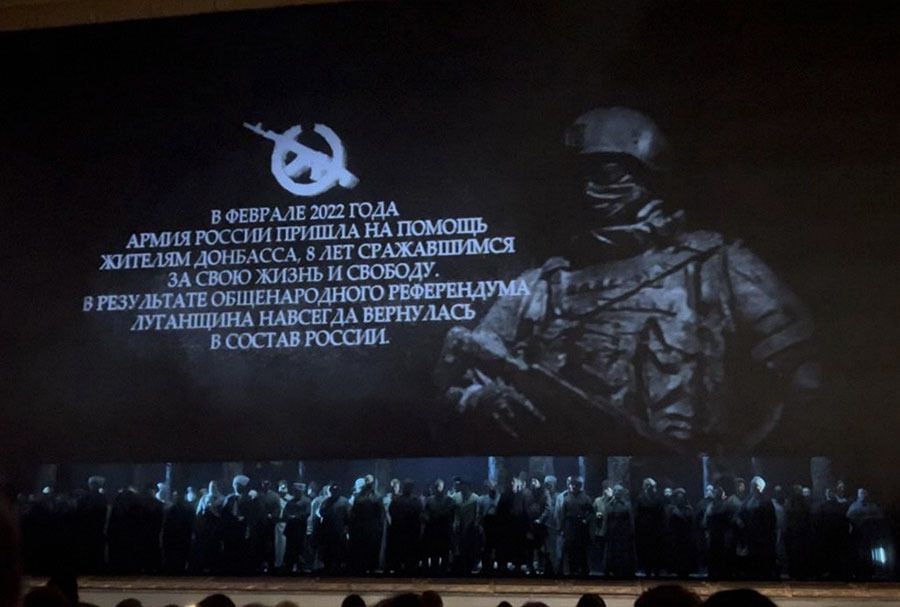
“In 2014, the junta seized power in Kyiv and began repressing its citizens,” the captions above the stage near the finale report. The choir echoes the captions: “Our Ukraine is lost! Defend it, people!” The running news ticker in the online broadcast decodes: “Deputy Minister of Defense of the Russian Federation Tsivileva awarded state honors to the SVO fighters.” Before us is the premiere of Prokofiev’s opera “Semyon Kotko” at the Bolshoi Theatre. At the podium is conductor Valery Gergiev.
In the context of the maestro’s participation in the UnʼEstate da Re festival in Caserta, Italy, discussed over recent weeks and where his concert was scheduled for July 27, the shocking production in Moscow gained additional significance and explained everything about the conductor’s political stance (in case anyone had doubts!). If it were any other conductor not seen as close to power, his ideological preferences would hardly be discussed. But Gergiev is not just a conductor; he is a government official and long ago ceased to be merely close to power — he is part of it. “Part of that force which eternally desires evil.” And no good.
One cannot but agree with those who consider Gergiev’s return to Europe unacceptable after being “canceled” by the West in 2022 for refusing to condemn the war in Ukraine. But these concerned people can be reassured: a concert at an obscure provincial festival in Italy would not have made waves nor served as a springboard for Gergiev’s return to Europe. Thus, Gergiev will never be Putin’s cultural ambassador legitimizing his actions. And no one will stop the Dutch citizen from coming to Europe anyway (except Latvia, which banned his entry indefinitely in 2022; only Ukraine and Canada have sanctioned the conductor). Just to remind, Gergiev has held a Dutch passport since he led the Rotterdam Orchestra from 1988 to 2008, and until 2021 inclusive, he annually hosted the eponymous Gergiev Festival there, now discontinued.
Far worse is that no one will prevent Gergiev from legitimizing Putin not in Europe, where such attempts meet resistance, but in Russia, poisoning an already hardly livable atmosphere and justifying it with great music. All while speaking beautiful, no, exquisite words.
When asked why he ended the 249th season of the Bolshoi this way, the maestro explained during the intermission of the premiere broadcast, citing someone else’s authority: “According to Sviatoslav Richter, the great pianist,” he said, “‘Semyon Kotko’ is Sergei Sergeyevich Prokofiev’s most powerful opera. Richter told me this personally in Japan in December 1995; it was our last meeting. He made me promise that ‘Semyon Kotko’ would live on Russian stages.”
The music is indeed stunning, but what, one wonders, prevented this work from living on our stages before? Nothing — just now is the right moment. In a nightmare, Prokofiev could not have imagined what Gergiev would prepare for his heroes and audience next. The slides with captions first describe 1919, then 1943, followed immediately by the memorable 2014. Then we jump to 2022 (“Where were you for eight years?”), when “the Russian army came to help the residents of Donbass, who had been fighting for their lives and freedom for eight years. As a result of a nationwide referendum, Luhansk permanently returned to Russia.”
All this can be read above the stage, while below, the orchestra, choir, and soloists distract from the political agenda. But those who attended the opera’s first performance a few days ago were so shocked by the director’s idea that news spread, and even those who had never cared for opera tuned into the online broadcast.
Photo: social media
No One Repented
The plot is taken from Valentin Kataev’s novel “I, Son of the Working People” (1937), and the libretto was co-written by him and Prokofiev. The Civil War is raging in Donbass (Prokofiev was born in Solntsevka — in Ukrainian, Sontsovka, in the Bakhmut district). Semyon Kotko fought in World War I, returned to his native village to his fiancée, but her former commander, her father, decides to marry her off not to a poor soldier but to a rich, albeit former, landowner. Then German spies infiltrate the village; Semyon and his comrades join the partisans, who eventually manage to thwart the unwanted wedding, free the bride — and the people celebrate victory and a wedding for love.
The anti-war public, stirred by the premiere, described the opera as penitential — this is not true. Prokofiev, a recent émigré who left after the revolution and lived abroad with a Nansen passport until the early 1930s, wanted to return home — and his homeland wanted him back. He was not forced to repent — loyalty was enough. Once, Sergei Sergeyevich dreamed that Meyerhold would stage his “Love for Three Oranges.” But the time was wrong, and in 1939 the great composer and director had to discuss not the fairy-tale opera by Gozzi but a topical plot, and who are we to throw stones at them.
Meyerhold had one year left to live, and Prokofiev, rashly and untimely returning home, was forced to adapt to a new reality in which he would survive the war, his Spanish wife’s arrest in 1949, and the suppression of his music. He died on March 5, 1953, the same day as Stalin.
Today, it is precisely the opera’s setting that justifies the theater’s choice: the opera was easily adapted for propaganda purposes, and it was exploited as such.
The decision was not made by Gergiev alone but also by the director, Sergey Novikov. Some may know this name from the show “What? Where? When?” — he appeared on screen as a representative of Rosatom. His current roles and resume are clarified in an article dedicated to the premiere: “Now he [Sergey Novikov] is head of public projects in the Russian Presidential Administration. Recently, he launched the countdown to the Intervision contest on Manezhnaya Square. Novikov oversees showbiz stars and cultural figures at the Presidential Administration. He distributes manuals on how to talk about Putin, the war, Ukraine, and the ‘terrible West,’ summons artists ‘to the carpet,’ and assigns foreign agent statuses.” And also — he directed the opera. The production came across as archaic, old-fashioned, as if from the 1950s. But the singing is decent in parts — if you close your eyes, the music saves it.
Head of the Russian President’s Public Projects Department Sergey Novikov. Photo: https://rus.team
Between the Streams
For the director/censor, this is an important career step. But for a conductor of Gergiev’s stature, it’s a dubious, if not a step into the abyss.Over the last three years, having achieved everything he aspired to (realizing the dream of leading the pre-revolutionary Directorate of Imperial Theaters recreated especially for Gergiev and bringing not only the Mariinsky Theatre but also the Bolshoi under his control), Valery Abisalovich behaved with utmost caution.
We remember him at different times — the 2008 concert in Tskhinvali after Russia’s attack on Georgia, and in the ruins of Palmyra in 2016, when Gergiev, as a loyal vassal, supported the Russian army’s aggression in favor of Sadat’s regime. And how on March 11, 2014, the conductor signedan appeal by Russian cultural figures supporting Russia’s foreign policy and President Putin in Ukraine endorsing the annexation of Crimea, and in 2017, cornered before a Washington concert,he told Voice of America he hadn’t signed anything, although his name appears under the document as number 97.
In 2022, Gergiev did not comply with Western orchestras and theaters’ demands to condemn the war, but he also never approved it anywhere. Gergiev’s ribbon was never pinned on the Mariinsky or Bolshoi. Twice, in 2012 and 2018, acting as Putin’s trusted representative in presidential elections, he was not noted for such actions last year, though by status he should have been. “Novaya Gazeta Europe” reminds that “Gergiev and the ensembles under his leadership did not participate in military propaganda (yes, his theaters, like all others in Russia, participate in charity programs, but he himself did not visit occupied territories), which ensured he faced no European claims.”
And then suddenly “junta” and “Luhansk returned” — it seems this cancels out Gergiev’s attempts to slip through “between the streams.”
Serving the Sovereign
Why he does this is a question occupying many. The mere list of orchestras and institutions that rejected him in 2022 defines his former place on the musical Olympus: Munich Philharmonic Orchestra, where he was chief conductor; Bavarian Opera; Elbphilharmonie in Hamburg; Verbier Festival (where Gergiev led the Festival Orchestra for many years); Milan’s La Scala Theatre (where he last conducted “The Queen of Spades” on February 23, 2022); New York Metropolitan Opera; Vienna and London Philharmonic Orchestras; Carnegie Hall…
After Crimea, the London orchestra did not fire him — they let him finish his contract in 2015, which was ending and a new one was starting in Munich, almost canceled because of Crimea, but Munich also yielded then. Gergiev had it all — so why did he lose it? To craft propaganda alongside a functionary?
The only convincing theory for this strange choice is that Gergiev wanted not to be near power but inside it, “the mistress of the sea, and for the golden fish…” The time of the broken trough has not yet come for him, but it’s approaching. This trough may turn out to be not a status or position but the profession — the musical side of things, which inevitably loses in a struggle with bureaucratic activity.
This process began long ago when Gergiev stooped, for example, to concerts with musicians like Denis Matsuev, started arriving late or not showing up for performances (I remember this at the Mariinsky), giving 130 concerts a year, which inevitably leads to shoddiness.
Music does not forgive betrayal. And this is what fundamentally distinguishes Valery Gergiev from Herbert von Karajan, with whom he is often compared and who was, of course, his role model from the start.
Neither the great conducting teacher Ilya Musin, who taught Gergiev, nor the remarkable Yuri Temirkanov, from whose hands he received leadership of the Mariinsky Theatre, and certainly not Wilhelm Furtwängler, whose name is mentioned in this context — only Karajan. Gergiev, who won the 1976 Conductors Competition organized by Karajan, used to repeat his idol’s mantra: “There is no crime I wouldn’t commit to realize myself.” But what does realization mean for Gergiev now?
Karajan made over 800 recordings in his lifetime, including six complete Beethoven cycles — no one else managed that many. And why? He alone achieved the status of lifetime director of the Berlin Philharmonic Orchestra. Within the Salzburg Festival, he organized another, the Easter Festival (by the way, the same name as the festival Gergiev has held in Russia since 2002).
But Karajan despised shoddy work. His athletic approach to life was expressed in yoga, swimming, skiing, yachting, collecting sports cars, and owning a sports plane. Karajan had a couple of villas; his wife was a model who had worked for Dior; his main weapon was absolute unscrupulousness. If he had to join the NSDAP, he joined twice. If he had to conduct in a Nazi uniform — so be it, no sentimentality. He wanted bonuses from the Third Reich leadership but did not care about the rulers themselves — they were just means.
For Gergiev, everything is clearly different — he serves the sovereign. It seems this is now his main purpose, how he understands his place in power.
Dear Bourbons
Perhaps Gergiev also shares with Karajan a passion for luxury, and here it’s hard not to recall the extensive foreign property of the Russian conductor, known from Navalny’s team investigation. Even the huge Manhattan apartment and the dacha with a concert hall in Repino, plus apartments in St. Petersburg and Moscow and a dacha on Nikolskaya Hill, do not impress as much as his real estate in Italy. Among other things, he owns: a villa near Rome, a 5.5-hectare cape and land in Massa Lubrense near Naples, half a hectare of farmland with an amusement park, basketball court, and restaurant in Rimini, 800,000 sq. m of land in Milan, and finally the crème de la crème of the collection, Venetian properties — the famous Palazzo Barbarigo with its mosaics on the Grand Canal (plus another 15th-century palace nearby) and the Quadri restaurant on San Marco. Everything is registered to the company Commercio edilizio S.R.L., owned by Gergiev and managing his Italian properties, inherited from harpist Yoko Nagae. And she inherited it from her husband — Count Renzo Ceskin, who made his fortune supplying the army during World War II. Nagae supported the Mariinsky as a patron and ultimately bequeathed everything to the theater’s artistic director.
The real estate is not lying dormant. Following the Easter Festival organized by Gergiev in April-May this year, a System project investigation showed that, according to the Milan-Monza-Brianza-Lodi Regional Chamber of Commerce, Commercio edilizio S.R.L. posted a net profit of 2.3 million euros in 2021 alone. According to the investigation, profits have decreased by several hundred thousand euros annually since then, but not because the real estate is depreciating. It is known that part of the Milan commercial real estate has already been sold.
Most likely, Gergiev is gradually withdrawing funds from Italy, fearing sanctions — in case they eventually affect him. Although the US Congress made an unsuccessful attempt to include Valery Gergiev in American sanctions lists only in autumn 2022 — the House of Representatives rejected the document. Europe as a whole did not even try.
Here we come close to the story with the festival in Caserta, near Naples — this musical event is surely receiving unprecedented attention in history.
The name “UnʼEstate da Re” (“A King’s Summer”) recalls that the local palace served as a summer residence for the Neapolitan Bourbons. Now it is listed as a UNESCO World Cultural Heritage site and is state-owned, which tries to draw attention to this non-capital monument. Concerts and performances held in the palace’s patio are designed to attract tourists, and it is understandable why local authorities, forced to react somehow to the scandal linked to Gergiev’s concert, long refused to cancel it.
The concert program featured classic masterpieces — the overture to Verdi’s “La forza del destino,” Tchaikovsky’s Fifth Symphony, and Ravel’s “Boléro,” and tickets cost not 10-15 euros as reported but a full 30, which is generally normal for an obscure provincial open-air festival supported by the state and local authorities — it’s not Salzburg or Aix-en-Provence, after all. The festival is a private initiative: organizers need to sell tickets; money rules all. Moreover, Gergiev was to perform with the Verdi Theatre orchestra in Salerno, bolstered by Mariinsky musicians, so more people were interested in his appearance than one might imagine.
Politicians had no power over them until the arguments “against” outnumbered those “for.” Despite calls to cancel coming from all sides.
“As Putin’s ‘cultural ambassador,’ Valery Gergiev implements the strategy of Russian soft power,” Yulia Navalnaya wrote in a column published July 15 in the Italian La Repubblica. “One of its goals now is to normalize the war and Putin’s regime.”
Excluding the Russian conductor — “a known supporter of Putin and the Kremlin regime” — from the festival program was demanded by European Parliament Vice-President Pina Picierno. Italy’s Culture Minister Alessandro Giuli warned that Gergiev “could turn the festival into a mouthpiece of Russian propaganda.” And on July 10, as the Telegram channel ‘Sirena’ reported, FBK lawyers sent statements to Italy’s Ministry of Culture and Interior Ministry demanding the cancellation of Gergiev’s performance and a ban on his entry due to his potential to “threaten Italy’s public order and security” because of his support for the occupation of Ukraine and closeness to Putin.
Alas, it is hard to believe the latter demand will be met. In part because Italy respects property. The President of the Campania region (equivalent to governor), Vincenzo De Luca, responding to questions from the French outlet RFI, defended the festival’s decision not to cancel the concert until the last, believing that even amid the aggression condemned in Italy and by himself against Ukraine, “ending dialogue (...) does not promote peace but only fuels sources of hatred.” Of course, this is pure hypocrisy, as confirmed in an AFP comment by Metropolitan Opera General Manager Peter Gelb. In his opinion, Valery Gergiev is “Putin’s creative double,” and “there can be no ‘cultural exchange’ with mass murderers and child kidnappers — this is the modus operandi of the current Russian regime.”
Amid the scandal with the Caserta festival, Valery Gergiev’s concerts with the Mariinsky Theatre orchestra in Spain, announced for 2026, disappeared from the posters. So his sovereign will not yet succeed in expanding influence in Europe through Gergiev. All unspent power will be spent at home, where it is by no means soft.
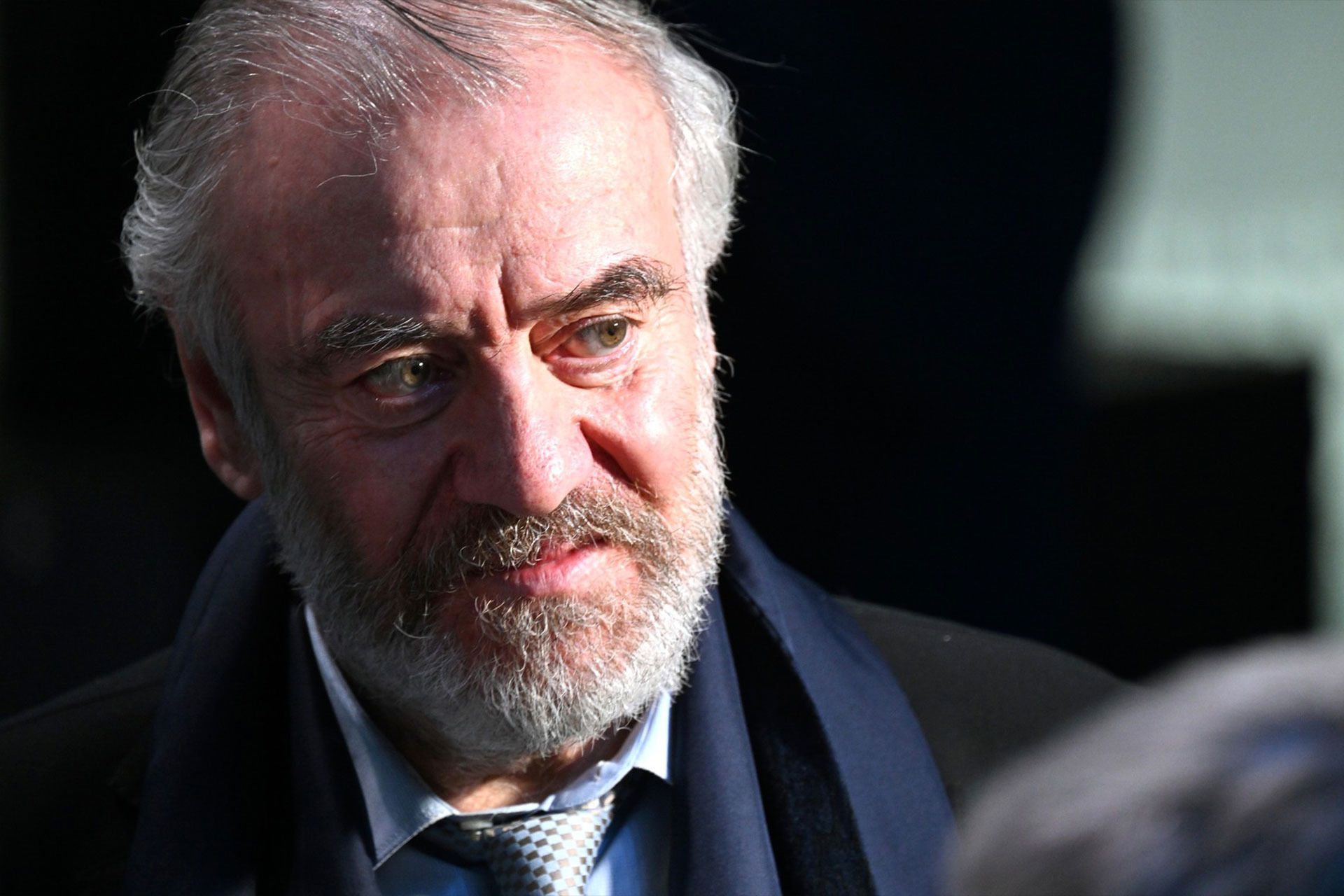
Main photo — Valery Gergiev at the plenary session of the United Cultures Forum. Source: kremlin.ru
If you enjoyed this article, consider making a donation — one-time or, even better, monthly. Your support helps us motivate our authors and become better with every article.
Our organization is recognized by the Internal Revenue Service (IRS) as a 501(c)(3) tax-exempt, charitable organization, which means that all contributions made to us are tax-deductible to the fullest extent permitted by U.S. law. Individuals may generally deduct charitable contributions of up to 60% of their Adjusted Gross Income (AGI) for cash donations made to qualifying 501(c)(3) organizations. For donations of appreciated assets (such as stocks or other long-term capital assets), the deduction is typically limited to 30% of AGI, based on the fair market value of the asset. C-corporations may deduct charitable contributions of up to 10% of their taxable income for donations made to eligible charitable organizations.
By submitting a donation, you confirm that you have read and accept the following documents: Privacy Policy and User Agreement, and also give consent to the processing of your personal data.
If you would like to unsubscribe from a monthly donation, please email us at: [email protected]