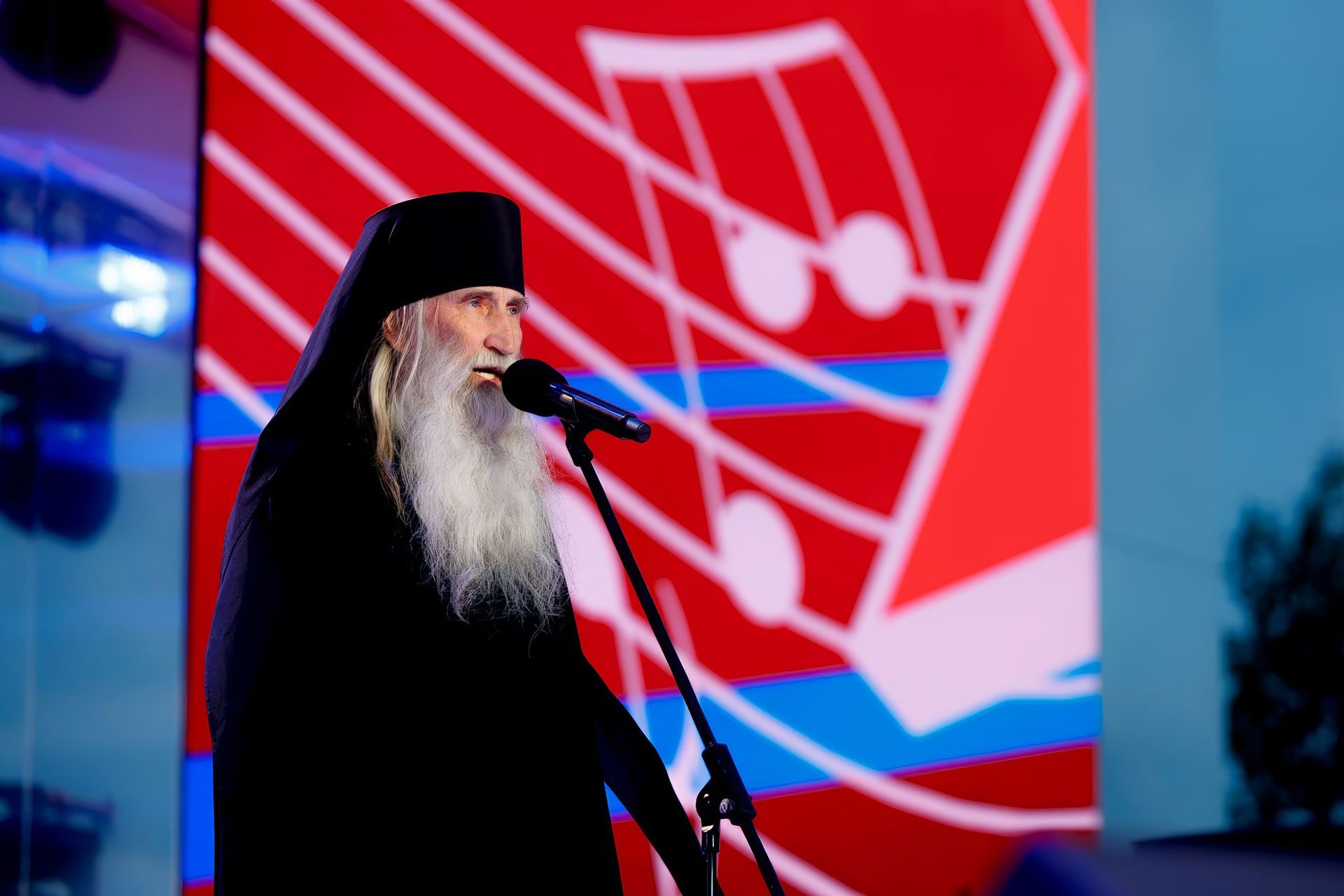
On August 6, a gala concert of the “SVO Ballads” festival took place in Moscow’s Zaryadye Park. It was organized by Monk Kiprian — a veteran of the Afghan war, Hero of the Soviet Union, and a fan of singer-songwriter music in civilian life. A correspondent from “Most” reports on how it all unfolded.
Photo: t.me / @balladasvofest
This piece was prepared by the team behind the “Blue Capybaras” project, where mentors work with aspiring journalists.
On a hot August evening, a line forms along Varvarka Street at the entrance to Zaryadye Park: visitors pass through metal detectors, and security checks their bags. Here, in a large amphitheater just two hundred meters from the Kremlin, the gala concert of the second season of the All-Russian festival “Ballads of the Special Military Operation — Time Has Chosen Us” will begin at 8 p.m. The concert is organized by the “Heroes of the Fatherland” foundation with support from the Presidential Fund for Cultural Initiatives, the “Defenders of the Fatherland” foundation, the “Committee of Families of Warriors of the Fatherland,” and several similar organizations. The goal is to collect and preserve songs by authors “connected to the SVO.”
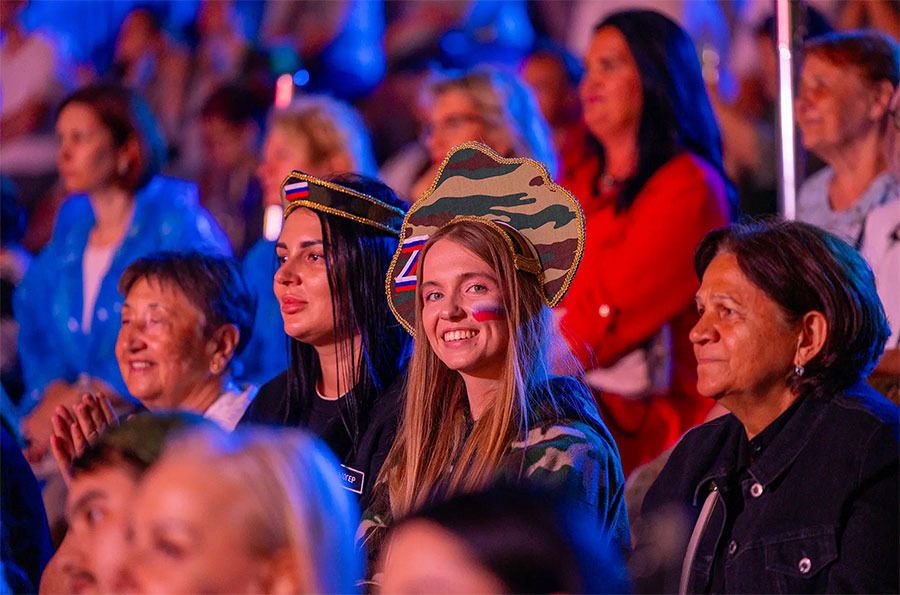
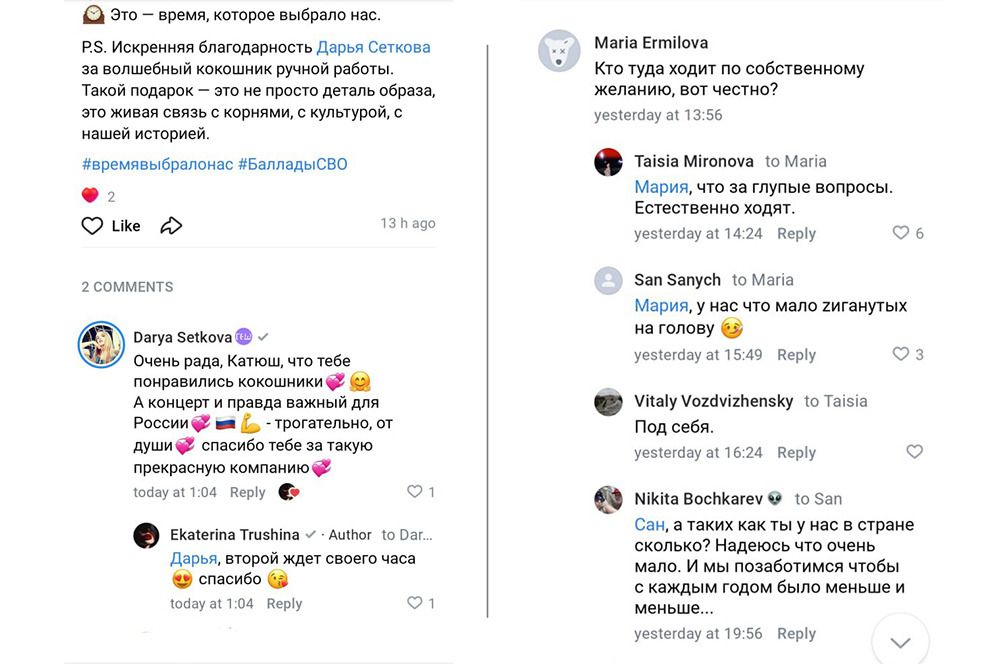
There are no seats left — according to the organizers, over 3,000 people attended. The wooden bench-steps in the center in front of the stage are cordoned off with blue tape: here sit military personnel undergoing rehabilitation in Moscow hospitals — wearing uniforms and light blue hospital gowns, with their relatives nearby. The most devoted spectators also take these seats — entry to the festival is free, but for guests worried about “being left without seats,” the support service issued tickets. Among them stand out two girls wearing camouflage kokoshniks — patriotic blogger Darya Setkova and her friend.
Photo: Website of the Presidential Fund for Cultural Initiatives
A little higher up sit servicemen in neat rows — blue berets, striped shirts, and green uniforms. One took the opportunity to invite his beloved to the concert as if on a date: she limps on heels along the gravel paths of Zaryadye, dressed in an evening gown and wearing makeup. His comrade holds a woman (likely his mother) with one hand and a girl with the other, staying like this throughout the concert. A group of young cadets in branded T-shirts stands out like a scarlet spot in the hall. At least half of the audience are women and men of retirement age.
To the left of the stage, on soft multicolored poufs, lie the luckiest guests. Spectators who arrived later crowd the aisles. Natasha from the tax office, a woman about forty, holds an open thermos emitting a port wine smell: opaque liquids over 0.5 liters are confiscated at the entrance, but some manage to sneak them past security. “Want me to get the fighters up so you can sit?” her companion Maxim offers Natasha and her friend, but they decline and stand for two and a half hours, even when seats free up, fanning themselves with a single handheld fan shared by all.
During the concert, Victory volunteers in white branded hoodies walk back and forth: these volunteers originally helped WWII veterans and are now involved in various patriotic events. It’s unclear if they have any other role at the concert, but they definitely add to the spectacle’s mass appeal.
“Is Defending the Fatherland Violence?”
To the amphitheater’s applause, Monk Kiprian steps onto the stage — in civilian life Valery Burkov, president of the Heroes of the Fatherland foundation — greeting “veterans of all wars.” In the early 1980s, he volunteered to go to Afghanistan, where his colonel father died, and soon after, he himself was blown up by a mine. Both his legs were amputated. According to his story, Valery experienced three clinical deaths during surgery in the hospital. But he later stood on prosthetics and served for another 13 years. Now, the prosthetics are hidden under his monastic robes, and his gait doesn’t reveal that the priest has no legs.
In October 1991, Burkov received the Hero of the Soviet Union Star — he is one of the last officers to be awarded this title. Later, he headed the Coordination Committee on Disability Affairs under the President of Russia, served as an advisor to Yeltsin on disability issues, and was responsible for developing barrier-free environments in Russia. The SVO Ballads festival website even claims that it was on Burkov’s initiative that the UN proclaimed December 3 as the International Day of Persons with Disabilities (though there is no confirmation of this in published UN materials or other open sources).
In the 2000s, the Afghan veteran entered politics. He tried to run for the State Duma in the 2003 and 2007 elections representing the far-right party “Rus’,” but the party failed to register for the elections. That same year, 2007, Burkov, according to him, campaigned for “A Just Russia” and boosted its ratings. To his deep disappointment, the party excluded him from the candidate list — and for the first time, the Hero of the Soviet Union felt the desire to enter a monastery. In the late 2000s, according to the “Kulturologia.ru” website, the presidential administration offered Burkov, then a deputy of the Kurgan Regional Legislative Assembly, a governor’s post. This proposal created a “vacuum inside him.” It was then that Valery immersed himself in studying the Holy Scriptures. In 2016, he took monastic vows.
In one interview, the monk called the war in Afghanistan the most important event in his life — that’s where he “found his backbone.” The priest justifies killing in battle with Christian commandments: “Is defending the Fatherland violence? You know, killing is one thing, it’s a crime. And, in fact, even in war, killing is a crime: we take from each other a life that we did not give. But our Church has always blessed and continues to bless warriors defending the Fatherland.” In another interview, the former soldier reflects on the benefits of the SVO: according to Father Kiprian, its goal is “that everyone — those living in Ukraine, Ukrainian soldiers, our servicemen, their wives, mothers, children — finally turn to their Father and, like lost children, return to Him.”
Although in conversations from a decade ago, the newly tonsured Kiprian thought differently: “War is psychological trauma in any case, because every day you see death, blood, tragedies. Although one cannot get used to death, some internal protection still kicks in, and you start perceiving what’s happening differently. And in war, you constantly face a choice: to break the moral law God put in us or not… I wouldn’t wish anyone to participate in combat! It’s a very hard, unnatural thing.”
Now Monk Kiprian travels to the front line — wearing a black bulletproof vest “so he doesn’t stand out in his robes” and sports the Hero of the Soviet Union star on his chest (he wears it on his monastic garment by blessing of his spiritual mentor, Father Makary). Burkov conceived the “SVO Ballads” project as a continuation of his own creative work: since 1988, he has collected, written, and sung songs inspired by his combat experience — to “raise patriotic spirit” in society.
“Every song is written from the heart, from what the person has experienced. It’s their understanding of what’s happening now,” he explains to the audience before the concert program begins. “It’s an address to the enemy, it’s an address to all of us.”
“A Bridge Between Rear and Front”
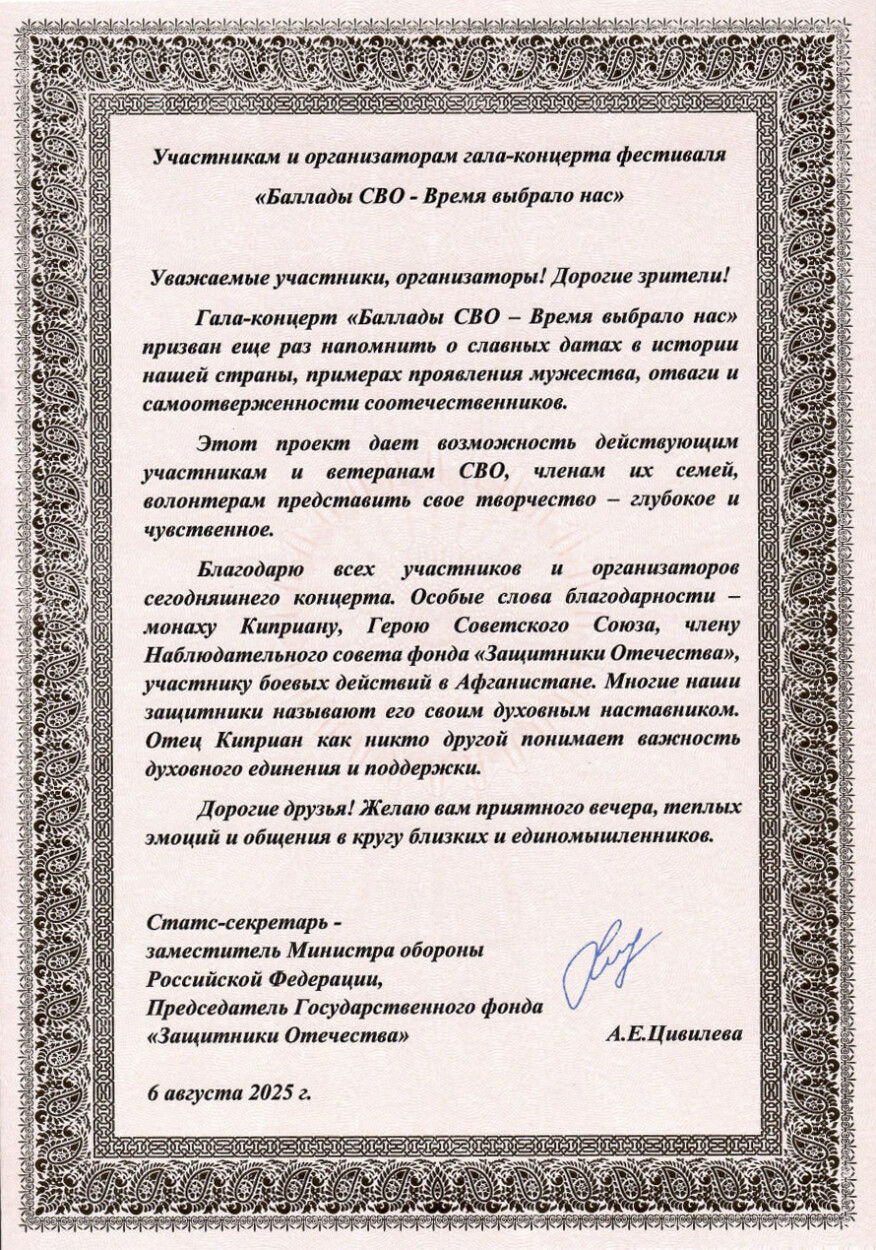
Instead of a usual podium, the stage is piled with crates from shells, covered with a camouflage net. A representative of the “Defenders of the Fatherland” foundation reads a message from the foundation’s chairwoman Anna Tsivilyova (Deputy Minister of Defense and Putin’s niece): the concert “is meant to once again remind us of glorious dates in our country’s history,” “special thanks to Monk Kiprian,” “many of our defenders call him their spiritual mentor.”
Finally, the hosts move on to the concert program: “Every song is a bridge between the rear and the front, between the past and the future of our country.”
Fifteen performers participate in the “SVO Ballads” festival — according to official information, an expert council selected them from 550 applications. Each has a connection to the war in Ukraine: some served themselves, some volunteered, some have husbands at the front. The ensemble “Grandmothers’ Grandchildren” went to the civil war in Syria and delivered icons to Russian troops fighting on the side of dictator Bashar Assad — “600 pocket-sized, 10 medium, and two large ones.”
Women sing about love and waiting, men — about courage and feats. The audience applauds after each song, records the concert on mobiles, and lights up phone flashlights. When the song “Unworldly” about Hero of Russia Vlad Dorokhin, who blew himself up with two grenades, plays, even tax office employees cry. The lyrics were written by Ruzanna Avetisyan, daughter of an SVO participant and a deputy of the Simferopol City Council of the Republic of Crimea.
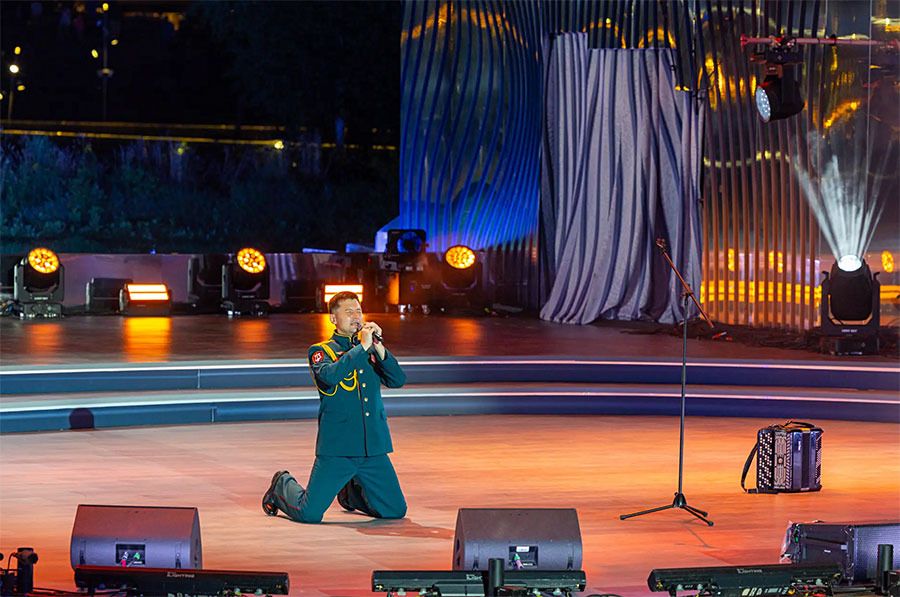
Each performance is preceded by a kind of patriotic stand-up: participants of the gala concert deliver speeches about Russia’s victory. After the song “Ivan, Shamil, and Salavat,” singer Salavat Dasaev falls to his knees and proclaims that a Russian soldier does this only three times: “When he prays — asks the Almighty, when he kisses the tender hands of his mother or in battle before a wounded comrade. And never again!”
Photo: Website of the Presidential Fund for Cultural Initiatives
At the start of the concert, a woman rises from the center row holding a tricolor with the inscription “For ours! For truth! For victory!” — and stands with the flag until the end. A man in a striped shirt with a badge on his chest reading “I chose the President of Russia” spends the entire concert standing with a home camera, occasionally shouting “Victory will be ours.”
Soon after the first songs, the soldiers leave in neat columns. Their seats are taken by civilians tired of standing, whoever managed to get there. So many people crowd the aisles that when the central sector stands in unison, spectators on the sides don’t see it and remain seated.
Zara and Mara
The festival’s experts are 19 patriotically minded public figures and musicians, including singer Zara, who performed the song “Ogonyok” at the concert. Besides her and the novice performers, other popular artists are also in the program.
Out of competition, the amphitheater heard the song “My Homeland Returns” by the band “Zveroboy.” According to the authors, the song was “written on the third day after the start of the special military operation” and dedicated to “the defenders of Donbass.” Singer Sergey Nikhaenko performs the song “Height” about emotional emptiness:
I’ve forgotten how to cry in war,
Losses are now a given for me.
I no longer trust silence,
I hide my pain and my joy.
Rock singer Mara comes on stage not in a dress like the other girls but in a tank top, jeans, and sneakers. In 2012, she released the song “Dizziness” with the words: “I vote for a gay mayor, for a woman president: I choose those who will never choose war!”Now Mara performs the song “Your Shield” about two Russian volunteers with call signs “König” and “Oper.” According to the singer, after a battle with the Ukrainian side, the first was surrounded with broken legs and a fractured spine. He crawled on his elbows toward his own, found a radio along the way, and contacted the reconnaissance company commander “Oper.” To stay conscious, “König” rubbed his face with wormwood: “That sharp ammonia smell gave him strength again for a while... And ‘Oper’ just dragged him because ‘I will be your shield, you will be my shield.’
The only one whose number was not directly related to combat actions is Pyotr Lundstrem: he comes on stage and simply plays a Bach melody on the violin.
“Together We Are One People”
After the final number, the audience begins to disperse.
“Girls, maybe we should go too?” suggests a lady with a bag instead of a purse to her neighbors.
“Are you pissed yourself? Pissed? She’s going to pee herself now!” her friend laughs at her own joke.
“No, no, I don’t want to.”
“Let’s stay, maybe Father Kiprian will say something else,” sums up the third.
During the awards ceremony, which took up a third of the concert time, each of the 15 participants received some kind of diploma. Four grand prizes were awarded by “SVO participants”: chairman of the “Movement of the First” Artur Orlov, participant of the presidential program “Time of Heroes” Maksim Sholomov, and Aynur Safiullin. Radio stations “Zvezda,” “Pride,” “Kalina Krasnaya,” and “Radio 333” each selected one performer whose songs will receive airtime. Three others became “leaders of the public vote.” Those who did not fit into any category were awarded diplomas from the “Defenders of the Fatherland” foundation — “for special contribution.”
At the finale, after the awards, the participants, together with Alexander Ivanov and Monk Kiprian, sing Sergey Trofimov’s song “Motherland”:
Grandmothers’ tales about love and courage,
Where goodness and truth protect the white world.
Grandfather’s medals “For Berlin” and “For Prague”
And the spring festive salute...
I know that together we are one people!
And my happiness flies, and my joy sings.
“Alright, now run to the bathroom!” exclaim Father Kiprian’s fans.
***
Under the news about the concert, user “Maria Ermilova” expresses bewilderment: “Who honestly goes there of their own free will?”
“Maria, don’t we have enough people who are crazy in the head here 🤒,” replies “San Sanych.”
On the evening of August 10, the concert broadcast will be shown on the “Zvezda” TV channel.
If you enjoyed this article, consider making a donation — one-time or, even better, monthly. Your support helps us motivate our authors and become better with every article.
Our organization is recognized by the Internal Revenue Service (IRS) as a 501(c)(3) tax-exempt, charitable organization, which means that all contributions made to us are tax-deductible to the fullest extent permitted by U.S. law. Individuals may generally deduct charitable contributions of up to 60% of their Adjusted Gross Income (AGI) for cash donations made to qualifying 501(c)(3) organizations. For donations of appreciated assets (such as stocks or other long-term capital assets), the deduction is typically limited to 30% of AGI, based on the fair market value of the asset. C-corporations may deduct charitable contributions of up to 10% of their taxable income for donations made to eligible charitable organizations.
By submitting a donation, you confirm that you have read and accept the following documents: Privacy Policy and User Agreement, and also give consent to the processing of your personal data.
If you would like to unsubscribe from a monthly donation, please email us at: [email protected]