Tajikistan is the only post-Soviet country where power has not changed hands since the early 1990s. The president long ago chose his eldest son, Rustam Emomali, as his successor, but the transfer of authority is constantly postponed.
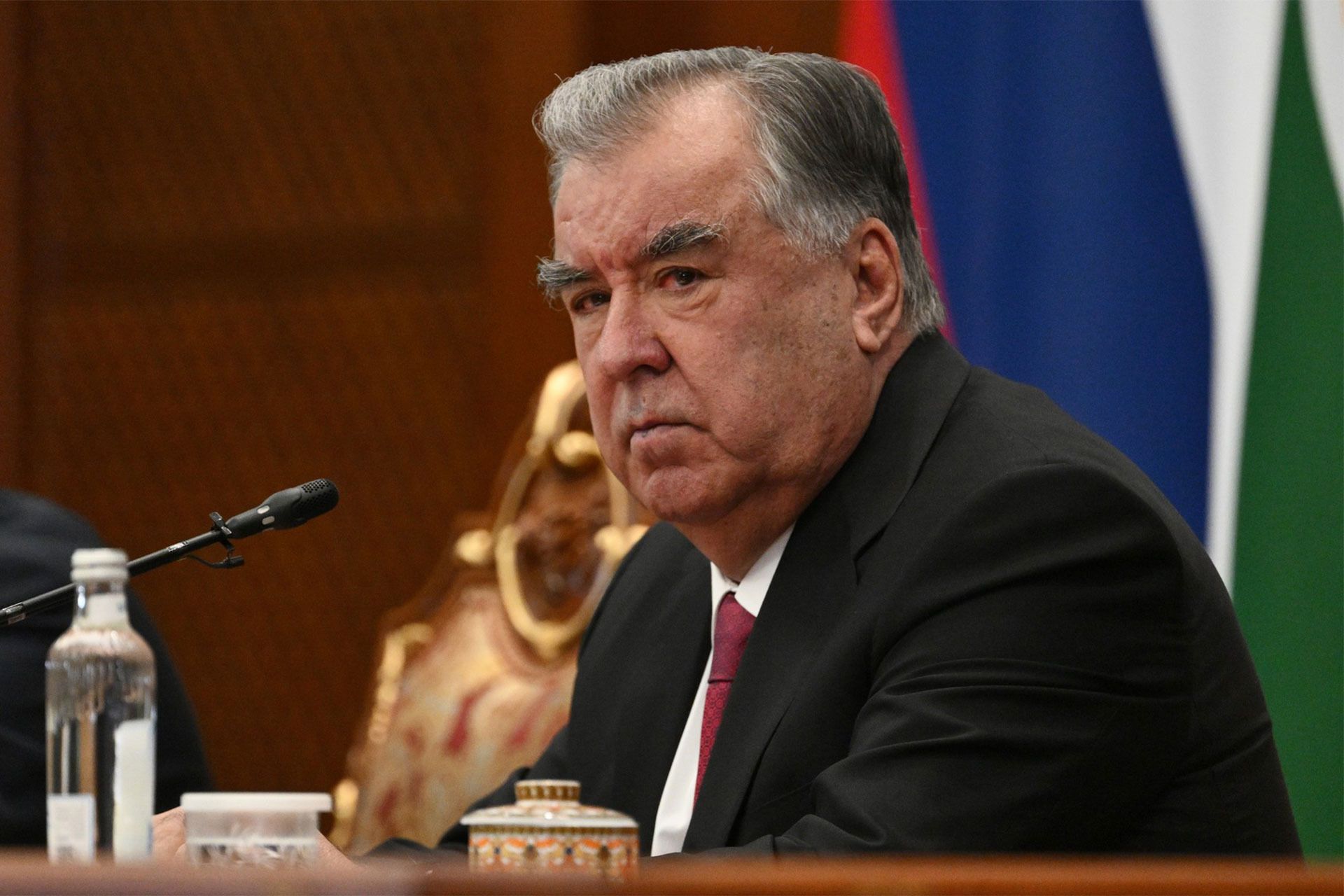
President of Tajikistan Emomali Rahmon at a document exchange ceremony following Russian-Tajik talks. Dushanbe, October 9, 2025. Photo: kremlin.ru
At the end of January, Rahmon disappeared from public view for two weeks, sparking rumors of his death. No one in the country knew how to react. The system seemed paralyzed. Rahmon eventually returned, but this episode revealed a key vulnerability: if he does not personally transfer power to his son, there are no guarantees his son will become president. There are plenty of people eager to take his place.
Silence
During Rahmon's three decades in power, he has been declared dead more than once—but every time, it was just rumors. But his disappearance in February seriously alarmed the country. The president's motorcade stopped appearing on the streets of Dushanbe, and traffic in the capital was not blocked off—a clear sign the head of state was not in the city. State television switched to sentimental programs about Rahmon's youth and achievements: what he was like as a son, friend, father, grandfather, president. On social media, people wrote that entertainment events were being canceled and security around government facilities was being tightened—as if the country was preparing for mourning or a state of emergency.
In Eastern autocracies, a leader's death is often kept secret while elites negotiate a successor. That's what happened in Azerbaijan in 2003, when President Heydar Aliyev died; in Turkmenistan in 2006 after Saparmurat Niyazov's death; and in Uzbekistan in 2016 after Islam Karimov's death. With this logic, people began to speculate: the elites were probably already dividing up power, even though Rahmon had planned the succession scenario in advance.
Tensions increased because the country's top security official, Saimumin Yatimov, head of the State Committee for National Security and one of Rahmon's closest allies, also disappeared from public view. Rumors spread that after the president's disappearance, Yatimov had hastily left the country.
But the most telling was the silence of the son. Rustam Emomali, speaker of the Senate and by law the country's second-in-command, is the official successor. If the president is incapacitated or leaves office, the Senate speaker is supposed to take over until elections are held. But Rustam made no public statements—not even a brief comment to say his father was fine and the situation was under control.
The presidential administration and bureaucracy were also silent. Yet Rahmon is almost 75 years old—it's getting harder to hide his health, and those around him should at least know how to respond. The system built for succession seemed paralyzed in Rahmon's absence.
The president did return—reportedly after receiving treatment in China. But these two weeks showed that if Rahmon leaves without personally handing over power to his son, the transition risks turning into a behind-the-scenes struggle among elites. And there are no guarantees Rustam will be able to seize power.
The Successor
Rahmon began preparing to transfer power to his son back in the 2010s. The constitution was amended to lower the minimum age for presidential candidates from 35 to 30. Rustam was about 30 at the time—the signal was clear. His father involved him in government: he started by heading the Customs Service, then led the Anti-Corruption Agency and the Football Federation, and since 2017 has been mayor of Dushanbe. Since 2020, he has combined this post with that of Senate chairman—the country's second-in-command: if the president leaves office early or dies, he automatically takes over. It seemed everything was ready for the transition. Yet it keeps being postponed.
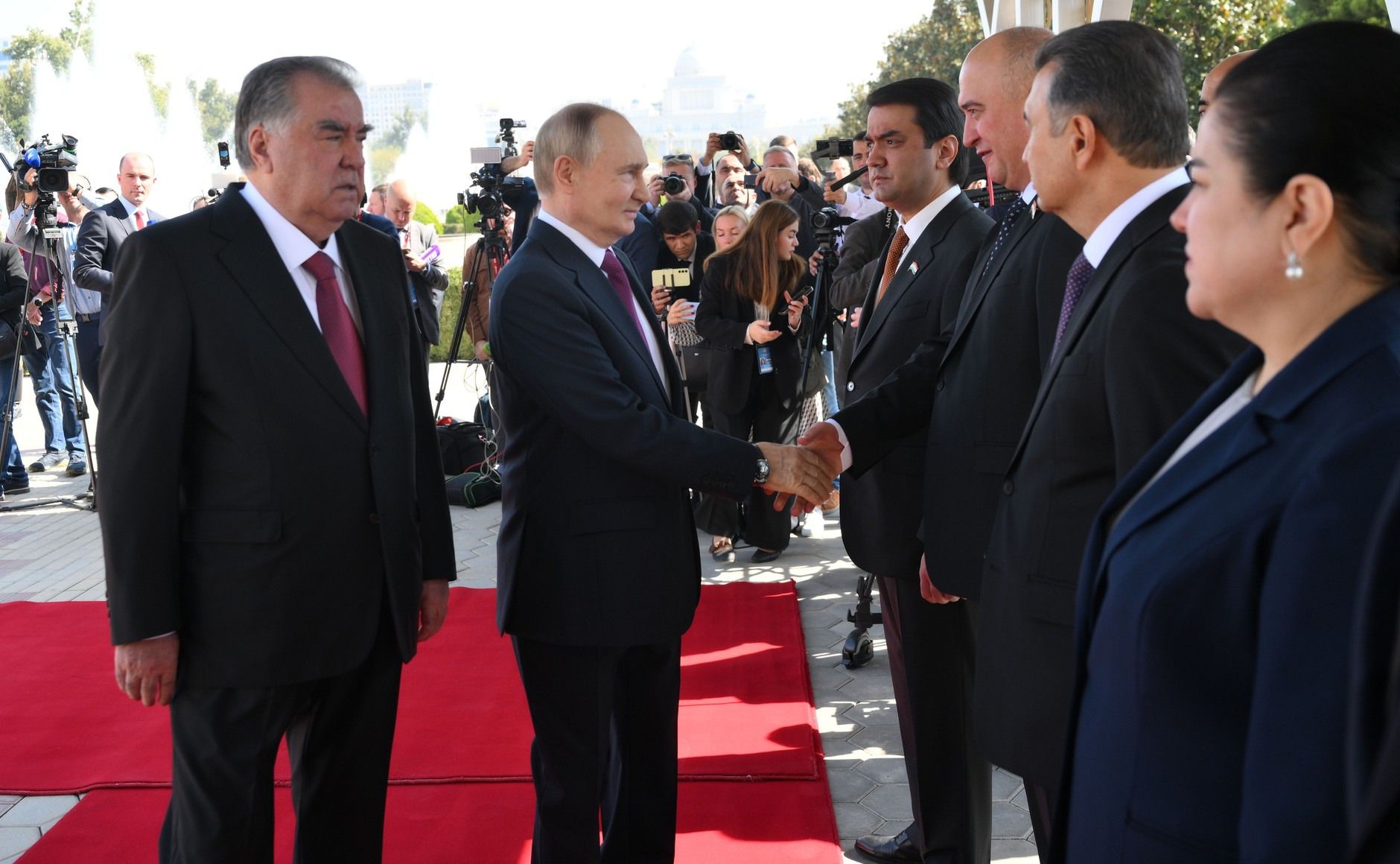
President of Tajikistan Emomali Rahmon, Russian President Vladimir Putin, and the president's eldest son Rustam Emomali (first right of Putin). Dushanbe, October 9, 2025. Photo: kremlin.ru
The reasons, apparently, lie with Rustam himself—he is still not ready. He has little management experience and weak public speaking skills. At public events, he is often silent, and his TV appearances are narrated by a voiceover. There are also rumors that Rustam has trouble controlling his aggression. In 2008, he allegedly shot his uncle, and in spring 2022, he reportedly shot at GKNB head Yatimov, who refused to follow his orders.
Rustam's supporters paint a different picture: as mayor, he improved Dushanbe, supported youth initiatives, and began forming a team of technocrats. Some elites see him not as a weak successor, but as a new-type manager—pragmatic and less burdened by the Soviet past.
The drawn-out transition is also explained by external factors. It is believed that Russia and China are not happy with Rustam's candidacy.
Tajikistan is a key outpost for Russian security on the southern borders of the post-Soviet space. The country went through a civil war in the mid-1990s and borders Afghanistan, where Taliban power remains fragile. To contain risks, Russia maintains the 201st military base there. China, which has invested heavily in Tajik rare earth metals, has opened two of its own military bases. Yet even with such protection, in December 2025, several Chinese citizens were killed on the Tajik-Afghan border. Unlike his father, Rustam is seen by Moscow and Beijing as a less predictable figure. And predictability is exactly what both partners want from Dushanbe.
However, these fears are probably exaggerated. Both Russia and China are now busy with their own agendas and will ultimately trust Rahmon's choice. It appears that Rahmon himself is stalling the transition—he fears the path to a smooth transfer of power is not yet clear.
Family
Among the main obstacles to the transition are Rahmon's own children. The president has nine: two sons and seven daughters. Many consider themselves no less worthy of becoming president than Rustam. Especially since, in terms of management experience, many of them would give him a run for his money.
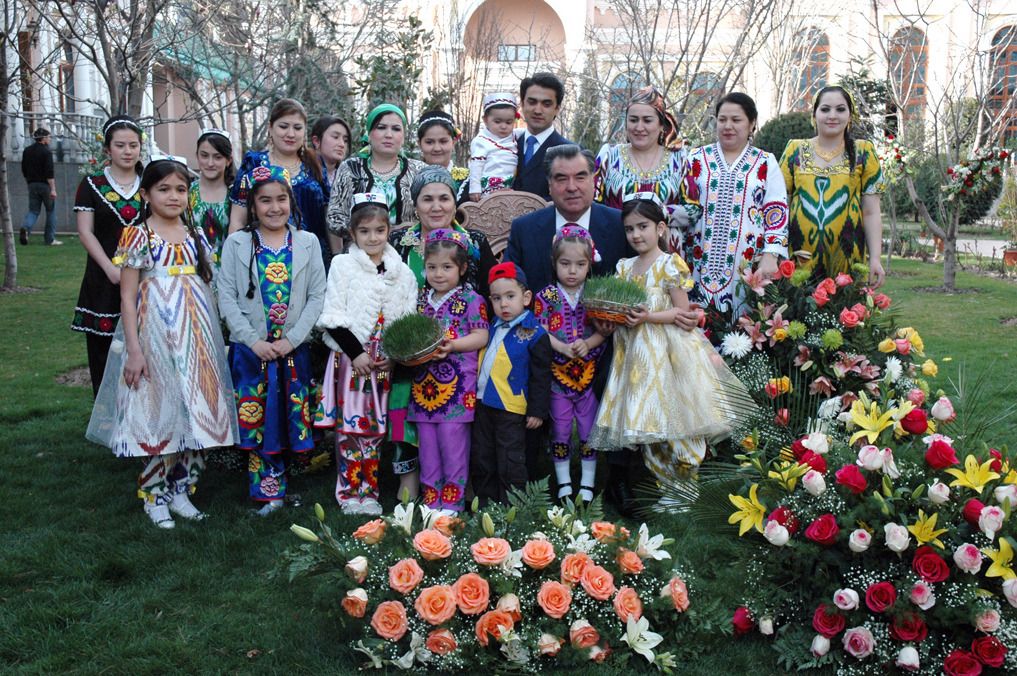
Emomali Rahmon and his family. Dushanbe, March 21, 2011. Photo: Wikipedia / Sulton1987 / CC BY-SA 3.0
Just look at the daughters. The second, Ozoda Rahmon, has headed the presidential administration for many years and enjoys real authority among officials and security forces. The fifth daughter, Rukhshona, works in the diplomatic service and is married to prominent businessman Shamsullo Sokhibov, who amassed his fortune thanks to his ties with the president. The third daughter, Tahmina, along with her husband Zarifbek Davlatov, oversees the Civil Aviation Agency—a monopoly in the airline ticket market. The fourth daughter, Parvina, owns the largest pharmaceutical company, Sifat Pharm, which receives multibillion-dollar government contracts and controls most of the country's pharmacies.
Not everyone is likely happy that power will go to Rustam. His opponents fear that if he comes to power, he will start forming his own team and redistributing resources. Whether there will be a place for brothers, sisters, and their families is a big question.
Rahmon apparently understands the ambitions of his other children and, while still in power, tries to neutralize them. He sent Rukhshona to London as ambassador with her husband, removing both as possible rivals to his son. The heir himself has also joined the struggle with relatives. According to reports, Rustam was involved in leaking to the media information about an alleged affair between his sister Ozoda and her driver.
However, the president himself is as dependent on his family as they are on him. The loyalty of his daughters, sons-in-law, nephews, and grandchildren ensures the regime's stability. By concentrating the country's governance within the family, the head of Tajikistan has created a system that, when power is transferred, could become a serious threat to the successor.
Purge
Rahmon's regime relies not only on family loyalty, but also on the security forces. To prevent them from becoming a threat themselves, Rahmon regularly reshuffles and purges their ranks. The latest, in January 2025, was the largest: the president removed almost the entire security leadership at once. Defense Minister Sherali Mirzo, who had held the post for 12 years, was dismissed. Also removed were Beg Sabur, head of the Communications Service, and Prosecutor General Yusuf Rahmon. Their sons are married to the president's daughters, which for many years was considered a guarantee of untouchability. But as soon as conflicts began in the children's families—including Yusuf Rahmon's son's divorce from the president's daughter—dismissals followed.
The only security official untouched by the purges is GKNB chief Saimumin Yatimov, who has held the post since September 2010. He knows too much: he personally took part in many regime operations and oversaw the toughest ones. In particular, operations in Gorno-Badakhshan—an autonomous and poorest region where, after the civil war, field commanders settled. Enjoying authority among locals, they took on solving social problems the authorities ignored. Rahmon saw this as a threat: too influential regional groups could become serious rivals for him and, in the future, for his inexperienced son. Starting in the mid-2010s, Rahmon and Yatimov conducted several security operations in GBAO. The most brutal was in spring 2022: up to 40 people died, and dozens were arrested.
Yatimov oversaw the persecution of the Islamic Renaissance Party—one of the last legal opposition forces in the country. After the civil war, the party was a party to the 1997 peace agreement, which gave it a quota in parliament. Nevertheless, in 2015 Rahmon banned it, declared it terrorist, and Yatimov led the effort to expel all party members from the country. That same year in Istanbul, Tajik opposition figure Umarali Kuvvatov was shot dead. Yatimov, who oversaw GKNB's foreign operations, was mentioned in connection with pressuring opposition members in exile, but Dushanbe officially denied involvement.
At the same time, Yatimov is considered one of the opponents of transferring power to Rustam—he is said to lobby for Ozoda's interests, with whom he has close working relations. Rahmon would probably like to get rid of him: Yatimov poses a direct threat to Rustam, and his dismissal has been predicted for a long time. But firing him is not easy—he knows too much. An ousted Yatimov could be far more dangerous to the system than one inside it.
When Rahmon disappeared from public view for two weeks in February, the first talk was that security officials and relatives, including Rustam, were negotiating over succession. Many believed that whoever took charge of the crisis would determine the transition. But the system froze. Even regarding Yatimov, there were rumors he had hastily left the country—although, given his influence, that seemed odd.
However, officials may have stayed silent on purpose—knowing the president was alive and not wanting to get ahead of events. But that doesn't mean that if he leaves without officially transferring power, everything will go as quietly.
Or maybe it's simpler: Rahmon has become a hostage to the illusion that he is fighting threats for his son's sake—when in fact, he simply can't imagine life without power. His suspicion of anyone who threatens his own power—and, by extension, his successor—turns the upcoming transition into a source of tension within the regime. And this delay could cost Tajikistan dearly.
If you enjoyed this article, consider making a donation — one-time or, even better, monthly. Your support helps us motivate our authors and become better with every article.
Our organization is recognized by the Internal Revenue Service (IRS) as a 501(c)(3) tax-exempt, charitable organization, which means that all contributions made to us are tax-deductible to the fullest extent permitted by U.S. law. Individuals may generally deduct charitable contributions of up to 60% of their Adjusted Gross Income (AGI) for cash donations made to qualifying 501(c)(3) organizations. For donations of appreciated assets (such as stocks or other long-term capital assets), the deduction is typically limited to 30% of AGI, based on the fair market value of the asset. C-corporations may deduct charitable contributions of up to 10% of their taxable income for donations made to eligible charitable organizations.
By submitting a donation, you confirm that you have read and accept the following documents: Privacy Policy and User Agreement, and also give consent to the processing of your personal data.
If you would like to unsubscribe from a monthly donation, please email us at: [email protected]