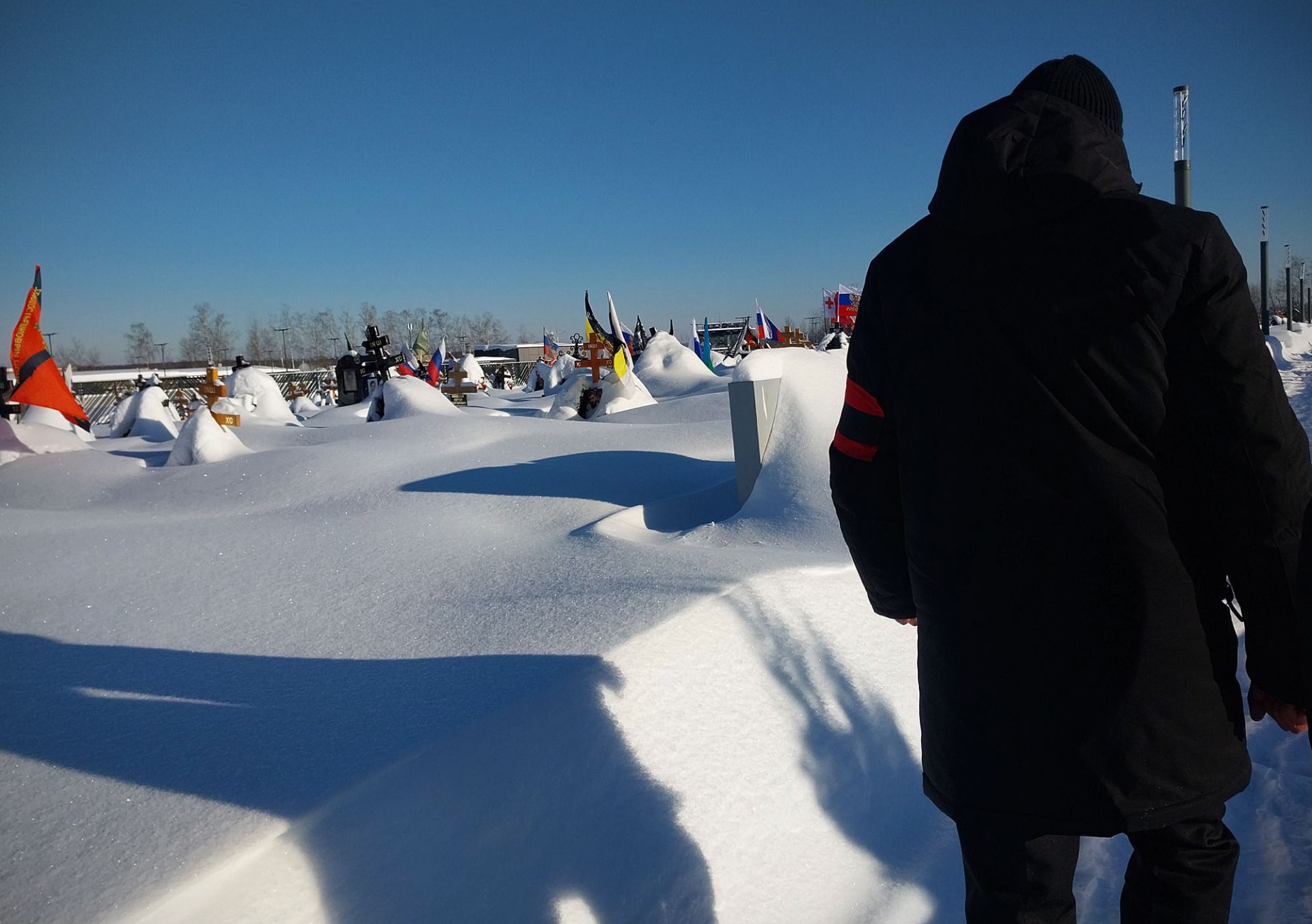
In the four years since the start of the Special Military Operation, military funerals in Russia have become entirely routine. Funeral brigade workers do not openly condemn the war, but their negative attitude toward what is happening becomes clear in conversation.
Photos by Nikita Zolotaryov
You can read the first part of the journalist’s experiment diaries here.
01/30/2026
My first SMO funeral is supposed to take place at Domodedovo Cemetery, but the body needs to be picked up at Nikolo-Arkhangelskoye—there’s a body storage facility there. It’s used to keep bodies longer than ordinary morgues—the freezers are more powerful. “Cargo 200” often ends up here, as well as unidentified or unclaimed bodies. There are six such body storage facilities in Moscow.
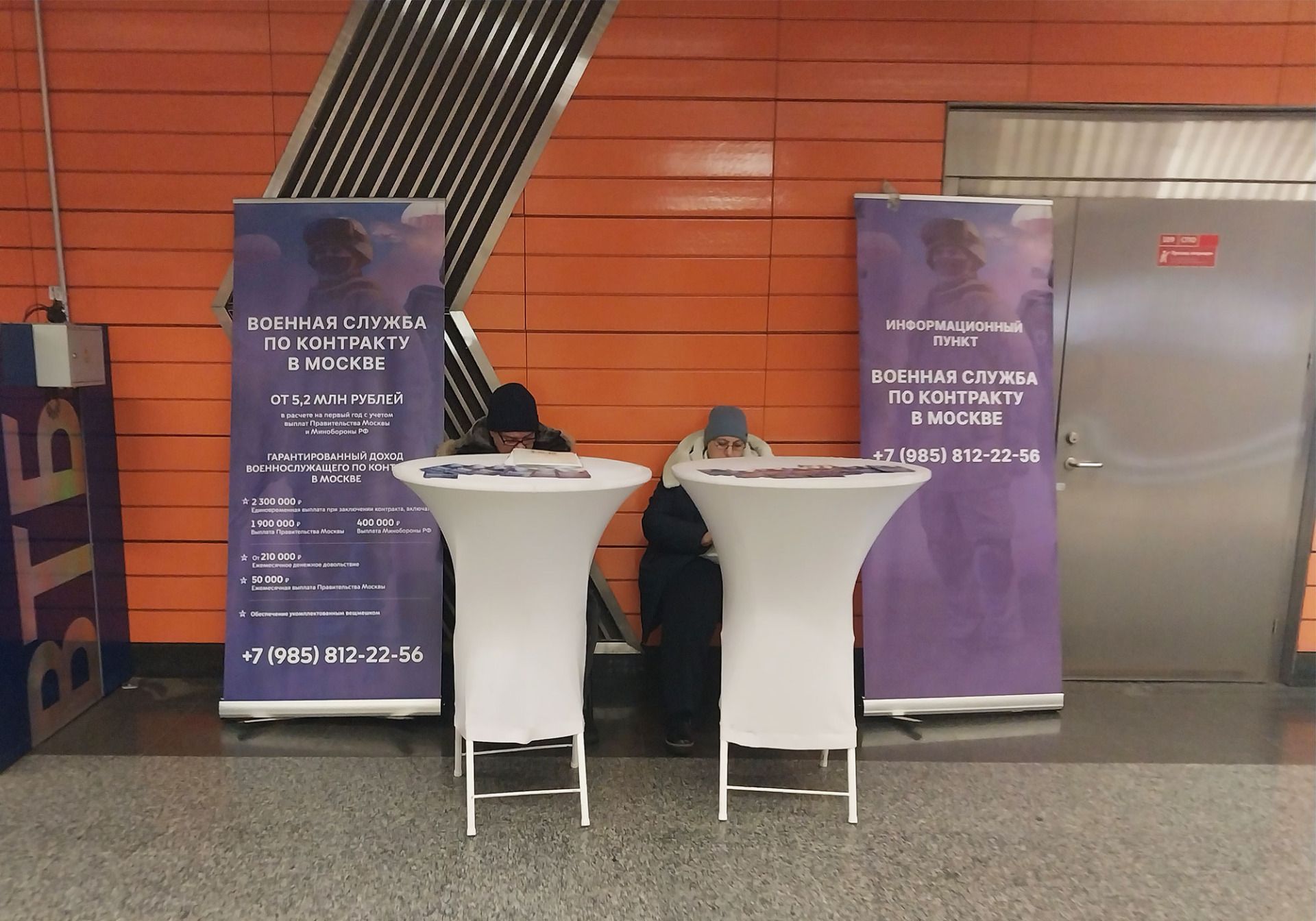
My team and I meet at 8:30 at Novokosino station. Near the turnstiles by the wall, there’s an information stand where you can get details about contract military service.
Kolya arrived before everyone else, and while we’re waiting, he jokes with me about the specifics of military funerals:
“It’s almost a regular funeral, except I’ll have more hassle, running back and forth, while you’ll stand aside and laugh at me. Just make sure the relatives don’t notice you laughing.”
Advertisement for contract military service at Novokosino metro station
Finally, Kolya adds that the coffin should be carried on the shoulders—that’s the honor for military funerals—and that tips at military funerals are rare. “Of course, I got tips the last three times, but I was very lucky,” he immediately explains. Kolya has been on the escort team for nine months without days off, and he juggles it with his main job. He became the team leader in his first month.
Soon, Vlad—a fan of dark humor who has been escorting funerals since August and wants to become a funeral agent—joins us, along with quiet Timofey. While we wait for the bus to the cemetery, he stays silent—saving his energy.
The body storage facility is supposed to open at 9 a.m., but the staff are late. Finally, an employee opens the sliding gates for us. Behind them, under a canopy in front of the warehouse, there are empty zinc coffins and various trash.
We carry the empty coffin from the hearse into the storage and lay it on the floor. The worker moves the coffin to make it easier to transfer the body, takes all the deceased’s documents, and goes to a neighboring room, where open zinc coffins are stored on shelves. The staff take one down and place it next to the burial coffin to transfer the body bag from the zinc coffin.
The body is in a funeral polyethylene bag—a pathological bag. It’s supposed to hold in biological fluids and block the smell of decomposition. According to other funeral brigade members, sometimes the bag doesn’t help. But at least through the black plastic, you can’t see the mangled body.
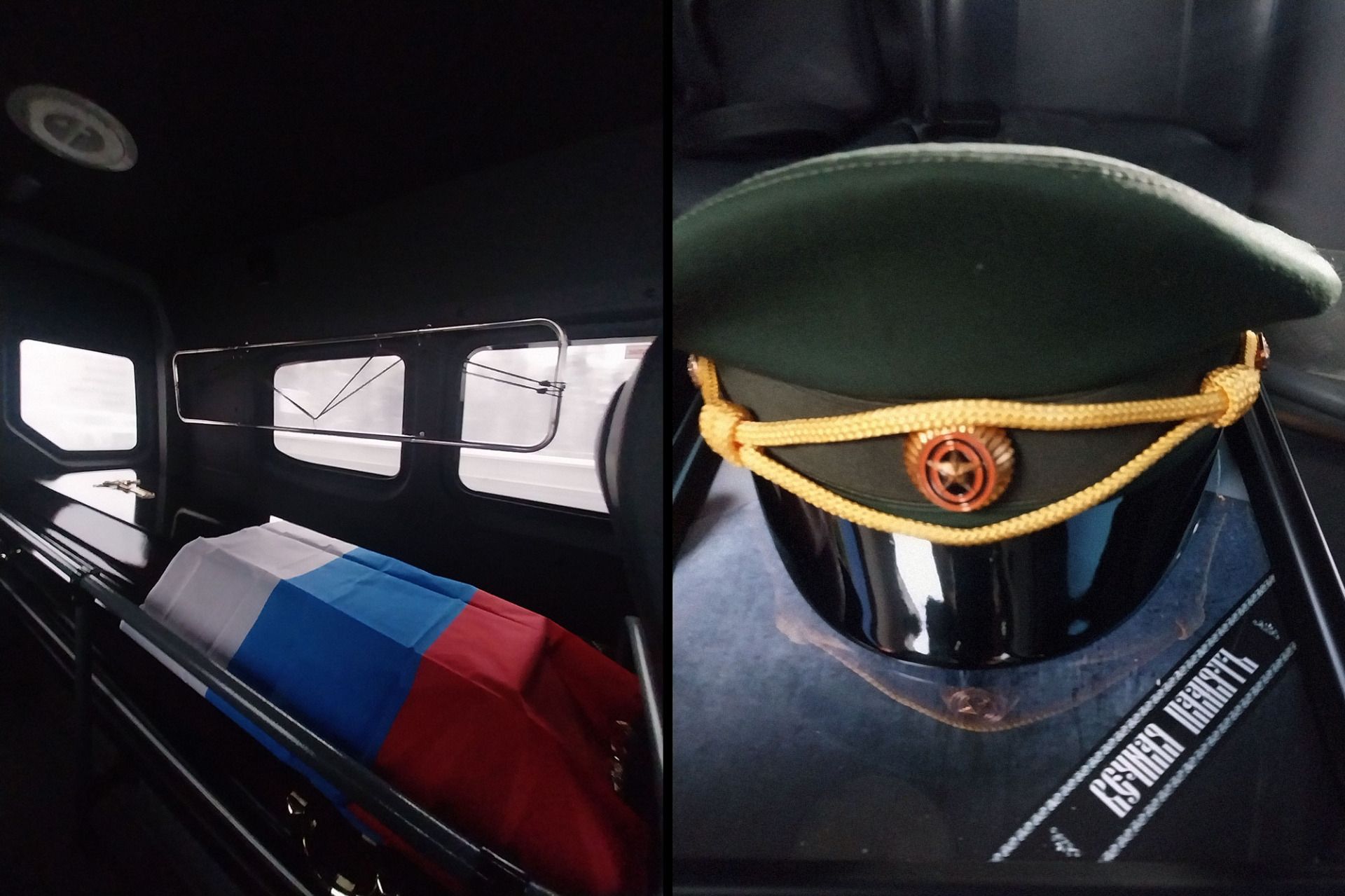
This time, the body is whole. The bag is slightly open, and you can see a bit of the deceased’s face. We cover it with a blanket and take the coffin to the car. There, team leader Kolya hands me a rolled-up black plastic ribbon with the inscription “To the Defender of the Fatherland from the Ministry of Defense.”
“Here’s a souvenir for you. These are standard ribbons that are issued, but we don’t use them, sometimes we keep them,” he says.
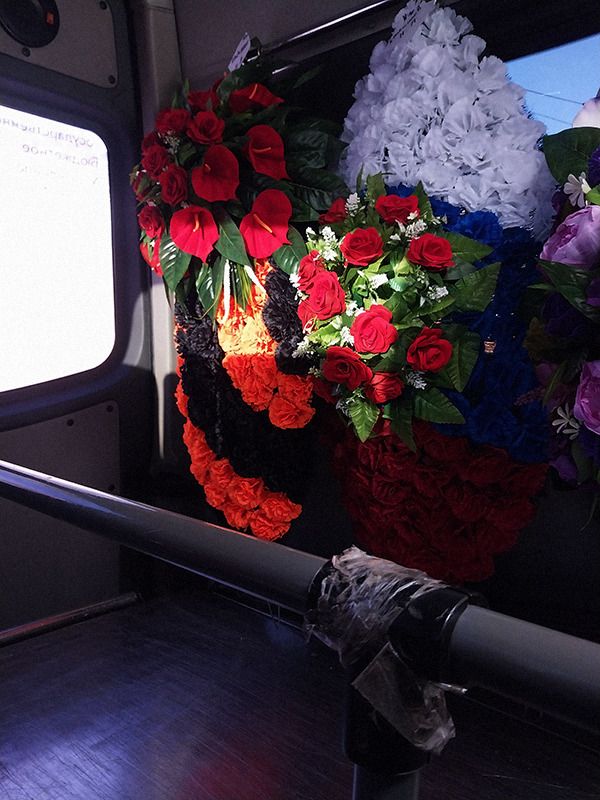
Besides the ribbon, the Ministry of Defense gives the fallen soldier a wreath.
As we drive, Vlad puts on headphones and falls asleep, while Timofey and Kolya discuss work, the deceased, and then the war. They don’t openly condemn the SMO, but from their conversation, it’s clear they have a negative attitude toward what’s happening.
“They’ve never seen that kind of money in their lives, and never will!” one of them says about the dead Russian soldiers. The funeral brigade colleagues speak regretfully about people who have no other way to solve their financial problems than to enlist for war.
We arrive at the old cemetery by the church, where the funeral service will be held. Near the church, the priest is clearing the road of snow. On the way to the church, we try carrying the coffin on our shoulders. Inside, we place the coffin on stands, put the cap and portrait at the “head” end, and the Russian flag at the “feet.” The loose ends of the flag are tucked inside the coffin.
The relatives finish the paperwork. By the hearse, the client talks with the team leader, and a big guy is holding an open bottle of Jägermeister. All the close relatives, along with the team leader, go into the church. The three of us enter at the end of the service and stand in the corner with the team leader. The relatives start to approach the coffin to say goodbye to the deceased. Two women sit on a bench by the entrance and begin to sob heavily.
After the service, the priest adds a few words, talking about the deaths of soldiers in the field, about desk-bound officers, and how everything is different for them after death. He ends by saying how important it is for society to unite for victory in the war.
We take the coffin back to the hearse to go to the new cemetery for burial. While we wait to leave, I talk with Andrey about the funeral service:
“Do priests often say things like that after the service?”
“It depends. Some like to talk for a long time—they’re trying to help people process their loss. But it was odd that this one was campaigning for the war.”
The hearse stops by a small area with a table and a tent. Under the tent, there are soldiers in an honor guard—three very young, and a fourth, an officer, much older. When we unload the coffin onto the table, the relatives ask the team leader to open the lid so they can place special items inside—an Iron Maiden vinyl record, cognac, cigarettes, toothpaste, a toothbrush. The team leader is already closing the coffin, but then the big guy, drunk on Jägermeister, asks him to lift the blanket and show the mother her son’s face.
“Better not,” the team leader asks.
“I’m old enough, I’ll survive,” the mother replies.
The team leader obeys and turns back the blanket. The woman silently gazes at her son’s dead face—intact, but half red.
“And you said it was a nightmare, that it was all bad,” the tipsy relative says, blushing himself.
“I didn’t say it like that, but okay,” the team leader replies.
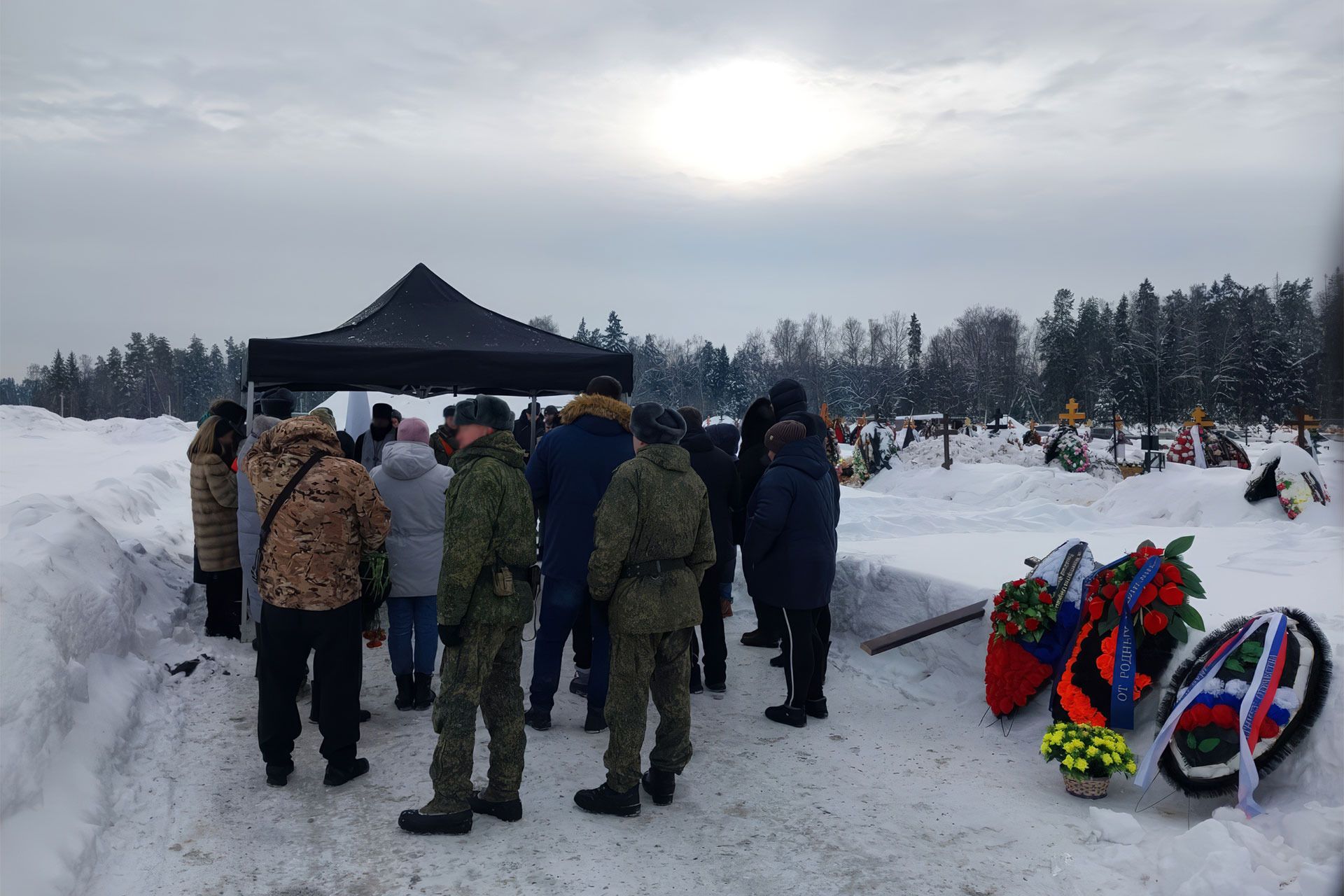
All preparations are done, and the funeral procession begins. The soldiers remove the flag from the coffin, fold it, and give it to the relatives. The senior soldier hands over the cap, a pillow for medals, and a chest. We carry the coffin onto the road, lift it onto our shoulders, and at the command “With the left!” march about 100 meters to the grave. After the gravediggers lower the coffin into the pit, three shots are fired into the sky.
After saying goodbye to the relatives of the deceased, the team leader gestures to us that there will be no tips today.
01/31/2026
The hearse driver is almost half an hour late—any longer and he could have been fined. While we wait, one of the loaders, Ilya, suggests warming up with some alcohol. Today, it’s cold.
Finally the hearse arrives, and we go for the body. Our deceased is light, in a sealed bag—likely missing some body parts. We cover the coffin with a flag, quickly carry it to the hearse, and head to Domodedovo Cemetery. The service will be held at the graveside. Loader Andrey is surprised by the number of flags and starts filming them with his phone.
“I don’t know if there’s a camera here, or if it’s allowed to film the flags. I don’t care. If I get fired for this, I’ll only be glad,” he says.
The hearse stops by the tent, the team gets out and starts preparing the wreaths—attaching ribbons to them. These are better quality than those from the Ministry of Defense—wider, with inscriptions like “From wife to husband.” You have to fold the ribbon in half, loop it under one of the frame wires, and thread the loose ends through the loop. I don’t have gloves, so with each wreath, it takes longer—my fingers are freezing.
The priest arrives and asks the team for the deceased’s name. Then the soldier’s wife approaches, and the priest asks her, “Mobilized or contract?” When he hears “contract,” he simply replies, “Good.” The wife asks to see the body, but the team leader and priest dissuade her.
“Feet frozen?” the priest asks me. “Check out self-heating insoles. I bought them for pennies at ‘Sportmaster,’ and now I’m very warm, even with these boots. It’s cold today, I have a few more services. I’ll definitely need some vodka.”
“Good tip! I’m already warming up!” Ilya tells the priest and shows him a flask.
The priest complains that the cemetery management didn’t assign more people for today. A line of cars forms on the road. Today, they’re burying 12 SMO participants here.
Finally, it’s time to carry the coffin. The priest leads the procession with incense, singing a memorial prayer. Later, the team leader tells me that at the end of SMO funerals, you can’t ask the client for a “thank you.” But today, we got a tip—10,000 for five people.
By undertaker standards, these were good, respectful funerals. And disrespectful funerals, according to one of them, “are when it’s obvious the person went for the money, died, his wife gets the death payout, no one cares, and the wife already found a replacement. Only the mother is to be pitied.”
“It’s all very sad, so many, possibly good young Russian guys are dying, and our gene pool is shrinking a lot, really a lot,” he adds.
02/06/2026
Today’s funeral is at Yastrebkovskoe Cemetery. The body storage is the same as last time. Team leader Stepan has already been at the storage for an hour. The bus doesn’t arrive as scheduled, so one of the loaders calls a taxi to avoid being late. At the meeting point, Stepan silently hands us GBU “Ritual” armbands and badges, we take photos for reporting, and get on the bus.
“Serves you right, you damn millionaire,” mutters a 60-year-old loader nicknamed Behemoth, looking at the coffin. “And he stinks, too.”
I don’t smell anything. Because the bus is accelerating and braking, we have to hold the coffin extra steady, which is not very well wrapped in the Russian flag.
At the cemetery, while we wait for the paperwork, Behemoth tells me a bit about his life. He’s tried all sorts of jobs, from chemist to furniture store manager, and before the “big war” he traded on the stock exchange. Now, because of sanctions, “everything’s blocked,” and the former trader works on the funeral escort team. But today is his second-to-last shift: he quarreled with the contractor and is quitting.
We arrive at the cemetery and stop far from the tent where the service will be held. The second loader suggests to Stepan that they carry the coffin from here, “so there’ll be more honors,” but Stepan doesn’t react to the joke. We unload the coffin, lay it on the table under the tent, and discuss with the gravediggers which route is best to carry the coffin so the ground for digging won’t be frozen. Stepping on the snow packs it down and removes the insulation in spots—the diggers don’t want that.
Finally, the relatives and loved ones arrive. They gather around the tent, and soon the service begins. There are about 30 people—they fill the whole road, standing in several rows, and the coffin can’t be seen behind them. At the end of the service, the priest calls the relatives to say goodbye to the soldier. The last to say goodbye is the deceased’s father. He puts his hand on the coffin, moves his lips, lets a tear fall, and steps away. The team surrounds the coffin, lifts it, carries it out from under the tent, puts it on their shoulders, and walks forward led by the priest for 10 meters, then passes the coffin to the gravediggers—who go their 10 meters to the grave. All the loved ones follow, to lay the deceased to rest. One of the gravediggers holds a shovel with earth, and the loved ones each take a handful and throw it onto the coffin.
While the grave is being filled in, my colleagues discuss SMO funerals. Our contractor started giving us such orders in September 2025. But actually, almost all GBU “Ritual” contractors have SMO funerals.
“What stuck with me in this job is that some soldiers and warrant officers don’t know what to do and ask us. For example, some don’t know how to properly fold the flag or hand it to the relatives. That shows that sometimes no one cares about these honors,” one undertaker says.
If you enjoyed this article, consider making a donation — one-time or, even better, monthly. Your support helps us motivate our authors and become better with every article.
Our organization is recognized by the Internal Revenue Service (IRS) as a 501(c)(3) tax-exempt, charitable organization, which means that all contributions made to us are tax-deductible to the fullest extent permitted by U.S. law. Individuals may generally deduct charitable contributions of up to 60% of their Adjusted Gross Income (AGI) for cash donations made to qualifying 501(c)(3) organizations. For donations of appreciated assets (such as stocks or other long-term capital assets), the deduction is typically limited to 30% of AGI, based on the fair market value of the asset. C-corporations may deduct charitable contributions of up to 10% of their taxable income for donations made to eligible charitable organizations.
By submitting a donation, you confirm that you have read and accept the following documents: Privacy Policy and User Agreement, and also give consent to the processing of your personal data.
If you would like to unsubscribe from a monthly donation, please email us at: [email protected]