The announcement of the August 15 meeting between Donald Trump and in Alaska shocked the entire world without exaggeration. Even seasoned observers needed several days to realize — this was not a guess, a prank, or a hoax. The range of assessments and forecasts for the upcoming summit was enormous: from hopes that the war would end very soon to skepticism about whether everything might fall apart at the last moment. Let’s try to understand the position both sides approached this rendezvous from and what might follow afterward.
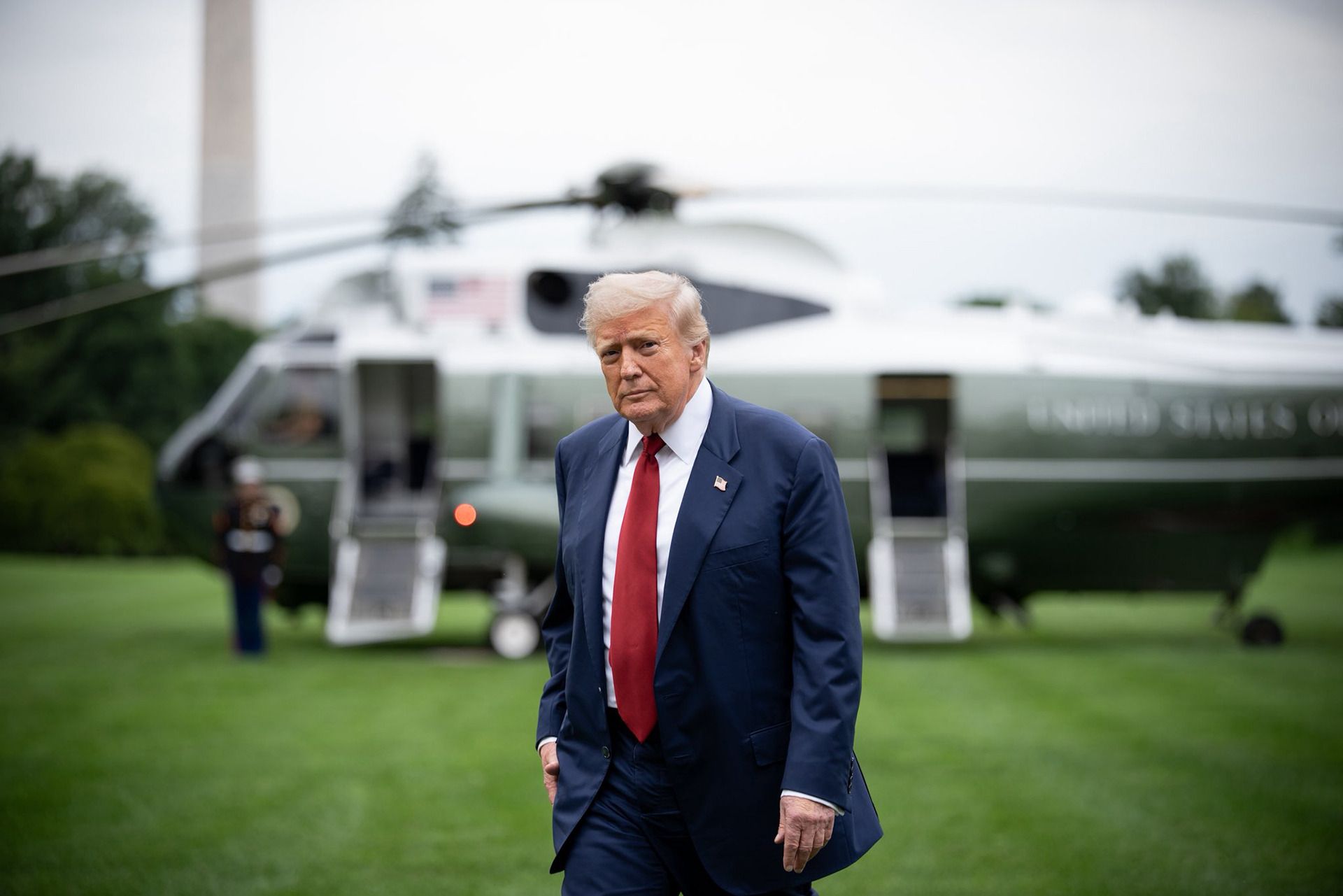
Donald Trump, August 12, 2025. Photo: x.com / potus
The news about the Alaska summit was met online primarily with memes about the 1938 Munich Agreement. Various image variations boiled down to one storyline — Trump appeared in the guise of British Prime Minister Neville Chamberlain. This politician, as is known, a year before World War II first allowed Hitler to carve out the Sudetenland region from Czechoslovakia, then let the Reich fully absorb its neighboring republic.
Image: threads.com
The analogy was popular not only among cartoonists and meme creators but also among more serious commentators. Some publications picked up on the comparison: saying Vladimir Zelensky is the new Edvard Beneš. This refers to the 1938 Czechoslovakian president, with a common story that in Munich he supposedly sat in a corridor while foreign politicians decided the fate of his country. Critics of Trump claimed that even if the Ukrainian president attends the summit of major leaders, he will only receive documents to sign retroactively.
This parallel is flawed from the start. First, Beneš was not held in a Munich corridor because he never personally went to Bavaria. Understanding well where the wind was blowing, the Czech sent two anonymous diplomats in his place to the dubious ceremony. Second, Zelensky must try hard to become the second Beneš. Unlike the Czechoslovak leaders of the 1930s, who avoided open conflict with the Nazis, the head of Ukraine has long chosen armed resistance. Yes, the frontline situation for Kyiv is currently worrying (more on this later), but nothing yet indicates political readiness in Kyiv to surrender.
Moreover, the ill-fated Beneš faced the black September of 1938 in complete diplomatic isolation. The British openly urged Prague to hand over the Sudetenland to the Nazis even before Munich, and France, bound to the Czechs by a defense pact, withdrew from the process. With Ukraine, things are different — it still has enough allies who regularly provide military assistance. On August 13, this was confirmed again during online talks between Trump and a group of European leaders ahead of the Anchorage meeting. Friedrich Merz, Emmanuel Macron, Keir Starmer, European Commission President Ursula von der Leyen, and NATO Secretary General Mark Rutte all participated.
Those gathered were united: any decisions made in Alaska must consider the fundamental security interests of both Europe as a whole and Ukraine in particular. So even if Trump suddenly wants to play Chamberlain, Old World politicians will not support the American.
Flying to the States to See Trump Himself!
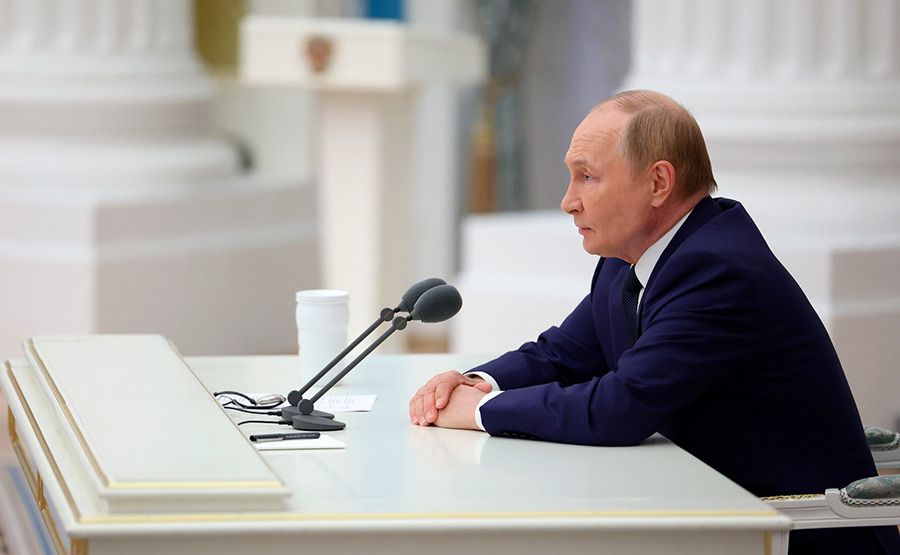
Vladimir Putin at a meeting on preparing the Russian-American meeting in Anchorage. Moscow, Kremlin, August 14, 2025. Photo: kremlin.ru
Of course, Trump’s latest pivot toward peace in Ukraine could not but confound observers. Recall that initially, on July 14, the US president issued an ultimatum to the Russian leadership to cease fire within 50 days. Otherwise, he threatened 100% tariffs on all countries continuing to trade with Moscow. But just 12 days later, the American escalated the situation: the deadline shifted from September 2 to August 8. Yet infinity was not the limit for Trump. On August 6, his special envoy Steve Witkoff flew to Moscow, and soon the surprised world learned about the Alaska meeting.
In a way, the billionaire politician stayed true to himself — even during Trump’s first presidency, experts discussed his “flood the zone” strategy.This refers to cases when an eccentric leader and his team intentionally “flood” the information space with seemingly meaningless, controversial, and even contradictory statements.
That the last point works was personally demonstrated by. As soon as the Alaska meeting took shape, the Russian president spent all of Friday, August 8 calling almost every friendly state about his trip. Other details are telling as well. The issue of a personal meeting between Putin and Trump was raised last winter during already somewhat forgotten talks in Riyadh and phone calls between the two presidents. But then Moscow hid behind vague phrases like: “intensive work is needed, it’s hard to talk about a date yet”. Translated from diplomatic to everyday language, this meant a lack of real interest in the Kremlin.
But by late summer, the mood among Russian leadership clearly changed. Now Putin immediately agreed to the meeting — despite Trump’s recent provocative stunt. On August 4, after a social media spat with Dmitry Medvedev (sic!), Trump ordered two US nuclear submarines to be sent to “relevant regions.” And Washington’s foreign policy activity didn’t stop there.
On August 8 — the same day Putin was calling friendly presidents — Trump received Nikol Pashinyan and Ilham Aliyev at the White House. The Armenian and Azerbaijani leaders signed a declaration on peaceful relations between their states. An unprecedented event: the longstanding conflict between two post-Soviet republics was settled not by Russia, but by the US. Moreover, the US brokered a 99-year lease of the strategically important Zangezur corridor — precisely when Moscow’s relations with Yerevan and Baku are, to put it mildly, quite strained.
Donald Trump with Azerbaijani President Ilham Aliyev and Armenian Prime Minister Nikol Pashinyan, August 8, 2025. Photo: x.com / potus
What is all this if not manifestations of the neocolonial model and unipolar hegemony repeatedly condemned by Putin? Yet the Russian president responded to both events simply by agreeing to a personal meeting. Moreover, not in neutral UAE (which the Russian leader called “a suitable place”), but on US soil. As Americans say in such cases, last but not least.
Budget in Exchange for Hectares of Lunar Fields
“Submarine diplomacy” and “concession diplomacy” were not the only recent moves by Trump against the Russian leadership. Just consider his post on his own Truth Social on July 31, when the American president called the Russian economy “dead.”
It seems Trump, coming from business, knows where to apply pressure. By late summer 2025, it’s increasingly difficult for Kremlin leadership to hide financial problems. While in winter-spring outside experts cautiously discussed overheating of Russia’s economy, stagnation in its civilian sectors, and other localized challenges, by July the situation became much clearer. According to the Finance Ministry, there is a nearly 19% hole in the Russian budget relative to its volume: the state spends significantly more all year than it earns (due both to falling oil export revenues and other factors).
Yes, officials publicly claim the difficulties are temporary and minor. However, against leadership here is simple arithmetic. Initially, the government projected a deficit for all of 2025 at 1.2 trillion rubles (0.5% GDP), then raised it in spring to 3.6 trillion (1.7% GDP). But now it’s only August, and the figure is approaching 5 trillion (2.2% GDP) — so pessimism is quite justified. Uncontrolled growth of budget losses never bodes well for citizens — it means price increases, income slowdown, and cuts in social services.
Natural question: can such an economy continue what the current authorities call a “special operation”?
Last spring, with oil prices falling, experts at the US Institute for the Study of War (ISW) suggested the situation was not yet fatal for Putin. Foreign experts then predicted that even with low resource prices, Russia could fight in Ukraine for at least 12-16 months. Western consensus has not yet revised this — they still believe Russia’s military endurance will last at least until 2027.
The conservative estimates are supported by the frontline situation. This summer, the Russian army continues advancing, primarily in Donbass. Specifically, in mid-August, the pace of Russian Armed Forces’ advance rose to an abnormal 100-110 sq km per day by this war’s standards. The attackers are trying at all costs to capture Pokrovsk in western Donetsk region. This is the penultimate district center still controlled by Kyiv, from where theoretically it’s possible to advance deeper into Ukraine — into Dnipropetrovsk and beyond.
Judging by how the battle for Pokrovsk is developing (even pro-Ukrainian observers call the situation there critical), the city’s fall is a matter of time. The Ukrainian Armed Forces clearly lack manpower to continue defending it.
Two “Moscows” in Three Years
The issue of territorial control remains the most painful for a full end to the war in Ukraine. And this deadlock is most visually apparent on the geographic map.
Putting aside Crimea and Sevastopol, the current situation in the regions incorporated into the Russian Constitution is as follows. The Russian army has almost completely captured Luhansk region (99%), while in Donetsk, Zaporizhzhia, and Kherson regions, it controls roughly 70-75% of the territories, forming a continuous arc along the Azov and partly Black Seas (up to the Kinburn Spit in Mykolaiv region). Meanwhile, Ukrainian forces confidently hold the administrative centers of Zaporizhzhia and Kherson, and the advancing side currently lacks the capability to seize both cities by force.
Also, despite numerous announcements, the Russian Armed Forces have not created a “sanitary cordon” in Sumy and Kharkiv regions. Such a cordon could have been useful in pressuring Kyiv to abandon everything mentioned in the Russian constitution. Meanwhile, Ukrainians lost a politically valuable asset last winter — part of the Sudzhansky district of Kursk region, occupied in August 2024. Theoretically, this small territory could have been very useful to Zelensky’s office this August, but now they no longer have it.
In short, the frontline is at a stalemate. Ukraine has enough forces only to hold the front line with minimal territorial losses, and Russia has enough only to maintain minimal forward progress.
Since late autumn 2022, after a series of offensives in Donbass, the Russian army has occupied only 15-17% of the declared “DPR” territory, about 4,500 sq km. In other words, three years of continuous grinding battles around Bakhmut, Avdiivka, Chasiv Yar, and elsewhere have yielded Russia territory smaller than two Moscows — and devoid of any life, turned into a lunar landscape and construction waste dumps.
Over the past two years, both sides have indulged in two misleading calculations. Ukrainians believed the enemy economy, overheated by military spending and crushed by international sanctions, would collapse soon, and the enemy army would go home on its own. The Russian leadership hoped the enemy would soon exhaust both Western support and its internal mobilization resources. Both theories have proven mistaken — the declared political goals cannot be achieved by military means by either side.
It seems Kyiv is ready to admit this openly. At least, in the list of Ukrainian demands published by Politico on August 13, there is no demand for the return of occupied territories. The demands include a full ceasefire, compensation for damages, future security guarantees, maintaining anti-Russian sanctions, and returning Ukrainian children and prisoners home. This package does not yet look like conditions Moscow would agree to “here and now.” But potentially, it could form the basis for a peace settlement — if, of course, the Kremlin abandons dreams of full control over the “new regions.”
“Finding the Right Combination Will Not Be Easy”
So far, it looks as if fate, against all odds, is giving a last chance to exit the deadlocked war amicably. On one hand, the Ukrainian leadership has effectively admitted it cannot forcibly restore the borders of 2013 or 2021. On the other, Kyiv’s demands to keep sanctions and seek compensation from Moscow can realistically be rejected if the Kremlin truly wants to cease fire.
Much depends personally on Donald Trump. He seems to be the best Western politician for the specific goal of being heard by Putin. Indeed, could Biden or Macron have pulled off any of the 47th US president’s stunts this month — whether responding to Medvedev’s tweets with nuclear submarines or leasing a transport artery in the distant Caucasus for 99 years?
The marked archaic style is what clearly brings the current Russian and US leaders closer. Both have repeatedly shown they are ready to act by methods not of the Cold War but the era of “gunboat diplomacy” and “The Great Game.” Perhaps Trump will find it easier in Alaska to offer his counterpart, along with the stick, a carrot: joint development of Arctic resources, the notorious rare earth elements, or other economic projects.
“Avoiding the situation of rewarding the aggressor here will still be impossible, but one can console oneself with saving the victim and the fact that the initial aggressive plans were much broader. Finding the right combination of such a ‘code’ will not be easy, and somewhere Putin will simply have to be pressured.”
- Alexander Baunov, Russian publicist
Yes, even in the best-case scenario for ending the war, all this will only be a first step. Perhaps in the form of the already discussed idea of an “air truce” or some other form. And even if this step is taken, it will require long, painstaking work and painful compromises with personal ambitions from all sides. In that case, a personal meeting between Putin and Zelensky will be needed: Trump has already announced its possibility, though at the moment such a scenario seems like fantasy. Finally, for Russia, ending the war means a series of painful processes — reintegrating hundreds of thousands of veterans into civilian life, closing pointless military industries in peacetime, and inevitably asking the population: what was all this for?
According to sources from The Guardianthere is currently little optimism. They say Putin, first, firmly insists that Ukrainian forces fully clear Donetsk region, and second, intends to divert Trump’s attention from Ukraine by discussing the renewal of Russian-American nuclear arms agreements. The US president will need both the stick and the carrot again to “bring the Russian colleague back to the war.”
However, the alternative is even bleaker — continuation of the war with all its consequences. Or perhaps even its transition to a qualitatively different stage: just recently, the first contingents of Russian troops began arriving in Belarus to participate in the “Zapad-2025” exercises. Let’s hope they return home safely after a month.
If you enjoyed this article, consider making a donation — one-time or, even better, monthly. Your support helps us motivate our authors and become better with every article.
Our organization is recognized by the Internal Revenue Service (IRS) as a 501(c)(3) tax-exempt, charitable organization, which means that all contributions made to us are tax-deductible to the fullest extent permitted by U.S. law. Individuals may generally deduct charitable contributions of up to 60% of their Adjusted Gross Income (AGI) for cash donations made to qualifying 501(c)(3) organizations. For donations of appreciated assets (such as stocks or other long-term capital assets), the deduction is typically limited to 30% of AGI, based on the fair market value of the asset. C-corporations may deduct charitable contributions of up to 10% of their taxable income for donations made to eligible charitable organizations.
By submitting a donation, you confirm that you have read and accept the following documents: Privacy Policy and User Agreement, and also give consent to the processing of your personal data.
If you would like to unsubscribe from a monthly donation, please email us at: [email protected]