The sad path of Venezuela: it could have been the American Qatar, but became a country-run criminal organization.
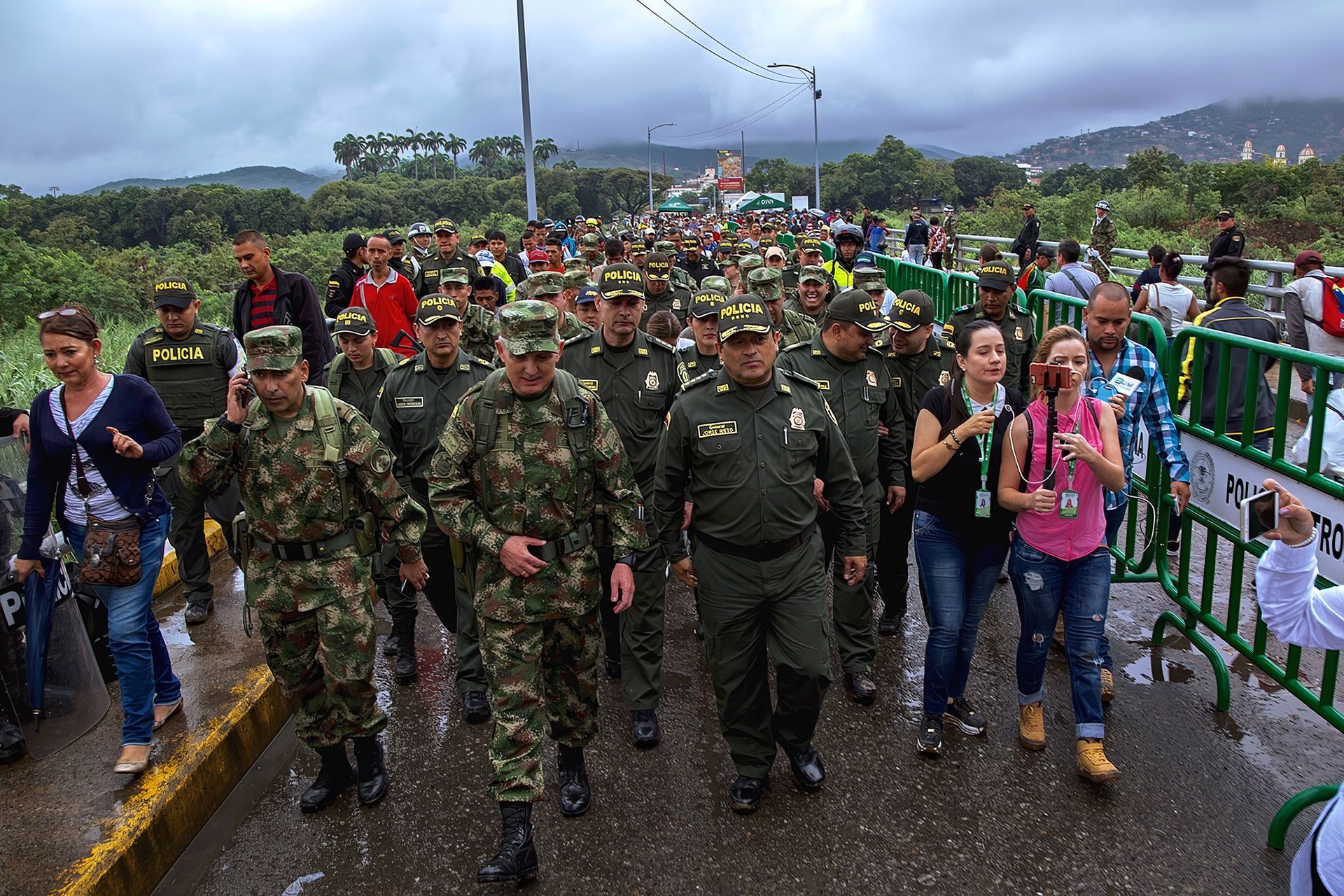
Colombian police at the border crossing escort Venezuelan citizens who decided to leave their country, February 2018. Photo: Wikipedia / National Police of Colombia
In 1913, a group of futurists in Russia shocked the audience with the opera “Victory Over the Sun.” The plot itself looked provocative: a squad of “budetlyans” sets off into space to conquer the star closest to Earth. The message was read between the lines. The celestial body symbolized Alexander Pushkin and other Russian classics, whom the futurists urged to “throw off the ship of history.”
More than a century later, the story of conquering the star received a new interpretation on another part of the globe. US President Donald Trump is determined to defeat the Cartel de los Soles, “Cartel of the Suns”: this is how the US refers to the alleged transnational drug trafficking network under the patronage of Venezuelan authorities. This autocracy, led by Nicolás Maduro since 2013, has become a kind of classic, albeit a highly dubious one. The local leftists — Chavistas — have held power for 26 years. They successfully survived the death of the regime's patriarch Hugo Chávez, foreign sanctions, and the drop in oil prices, the key export resource for Venezuela.
Meanwhile, Maduro's government enlisted criminals into its service and allied with terrorists and autocrats worldwide. Finally, the unchanging rulers of Caracas have brought their country — the richest in the world in oil reserves! — to economic indicators on the borderline between the third and fourth worlds. The fall of such “Suns” may not seem terrible, but it is unlikely to bring anything good to Venezuela and its neighbors.
The Long Road North
A peaceful life for Caracas resident Yoannelis Figueroa ended in the summer of 2023. One ill-fated night, people in uniform came to her home. The uninvited guests demanded a bribe from the young woman, threatening to harm her relatives otherwise.
Yoannelis was well aware of her “guilt.” She participated in the electoral campaign of María Corina Machado, an opposition presidential candidate (and future Nobel Peace Prize laureate). The vegetarian times of the late Hugo Chávez, when authorities turned a blind eye to anti-regime activism, were long gone. Under new President Nicolás Maduro, any act of open dissent promised Venezuelans trouble with the police or the tamed organized crime; by the mid-2020s, the differences between them in the country became conditional.
They [the police] put a gun to my son's head. It was terrible, I screamed. I thought they would shoot my child. They said I was protesting against the government. After that, they ransacked my house and demanded $150.
- Yoannelis Figueroa
For opposition Russians, this sounds like a fairy tale. Even by the standards of a depressed district center, a bribe of 12,000 rubles seems quite symbolic to buy off law enforcement for “politics.” But for impoverished Maduro's Venezuela, $150 is quite a fortune; the average citizen would have to save it for several years. Yoannelis, however, had dollars and obediently paid the uninvited guests. But the police extortion did not end there.
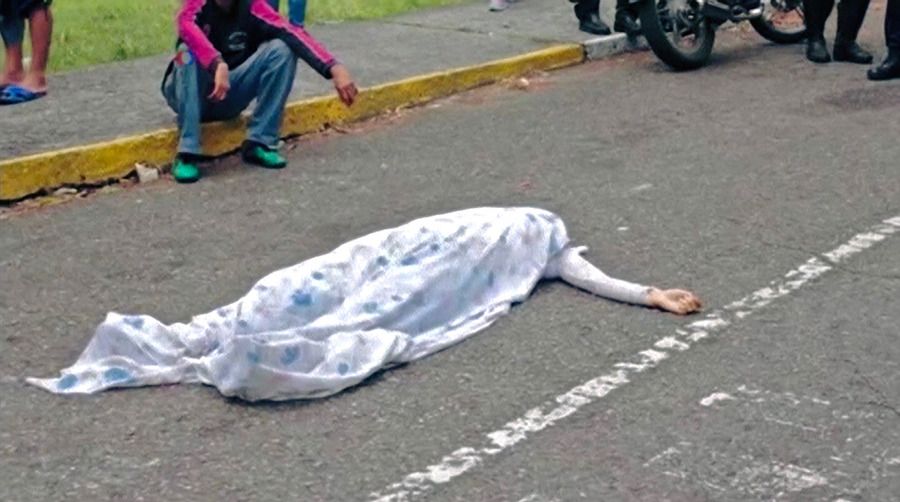
The body of 24-year-old Paola Ramirez — a student shot at a protest by presumably regime-loyal bandits, “colectivos,” April 19, 2017. Photo: Wikipedia / Voice of America
As the Venezuelan later suspected, the people in uniform were backed by her relatives working for the regime. Supposedly, Yoannelis's participation in Machado's campaign ruined their careers, and they decided to take revenge through corrupt law enforcers. By November 2023, Figueroa's monthly “tax” rose to $500, and the woman decided to flee the country with her husband and four children.
The journey to the US through Central America cost the family eight months of life, several thousand dollars in bribes to border guards, and countless nerve cells. In the end, Yoannelis and her loved ones illegally crossed the Mexico-US border on the freight train La Bestia — right on the roof, violating all safety rules, with hundreds of similarly desperate people from different Latin American countries. Anyway, Figueroa eventually reached the coveted New York, and this fall their story was told to the Russian-speaking audience by Novaya Gazeta Europe.
Yoannelis's story is one of many similar testimonies: by the end of 2025, over 8 million Venezuelans live outside their homeland. And this is despite the population of the “Bolivarian Republic” not exceeding 29 million people. In other words, about every fourth Venezuelan is currently abroad. Some flee political repression, others total poverty, and still others the organized crime intertwined with the state.
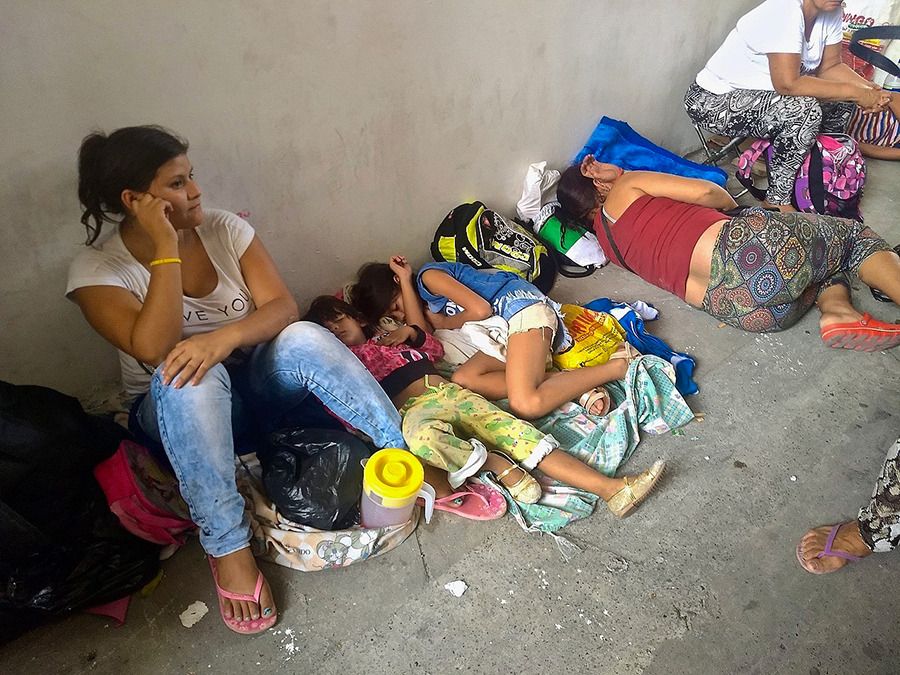
Venezuelan emigrants sleep on the street in Colombian Cúcuta, summer 2018. Photo: Wikipedia / PROVEA
At the turn of the 15th and 16th centuries, the country was named after stilt settlements on the Paraguaná Peninsula: they reminded Spanish sailors of Venice (Venezuela literally means “Little Venice”). Five centuries later, this allegory took on a new grim meaning. If “Great Venice” can be drowned by an impersonal force of nature, then “Little Venice” is dragged to the bottom of all world rankings by very specific people.
Amending the Constitution Amid Civil Wars
Venezuela became a separate sovereign state in 1830. Before that — after gaining independence from Spain in 1821 — it was part of the so-called “Gran Colombia,” a short-lived super federation in northern South America, for nine years.
The short-lived “Gran Colombia” of 1819-1831 on the map: now four separate states (Colombia itself, Venezuela, Panama, and Ecuador). Image: Wikipedia / Agostino Codazzi
At that time, former Madrid colonies proclaimed themselves republics, adopted progressive constitutions, and declared their loyalty to freedom and legality. In reality, young democracies were heavily storm-tossed, and political life was often a cycle of dictatorships and internal conflicts. Venezuela, in particular, stood out among neighbors only in a negative way.
Here are some figures:
15 major and minor civil wars occurred in the country during the first 70 years of its independent history;
26 times in Venezuelan history the federal Constitution was rewritten;
The republic waited 58 years for its first president who was lawfully elected and did not overstay his term (which at the time was two years). This man was Juan Pablo Rojas Paúl, who led Venezuela from 1888 to 1890 and managed to do much good for the country.
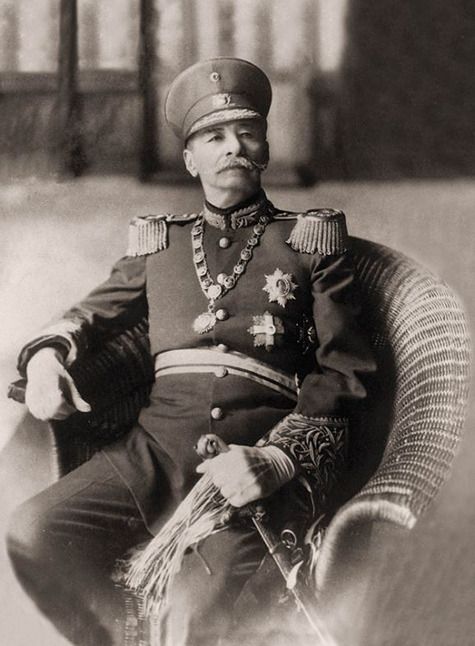
Unfortunately, Rojas's example did not inspire his compatriots much. His successors returned to old habits: trying to seize power at any cost and hold on to it as long as possible. The most successful was Juan Vicente Gómez — the future prototype of the main character in Márquez's “The Autumn of the Patriarch.” In 1909, Gómez seized the presidency by force and ruled for 26 years until his death. He largely became the father of modern Venezuela. Under him, large-scale oil production began, with revenues going not so much to the budget as to the president's and his associates' pockets through gray schemes.
Juan Vicente Gómez — the most successful Venezuelan dictator under whom oil production became the basis of the national economy, early 1930s. Image: Wikipedia / Archivo Audiovisual de la Biblioteca Nacional de Venezuela
After Gómez's death in 1935, many tried to follow his path but with little success. Then it seemed that “money had defeated evil.” Thanks to oil exports — despite the stinginess of British and American companies — some money appeared in Venezuela, a middle class emerged in cities, and mass democratic parties formed. Yes, all this splendor did not go beyond Caracas, Maracaibo, and other large, mostly “white” cities in the north, but it was something.
In 1958, a bloodless coup took place in Venezuela. Democratically minded officers overthrew their comrade-dictator Marcos Pérez Jiménez and restored civilian rule. The country then went against trends in neighboring South America: while ultra-right military juntas seized power elsewhere, Caracas chose parliamentary democracy and alternation of power.
Anti-Democratic Action
The years 1958-1999 are known in Venezuelan history as the Fourth Republic. It was an imperfect, quite corrupt, but still functioning democracy. A real miracle for Third World countries of the Cold War era — with their various shades of authoritarianism.
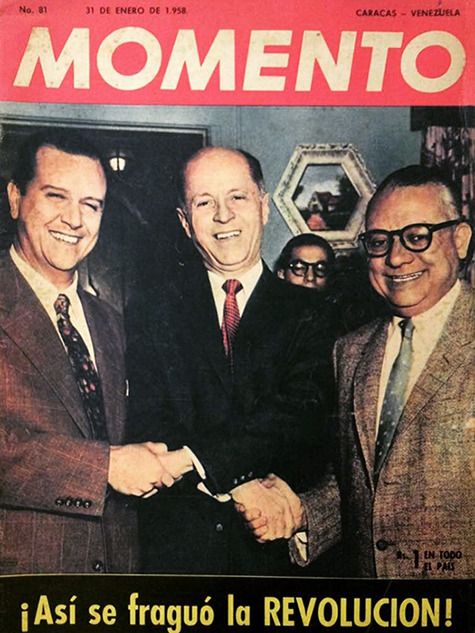
The key to the Fourth Republic's resilience was the Punto Fijo Pact. On October 31, 1958, in the city of the same name, leaders of the main political forces — the left-centrist “Democratic Action,” the liberal “Democratic Republican Union,” and the conservative Social Christian Party — agreed on common principles and unified rules of political struggle. The pact worked successfully for over 30 years. Parties alternately lost and won elections, power regularly changed hands, and the army stayed in barracks all that time.
Punto Fijo Pact on the cover of a Venezuelan magazine, 1958. From left to right, leaders of key parties: Christian Democrat Rafael Caldera, liberal Jóvito Villalba, and left-centrist Rómulo Betancourt. Image: Wikipedia / Revista Momento
Among the presidents of that era, Carlos Andrés Pérez of Democratic Action played a fateful role. The left-centrist politician served two terms, from 1974-1979 and 1989-1993. Pérez's first term coincided with the golden years for oil exporters. Due to the anti-Western embargo by Arab monarchies, oil prices quadrupled, and Venezuela was flooded with petrodollars. Pérez decided to indulge himself — his administration was nicknamed “Saudi Venezuela” due to lavish spending. Chronic corruption was exacerbated by welfare expansion, widespread nationalization, and large infrastructure projects.
Ten years later, Pérez returned to the presidency of a very different country. After the mid-1980s oil price crash, Venezuela found itself in a situation similar to the Soviet Union during perestroika. It suddenly became clear that relative prosperity rested entirely on “black gold,” and the country had nothing else to offer the global market. Then left-centrist Pérez almost instantly turned libertarian. Through a series of forceful acts, he rolled back all his previous reforms and left his core electorate without familiar salaries, benefits, and confidence in the future.
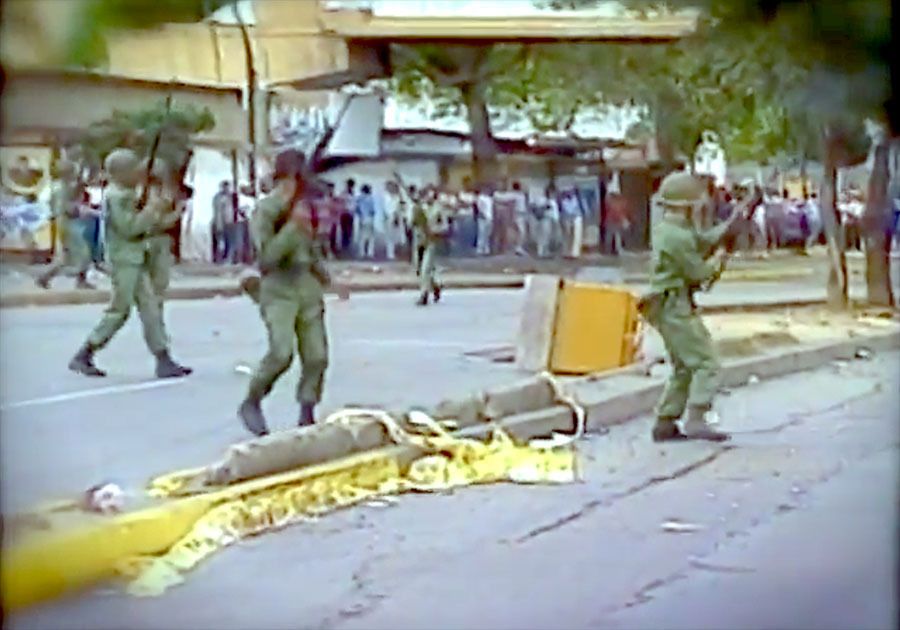
Ordinary Venezuelans literally didn’t know how to live on. Due to the cancellation of gasoline subsidies, thousands could not even get to work — they lacked money. The country instantly plunged into strikes and demonstrations, culminating in the February 1989 riots known as Caracazo. Pérez’s administration, faced with mass protest, did nothing but deploy army units against demonstrators. The result was similar to what would happen three months later in Beijing’s Tiananmen Square: soldiers fired on unarmed people; the uprising was brutally suppressed. Estimates of the dead range from 277 to 3,000 protesters over several days.
Soldiers dispersing Caracazo participants, February 1989. Image: Wikipedia / Prensa Presidencial
Pérez endured and continued neoliberal reforms. On paper, Venezuela’s economy even recovered, but society never forgave him for the horrors of Caracazo. In 1992, army officers twice tried to overthrow the unpopular president. Both attempts failed, but a year later, parliament impeached Pérez — formally not for the 1989 tragedy but for exposed financial fraud. Citizens elected right-centrist Rafael Caldera as the new president.
However, even this politician — much more honest and principled than his predecessor — could no longer save the Fourth Republic’s prestige. The imperfect Venezuelan democracy was undermined by low oil prices, banking crises, and corruption scandals. Moreover, Caldera made a fateful decision in search of civil peace. In 1994, the president granted amnesty to the leader of a two-year-old military conspiracy — 40-year-old Lieutenant Colonel Hugo Rafael Chávez Frías.
The Extraordinary Chavismo
Chávez was a completely unsystematic figure who did not fit into the framework of the Punto Fijo Pact and the Fourth Republic. The former coup plotter did not hide this; his supporters' party was initially called “Movement for the Fifth Republic.”
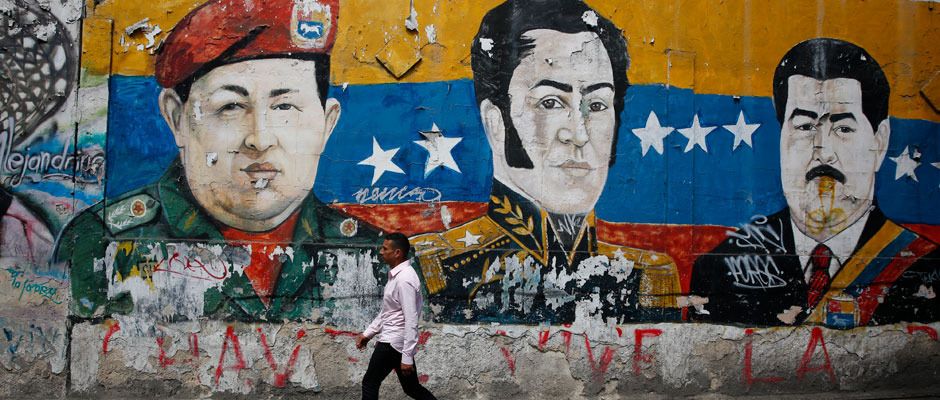
Typical mural for Chavista Venezuela: Simón Bolívar (center) depicted alongside the late (left) and current heads of state. Image: www.caracaschronicles.com
Chávez’s specific ideology was a mix of various leftist doctrines, distilled anti-Americanism, and the cult of Simón Bolívar. The young politician consistently positioned himself as the successor to the early 19th-century liberator hero. After coming to power, he named almost everything after his idol: his movement, its ideology, the national currency, and even the state itself. Quite ironic, since the real Bolívar held fairly conservative views during his lifetime.
Our fellow citizens are still unable to widely and independently exercise their rights because they lack the political virtues inherent to a true republican. Virtues that cannot be acquired under absolutist governments.
- from Simón Bolívar’s Cartagena Manifesto
Of course, the core Chavista electorate was not concerned with historical contradictions. They followed the former lieutenant colonel because the Fourth Republic was an empty sound to them: urban poor and residents of outlying southern and eastern states where petrodollars rarely reached. They saw Chávez as a man of action capable of ending the corrupt and deceitful regime. The populist also benefited from racial factors. Dark skin in Latin America traditionally associates with humble origins, making it easier for a non-white politician to become one of the poor.
And Chávez succeeded. On December 6, 1998, he won his first presidential election, and a year later successfully passed a revamped constitution in a left-populist spirit via referendum. On July 30, 2000, benefiting from the “reset” of terms in the new constitution, Chávez was reelected president — now with a six-year term instead of four. In 2002, the politician survived the first crisis: another failed military coup in Venezuela, this time under right-wing slogans rather than left-wing.
Despite eccentric behavior and international scandals, Chávez remained a popular leader throughout the 2000s. He was supported not only by poor mestizos and indigenous people from the periphery but also by a significant part of the educated middle class disillusioned with old politicians after Caracazo and 1990s corruption scandals. The explanation was simple. Like Pérez three decades earlier, Chávez bathed in petrodollars thanks to favorable prices and generously shared income with the poor. Meanwhile, white city dwellers, despite his uncompromising anti-capitalist rhetoric, were allowed to run their small businesses.
Chávez liberated small trade, made self-employment an accessible form of economic survival. Police and bureaucracy stopped demanding permits; Caracas’s central squares looked like continuous flea markets where people sold and resold items made at home in family workshops. And the slave blessed fate.
- Alexander Baunov, Russian political scientist
Nowadays, “normal” autocrats treat elections as acclamations. Strong competitors are eliminated early, opposition campaigning is suppressed, and streams of protest votes are blocked by massive fraud. Chávez, however, enjoyed popular votes with enthusiasm and tolerated competition. During 14 years in power, he participated in presidential elections four times and held six plebiscites on various issues. Hugo usually won by a small margin, and once — in 2007, during another attempt to rewrite the much-troubled constitution — he even lost to the opposition, admitting his failure live on TV.
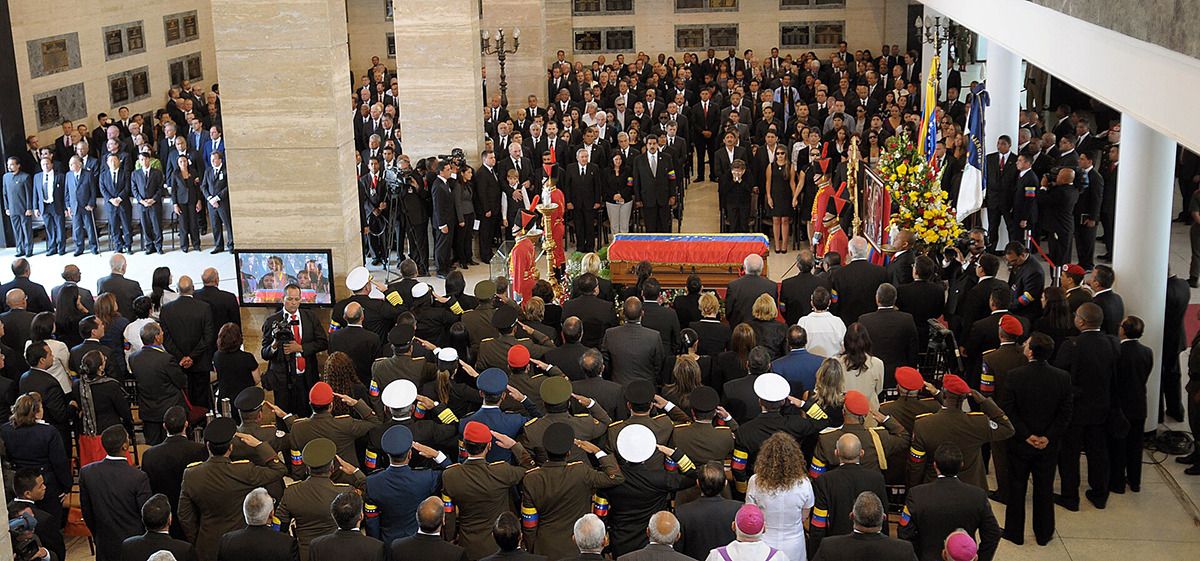
Farewell to Hugo Chávez, March 8, 2013. Image: Wikipedia / Presidencia de la República Mexicana
But on March 5, 2013, the still relatively young Chávez (only 58 years old) lost to a far more relentless opponent — death. Apparently, a viral infection worsened his prolonged cancer. Many then thought the “Bolivarian Republic” built by the deceased would hardly outlive its creator.
The Bus Took a Wrong Turn
Before his death, Chávez appointed his official successor — then 50-year-old Vice President and former foreign minister Nicolás Maduro, a bus driver by first profession. The replacement seemed unequal. The portly “august” with sagging cheeks did not even resemble his fit, loud “Caesar” with an eagle nose.
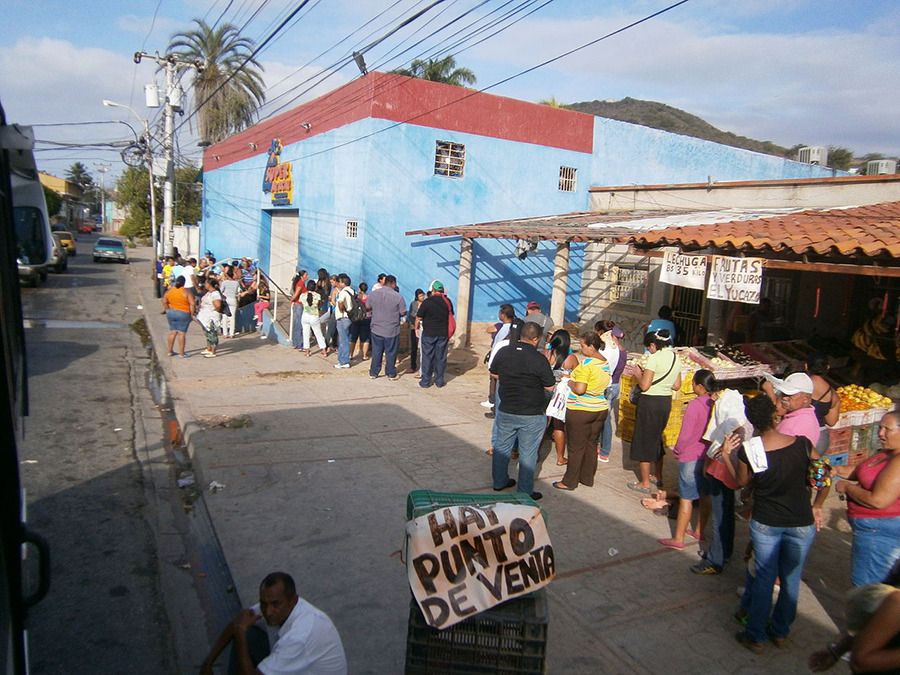
Venezuelans queue for groceries at a state food store, 2014. Image: Wikipedia / Wilfredor
Maduro won his first election with difficulty and clearly not without fraud. On April 14, 2013, the heir beat the united opposition candidate Enrique Capriles Radonski by only 1.5%. By the way, his two subsequent reelections — in 2018 and 2024 — went only slightly better. In both cases, the regime overwhelmed opponents with mountains of fraud and then brutally suppressed street protests. A year ago, authorities even feared allowing truly strong opposition candidates like Nobel laureate María Machado on the ballots.
Year after year, elections became harder for the regime not only due to Maduro’s lack of charisma. In the 2010s, Venezuela found itself on the same rakes as in the late 1980s. Once again, it became clear that nothing had changed in the national economy since Juan Vicente Gómez’s time. The country still lived off oil sales abroad — other sectors make up less than 20% of total exports. Therefore, the 2014 oil price collapse hit both the state budget and ordinary citizens’ wallets hard. The crisis’s consequences worsened as key economic sectors were again heavily regulated in Venezuela.
Another wave of anti-government protests in Venezuela: against rising crime and declining living standards, December 2016. Image: Wikipedia / EneasMx
It seemed Venezuelans would inevitably reject Chavismo as they did the Fourth Republic. In December 2015, the democratic coalition triumphantly won the National Assembly elections. In January 2019, the opposition parliament openly clashed with Maduro, demanding the president's resignation. By then, the nationalized economy was gasping for air: per capita GDP fell fourfold in less than 10 years , inflation reached thousands (%), and the first packagesof international sanctions followed.
[In Venezuela] there is no point in looking at statistics because official statistics do not exist. The last ones were published in 2014. Everyone searches for their own and quotes various data that cannot be verified. No one wants to comment on data presented by the other side. They just say: sorry, but it makes no sense. [What matters to them is] what their 600 bolivars a day [about $0.002 at the then exchange rate] are really worth.
Yet Maduro endured. The thing is, Chávez’s successor inherited not only murals with Bolívar and memories of squandered petrodollars. The patriarch of the “Bolivarian Republic” left the successor three working tools for a budding autocrat. And the former driver used them. These are:
A mass ruling party (since 2007 — the United Socialist Party of Venezuela) relying not on passive loyalty to the current leader but on fervent support for leftist ideology. Despite all difficulties, the USPV still has millions of active and ideologically motivated supporters. They sincerely believe that all the country’s hardships are the machinations of American imperialists and their fifth column inside Venezuela;
A purged and nurtured security apparatus. Since the 2000s, the security leadership in the republic has been closely tied to political leadership — not so much by “Bolivarian” ideas as by corruption connections;
Established diplomatic ties. The Chávez-Maduro regime originally maintained warm relations with allied Latin American regimes (Cuba, Bolivia, Nicaragua) as well as autocracies in the other hemisphere (Russia, China, Iran). These ties only strengthened as Venezuela tightened its screws and clashed with the “collective West.”
Chavistas also found a less conventional tool. The worse the economy fared, the more the Caracas regime merged with organized crime.
Dictatorship of Slums and Cartels
“Colectivos are the pillars that protect our Homeland. Guarimberos are mortally feared,“ said Prison Affairs Minister Iris Varela back in February 2014. In this short quote, two important terms for Venezuelan politics appear, unfamiliar even to Spanish-speaking foreigners at first glance. So, guarimberos are something like “Maidan activists” or “protesters” in the post-Soviet tradition; a slur used by USPV activists to name their enemies. Meanwhile, colectivos are, on the contrary, the regime’s closest friends — tamed criminal gangs, the local equivalent of oprichniks, titushky, or Red Guards.
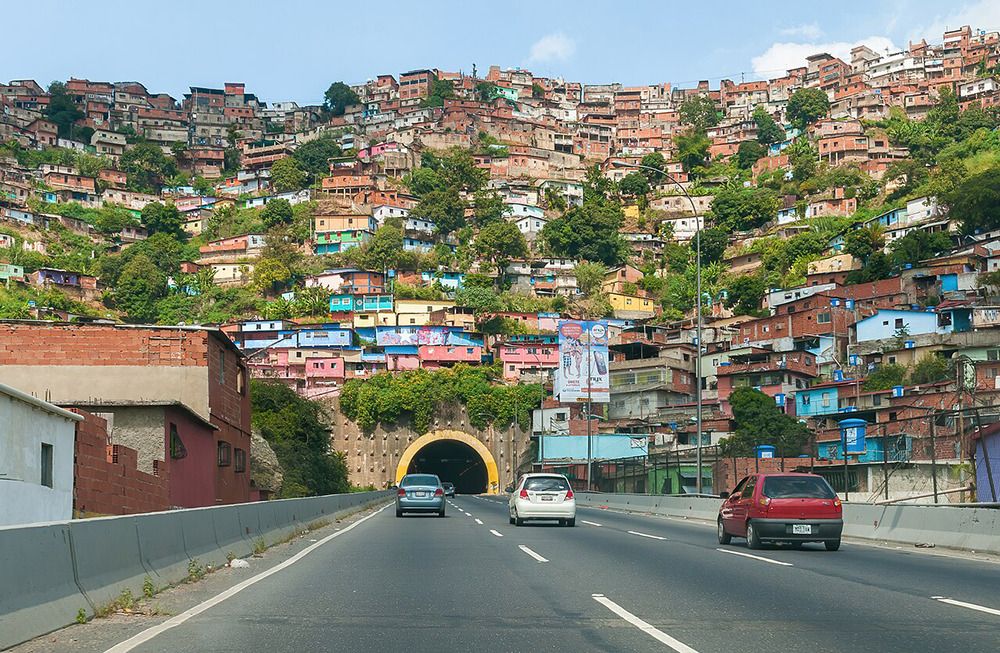
Caracas slums, 2013. Image: Wikipedia / Wilfredor
As early as the late 1980s, colectivos sparked protests against President Pérez’s neoliberal reforms. In Caracas slums and other cities, they formed self-defense in response to security forces’ brutality. Soon Pérez was impeached, then the Fourth Republic fell, but the militant poor’s squads didn’t disappear. The new regime saw them as natural allies, christening friends as “Bolivarian circles.”
Already during Chávez’s presidency, colectivos gained broad powers, effectively replacing municipal police. Under the much less stable Maduro, their status solidified — the uncharismatic successor needed thugs capable of any violence. Initially, colectivos chased those very guarimberos, usually from the middle class. But by the late 2010s, Maduro’s oprichniks didn’t hesitate to crack down on fellow poor if they protested loudly against power outages, water cuts, total shortages, and hopeless poverty.
“Colectivos” became a state within a state — they were simply “given” the population of their neighborhoods to “feed.” […] There are great opportunities here for both corruption and black market food sales. Food in Venezuela is already called a new kind of drug: just as profitable, but absolutely safe.
Colectivos are not shy about ordinary drug trafficking either. But in this sphere, official state and security forces still hold sway. It can be assumed that drug rents — according to the twisted “rules” of Maduro’s regime — are meant to compensate generals for the many inconveniences of recent years. These include rampant crime, economic collapse, international sanctions, and more. If so, this tacit contract works well.
Motorcyclists from “colectivos” block a Caracas street during an anti-government rally, April 2017. Image: Wikipedia / Oscar
According to Western media reports, Venezuelan authorities maintain old ties with FARC, communist guerrillas from neighboring Colombia. Fighters supply cocaine to Caracas, which then flows to the US and Europe. In the mid-2010s, the UN stated that over 50% of cocaine entering Europe passes through Venezuela, and local opposition called the regime a “narco-state.” Maduro consistently denies these accusations, but sometimes the truth peeks out too clearly. For example, in November 2015 in Haiti, the adopted son and nephew of the Venezuelan president were caught with 800 kilograms (!) of white powder .
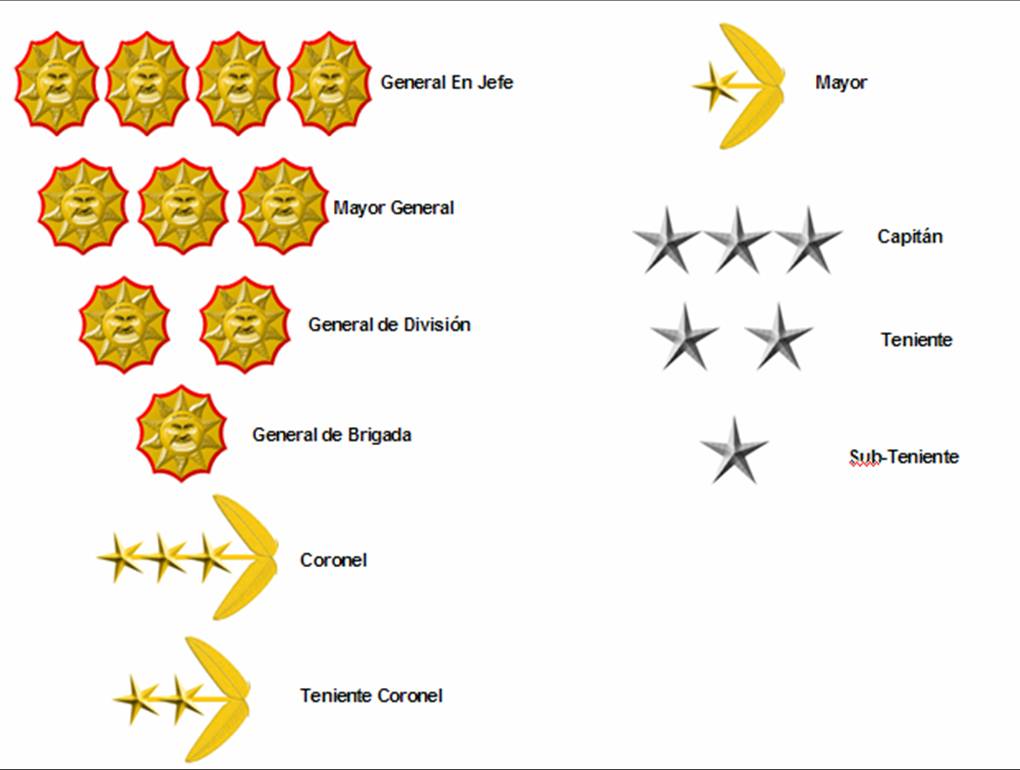
Venezuela’s transformation into a cartel state further strained its already tense relations with the United States. By the way, Washington has not recognized Maduro as a legitimate president since Donald Trump’s first term and declared the foreign politician wanted as a drug trafficker. The successor of Chávez and his circle are also accused by the US of ties to “Tren de Aragua,” the largest international Venezuelan organized crime group, and of creating the aforementioned “Cartel of the Suns.” This name refers to security officials from Caracas involved in smuggling — the fact is Venezuelan army generals wear shoulder boards with cheerful suns instead of ordinary stars.
But the big question is how long Maduro’s regime will shine in world politics. A year ago, the example of the Assad clan dictatorship in Syria reminded everyone how suddenly autocracies can be mortal. According to American media, the Venezuelan leader himself has already privately agreed to an honorable peace with the demonstrably hated “gringos” and is allegedly ready to let US business in on special terms. If so, such a deal might suit Trump and his established New York businessman mindset. Or maybe not: being remembered as the winner of the “Suns” is far more honorable.
If you enjoyed this article, consider making a donation — one-time or, even better, monthly. Your support helps us motivate our authors and become better with every article.
Our organization is recognized by the Internal Revenue Service (IRS) as a 501(c)(3) tax-exempt, charitable organization, which means that all contributions made to us are tax-deductible to the fullest extent permitted by U.S. law. Individuals may generally deduct charitable contributions of up to 60% of their Adjusted Gross Income (AGI) for cash donations made to qualifying 501(c)(3) organizations. For donations of appreciated assets (such as stocks or other long-term capital assets), the deduction is typically limited to 30% of AGI, based on the fair market value of the asset. C-corporations may deduct charitable contributions of up to 10% of their taxable income for donations made to eligible charitable organizations.
By submitting a donation, you confirm that you have read and accept the following documents: Privacy Policy and User Agreement, and also give consent to the processing of your personal data.
If you would like to unsubscribe from a monthly donation, please email us at: [email protected]