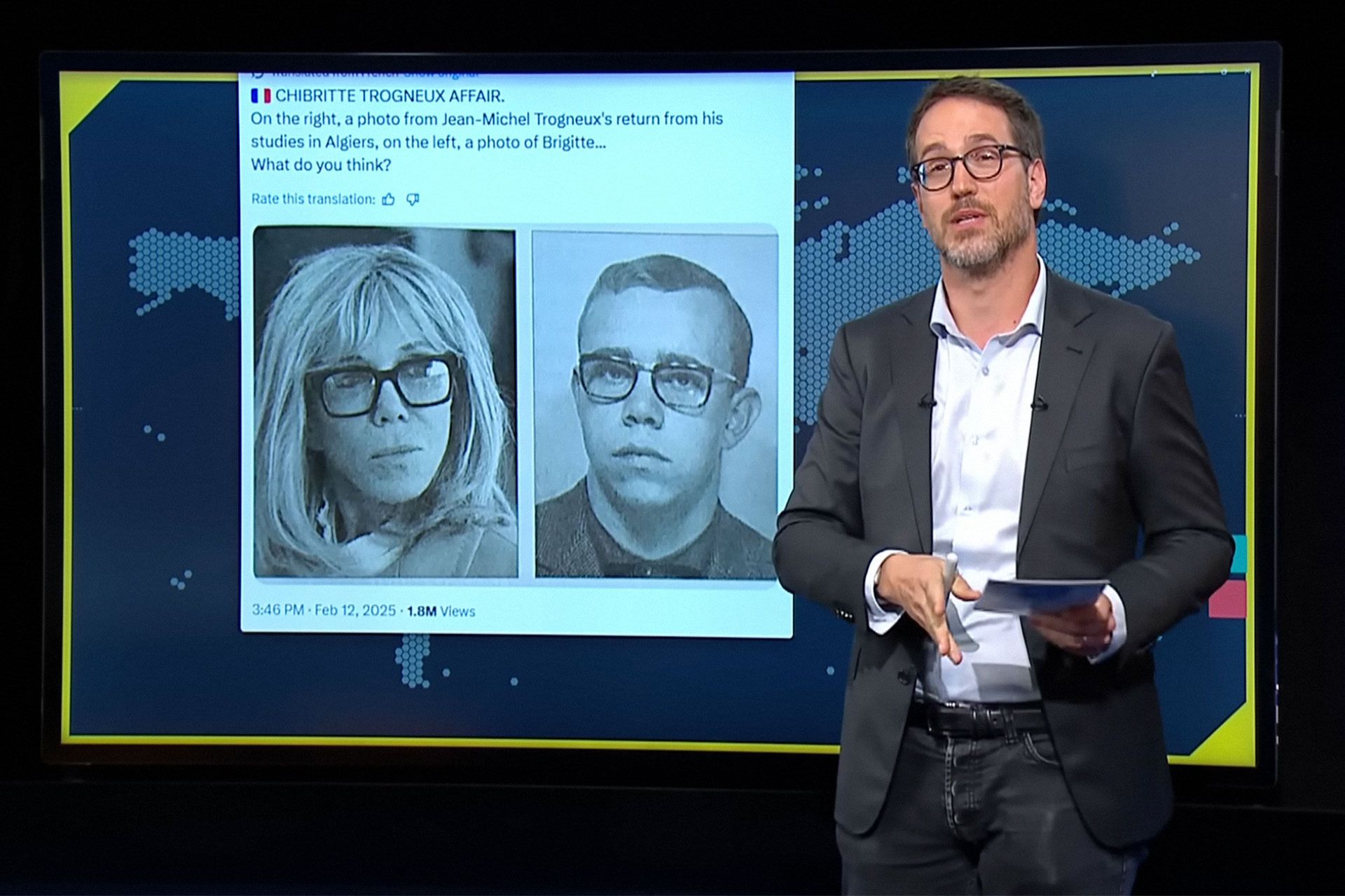
The trial began in Paris two weeks ago, accusing 10 people of online harassment of the First Lady of France. The accused — bloggers and internet publications prone to conspiracy theories — have for years spread rumors that Brigitte Macron was born a man and underwent gender transition. Neither the fact that the woman has three children from her first marriage, nor other obvious circumstances of her life, disproving such extravagant versions from the standpoint of common sense, stopped these claims.
Frame from video: YouTube / @FRANCE24
Comments on the trial go far beyond discussing the personal experiences of the First Lady of France, although it would be wrong to underestimate them. It is hard to imagine what it is like to hear for years about the spread of nonsense directed at you and to feel powerless to stop it. Her daughter Tiphaine spoke in court about Brigitte’s deteriorating health due to absurd rumors on social media and the inability to find an adequate response to their spread. Perhaps turning to legal procedures was the right decision. But its downside inevitably involved attracting even more attention to this unpleasant story. However, the prosecutor requested for the accused from 3 to 12 months of suspended sentences combined with various fines, which could serve both as moral compensation for Brigitte Macron and as a warning to future online harassers. The judges are to deliver the verdict in early January 2026.
The broader significance of the trial lies in continuing the complex public debate about the limits of permissible speech on social media and the ways to establish (if needed) and control these limits. As could be easily expected, the accused build their defense mainly by recalling constitutional guarantees of freedom of speech, but also speak of “humor and satire,” the “spirit of Charlie Hebdo,” and the right to inform their followers.
Obviously, their lawyers will seek to minimize the harm to Brigitte Macron by arguing that no one should be judged for an opinion, even if unfounded, or a joke, even if unsuccessful. On the other hand, the prosecutor deliberately used the concept of harassment, i.e., conscious and systematic persecution, when preparing the charges.
The contest of these positions in court should contribute to understanding the new state of the modern world, where, thanks to social networks, the opportunity for public expression is now available to everyone. But does this come with responsibility, as it did before, in the era dominated by newspapers and television? And if so, where is the line that must not be crossed? Can a social media user claim with impunity that the earth is flat, or that the mayor of the city where they live actually has six hands?
Who are all these people?
It makes sense to look closer at the biographies of the accused, who, according to the investigation, were not part of a conspiracy and did not act according to a prearranged plan but nevertheless spread rumors on a “pack principle,” which is quite characteristic of online harassment. Notably, all of them are not very young, ranging from 41 to 60 years old — they are experienced bloggers with a large number of followers. Of course, there is no need for a detailed study of their life paths, but some details of these people’s activities may help understand the essence of the trial.
Amandine Roy in the courthouse. Frame from video: YouTube / @France24_en
For example, Amandine Roy (a pseudonym), who runs a professional YouTube channel and presents herself as a “medium,” journalist, or “whistleblower.“ She specializes, according to her, in investigations and exposés, allowing no conformism. In particular, she claimed that Brigitte Macron is actually her older brother Jean-Claude Tronier, who allegedly underwent gender transition (in fact, he died in 2018). Amandine Roy organized a four-hour broadcast on her channel on this topic, inviting another accused, Natasha Rey, where both participants enthusiastically spoke about the ”deception“ and ”fraud“ of the First Lady. In other episodes of her show, Amandine Roy, already as a medium, discussed supernatural powers and abilities.
Another curious figure is Aurélien Poirson-Atlan, known under the female pseudonym Zoe Sagan. On social network X, he has a group with 200,000 followers. There, Poirson-Atlan published various exposés about celebrities, trying in an entertaining style to mix jokes, rumors, and conspiracy theories so that they could always be passed off as flights of imagination.
Also noteworthy is “strategic consultant” Bertrand Scholler, who for a long time on his Twitter fought against the “deep state” in all its forms. He questioned both the official investigation of John Kennedy’s assassination, COVID vaccination, and virtually any event in world history. He explained the war in Ukraine solely from Putin’s perspective. It is no surprise that Scholler gladly joined the spread of rumors about Brigitte Macron, exposing yet another elite conspiracy.
Thus, we are dealing with people who have long and professionally managed and monetized various social media accounts, having both a dubious reputation and a relatively wide audience.
This is not about ordinary people who in private correspondence spoke disrespectfully about the First Lady. All of them are bloggers making a living online and choosing very specific content for this purpose.
Support from across the ocean
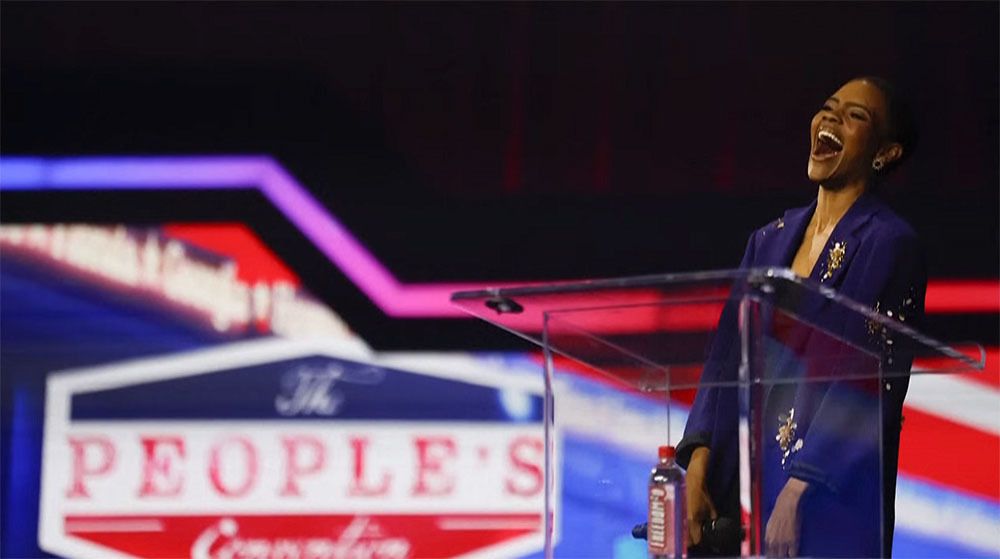
However, all the achievements of the 10 French influencers accused of online harassment of Brigitte Macron pale in comparison to their American colleague Candace Owens, who alone has over 6.5 million followers on Instagram. She has long supported Donald Trump and the MAGA movement and is known as an influential and popular political commentator in that environment.
Candace Owens. Frame from video: YouTube / @France24_en
In July 2025, the Macrons filed a lawsuit in Delaware state court against Owens, accusing her of spreading defamatory information. The case concerns the repetition of the same rumors that Brigitte Macron was supposedly born a man and underwent gender transition. While in France these talks began in 2021 through bloggers whose names are now well known, Candace Owens picked up the topic in 2024, naturally citing French sources. Thus, over several years, the rumors grew like a snowball, appearing in the most unexpected places, in programs by various authors.
It is now difficult to understand who and why linked the identity of the First Lady with that of an allegedly transgender older brother, who had already passed away by that time — but once it appeared, the strange version took on a life of its own and became a reason for scandalous exposés by anyone interested.
The French president and his wife faced a difficult choice. On one hand, they could ignore the ridiculous rumors and wait for them to die down on their own. Famous people often choose this tactic because the reputational costs of a public trial can be significant even in case of victory. But on the other hand, this had been going on too long and required some decision, for example, judicial.
Meanwhile, the trial in the US is not expected to be easy. Under French law, in defamation cases the burden of proof lies with the disseminator of information — and therefore the accused today try to pretend they either joked or sincerely repeated someone else’s version, knowing they cannot confirm their words. But American justice views such cases differently, as directly follows from the First Amendment on freedom of speech. The US court will require proof from the plaintiff, and Candace Owens has already stated she will demand a medical examination of the First Lady by American doctors. Obviously, Brigitte Macron’s trials are far from over.
A threat to democracy
The problem of Brigitte Macron’s legal cases against internet haters lies in the need to distinguish private expression from a defamatory campaign.
Before the era of social networks, citizens could discuss any celebrities in their kitchens as they wished, even repeating the most absurd rumors. Public statements, however, implied readiness to prove them. If today someone writes something on Instagram or edits a video on YouTube, where are the criteria allowing to distinguish private opinion from public speech?
It seems that the number of followers hardly fits this role, since depending on the audience’s interests, it does not reflect the author’s professional involvement. Sports stars or show business celebrities have many followers without any effort.
Nevertheless, some considerations may be useful for reasonable social media governance in the near future.
First, the emergence of the term internet stalking in indictments seems justified, since the concept of harassment is already quite workable for justice. Essentially, systematic bullying of a schoolchild by classmates is as unacceptable as online intrusions into private life from social networks. For the court, proof of damage caused by the persecution is necessary, not the motives of the persecutors or the presence of collusion between them.
Second, it is important whether the blogger whose statement is under scrutiny monetizes their activity. Monetization itself, of course, should not cause suspicion regardless of whether the viewer agrees, for example, with how a culinary influencer cooks soup. But regularly publishing unchecked information about someone’s private life combined with earning income from this content may indirectly indicate a conscious choice of such a genre.
Third, a sign of internet stalking may be active participation in campaigns by fake accounts and/or foreign publications that spread ridiculous rumors and increase their absurdity. In particular, Macron’s detractors, including in Russia, gladly relayed news that the First Lady was born a man as a version worthy of attention. This was done by both seemingly reputable publications and little-known bloggers on Telegram. Obviously, such campaigns are already part of hybrid wars, and there are good reasons to fear the expansion of this practice.
Modern democracies are learning to live in a new world where information spreads very differently than ten years ago. It is necessary to preserve the values of freedom of speech but avoid sinking into chaos of ridiculous rumors and conspiracy theories without resorting to unjustified bans. Perhaps open trials like Brigitte Macron’s case will help find this difficult path.
If you enjoyed this article, consider making a donation — one-time or, even better, monthly. Your support helps us motivate our authors and become better with every article.
Our organization is recognized by the Internal Revenue Service (IRS) as a 501(c)(3) tax-exempt, charitable organization, which means that all contributions made to us are tax-deductible to the fullest extent permitted by U.S. law. Individuals may generally deduct charitable contributions of up to 60% of their Adjusted Gross Income (AGI) for cash donations made to qualifying 501(c)(3) organizations. For donations of appreciated assets (such as stocks or other long-term capital assets), the deduction is typically limited to 30% of AGI, based on the fair market value of the asset. C-corporations may deduct charitable contributions of up to 10% of their taxable income for donations made to eligible charitable organizations.
By submitting a donation, you confirm that you have read and accept the following documents: Privacy Policy and User Agreement, and also give consent to the processing of your personal data.
If you would like to unsubscribe from a monthly donation, please email us at: [email protected]