On November 30, 1939, the USSR attacked Finland. On the anniversary of the start of the “uncelebrated war,” we explain how Stalin turned a peaceful neighbor into a fierce enemy.
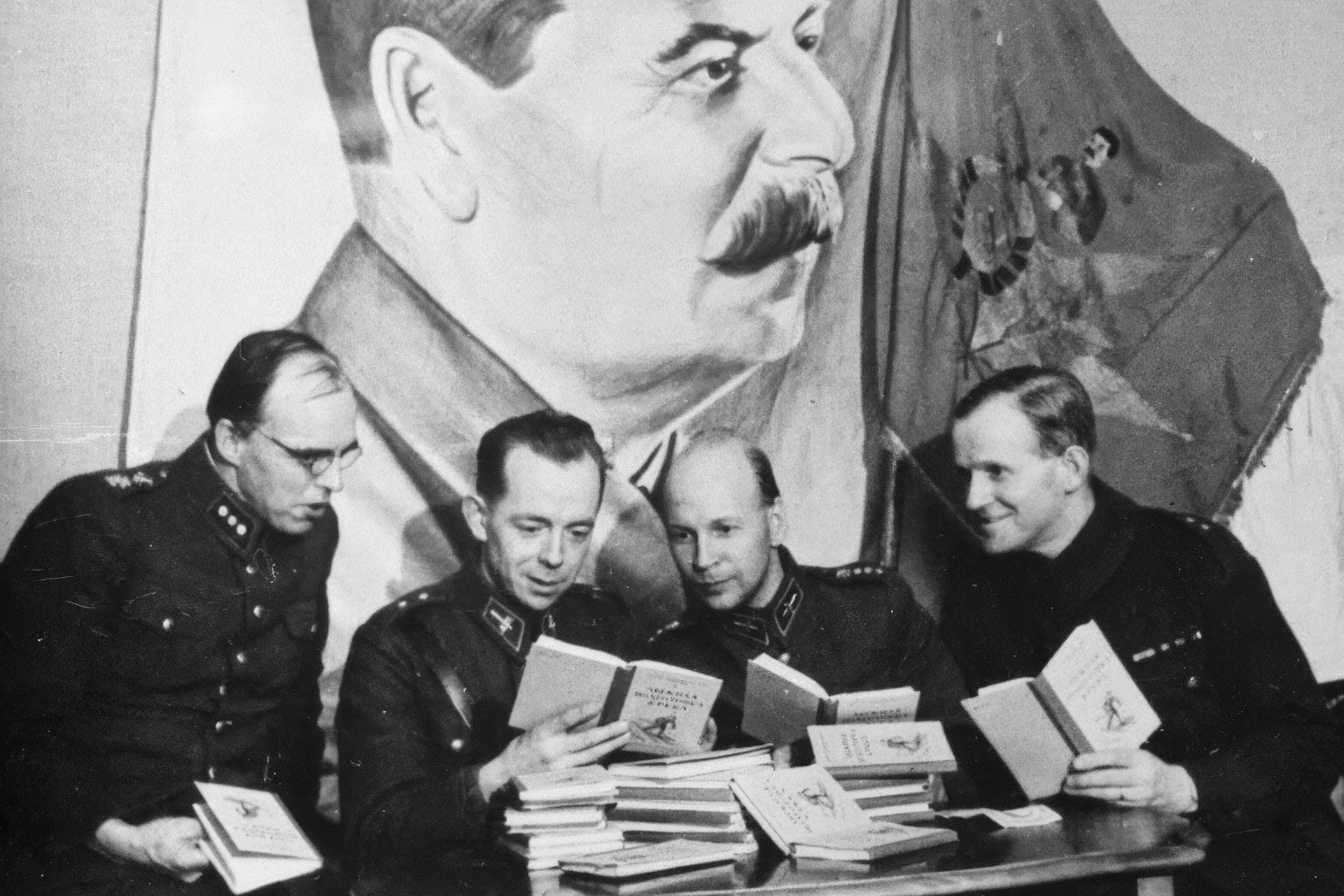
Finnish officers study captured Red Army commanders' manuals against a backdrop of captured banners depicting Joseph Stalin. Suomussalmi, January 1940. Photo: Wikipedia
Five years ago, few in Russia noticed a strange ceremony in Petrozavodsk: on September 5, 2020, the capital of Karelia solemnly welcomed a copy of the banner of the 18th Rifle Division of the Red Army, lost 80 years earlier. The report of the event can still be read on the republic's website, and over time it has aged well. The photo report from 2020, filled with imperial spirit, is harmoniously complemented by today's news: “More than 500 veterans of the Special Military Operation have found jobs in Karelia,” “A Special Military Operation soldier awarded the 'For Courage' medal in Segezha district,” or “Karelian authorities explain planned reduction in electricity consumption ranges.”
The text of the article itself is also remarkable in its own way. Much is said about where and how the copy of the banner was made, with pompous quotes from officials. Even the circumstances of the original loss are highlighted: in March 1940, the 18th Rifle Division was destroyed by the Finns while trying to break out of encirclement near the Lemetty tract on the northern shore of Lake Ladoga. Only the main thing is omitted—the soldiers of the ill-fated division were not defending their homeland, as one of the speakers at the ceremony claimed; they were merely unsuccessfully trying to seize someone else’s land.
The USSR's attack on Finland—usually referred to as the separate Winter War, though strictly speaking, it was one of many campaigns within World War II—remains an unpopular episode in Russian historiography. It is mentioned in passing in history classes, no films are devoted to it, and books about it are rare. Today, this seems like a missed opportunity—otherwise, perhaps, current news from the Republic of Karelia's website would be read with more cheer. But it's never too late to debunk persistent historical myths.
Myth 1. In 1939, Finland was a fascist dictatorship allied with Hitler, so a preemptive war against it was justified.
Late-1930s Finland seems like a good target for historical victim-blaming. One can start from the fact that in 1941-1944, this country did indeed fight on the side of Nazi Germany. To be thorough, add other facts: the presence of an ultra-right party in the Eduskunta (Finnish parliament), some enthusiasts drawing maps of Suur-Suomi, and some inappropriate statements by certain politicians. The result is a malicious sub-Arctic pseudo-Reich, which the USSR had every moral right to stop.
However, all of the above is taking real circumstances out of context. Finland in the 1920s–1930s was a functioning parliamentary democracy. Governments and presidents changed regularly, the separation of powers worked, and various forces coexisted peacefully in parliament. In July 1939, in elections to the Eduskunta, the top two places went to the Social Democrats and the Agrarian Party—both far from fascism—who together won almost two-thirds of the seats.
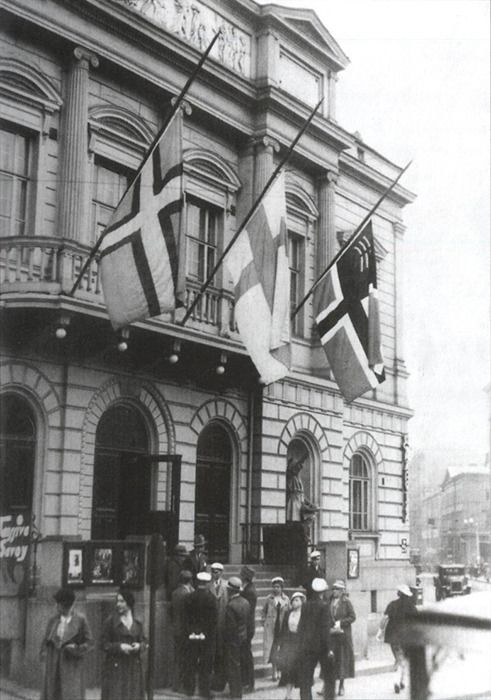
A solidarity event by Finns for Finnish-speaking citizens of the USSR: the flags of Karelia (left) and the Finnish Ingrians (right) are displayed next to the national flag. Helsinki, 1934. Photo: Wikipedia
Finnish governments stayed out of military alliances and consistently pursued a policy of neutrality. Up until the late 1930s, the army was funded on a residual basis. Soldiers joked about the “Kayander fashion”—named after the prominent politician Aimo Kallio Kayander, who formed the government three times. The idea was that, due to underfunding, conscripts were left in civilian clothes. They were only given army belts and badges on their hats—so they would count as servicemen under international conventions.
We are proud that we have little weaponry rusting in arsenals, little military clothing rotting and molding in warehouses. But in Finland, we have a high standard of living and an education system we can and should be proud of!
- Aimo Kayander, Prime Minister of Finland, 1937–1939
It is worth noting separately: until 1940, the Finnish authorities oriented themselves toward France and Britain and did not seek closeness with the Third Reich. Helsinki bought any weapons except German, and sent its officers to study anywhere but Germany. All signed bilateral documents were no more than trade agreements.
In September 1938, Finnish-German relations were further complicated by a ridiculous incident at a League of Nations dinner in Geneva. Amid the Sudeten crisis, Finnish Foreign Minister Rudolf Holsti overindulged in alcohol and publicly called Adolf Hitler “a mad dog that needs to be shot.” Naturally, Holsti's diplomatic career ended there, but the incident left a mark.
Myth 2. The Finns themselves forced the USSR to attack by being uncooperative—they were offered a peaceful solution
From April 1938 to November 1939, the Bolsheviks several times proposed to their neighbors to reinforce the 1932 non-aggression pact with new agreements. Initially, the discussion was about Finland ceding Gogland Island (Suursaari) to the USSR, but new ideas were added later.
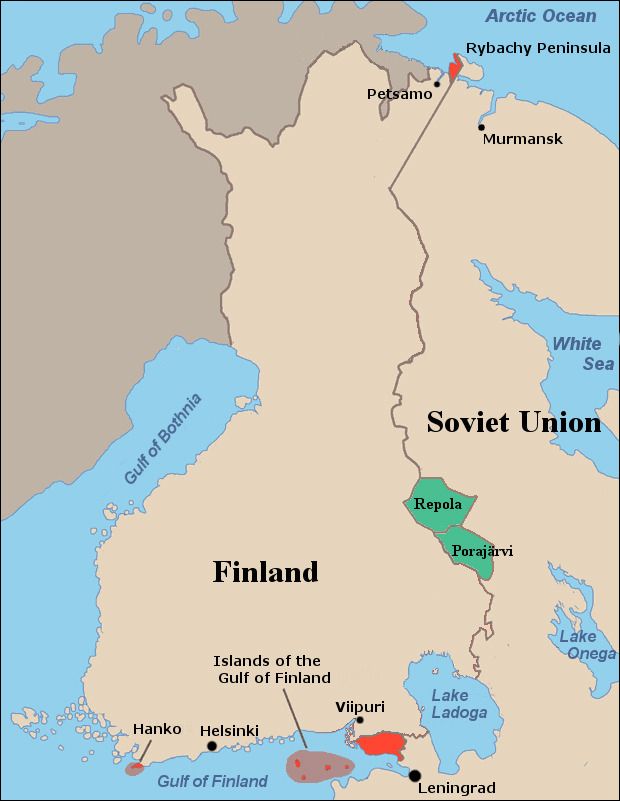
In August 1939, Stalin was emboldened by the Molotov-Ribbentrop Pact, whose secret protocols placed Finland in the Soviet sphere of influence. By the start of the war, the Finns were required to: - move the then border between the countries on the Karelian Isthmus 90 km to the west. According to the 1920 Treaty of Tartu, the border ran along the Sestre (Rajajoki) River—near Leningrad’s suburbs—which angered the Soviet leadership;
- cede Suursaari and several other islands in the Gulf of Finland, as well as part of the Barents Sea coast, to the Bolsheviks;
- lease the Hanko Peninsula for 30 years to build a Red Navy base there.
The final version of the Soviet proposals to Finland. Territories the Communists agreed to give up are shown in green, those they wanted to take are in red. Map: Wikipedia / Realismadder
In exchange, the Finns were promised twice as much territory in southwestern Soviet Karelia, though of lesser value. Helsinki politely refused. The reason was the complicated history with Moscow, the de facto former metropolis and recent enemy in the 1918–1920 war; the Finns clearly did not want to tie themselves to the Soviets. Yes, local politicians tended to think they would have to move the border away from Leningrad. But the other points—especially the Soviet military base at Hanko—were unacceptable to them.
In late autumn 1939, this stubbornness ended Soviet-Finnish negotiations in Moscow. On November 9, Stalin and his loyal foreign minister Vyacheslav Molotov showed the foreigners the door. On November 26, the Kremlin got its desired casus belli by staging the shelling of Soviet border guards near the village of Mainila, blaming the Finns. Three days after the provocation, diplomatic relations were broken off, and the next day, November 30, the Red Army launched a full-scale invasion.
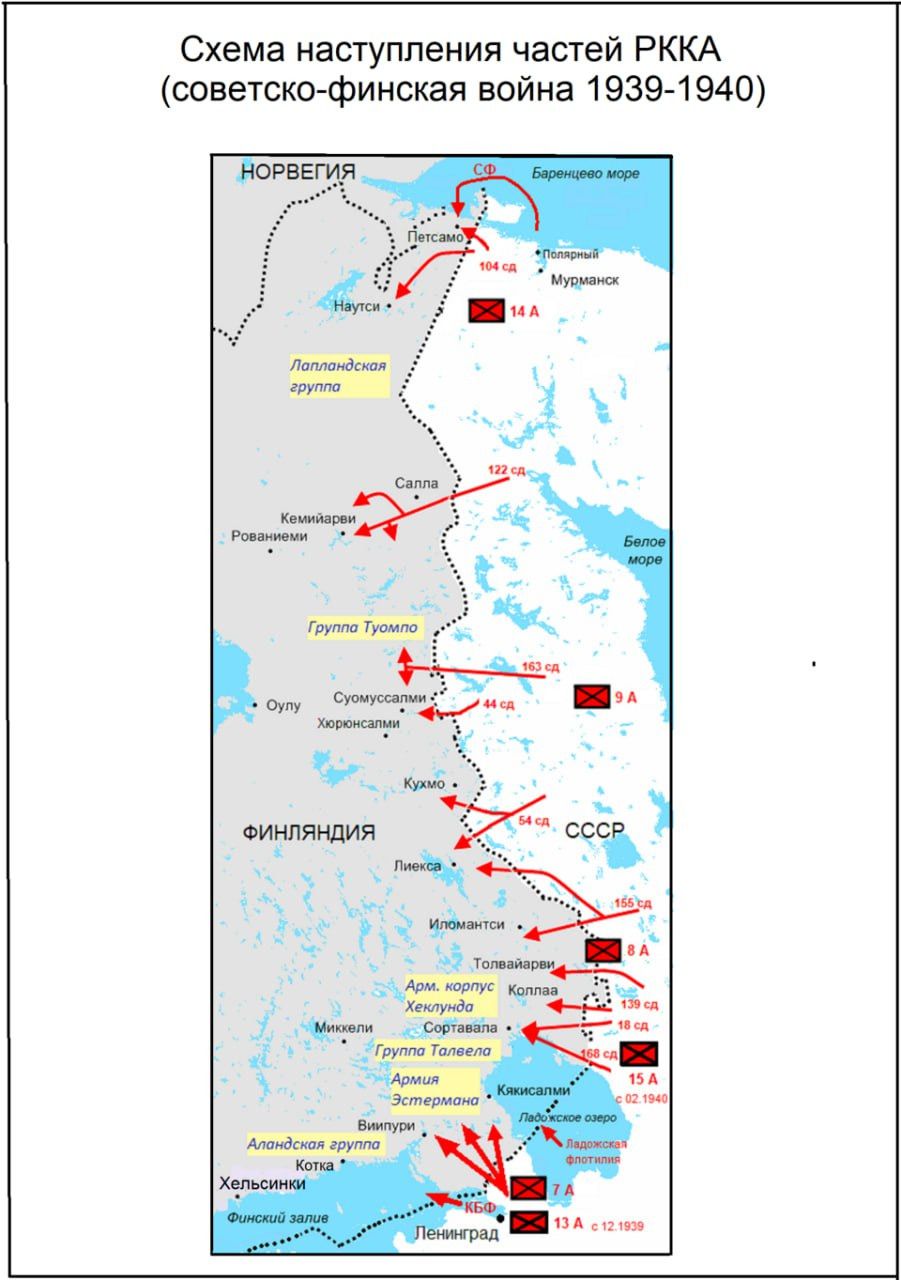
The Red Army command's failed “blitzkrieg” plan. As shown, four armies were supposed to capture all of Finland with parallel attacks perpendicular to the border. Map: Wikipedia / Semenov.m7
After that, the jester stood on his head and shook his foot at the Soviet Union, which supposedly encroaches on Finland’s independence. A truly majestic pose! […] Soon, apparently, [Finnish Prime Minister] Kayander will have the opportunity to see for himself that the real far-sighted politicians are not the marionettes of the Finnish government, but the current leaders of Estonia, Latvia, and Lithuania, who have signed mutual assistance pacts with the USSR
- Pravda, November 26, 1939
But was Finland's stubbornness in vain? In 1938–1939, they saw how Czechoslovakia's submission to the Third Reich led to the destruction of the Slavic republic. The Finns could not fail to notice how the USSR was simultaneously pressuring Lithuania, Latvia, and Estonia, also seeking permission to bring in its troops. Soon, all three Baltic states, like Czechoslovakia before them, would disappear from the political map—but Finland would remain.
Myth 3. Stalin only wanted to adjust the border, not annex Finland to the USSR
The crisis in Soviet-Finnish negotiations was accompanied by relentless anti-Finnish propaganda from Stalin's agitprop. Even before the Mainila incident, Communist broadcasters called Finnish politicians nothing but clowns, roosters, and puppets, “shedding crocodile tears over their dirty mugs.” The propaganda promised a speedy end to the “bloody clique of Tanner and Mannerheim”—the then foreign minister and commander-in-chief of Finland’s armed forces.
The Red Army planned to install a completely different government in Finland—Finnish Communist émigrés living in the USSR, led by former Comintern secretary Otto Kuusinen. On December 1, 1939, in the captured border settlement of Terijoki (now Zelenogorsk in Leningrad Oblast), Kuusinen and his comrades proclaimed the “Finnish Democratic Republic“. On December 2, “FDR” representatives signed a treaty of cooperation and mutual assistance with the Soviet Union.
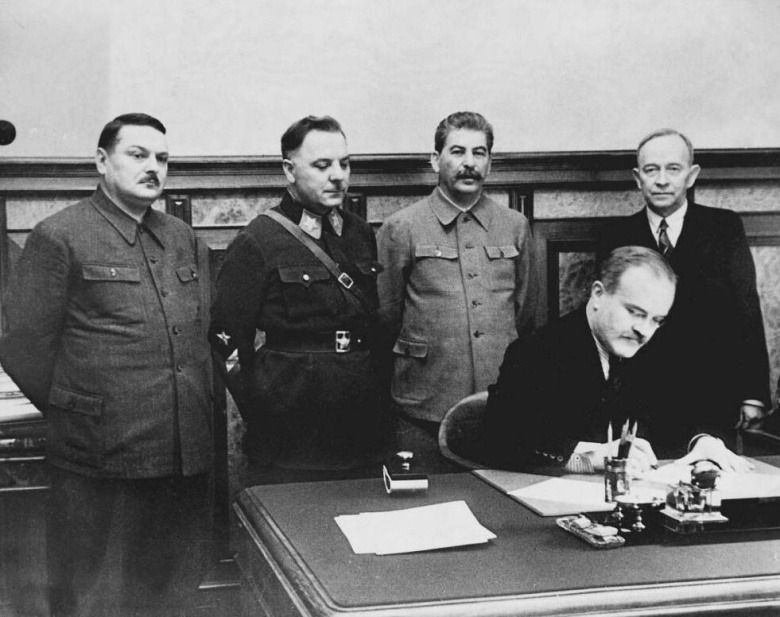
Vyacheslav Molotov signs the treaty between the USSR and the “FDR.” Far right: “President of the Republic” Otto Kuusinen. December 2, 1939. Photo: Wikipedia
At the time, Molotov explained to foreign diplomats that there had supposedly been a workers' uprising among the northern neighbors. The previous government fled, the people created a new state. The USSR—strictly within the framework of the treaty—was helping the young “republic” fight all kinds of nationalist militants.
The 1st Finnish Corps […] will be reinforced by volunteers from revolutionary workers and peasants and should become the strong core of the future People's Army of Finland. The First Finnish Corps has the honor of bringing the banner of the Finnish Democratic Republic to the capital and raising it over the presidential palace for the joy of the workers and the fear of the enemies of the people
- from the declaration proclaiming the “FDR”
However, foreigners were not impressed with the story of an uprising: worldwide, only two Soviet satellites, Mongolia and Tuva, recognized Kuusinen's regime. In fact, Molotov's project was nowhere near a semblance of a sovereign state. All official “republic” documents were edited by the Soviet Communist Party Central Committee. The “Finnish People's Army” was staffed exclusively by Soviet citizens of Finno-Ugric origin. And due to the failure of the Soviet blitzkrieg, the “FDR” became not even a puppet, but a virtual state that never got beyond the Karelian Isthmus.
In the end, the Kremlin had to quietly abolish the “republic” in March 1940 to sign a peace treaty with Finland's legitimate government. But there is no doubt that if the Soviet invasion had gone according to plan in the winter, Kuusinen and his comrades would have been installed in Helsinki and would have requested “reunion” with Moscow—just as pro-Soviet collaborators did in the Baltic states.
Myth 4. The plan was to conquer all of Finland by December 21—Stalin's birthday
One of the less obvious paradoxes of Stalin's USSR was that the dictator's official birthday was celebrated rather modestly, even on round anniversaries. During all his years in power, Joseph Vissarionovich only allowed a truly grand celebration once—ten years after the Winter War, in 1949.
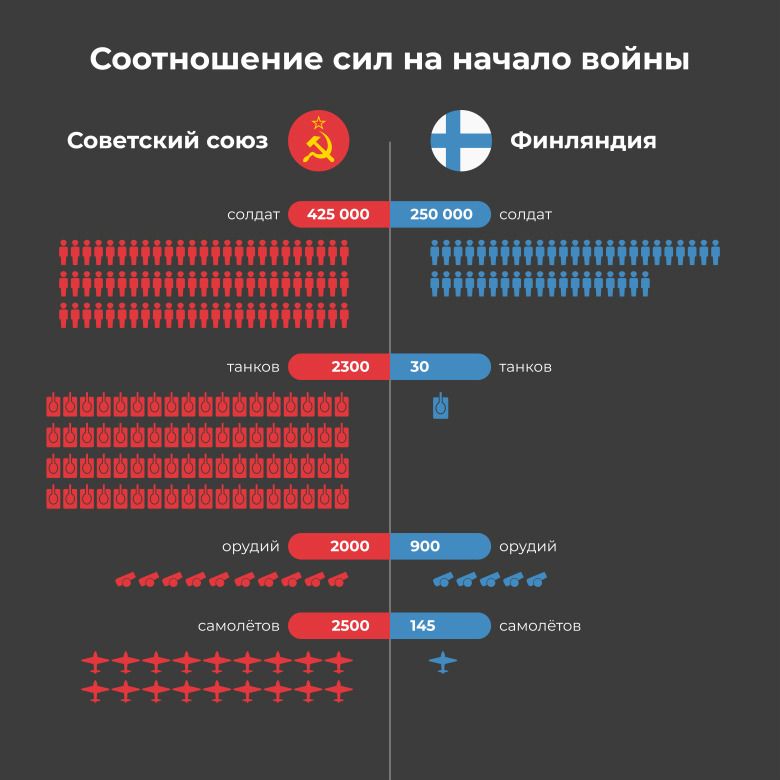
The concentration of manpower and military equipment against each other in Finland and the USSR. Infographic: Alexander Pavlenko
In late 1939, Stalin's next anniversary did not appear at all in official documents related to the invasion of Finland. It was believed the campaign would end much earlier than December 21. American journalist William Shirer later recalled how, in Berlin, a Soviet embassy worker assured him that the Red Army would finish off the Finns in three days. Vyacheslav Molotov gave the same estimate at the time.
Molotov was firm. “We have no choice but to make them understand their mistake and accept our proposals, which they stubbornly, recklessly reject in peace talks. Our troops will be in Helsinki in three days, and there the stubborn Finns will be forced to sign the treaty they refused in Moscow.“ Molotov repeated several times that the Finnish delegation had been received very cordially here. But the Finns persisted
- Alexandra Kollontai, Soviet diplomat
However, wars are not fought by diplomats, and “three days” should be seen more as a metaphor. More importantly, Red Army command plans called for only a slightly longer campaign. Future Marshal of Artillery Nikolai Voronov later testified that Deputy Defense Commissars Grigory Kulik and Lev Mekhlis, before the invasion, spoke of an “operation” lasting “10–12 days.” Similar timeframes for defeating the main Finnish forces appear in surviving orders for individual Red Army units. So, the plan was to conquer the foreign country well before December 21.
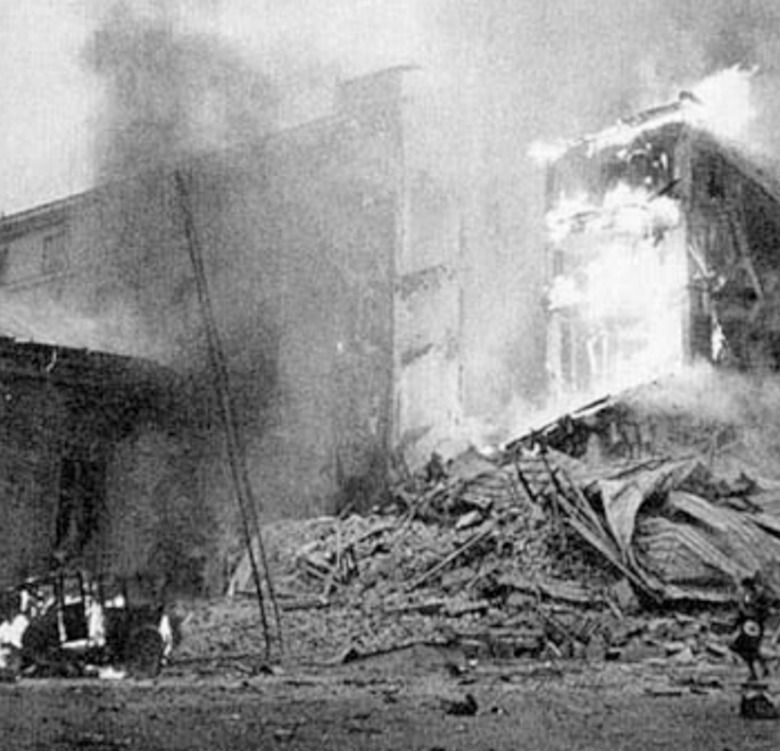
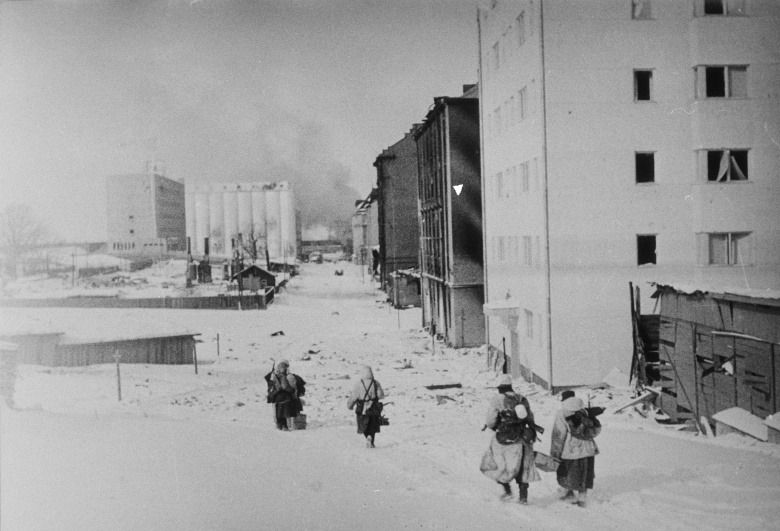
A residential building in Helsinki burns after a Soviet bombing raid. November 30, 1939. Photo: Wikipedia
Foreign observers thought the same way. Even during the Moscow negotiations, Swedish and German diplomats urged their Finnish colleagues to accept all Soviet terms—arguing that they had no chance against the Russians. After the war began, British Prime Minister Neville Chamberlain, while expressing solidarity with Finland, banned military supplies to them. The logic: what’s the point of handing out weapons during a world war—within two weeks, all the tanks, planes, and guns will end up with the Bolsheviks anyway.
Myth 5. The Red Army's rapid success was hindered by abnormal cold and the impenetrable Mannerheim Line
After the Winter War, the Mannerheim Line—Finnish fortifications on the Karelian Isthmus, named after the commander-in-chief—was almost glorified by Soviet propaganda. In the summer of 1940, a documentary film was dedicated to it, and its claims stuck in the popular imagination. The film claimed that unnamed international experts considered the Karelian Isthmus fortifications absolutely impregnable, so breaking through the line in February 1940 was the Red Army's greatest military victory.
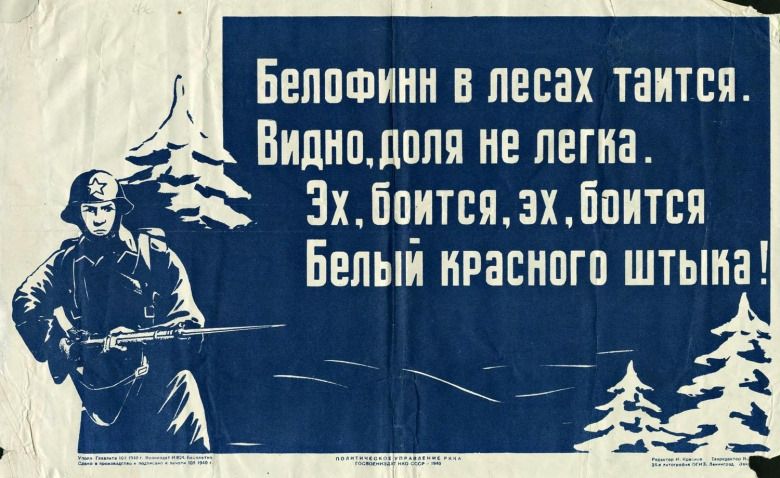
Red Army propaganda poster from the war against Finland, 1939. Image: Wikipedia
This thesis contradicted reality, as in the 1930s the Finns built a very modest defensive line. Only a year before the war did General Mannerheim barely convince the government to build real concrete fortifications instead of wooden-earth ones. Due to the high cost, they were nicknamed “millionaires,” and only about twenty were completed.
The resulting complex still looked modest compared to its contemporaries—the French Maginot Line and the German Siegfried Line. So, by exaggerating the Mannerheim Line's strength, Soviet agitprop hid the unpleasant reality: Red Army command had little understanding of the enemy and its capabilities.
There was a defensive line, of course, but it consisted only of rare permanent machine-gun nests and two dozen new pillboxes built at my suggestion, connected by trenches. […] Its strength was the result of the resilience and courage of our soldiers, not the strength of the structures
- Carl Gustaf Mannerheim
Another widespread misconception is that the Red Army was hampered by abnormal cold during the December battles on the Karelian Isthmus. In reality, until December 20, temperatures in Finland did not fall below –20 to –25°C. Frosts below –30°C came only in January 1940, when active combat paused. And in late February 1940, when the Red Army finally broke through the enemy's defenses, the Mannerheim Line faced even harsher frosts and deeper snow than in the early days of the invasion.
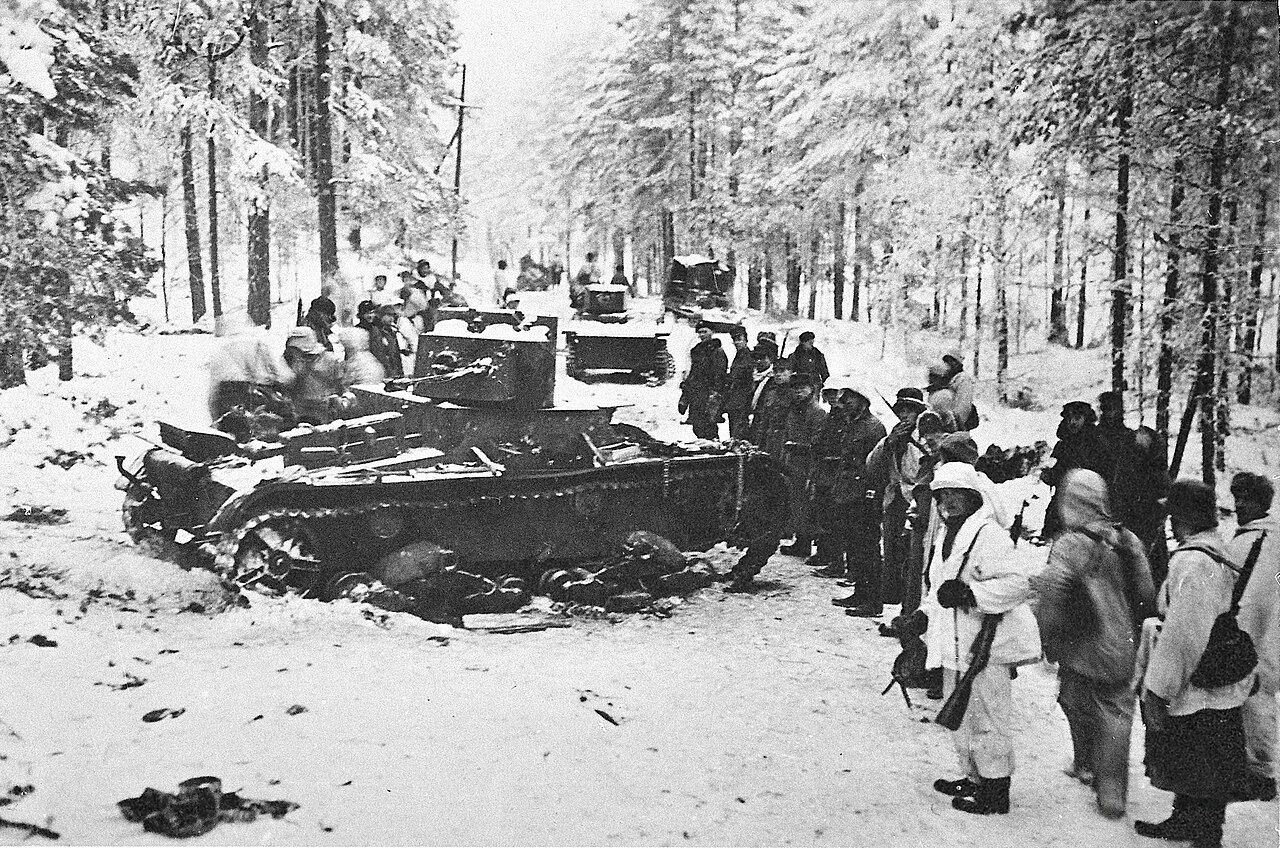
Finnish soldiers inspect captured Soviet light tanks. December 1939, Tolvajärvi, Lake Ladoga area. Image: Wikipedia / finna.fi
However, ordinary Red Army soldiers suffered even at moderate winter temperatures for northern Europe. Most of the personnel spent weeks living in dugouts and wore thin greatcoats, budenovka hats, and tarpaulin boots. When the cold set in, warm clothing was not distributed to all units. Unsurprisingly, during the 105-day war, frostbite of varying severity—by the most conservative estimates—affected 9,614 Red Army commanders and soldiers.
This fact helps explain the real reasons for the Red Army's failures on the Finnish front in the first two and a half months of the war. In the “valleys of death,” like the one where the 18th Rifle Division mentioned at the beginning perished, Soviet soldiers were led by
- underestimating the enemy at the strategic planning level. It was assumed that Finnish soldiers would not resist and the Red Army would occupy the entire country with four parallel offensives;
- unconventional Finnish tactics in the face of overwhelming Soviet superiority in manpower and equipment. Stubborn positional defense was combined with maneuvers by mobile small groups, allowing them to encircle and destroy entire enemy divisions;
- low competence of Red Army commanders (about 60–70% took their posts after Stalin's purges), compounded by equally poor training of ordinary soldiers.
Myth 6. Stalin showed mercy to the Finns by not crushing them at the end of the war
In January 1940, Stalin put Commander Semyon Timoshenko in charge of the Finnish Northwestern Front. He could not reorganize the fighting army on the fly, but quickly found the only way it could salvage the situation. Timoshenko halted operations in the Lake Ladoga and White Sea Karelia areas, concentrated maximum forces on the Karelian Isthmus, and gave the Red Army as much artillery superiority as possible. The simple strategy worked: on February 11–16 at Lake Summa, the Red Army broke through the Mannerheim Line.
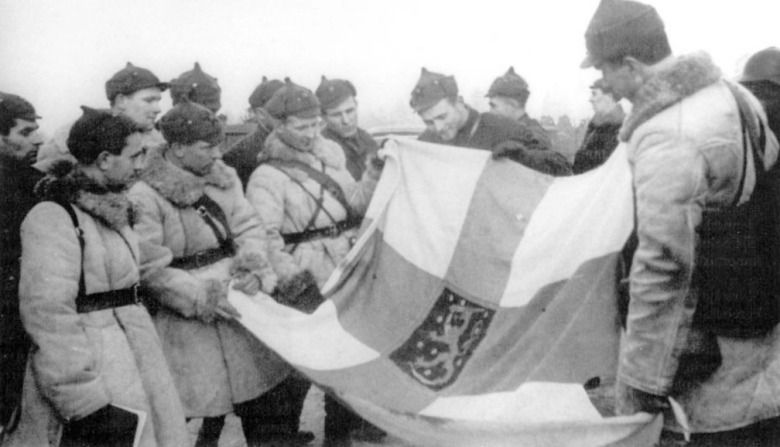
Red commanders with a captured Finnish flag, 1940. Photo: Wikipedia / Mannerheim-linja: Talvisodan legenda
The Finnish front did not collapse overnight; defenders retreated west with fighting. Nevertheless, strategically, Finland was already doomed—only large-scale outside support could save it. From late December 1939, Britain and France supplied Finland with weapons. Sending an Allied expeditionary force was discussed, but the timeline kept shifting. The Helsinki government was nervous. It seemed that the much-desired help would arrive only when the front line reached the capital.
But the Kremlin was also worried: what if the Western Allies actually came to the Finns' aid? In 1940, Stalin did not want a direct conflict with the British and French—he hoped to wait while they fought the Third Reich. In the end, the Soviets and Finns, with neutral Sweden's mediation, reached a compromise unpleasant for both sides. The Kremlin abandoned its dream of fully annexing Finland, and Helsinki gave up hope of holding out without territorial concessions. On March 12, 1940, the two sides signed a peace treaty in Moscow.
A group of Finnish soldiers retreats to the demarcation line. The last minutes of the war. Vyborg, March 13, 1940, around noon. Photo: Wikipedia
Nazi Germany also played a role in the reconciliation. Incidentally, the Nazis maintained a neutrality favorable to the USSR throughout the Winter War: they did not let foreign volunteers or arms supplies reach Finland via their territory. And in February 1940, Reichsmarschall Göring personally hinted to Finnish envoys that their republic would be better off making peace with the Bolsheviks for the time being.
Remember, you should make peace on any terms. I guarantee that when we soon go to war against Russia, you'll get everything back with interest
- Göring's quote from secret negotiations with the Finns (according to Ragnar Nordström)
Of course, the Nazis were motivated not by pacifist ideals but by self-interest. An Anglo-French force in Scandinavia threatened the Reich's Swedish ore supplies, and a vengeful Finland was a valuable partner for the coming invasion of the Soviet Union. And Finland played this role just a year and three months after the Moscow peace was signed.
Myth 7. The USSR won the Winter War
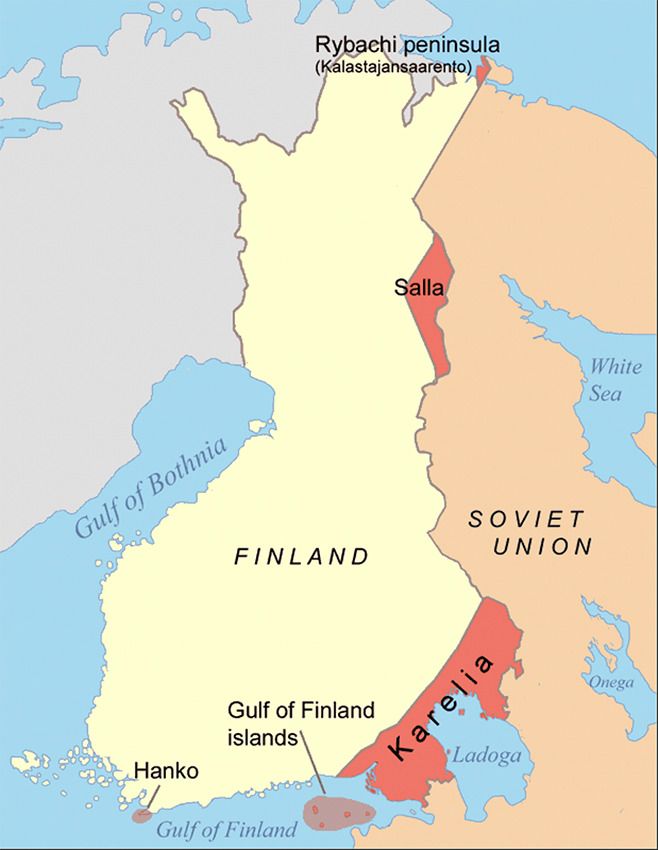
If you read the Moscow Treaty out of context, there seems to be no doubt about the outcome of the 105-day conflict. Stalin got the coveted Hanko on a 30-year lease (this clause would be revised in 1944), the Karelian Isthmus, and several other border territories. In total, Finland lost about 40,000 sq. km—over 10% of its prewar territory, including its second-largest city, Vyborg.
Territorial changes after the war; areas ceded to the USSR are marked in orange. Map: Wikipedia / Jniemenmaa
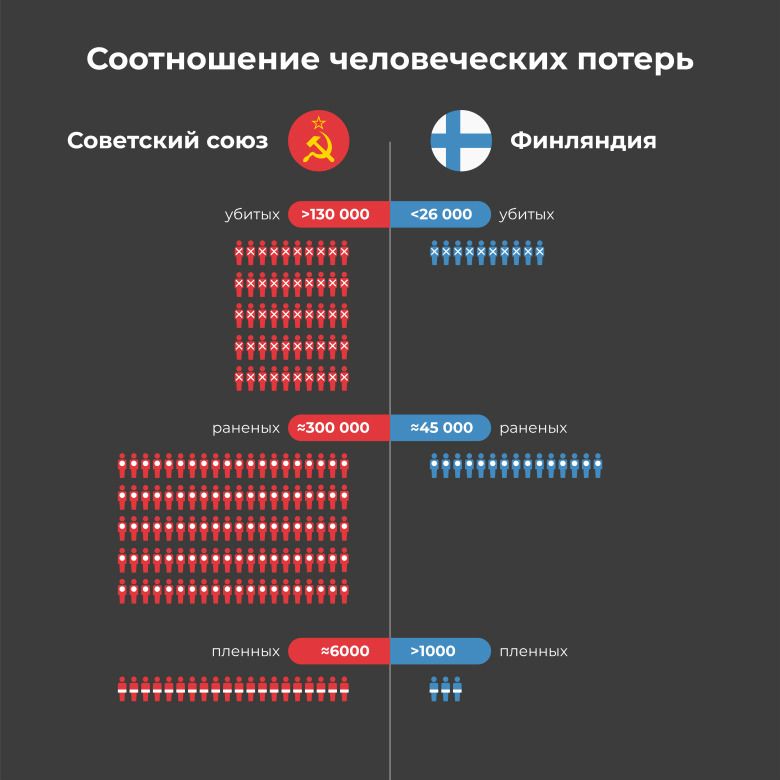
But the victorious mood is spoiled, first, by the enormous Red Army losses. Dead, missing, and died of wounds, the nominal victors lost over 130,000 people, and another 250,000 were wounded, captured, or frostbitten. This is several times more than Finnish losses.
Each day of the war cost the USSR about 1,200 dead soldiers.
Second, the original goal of the war—to occupy all of Finland in a short “special operation”—was a complete failure.
Third, the northern neighbor, despite formally acknowledging defeat, became a sharply hostile state toward the USSR. In the summer of 1941, Finland eagerly supported the Nazi “Barbarossa” plan. Without the help of its new allies, the Germans could hardly have blockaded Leningrad for so long, with the most horrific consequences for its residents.
Comparison of losses on both sides in the Winter War. Infographic: Alexander Pavlenko
Finally, in the Third Reich itself, only after the Winter War did overconfidence about the USSR's military power take hold. Even Hitler's closest entourage had initially thought that attacking the Communists was possible only after conquering all of Europe. But after Stalin's “victory,” no one in the Nazi leadership argued with the Führer's favorite thesis: the Soviet Union is a rotten building—just knock on the door, and it will collapse by itself.
The Nazis' blind faith would lead them to their own catastrophe, which, unlike Stalin's “blitzkrieg” in Finland, would be irreversible. But that is another story.
Red Army soldier Melnik said: “People are starving at home, and we are going to defend someone else—why?” Red Army soldier Pozheg Stepan said: “They're driving us to slaughter, we don't need to defend Soviet power.” Red Army soldier Chernyak Nikolai said: “I don't know what we're fighting for. Under Soviet rule, I lived poorly, and those we supposedly liberated lived better than us, so why liberate them?” Similar anti-Soviet statements are also made by other Red Army soldiers
- from the report of the 7th Department of the Main Directorate of State Security, NKVD, January 24, 1940
Main sources for this article:
Alexandrov K., Lobanova M. “War with Finland” (radio series)
Aptekary P. “What losses in manpower and equipment did the Red Army suffer in the Finnish campaign?”
Vladimirov A. “Suomi the Beauty Welcomed Them”
Voronov N. “In Military Service”
Lipatov P. “Red Army Uniforms”
Mannerheim C. “Memoirs”
Morgunov M. “The Uncelebrated War”
Nabutov K. “Secrets of the Finnish War” (documentary)
Sokolov B. “Secrets of the Finnish War”
Khristoforov V. “The Winter War of 1939–1940 in Declassified Documents”
If you enjoyed this article, consider making a donation — one-time or, even better, monthly. Your support helps us motivate our authors and become better with every article.
Our organization is recognized by the Internal Revenue Service (IRS) as a 501(c)(3) tax-exempt, charitable organization, which means that all contributions made to us are tax-deductible to the fullest extent permitted by U.S. law. Individuals may generally deduct charitable contributions of up to 60% of their Adjusted Gross Income (AGI) for cash donations made to qualifying 501(c)(3) organizations. For donations of appreciated assets (such as stocks or other long-term capital assets), the deduction is typically limited to 30% of AGI, based on the fair market value of the asset. C-corporations may deduct charitable contributions of up to 10% of their taxable income for donations made to eligible charitable organizations.
By submitting a donation, you confirm that you have read and accept the following documents: Privacy Policy and User Agreement, and also give consent to the processing of your personal data.
If you would like to unsubscribe from a monthly donation, please email us at: [email protected]