What makes this story especially intriguing today is the fact that Israel was actively (albeit secretly) assisted by Iran back then—not the old Shah’s regime, but the Khomeinist one we know. So why did the Islamic Republic support the Zionist strike against their own fellow Muslim co-religionists?
The ongoing Israeli operation “The People as a Lion” shook the entire world. After many years of muscle-flexing, proxy wars, and espionage operations, the Jewish state struck directly at Iran for the first time. And so far it seems that despite all its ostentatious belligerence, the Islamic Republic was not ready for a real confrontation with the “Zionist entity.” If the conflict does not turn, Tehran risks at least losing its top officers, key nuclear scientists, and main atomic program facilities.
Such an outcome would not be unprecedented. Forty-four years ago, Israel already deprived another dictatorship of atomic weapons—a regime that had incessantly declared its desire to throw the Jews into the sea, and in a country with a similar name—Iraq during Saddam Hussein’s era. These events entered history as Operation “Opera” (also known as “Babylon”).
The Bomb for a Failed Empire
In 2025, it’s hard to imagine that just 40-45 years ago Iraq claimed leadership over the entire Arab world. By the late 1970s, local political life—which for nearly 20 years had been a cycle of bloody coups and short-lived dictatorships—had stabilized. The country had gained a “permanent” autocrat, the well-known Saddam Hussein Abd al-Majid al-Tikriti.
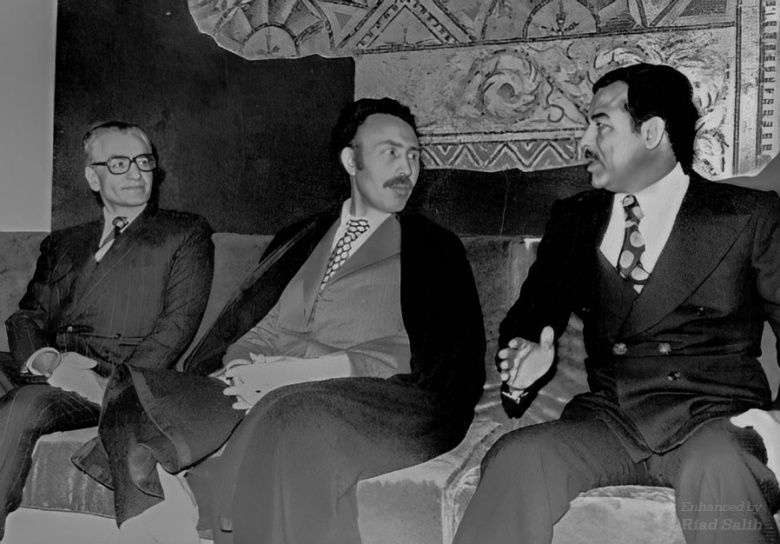
Saddam Hussein (right) and the last Iranian monarch Mohammad Reza Pahlavi (left) during negotiations mediated by Algerian President Houari Boumédiène, 1975. Photo: Wikipedia
At that time, Saddam was far from his final image—the pitiful old man abandoned by all, with a tangled beard and a half-mad look. He was a young (born in 1937), energetic, and charismatic politician, respected both in the Middle East and beyond. Recall that during the Cold War, Iraq was a secular republic, proclaimed the building of “Arab socialism,” and was considered an important Soviet ally in its region.
So, Saddam aspired for imperial greatness for his country. He saw Baghdad as the leader of the entire Arab world and seemed to hold all the cards for it. The previous contender, Egypt, had become an outcast in the Middle East due to the Camp David Accords with Israel around the same years, while oil-rich Iraq was showered with billions of dollars following the 1973 global crisis. Accordingly, the local authorities constantly expressed their deepest hatred of Zionism, sponsored various Palestinian militant organizations, and finally decided to become the first nuclear power in the Muslim world.
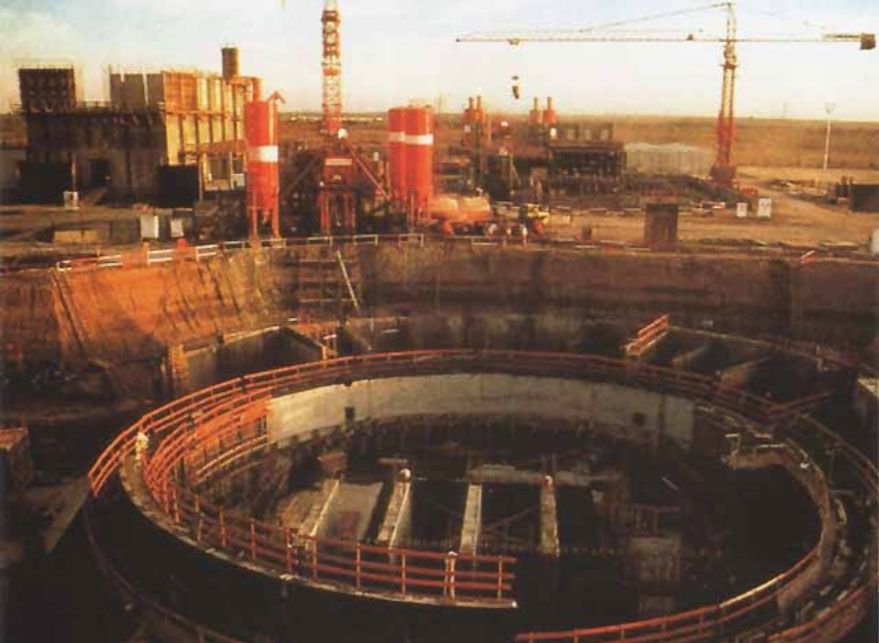
Construction site of the nuclear complex in Iraqi At-Tuwaitha shortly before the 1981 airstrike. Photo: angelfire.com
The most obvious partner, the Soviet Union, was not in a hurry to help specifically here. As early as 1975, in the Kremlin, Saddam was clearly told that Moscow would only support a peaceful atomic program for Baghdad under IAEA control. The Iraqi was not offended and decided to find new friends, especially since oil dollars kept pouring into his country. In autumn 1975, French Prime Minister Jacques Chirac offered the Arabs the Osirak reactor with a capacity of 70 MW, the Isis research laboratory, and a year’s supply of enriched uranium. The price was just three billion in US currency.
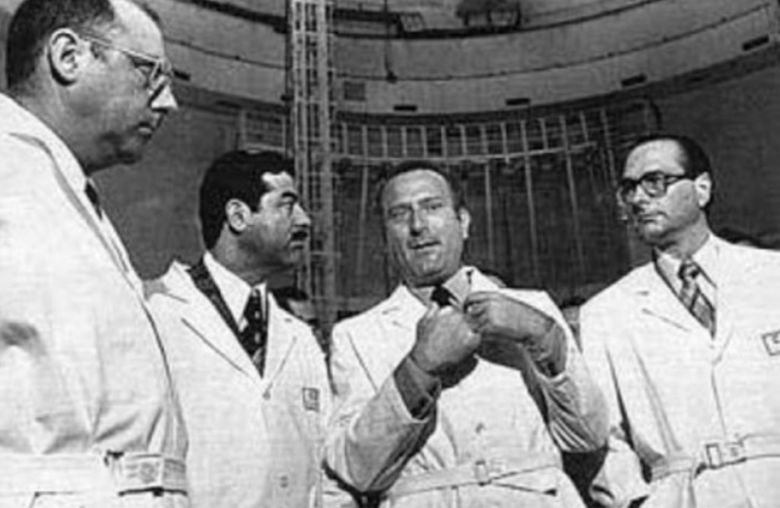
Saddam Hussein (second from left) talks with French nuclear scientists and Prime Minister Chirac (far right), 1975. Photo: Portierramaryaire.com
Formally, it was again about a purely peaceful atom. However, unlike the USSR, the French skillfully bypassed international oversight mechanisms, indirectly allowing their partners to pursue military developments. But Paris also refused the Iraqis a whole range of materials and equipment necessary for producing the critically important plutonium. Saddam’s advisors decided that French coquettishness was not critical—the missing uranium quantities and devices like the hot cell could be bought in other countries, from Brazil to West Germany. With their help, the Arab republic would have its own plutonium.
It’s worth noting that Western science still lacks consensus on how honest Paris was in its dealings with the Iraqis. In 2005, Harvard professor Richard Wilson claimed the French engineers were cunning. Allegedly, they designed Osirak with a deliberate defect that would prevent Saddam’s engineers from later obtaining plutonium of the required quality.
“The Osirak reactor, which Israel bombed in June 1981, could not produce [atomic] bombs. French engineer Yves Girard clearly designed it unsuitable for this purpose. This was obvious to me during my visit [to Iraq] in 1982.”
- Richard Wilson
However, this assessment was made 24 years after Operation “Opera.” In the early 1980s, foreign observers viewed Saddam’s Iraq as a nuclear power in the making. For example, Soviet Middle East expert Valery Yaremenko stated that in spring 1981 Moscow experts predicted Saddam’s nuclear scientists could produce 3-5 bombs annually by 1983-1985. Soviet specialists noticed no signs of French trickery at the time.
For the USSR, Iraq’s new status was just one factor in Cold War tensions. But another state saw Saddam’s deadly weapon as a threat to its own existence. That state was, of course, Israel, whom the Iraqi dictator tirelessly denounced as the main enemy of all Muslims.
Cloak and Dagger No Longer Enough
From the late 1970s, Franco-Iraqi cooperation increasingly worried Jerusalem. At first, the Israelis tried to resolve the issue diplomatically, but Paris stubbornly insisted: our atom is peaceful, you have nothing to fear. Then the Israelis reconsidered their approach. Fortunately, in summer 1977, the left-wing government of peacemaker Yitzhak Rabin was replaced by the right-wing ministers of the far tougher Menachem Begin.
Following the government change in Israel came a series of mysterious incidents in Europe that struck Iraq’s atomic program. Some Arab scientists sent West were found in hotels with their throats cut; others died suddenly from unknown illnesses. Police found no evidence, and the almost sole witness (a Parisian sex worker summoned by one of the Iraqis before death) immediately died in a car accident. Meanwhile, European companies working with Arabs received anonymous threats from so-called terrorists and faced waves of sudden dismissals.
On April 5, 1979, the climax of this devilry was an explosion in Toulon, France. The hulls of Osirak reactors awaiting shipment to the Arabs blew up at the naval port warehouse. The expensive equipment turned into a heap of metal in seconds, while other goods in the warehouse remained unharmed. Officially, Mossad’s guilt in these episodes has never been proven, but Viktor John Ostrovsky, a veteran intelligence officer who moved to Canada in the 1990s, claimed in his memoirs that all this was the work of his colleagues led by then-head of intelligence Yitzhak Hofi, helped by sayanim, pro-Israel European Jews.
“French police reported nothing about their investigation [of the April 5, 1979 explosion], and newspapers put forward various theories. For example, 'France Soir' suggested police suspected far-left extremists, 'Le Matin' claimed Palestinians carried it out on Libya’s orders, while weekly 'Le Point' pointed to the FBI. Some other papers accused Mossad, but an Israeli government representative rejected these accusations as anti-Semitic.“
- Viktor John Ostrovsky
Such operations certainly terrify the faint-hearted—but Saddam was not among them. The Iraqi dictator paid the French partners another hefty sum in dollars, and they set to work on a second Osirak.
By the end of 1980, the reactor was ready, and this time no mysticism harmed it. On schedule, the unit reached the Iraqi nuclear center at Et-Tuwaitha near Baghdad. It was given a new name—Tammuz (“July”), after the month when Saddam’s Ba’ath party seized power in 1968.
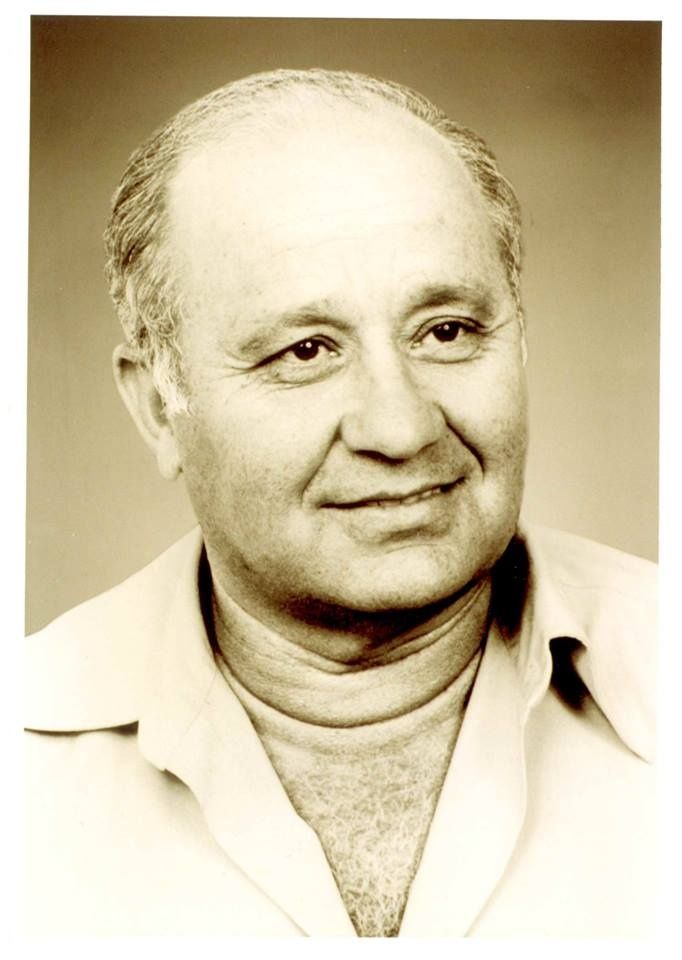
Yitzhak Hofi, head of Mossad from 1974-1982. Photo: Wikipedia / Israel Electric Corporation
According to Israeli journalists’ recollections, Yitzhak Hofi told Begin in conversations: what can you do, you can’t destroy everything with just a cloak and dagger. It was naive to think that a couple of assassinations and one explosion would guarantee stopping the Iraqis. And since the intelligence services’ capabilities were insufficient, the matter should be entrusted to the army.
The Enemy of My Enemy
That same autumn of 1980, the mechanism for destroying “Tammuz” was unwittingly activated by Saddam Hussein himself. On September 22, the dictator ordered his army to invade neighboring Iran, where a year earlier the monarchy had been overthrown and Shiite clergy led by the radical Ayatollah Ruhollah Khomeini had come to power.
Saddam wanted to seize Khuzestan from the Persians—a wealthy oil-rich coastal region with a partly Arab population—and simultaneously boost Iraq’s prestige in the Arab-Sunni world as a reliable guard against the Shiite revolution. Baghdad’s generals counted on revolutionary chaos in the enemy’s ranks and thus expected a short victorious war. But their invasion quickly bogged down—at the cost of huge losses, the Iranians trapped the aggressor in the border zone.
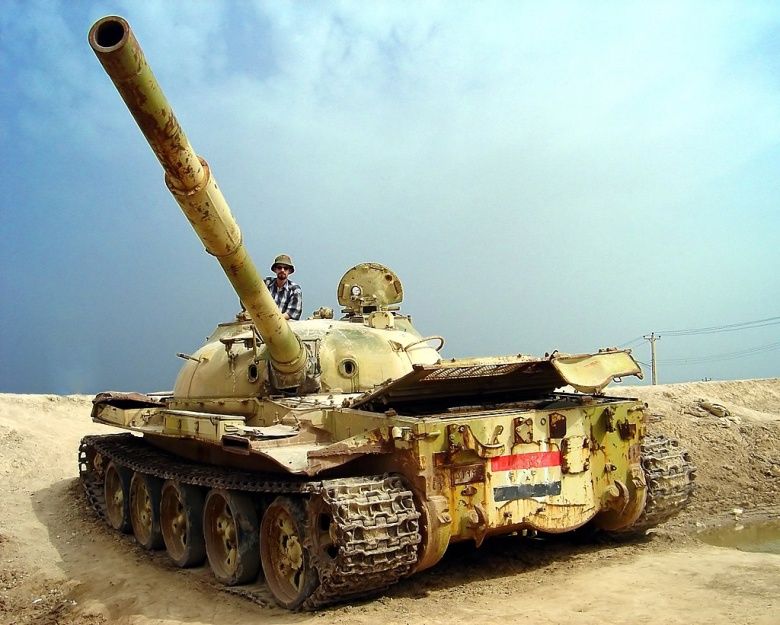
Destroyed Iraqi T-62 tank abandoned at the Khuzestan border, 2004. Photo: Hamed Saber
Meanwhile, in Tehran, as in Jerusalem, they realized they were dealing with a nuclear power in the making. Just a week after the enemy invasion, on September 30, 1980, the Iranian Air Force launched Operation “Burning Sword.” A squadron of American F-4 Phantoms obtained during the Shah’s era raided At-Tuwaitha and dropped bombs on the reactor. However, the Persians achieved limited success. “Tammuz” survived, though its commissioning was delayed by about three months.
Ironically, Saddam’s propaganda already claimed a conspiracy between its enemy and the “Zionists.” Allegedly, the ayatollahs put Jewish mercenaries behind the F-4 controls, who did all the dirty work for the Khomeinists. Apparently, Iraqi agitprop didn’t take this fake seriously—mutual accusations of ties with Israel were an old pastime among Middle Eastern dictatorships. But specifically Baghdad’s propagandists seemed to have invited trouble on their ruler’s favorite toy.
It’s unclear exactly when and under what circumstances Khomeini and his associates decided to entrust the destruction of “Tammuz” to the Israelis—openly hated but clearly more experienced in military affairs. It is certain that Israeli pilots had been preparing for the attack on At-Tuwaitha since 1979, and in autumn 1980 Begin’s cabinet finally approved Operation “Opera.” Many government members, including Defense Minister Ezer Weizman, considered the idea too risky until the last moment. It was believed that Iraq’s air force and air defense, equipped with the latest Soviet technology, were too strong, Israel could only succeed at the cost of pilot lives, and diplomatic problems would follow regardless.
However, most ministers saw another wave of international condemnation as the lesser evil compared to Saddam having a nuclear bomb. Moreover, cooperation with the Persians did not bother anyone. Under the Shah, Israel had excellent relations with Iran, so after 1979 many in Jerusalem hoped the Islamic Republic would “play around” and gradually return to at least a poor peace with the Jewish state.
“Israel [in 1980] tried to warn Tehran that Iraq was preparing to invade, but Iran was in such turmoil that only a few officials and military leaders saw or fully read the message. And just hours after Iraq began its invasion on September 22, a telex from Israel arrived at Iranian government offices, starting with the words: 'How can we help?'“
- Tom Cooper, American historian
In December 1980, Iranian pilots secretly handed over to the Israelis films of the latest aerial photography of At-Tuwaitha, using old contacts. As Swedish-Iranian historian Trita Parsi later claimed, in February-March 1981 Air Force officers from both countries met confidentially in France. The Persians’ side was supposedly led by Air Force Commander Colonel Javad Fakuri. The officer shared experience from “Burning Sword,” guaranteed the secret allies a backup airfield in Iranian Tabriz just in case, and promised to thin out the Iraqi air fleet before the secret allies’ strike.
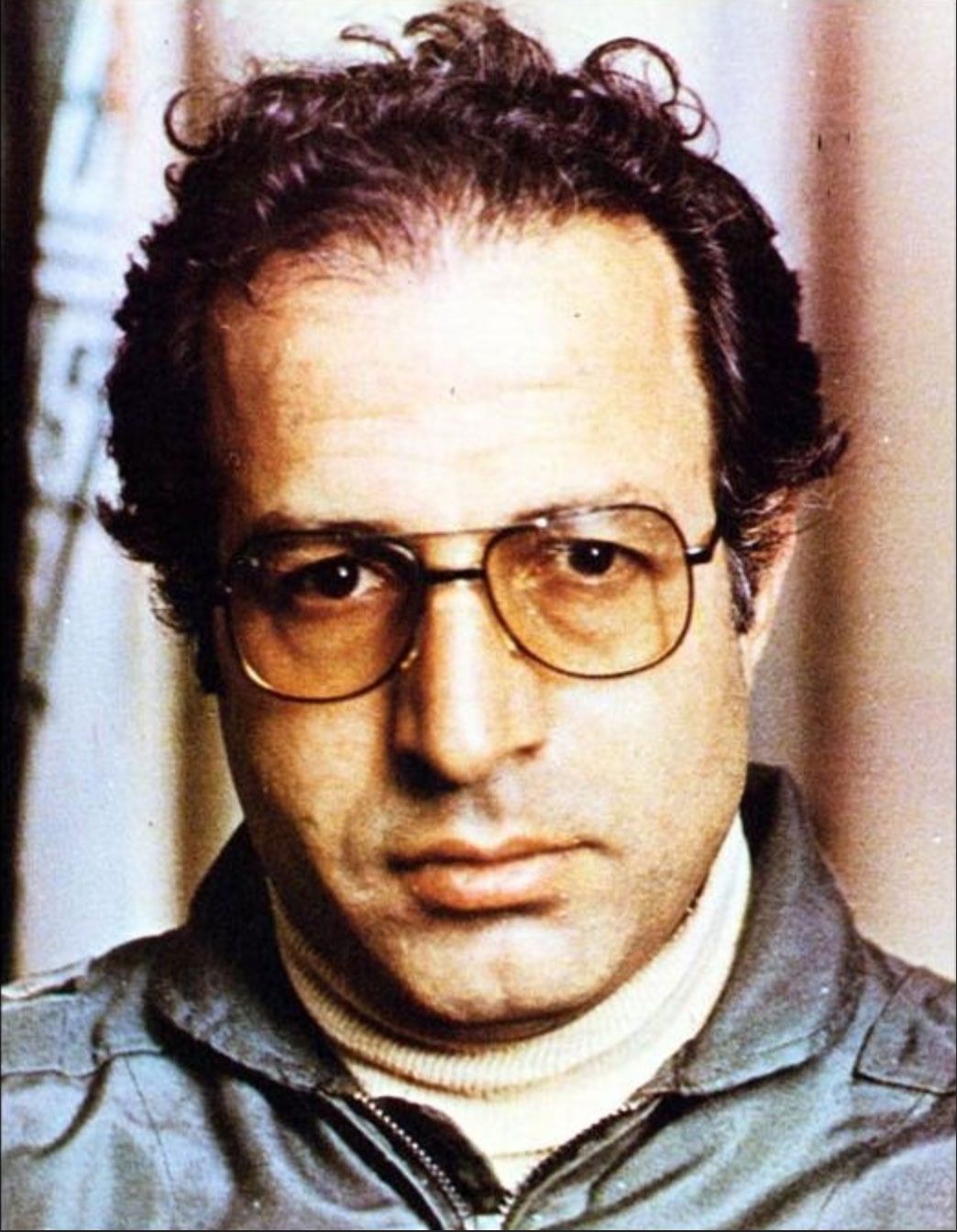
Colonel Javad Fakuri—coincidentally, he died in a plane crash before the end of 1981. Photo: Wikipedia
The Persians kept their word. On April 4, 1981, Fakuri’s pilots conducted a highly successful raid on the Iraqi N-3 airbase. According to the Iranians, they destroyed up to 48 units of Soviet and French equipment, including several interceptor fighters. Now it was time for the Israelis to move.
One Strike—and No More “Tammuz”
Ironically, Operation “Opera” became technically possible not despite but thanks to the Islamic Revolution in Iran. The operation required very harsh conditions: flying over 1,000 kilometers across desert, through the airspace of two then-hostile states (Jordan and Saudi Arabia), and then surviving a fight with Iraqi pilots and air defense. This made aerial refueling risky and imposed other restrictions.
Modern technology, like American F-16 Fighting Falcons, made bypassing these obstacles possible, but Israel wasn’t even on the waiting list for them when the operation was developed. And here the Khomeinists accidentally helped the Jews. The Islamic Revolution disrupted the approved US deliveries of brand-new “Falcons” to Tehran, and Israel’s Defense Minister Weizman immediately persuaded the overseas partners to give them to Israel. Then the Israelis spent several months preparing the attack, which violated numerous international law norms.
At least once, on May 8, 1981, the operation was canceled at the last moment. The daring plan unexpectedly became known to the left-wing opposition, Begin got nervous, and postponed “Opera” until better times. The final lightning order to execute the operation was given to the pilots on June 7, 1981. At 15:55, a squadron of eight F-16A led by Colonel Zeev Raz and six F-15A escort fighters took off from Etzion airbase.
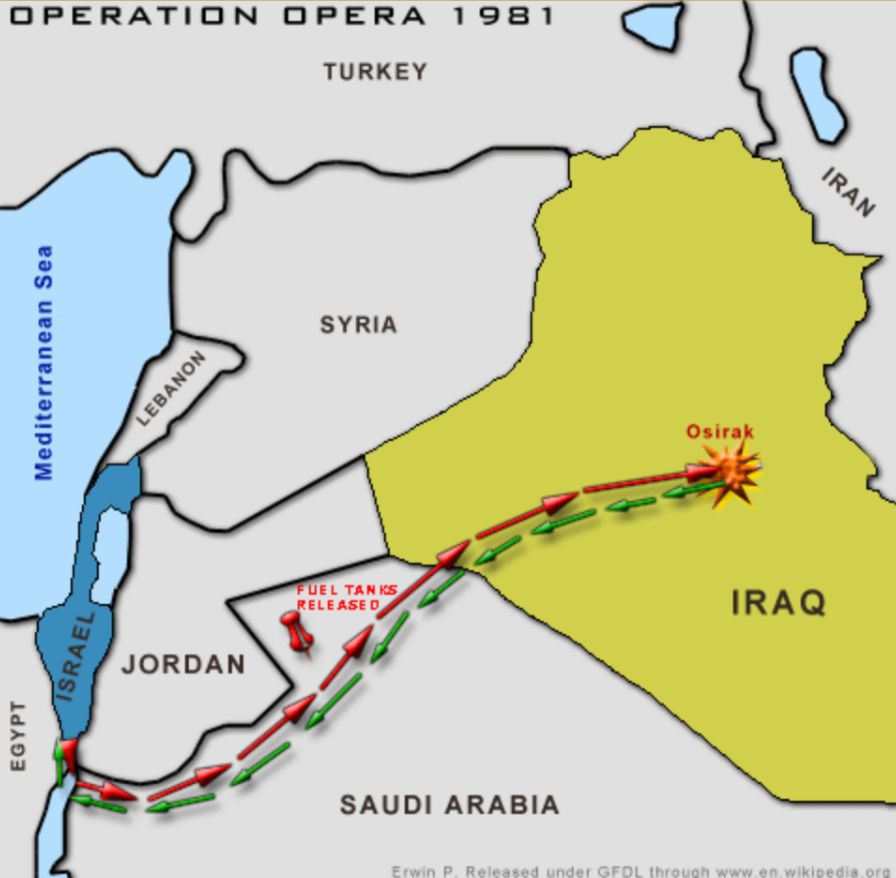
Route of the Israeli Air Force squadron during the operation. Map: Wikipedia
The squadron’s flight started with a mishap. Due to a carelessly planned route, pilots flew over the densely populated coast of the Gulf of Aqaba. According to a popular apocryphal story, the Israelis flew directly over the yacht of Jordan’s King Hussein I. The puzzled monarch—himself a trained military pilot—allegedly realized who and where was flying on F-16s. Hussein supposedly even ordered a report of what was seen sent to Baghdad. For unknown reasons, none of his subjects managed to contact the neighbors, and Raz’s team calmly continued their raid.
Israeli pilots knew their enemies very well and mastered various Arabic dialects perfectly. After passing Aqaba, the “Opera” squadron successfully posed over radio as lost Saudis to local controllers, and over Arabian territory similarly pretended to be Jordanians. Thanks to intelligence, Raz also knew about blind spots in enemy air defense at the Saudi-Iraqi border and skillfully flew through them toward the target.
As Soviet military experts working in Iraq in 1981 later recalled, Saddam’s officers at At-Tuwaitha were unprepared for a Zionist raid. Yes, the Arabs were used to threats from the east—from the Persians—but did not expect a trick from the west. According to one version, by 18:30 on June 7 most of the hapless defenders of the strategic facility had gone to dinner, leaving some radars completely unattended.
Of course, Raz and his team did not even dream of such luck. So they performed their part with utmost precision. Twenty kilometers from the target, the radar-evading bombers went into a dive, then quickly climbed out right over the cherished “Tammuz.” The operation’s climax lasted less than two minutes: during this time, the Israelis dropped 16 American bombs on the reactor, of which 8 to 13 hit the target precisely.
“Commander of the Air Force David Ivry contacted us on the way back: 'Remember, the flight ends only in the hangar. Be careful when landing.' But we heard pride and satisfaction in his voice. We ourselves were terribly proud—we achieved such a result without a single loss.“
- Amos Yadlin, Israeli pilot
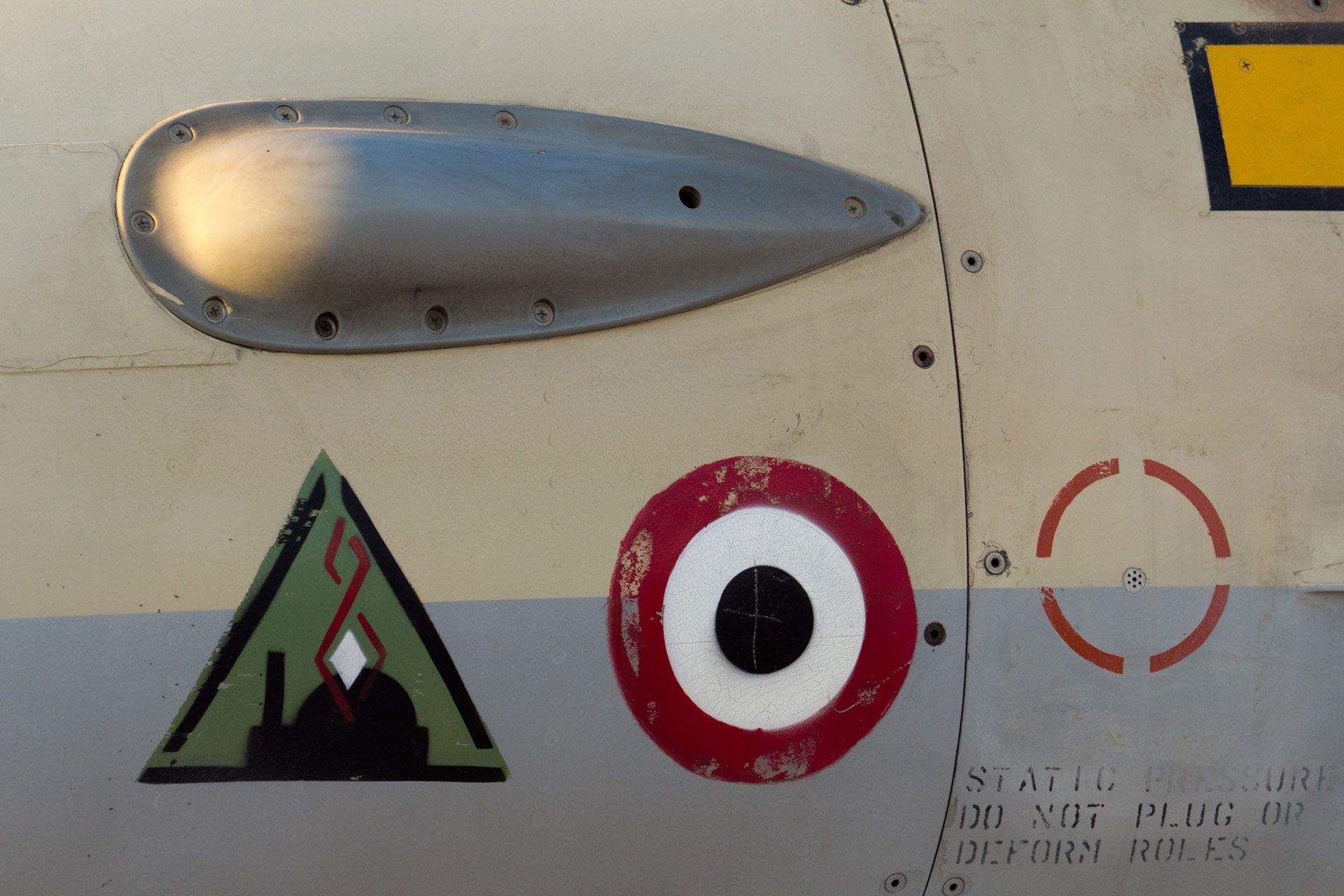
Marking of “Tammuz” destruction on the fuselage of one of the bombers involved in the attack. Photo: Wikipedia / Oren Rozen
Only after the bombing did Iraqi forces bother to fire at the raiders. The Arabs had the latest air defense systems like the Soviet “Kub,” but precious minutes were already lost—Raz’s men headed west. The technology’s capabilities could not compensate for simple human negligence.
An Unwon War, Unlearned Lessons
The first consequence of “Opera” was a Stalinist merciless purge among Iraqi air defense officers. Dozens of officers of various ranks were sent to prisons and execution chambers.
This massacre failed to revive Saddam’s nuclear program. The unyielding dictator tried to restart the project at other sites, but those efforts came to nothing: oil prices fell, and the war with Iran consumed more and more resources. The coveted weapon eluded the Baghdad dictator during his remaining 22 years in power.
Perhaps it was this trump card Iraq lacked in the war unleashed against the Iranians. It lasted until 1988, claimed about a million lives on both sides, and did not move the state border an inch. Israeli intelligence and the army secretly helped Tehran until the conflict’s very end (with intelligence, targeted equipment, and ammunition supplies), but the ayatollahs never revised their official hatred of the Jewish state.
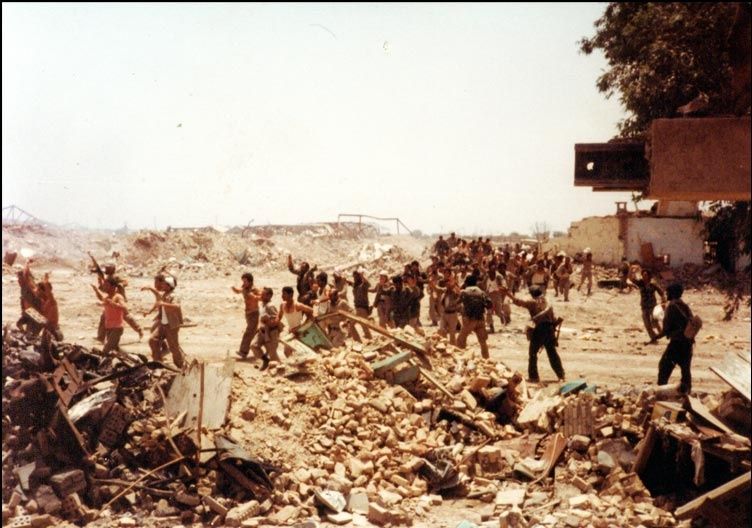
Iraqi soldiers surrender after the liberation of the Iranian city of Khorramshahr, 1982. Photo: Wikipedia
Israeli society received “Opera” as a nationwide victory. On June 30, 1981, Begin’s Likud party and its allies won the parliamentary elections. The incumbent prime minister formed a new government, whose work, however, proved controversial. Among other things, it was under this government that the IDF found its own “special operation,” rashly intervening in the protracted Lebanese conflict.
Menachem Begin gives a press conference after “Opera,” June 10, 1981. Photo: Wikipedia / Ilan Meiri
On the international level, Israel’s strike on Iraq was predictably condemned by almost everyone. The UN Security Council and General Assembly condemned the attack on a sovereign state, expressed concern, and deep apprehension. Left-wing speakers worldwide branded Israel a terrorist state, with many right-wing politicians agreeing.
“The world at large was outraged by Israel’s raid on June 7, 1981. An armed attack under such circumstances cannot be justified. It constitutes a serious violation of international law,“ Margaret Thatcher thundered. Jean Kirkpatrick, US Ambassador to the UN, was equally harsh, comparing the event to the Soviet invasion of Afghanistan. American newspapers used strong language. The sudden Israeli attack was an act of unforgivable and short-sighted aggression,“ declared the New York Times.
- Jordan Steele, British journalist
“Opera” significantly strained Jerusalem’s relations with Paris. Despite the fact that the Israelis deliberately struck on a calendar Sunday (counting on European specialists at At-Tuwaitha resting), one French engineer, 25-year-old Damien Chosspier, died alongside ten Iraqis at the site. A year later, Israel quietly paid compensation to his family, but the incident left a bitter aftertaste among many French.
Nevertheless, Israeli society embraced Begin’s “doctrine”: in exceptional cases, violating another country’s sovereignty is permissible if the fate of Israel itself is at stake. And the presence of nuclear weapons with a potential enemy is obviously the top threat. It’s even strange that after 44 years, this has been forgotten in the very country that helped the Israelis with Operation “Opera.”
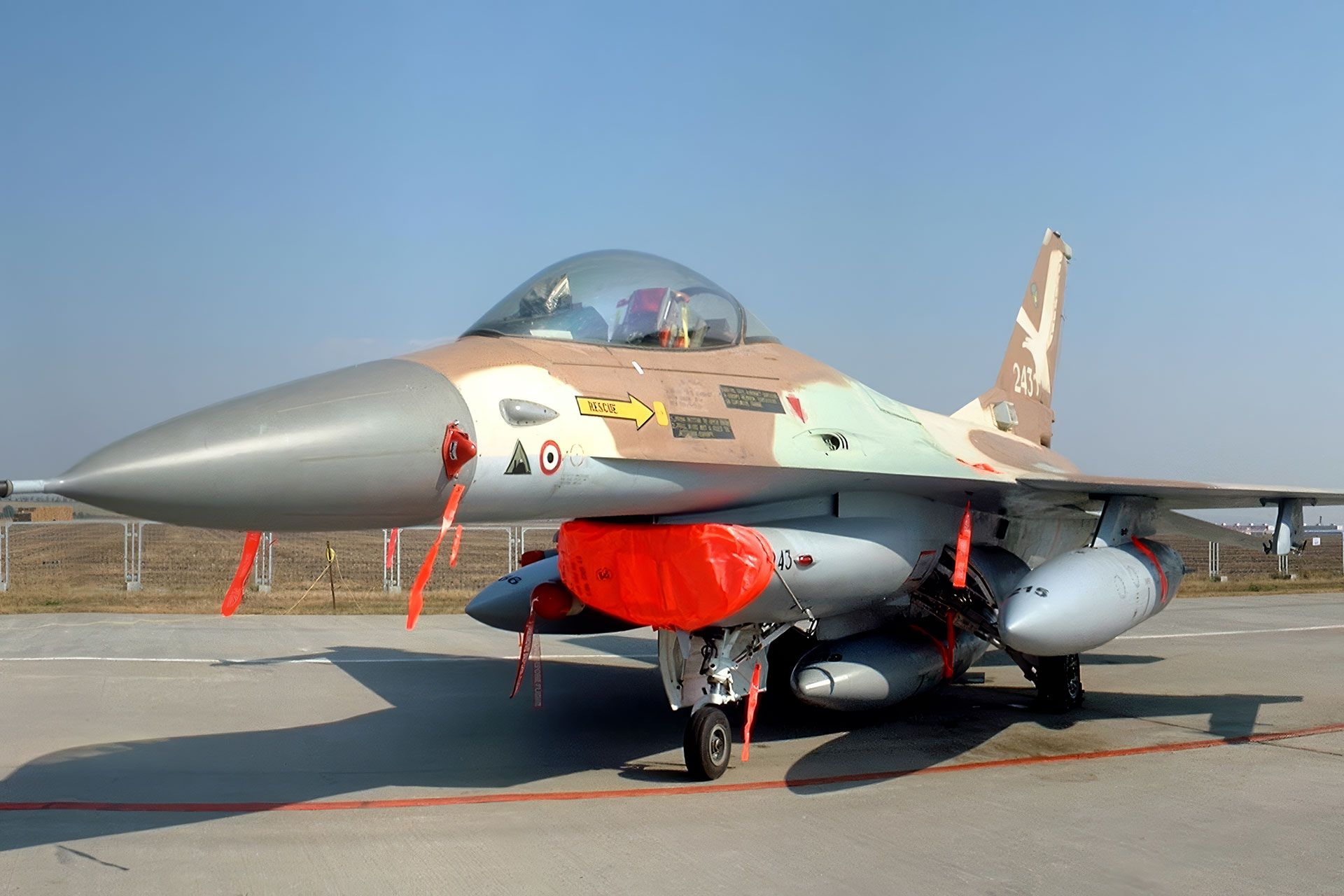
Main photo — F-16A of pilot Ilan Ramon, who participated in the raid on At-Tuwaitha and later became Israel’s first astronaut. Photo: Wikipedia / KGyST
If you enjoyed this article, consider making a donation — one-time or, even better, monthly. Your support helps us motivate our authors and become better with every article.
Our organization is recognized by the Internal Revenue Service (IRS) as a 501(c)(3) tax-exempt, charitable organization, which means that all contributions made to us are tax-deductible to the fullest extent permitted by U.S. law. Individuals may generally deduct charitable contributions of up to 60% of their Adjusted Gross Income (AGI) for cash donations made to qualifying 501(c)(3) organizations. For donations of appreciated assets (such as stocks or other long-term capital assets), the deduction is typically limited to 30% of AGI, based on the fair market value of the asset. C-corporations may deduct charitable contributions of up to 10% of their taxable income for donations made to eligible charitable organizations.
By submitting a donation, you confirm that you have read and accept the following documents: Privacy Policy and User Agreement, and also give consent to the processing of your personal data.
If you would like to unsubscribe from a monthly donation, please email us at: [email protected]