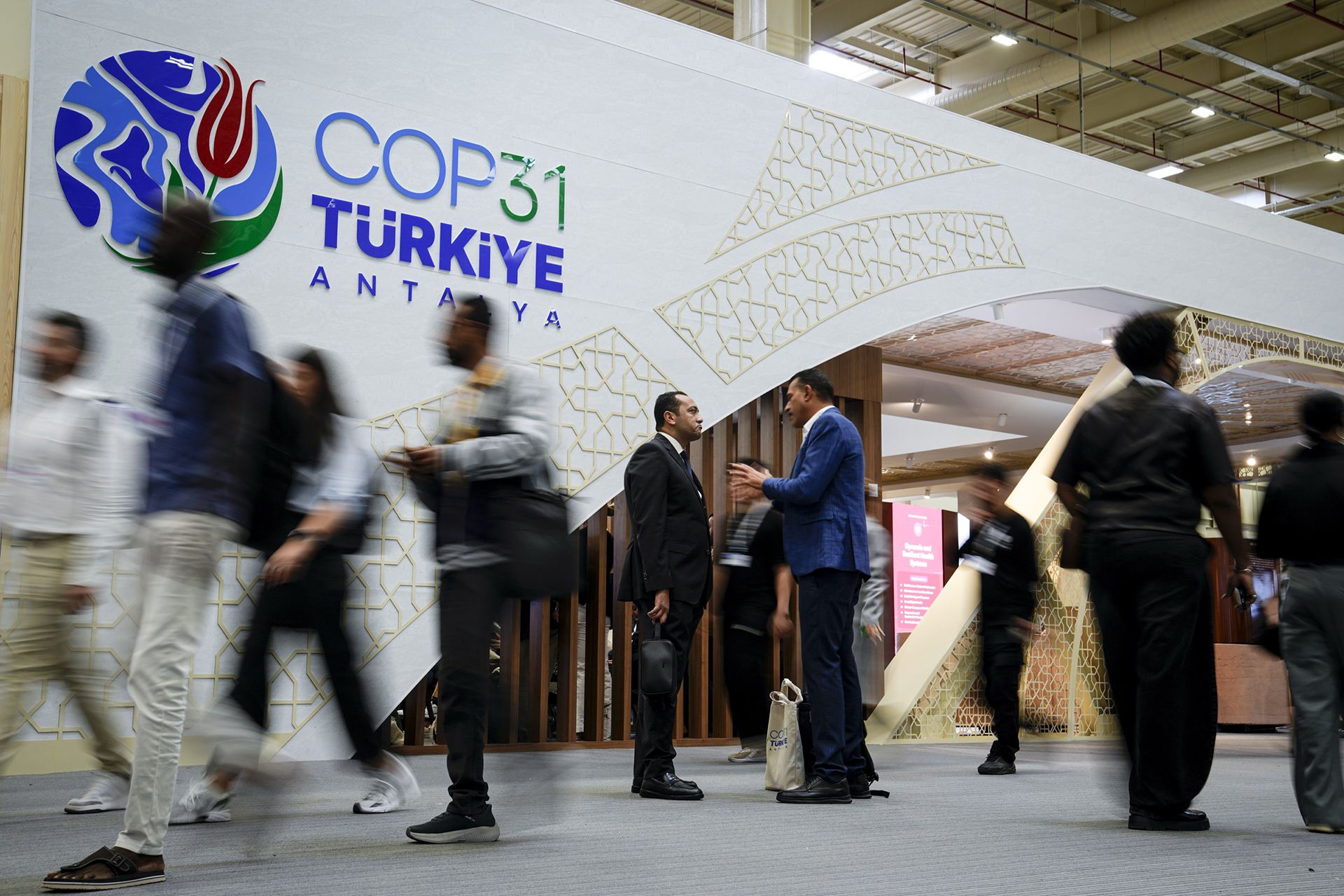
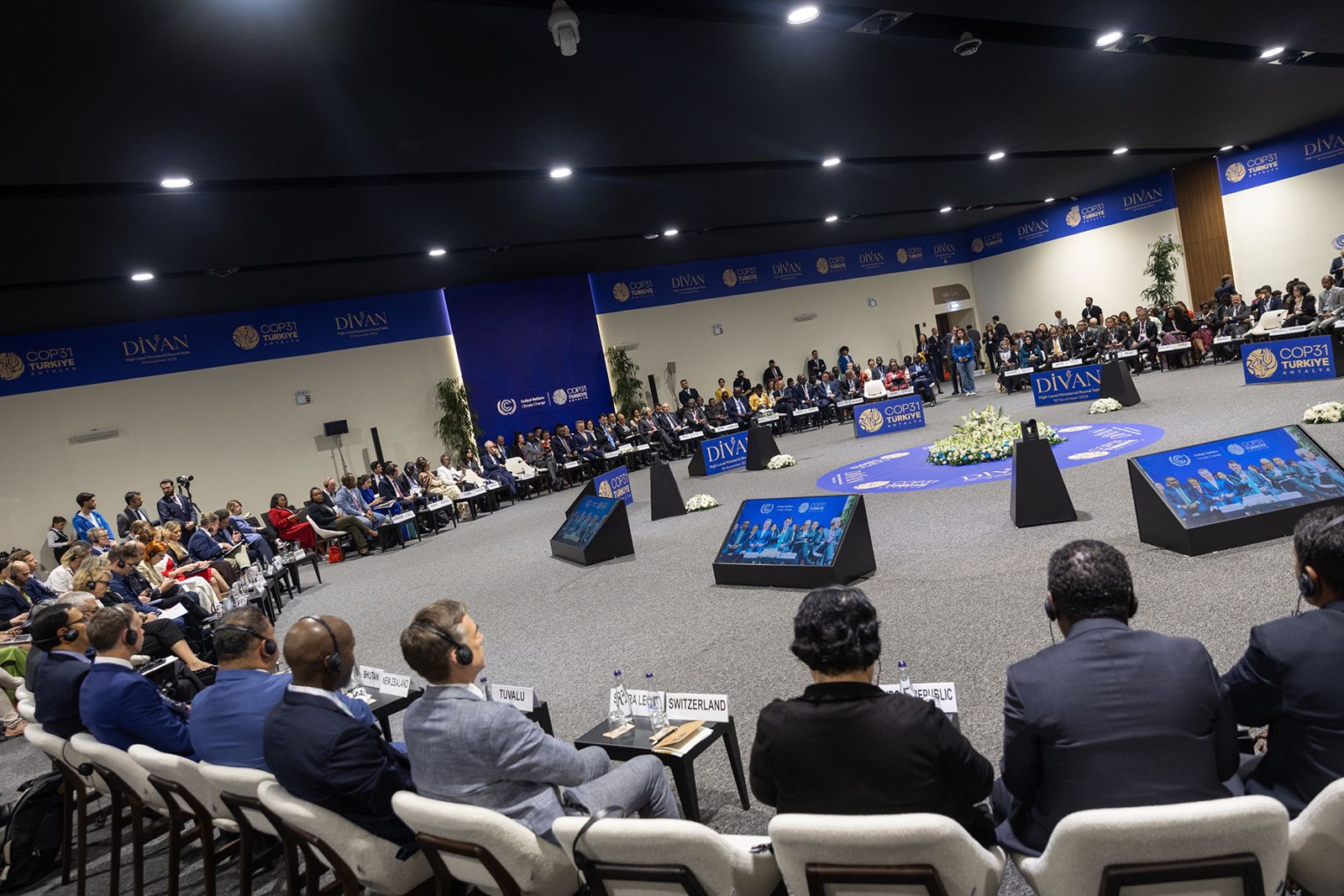
The COP31 summit in Antalya ended without the signing of an agreement. Disagreements over the climate agenda have happened before, but this is the first time it is happening under conditions where global warming has ceased to be hypothetical. Is there a way out of the obvious deadlock?
Photo: cop31.tr
The UN climate summit in Turkish Antalya ended in failure, Bloomberg notes: the agreement, which is considered a mandatory outcome of every meeting, was refused signatures by the EU and a group of island states. Why? The final document did not mention reducing the use of fossil fuels. And without that, the EU believes, it will not be possible to reduce the concentration of carbon dioxide in the atmosphere, which creates the “greenhouse effect” that heats the planet. The removal of commitments to reduce fossil fuel use was lobbied for by oil-producing countries. Turkey, as the host, proposed replacing this requirement with accelerated development of carbon capture technologies, which the “refuseniks” would not accept.
Hard Decisions
Despite the fact that concluding an agreement is mandatory after every summit, there have already been precedents when participants left without reaching a deal.
In 2000, at COP6 in The Hague (Netherlands), it was not possible to reach an agreement on developing mechanisms for implementing the Kyoto Protocol: the EU and the US disagreed over whether countries should take forests as carbon sinks into account when determining obligations to reduce CO2 levels (Russia also lobbied for this point, since it was important for it to take its vast forest territories in Siberia into account). As a result, the mechanism was eventually developed at an additional session in Bonn in 2001.
In 2009, at COP15 in Copenhagen (Denmark), it was not possible to agree on a new treaty that was supposed to replace the Kyoto Protocol. This time the irreconcilable positions were held by the US and China – the latter was in no way willing to accept a legally binding reduction in emissions. As a result, a non-binding Copenhagen Accord was prepared, which the participants “took note of”.
Finally, in 2019, at COP25 in Madrid (Spain), an agreement was signed, but its main point disappeared – the approval of rules for the global carbon credit trading market. That framework was agreed only the following year.
Thus, the current summit practically repeated the fate of the Copenhagen one. And there are clear reasons for this.
Photo: cop31.tr
The whole point of climate summits is to reduce the planet’s carbon footprint. One of the biggest CO2 producers is internal combustion engines and power plants running on fossil fuels. The “dirtiest” fuel is coal. The most common polluter is the automobile. Natural gas was recognized at COP28 in Dubai as acceptable as a “transition fuel”. That happened in 2023 and clearly shows why abandoning fossil fuels is so difficult.
Differences in Interests
Humanity is moving away from fossil fuels with difficulty. First of all, for technical reasons: converting power plants even from coal to gas requires investment, and nuclear plants after Chernobyl and Fukushima were long considered dangerous – they were included in the list of low-carbon technologies for combating climate change only in that same 2023 summit in Dubai. And this is no coincidence: it is worth recalling that the winter of 2022-23 became a real ordeal for Europe because of the cessation of Russian pipeline gas supplies – Vladimir Putin cut them off after starting the war in Ukraine in 2022. Before that, all EU countries except France had been steadily shutting down nuclear power plants, fearing a repeat of Chernobyl in densely populated Europe. It is worth remembering that Germany’s last nuclear power plants were shut down at the very moment the country was preparing to get through the winter of 2022-23 practically without heating.
That is the first obstacle to consensus. A fairly large number of countries still depend on fossil fuels almost entirely. And these are, as a rule, poor countries. The decisions adopted on transfers from wealthy countries to move away from fossil fuels are considered insufficient by poor countries.
Photo: cop31.tr
However, dependence on fossil fuels also exists in countries that are far from poor. For example, in the US, coal generation in 2026 accounts for 15-16% versus 10% from solar generation. And this despite the fact that the country is actively shifting to gas (40% of the energy mix at the moment). This is because coal generation formed the basis of the US energy system: at one time the country was among the first to begin large-scale construction of power plants, and then the main energy sources were coal and water (hydropower). And China, being a leader in the development of electric vehicles and solar generation, has only this year managed to reduce coal’s share in electricity generation to 49.7%. At the same time, the country has no intention of abandoning coal at all. On the contrary, it continues to build new coal units, using them as flexible reserve capacity to balance the power grid during periods of peak demand or windless and cloudy weather.
By the way, about electric cars. At COP26 in Glasgow in 2021, an agreement was reached on the gradual ban of internal combustion engine (ICE) cars. Countries, primarily European ones, took on voluntary commitments to stop producing ICE cars by 2035 and to completely phase out such vehicles by 2040. The document was supported by companies such as Ford, General Motors, Mercedes-Benz, Volvo, Jaguar Land Rover, and BYD. At the same time, the largest car markets (the US, China, Germany, France, Japan) and giants such as Toyota, Volkswagen, Stellantis, Honda, and Nissan refused to sign the declaration at that summit. And what happened? This year, the EU began to soften the requirements: European manufacturers are being thoroughly outcompeted by the expansion of Chinese rivals. And in the US, consumers themselves said a decisive “no”, unable to imagine life without the roaring engine of their huge pickup truck: an exception is made only for their native Tesla, and even then among urban intellectuals.
Thus, even among developed countries, as well as such large economies as China and India, there is a completely objective difference in the historical development of generation, the conditions for using alternative energy, the speed of development of electric transport, and so on. But now geopolitics has been added to all this, and it seems to have become the victim of the current summit in Antalya.
Gas, Oil, and Two Wars
The war in Ukraine started by Russia in 2022 made the gas market, and then the oil market, much more volatile than they had been before. And the war against Iran started by Trump, which ended with the blockade of the Strait of Hormuz and bombings of oil-producing countries in the region, made the situation worse.
As a result, a paradoxical situation emerged. On the one hand, there is plenty of gas in the world: proven reserves at the current rate of consumption will last half a century, and technically recoverable reserves for 200 years. Oil is even simpler: electric cars are pushing it out of the position of the main fossil fuel somewhere toward firewood, and this trend can no longer be reversed. But, as Boris Berezovsky used to say, “there was money, there will be money, but right now there is no money”. The same is true of oil and gas: there is plenty of it, but not where it is needed.
In the US today, gas prices are at record lows: production is growing, and liquefaction and transport capacity are not keeping up. In Europe, which has switched to imported LNG, gas is expensive – as a result, middlemen are doing best. Qatar – another gas giant – is today suffering from a rampaging Iran and the Yemeni Houthis it supports. The oil producers of the Persian Gulf are suffering from them too – their tankers are being hit, and fields and storage facilities are being bombed. Russia cannot take advantage of the situation – sanctions stand in the way.
The US is faring best, having become one of the leading players in the LNG and oil markets. But both the US and the Persian Gulf states understand that they can take advantage of high oil prices only for a fairly foreseeable future: right now in Europe the share of electric vehicles is rapidly growing, and in China they already account for more than 70% of the market. Even now, after the peak at the beginning of the blockade of the Strait of Hormuz, oil prices have not once exceeded that peak – and what will happen when the blockade ends?
Of course, countries like Saudi Arabia and the UAE have a great option – to crash prices and take market share from competitors. It is no coincidence that the Emirates even left OPEC, freeing themselves from the need to limit production. But this plan can only be implemented if global oil consumption does not decline – or at least does not decline drastically.
For the US, by the way, this is also relevant: although American shale oil is quite expensive, large producing companies can wait out a price slump in order to access new markets. But if one agrees to abandon fossil fuel use, not only shale producers will suffer – the US dollar will suffer too, since global oil transactions are conducted in it. And that is more than serious.
Is There Light at the End of the Tunnel?
So there is no way out and a temperature collapse awaits us? Not quite.
First of all, global warming is not a hellish furnace. Earth has experienced long periods of much higher temperatures and much greater concentrations of CO2 in the atmosphere. Moreover, human development began at a time when Antarctica was a green paradise and animals typical of today’s warm latitudes lived in the Arctic. In addition, warming in the mid-latitudes raises primarily winter temperatures: if summer becomes 2-5 degrees hotter, winter can easily become 10-15 degrees warmer. The farther north, the warmer the winters. In southern latitudes, meanwhile, precipitation increases: for arid regions this is a benefit (though not so much for humid ones).
The main danger of warming is not the rise in absolute temperatures, but the increase in climate extremes (floods, hurricanes, droughts, etc.) and sea-level rise. That is precisely why the small island states joined the EU’s refusal to sign the Anatolian agreement: they can literally go underwater, and within the lifetime of the current generation.
In fact, the possible solutions follow from the listed problems. But implementing them is not so simple.
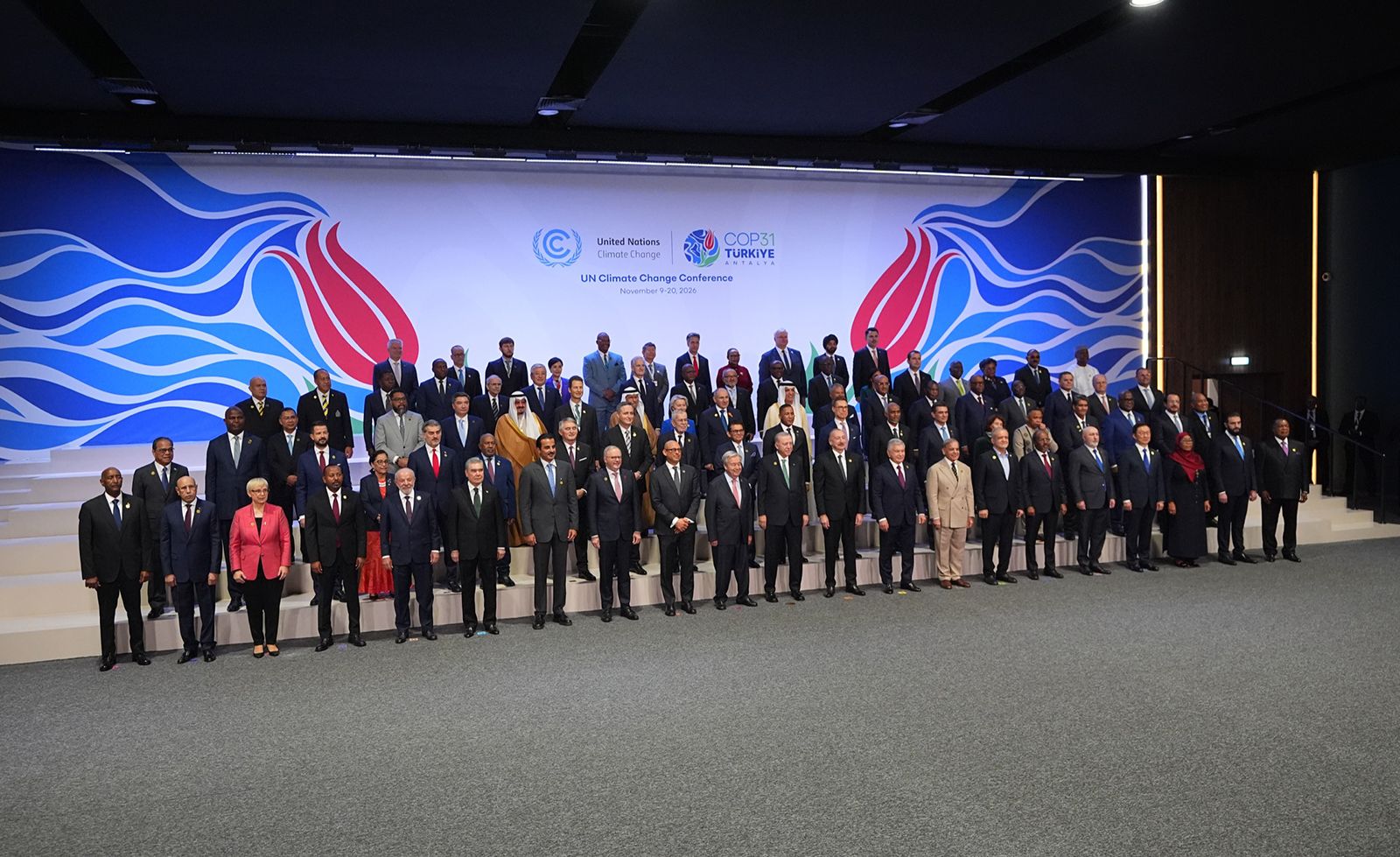
Leaders of the COP31 participating countries. Photo: cop31.tr
Organizing effective transfers of funds to poor countries. Although they account for no more than 1% of CO2 production, they are the ones suffering most from climate disasters. But it is not enough to develop a mechanism and even start paying – poor countries are almost universally marked by high corruption, and some of them are engaged in long, exhausting wars, including civil wars, or suffer from organized armed gangs.
China is the world’s largest producer of carbon dioxide – it accounts for 32% of global emissions. But China is already actively developing alternative energy and electric vehicle manufacturing. It would seem it should be encouraged? But developed countries are trying to wall off Chinese solar panels, wind turbines, and electric cars with tariffs – otherwise Chinese competitors will simply kill their own manufacturers.
Another separate issue is India. It accounts for 8.5% of global carbon dioxide emissions. But the country is one of the largest buyers of fossil fuels, and forcing exporters not to supply it with energy resources is hardly a feasible task.
By the way, the US accounts for 13% of carbon dioxide emissions. But why it is unprofitable for the US to support reducing oil use has already been said above.
Another separate issue is Russia. It is also among the TOP 5 CO2 producers – it accounts for about 5%. Until recently, Russia could even sell carbon credits thanks to the fact that its forests were counted as carbon sinks. In addition, 1990, when Russian industry was practically lying idle, was taken as the baseline CO2 level from which reductions had to begin. Nevertheless, uncontrolled logging of the taiga is doing its work. And now there is also the war with Ukraine – it is impossible to calculate how much pollution entered the atmosphere as a result of missile and drone attacks on the territories of these two countries.
It turns into a kind of three-body problem: no matter how you look at it, quite obvious solutions cannot be implemented. However, it is possible that China, where the abandonment of fossil fuels is proceeding at gigantic speed, will at some point switch to the side of the EU, which is strictly adhering to the line of phasing out hydrocarbons. Moreover, China may well demand even tougher measures if that gives it the opportunity to expand its climate-friendly products even further.
And then new climate summits may become even more dramatic.
If you enjoyed this article, consider making a donation — one-time or, even better, monthly. Your support helps us motivate our authors and become better with every article.
Our organization is recognized by the Internal Revenue Service (IRS) as a 501(c)(3) tax-exempt, charitable organization, which means that all contributions made to us are tax-deductible to the fullest extent permitted by U.S. law. Individuals may generally deduct charitable contributions of up to 60% of their Adjusted Gross Income (AGI) for cash donations made to qualifying 501(c)(3) organizations. For donations of appreciated assets (such as stocks or other long-term capital assets), the deduction is typically limited to 30% of AGI, based on the fair market value of the asset. C-corporations may deduct charitable contributions of up to 10% of their taxable income for donations made to eligible charitable organizations.
By submitting a donation, you confirm that you have read and accept the following documents: Privacy Policy and User Agreement, and also give consent to the processing of your personal data.
If you would like to unsubscribe from a monthly donation, please email us at: [email protected]