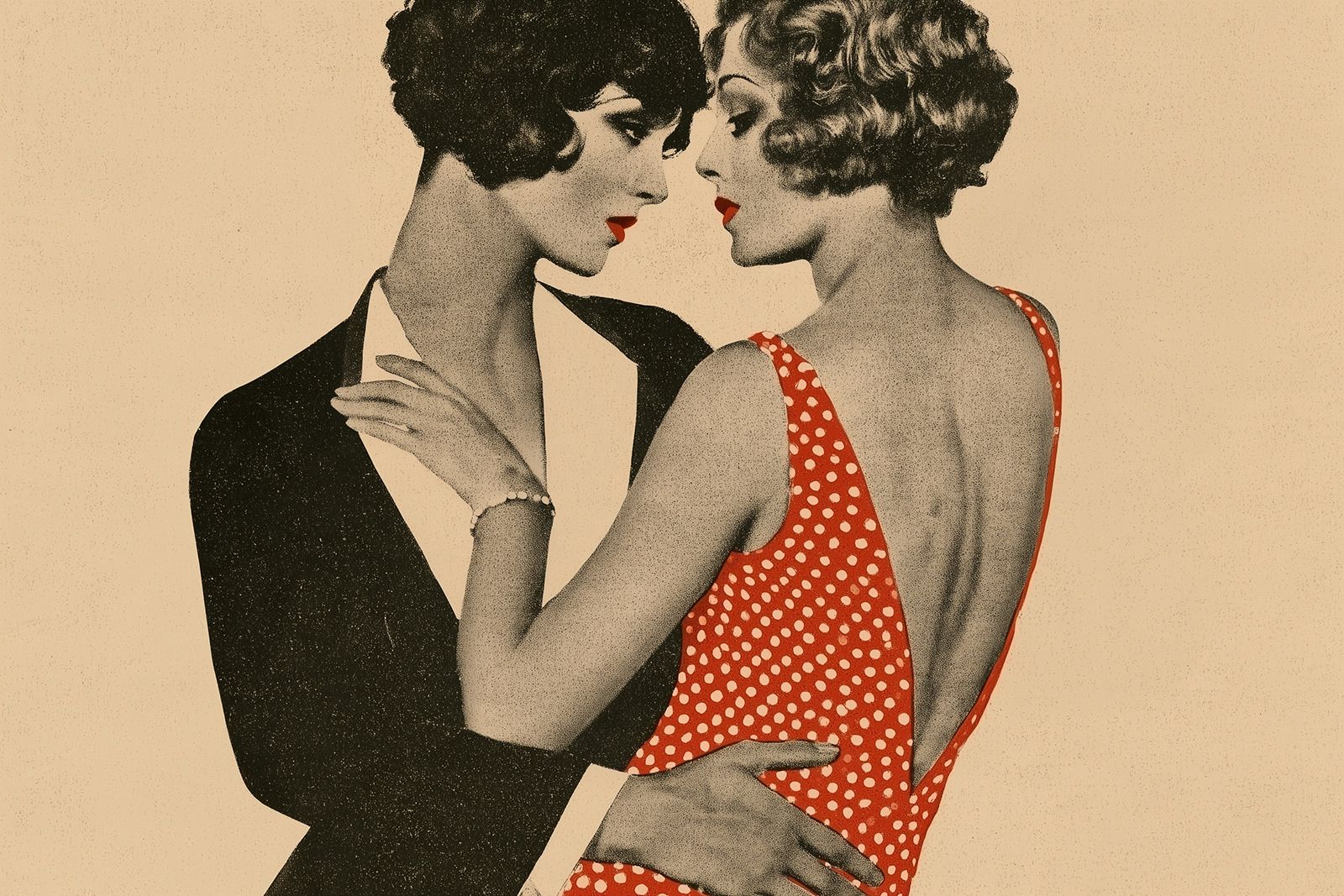
After Russia’s Supreme Court declared the “international LGBT public movement” an extremist organization in 2023, queer people have had to look for new ways to protect themselves. For some women, that way has been marriage to a man: it allows them to look “like everyone else” in the eyes of others and enjoy the corresponding social privileges. But safety comes at the cost of hiding oneself and new psychological trauma. “Most” tells four such stories.
Image: Midjourney / MostMedia
Maria speaks quietly and very carefully. It seems she has time to check every sentence before saying it out loud. Over the past few years, caution has become a habit. She is a little over thirty, and identifies as a pansexual and agender person (pansexuals are people whose attraction does not depend on another person’s sex or gender, and agender people are those who do not identify with any gender). She makes jewelry, works in the HIV field, does queer activism, and knows firsthand the consequences of anti-LGBT laws.
In 2023, in one Russian region, her colleague was detained and brutally beaten during questioning. That same day Maria wrote to her friend Dima: “How do we get married quickly so that if they lock me up, you can’t testify against me?” A few minutes later they submitted an application through Gosuslugi.
“Dima is someone I trust immensely. We feel like family to each other. At one point he even called me a comrade-in-arms. He also has an active civic stance”, Maria says about her husband.
The couple now lives in an “relationship anarchy” format. “In relationship anarchy there is no agreement — there is explicit communication. We’ve said what feels comfortable for him, what feels comfortable for me. How we see our relationship, how we want to continue and support it. We don’t live together, but we spend time with each other from time to time. We have sex, but not always — whenever we feel like it”, the woman explains.
Maria understands that her husband is an exception. Men usually do not attract her, and she herself calls this relationship “nonsense”.
Marriage has allowed her to feel safer. Maria always puts on her wedding ring when she goes to a public event. In conversations with people she doesn’t know well, she keeps the phrase “I have a husband” at the ready. And if the security services have questions, she is sure her husband will answer just as simply: “I don’t know anything. We’re married. Everything’s fucking great”.
Maria rarely leaves the house, tries to dress as inconspicuously as possible, and admits that sometimes she is simply afraid to walk down the street: “I don’t know what the hell it is, but people are constantly coming at me... Looking heterosexual is my protection”.
Once Maria returned from a trip to another country, where she could freely show affection to her girlfriend. A couple of days after arriving, they met up. Saying goodbye at a traffic light, they kissed out of habit. “And then literally a second later I pull back and say, ‘Oh, no. We’re in Russia,’” Maria recalls.
Maria has a group of queer friends she sometimes meets with. Conversations about relationships and politics happen at home, behind closed doors, and even there everyone speaks in hushed tones:
“If someone starts speaking louder, I immediately check that all the windows are closed and no one can hear us”.
Sometimes they dream of living somewhere in the woods, in little houses next to one another. But the feeling of safety is fragile even within the community. Fellow activists do not know Maria is married. Not the whole community is ready to accept her: “There was a time when I faced hate from the queer community because I had relationships with men”.
About once a week Maria goes on dates with “a lady”: “We choose a place, dress up. The vibe is romance-romance. And at this stage of life that’s what feels good to me”.
Psychologist Elena Mashkova says that today many LGBT people’s decisions in Russia are driven less by desire than by the instinct for self-preservation: “We resort to almost any means just to survive”.
But such safety, like the need to constantly hide part of one’s life, has its price.
“In Russia nobody stops you from living”
Tanseli is about twenty years old. She asks that her exact age and any details of her biography not be disclosed. During the interview she speaks quietly and falls silent for long stretches: many memories are hard for her. She decided to tell her story in order, as she says, “to get my voice back”.
“I identify as bisexual. That matters to me because I fell in love with a girl and suffered because of it”, Tansel begins. At 13 she had her first girlfriend and still tenderly calls her “my beloved”. When her mother found out about their relationship, it ended quickly: her parents beat Tansel while shouting, “girls don’t love girls”. “I shut down. It wasn’t the only time I remember being beaten while being yelled at about how I was wrong”, she says.
She speaks about her mother distantly: “She is a rule-following person. Maybe that was how her fear came out, her inability to control me. A year before that, the first law protecting children from LGBT propaganda was passed”. Now her mother is trying to rebuild communication, but Tansel calls her an “aggressor” and believes the old trust cannot be restored.
After the story with the girl, Tansel dated only men, but the relationships did not work out. “I fell in love with different guys who didn’t love me, used me, or kept me around, while they themselves suffered over someone else“, she recalls. Anton appeared when she was especially lonely and lacked support. They met at university. ”He constantly showed attention, wanted to spend time together, chose me right away“, says Tansel. She did not feel strong emotions, but they started dating anyway. Tansel thought she might fall in love with Anton. ”We got along well, supported each other. He knew I was bisexual, and he knew my story too. But he either didn’t know or didn’t want to realize that it wasn’t meant to be, that I wasn’t falling in love with him“, Tansel says.
A few years ago they got married. “On paper I have a very good life: a high salary, an easy job, a family. A husband as a screen, showing that I’m a proper heterosexual woman“, Tansel reflects. She explains that marriage gives her social approval and legal protection:
“If someone files a denunciation against me, I can show my passport in this state: ‘Look, I have a stamp and an official husband! What are you making up? You’re the ones obsessed with LGBT’“.
For relatives, marriage also creates the illusion of normality: “A significant part of my life is maintaining a beautiful fairy tale about me that they very much want to believe in“. Otherwise, her family will reject her and cut off all ties: “In words, she (my mother) accepts me and has no objection, but it’s the kind of acceptance that says ‘live and don’t stick out’. If I honestly want to discuss problems, she’ll say something like: ‘Nobody stops them (LGBT people) from living. And nobody stops anyone from living in Russia either’“, Tansel recounts conversations with her family.
With each year, her relationship with her husband gets worse. The woman admits that she “keeps” her husband around for peace and safety, understands that it is wrong, but cannot change anything. “I have treated and still treat my husband the same way one of my exes treated me — I keep him close because it’s calmer and more convenient for me. It hurts both of us; we’re on the verge of divorce”. She is not ready to go into details; it is hard for her to talk about.
Image: Midjourney / MostMedia
The illusion of a good life collapses when Tansel opens Instagram: the algorithms serve her queer women, music about love between women, various artists and performers. “It’s like a window into another world, a window to another side of myself. But in my tangible reality there is only me and the fairy tale I maintain”, the woman admits. All of this creates enormous inner tension in her, which her husband cannot understand: “I’m not even sure who I am anymore. I doubt my identity”. Asked whether she can openly express herself as a bisexual woman, the woman replies that under current circumstances it would be tantamount to suicide.
“I’m ashamed that I caved and married a white cisgender guy”
Bratislava looks very calm, even though the interview is taking place in a café. She speaks evenly, slightly academically, and mechanically rolls a ring from one finger to another. Bratislava is a little over thirty, comes from a small town in the Moscow region, is writing a dissertation, and works three jobs related to neuropsychology and psychophysiology.
Bratislava used to be actively involved in politics and feminism, but now, out of fear of persecution, she has shifted to “micro-activism”: she advises queer teenagers and continues to follow what is happening in the country. She also considers her account of her personal life to be micro-activism: “I want to make my country a good place. That matters to me”.
Without any fuss, casually, she shows fresh cut marks on her hand and says she takes antidepressants. She explains that the self-harm happened because of stress: she was deeply worried while preparing to defend her dissertation.
Bratislava identifies as a pansexual person — for pansexual people, attraction is not tied to a partner’s sex or gender. She had a long relationship with a girl named Anna: they lived together for five years, and that relationship affected her deeply. “We had a typical lesbian relationship — you know that joke about a lesbian showing up to a first date with a suitcase and handing over her keys on the second? That’s pretty much how it happened”, Bratislava recalls.
She has always been politically active: collecting signatures for opposition candidates, going to rallies, while her partner supported her in this. They had to move apart because of COVID — Bratislava was working in a hospital at the time, and the risks were too high. Maintaining contact became more and more difficult: “Little by little communication faded, and then the war started, and she began supporting Russia, while I also had principled positions”. They still keep in touch, and the relationship remains good.
Bratislava says Anna “unpacked” her sexuality. After the breakup she wanted more new connections — with both girls and guys. As a demisexual person (demisexuals are people for whom emotional connection is important when entering into a sexual relationship), it is important for her to feel emotional closeness first. So after registering on Tinder, she was not looking for sex — she just wanted to talk and get to know people. That is how Bratislava met Igor.
Over time the young people decided to get married. Bratislava’s family did not approve of her relationship with Anna: they said Anna had “bewitched” her. So Bratislava decided to marry, in part, to calm her family down: so they would “leave her alone”. But she also has feelings for Igor: “I can’t say I don’t love him, I do love him. This isn’t some marriage of convenience. But one of my thoughts was also to feel safer. And I wanted some peace”, Bratislava explains. Igor supports and understands her, helps her manage depressive episodes. They share views on what is happening in the country, and he approves of her activism: “When I start feeling like an object again, when everything is unpleasant, everything hurts, but I have to keep going, he often notices it. I chose a very gentle and sensitive person”.
A stamp in the passport by itself does not protect from persecution, but it helps others perceive a person differently. Psychologist Elena Mashkova explains:
“Marriage to a man by itself is not psychological protection. It is more about hiding identity and avoiding stigmatization. About ‘being like everyone else’ so that it is socially approved”.
But long-term concealment of identity and constant adaptation to society also have consequences. According to Mashkova, they increase the risks of anxiety, depression, chronic stress, and internalized homophobia. Even after ending up in a safe country, a person may continue to live on guard.
For multisexual people — those whose attraction may be directed toward people of several genders, such as bisexual or pansexual people — this is sometimes compounded by the feeling that neither the heterosexual nor the homosexual community fully accepts them.
Queer activist Regina Dzugkoyeva says that the community’s reaction to women who become less visible thanks to marriage to a man can be painful:
“This way of doing things is perceived aggressively by a large percentage of queer people. And, frankly, they are seen as traitors”.
According to her, in times of repression people expect solidarity from one another, and fear makes it hard to see the circumstances in which another person makes their choice: “To understand, accept, and forgive that, you need a lot of resources. Often people don’t have them. And the easiest thing is to go into aggression”.
Bratislava herself experiences her choice as betrayal: “I’m very ashamed that I caved and married a white, cisgender, heterosexual guy. Right now I feel like I betrayed everything”. She does not talk about the marriage, does not post photos, and tries to speak about her husband neutrally: “My partner”. She is scared: the feeling of being “a stranger among my own, my own among strangers” has accompanied her through her entire “depressively conscious life”.
Psychologist and queer activist Anife Devletova disagrees with this framing. Marriage to a man, she says, does not change a person’s sexual orientation and does not strip them of their belonging to the community: “Every woman has the right to choose whether to marry or not. The reasons for that marriage are secondary”.
Image: Midjourney / MostMedia
According to Devletova, one of the queer community’s important tasks is “to support one another rather than create even more phobias”.
“We kissed on the escalator, and nobody cared”
Anastasia is 29 years old. She gestures a lot, speaks quickly, gets carried away by her own story, and laughs often. She likes going to concerts, works in medicine, with people — “although the social sphere is not really close to me, it scares me, I even consider myself a social phobe”, she admits.
Her first relationship with a girl began when Anastasia was sixteen: “I didn’t even have any thoughts that it was wrong”. But gradually her partner became more cautious: on the street she kept her distance, tried to look like just a friend, and avoided any signs of closeness.
Anastasia opened Google and learned for the first time that society considers such relationships wrong. Almost at the same time, pressure at home increased. Her mother guessed about her daughter’s relationships, and her grandmother and close friend became more and more religious. The idea that loving girls is something wrong was voiced more and more often.
“At some point, I think, all these doubts from the outside convinced me that it was bad”, she recalls.
Anastasia kept trying to fit into social norms and tried relationships with a young man. They ended badly, but helped her figure herself out: “I realized that my attraction does not depend on gender”.
Anastasia was introduced to her future husband Sasha by mutual friends. They were brought together by similar views, and they attended protest actions in St. Petersburg together. At first she did not see him as a potential partner. But gradually they started talking and dating.
“Finally I was able to tell my mom: ‘I live with a guy, can you believe it?’ The legitimization happened. I can say that we went to sleep or that we got up and ate today. Before that I couldn’t do that”.
Almost immediately after they moved in together, her mother started asking about a wedding. Anastasia herself never saw marriage as a goal: “If I had been dating a girl, I would have wanted to get married even more, because it would have been a protest against society. Just to show that we can do that too”.
But the decision to get married was influenced by the war, and then mobilization and new repression.
“Marriage has a lot of advantages. Especially when you’re not heterosexual. You can tell everyone around you that you’re married, and nobody even thinks that you might be somehow different. You can tell your family that you’re married, and they’ll be happy. And you can visit each other in prison, in intensive care. It really gives privileges. And it’s sad that not everyone has them”, Anastasia says.
She unexpectedly began noticing things that had previously been inaccessible to her. One day she and Sasha kissed on an escalator: “I immediately turned my head toward people and realized that nobody cared. I was in shock. Wow. So that’s possible”.
Psychologist Elena Mashkova says that the habit of automatically assessing possible threats can become part of everyday life. So even marriage to a man and the outward ability to “be like everyone else” do not necessarily restore a person’s sense of complete safety.
Anastasia tells almost no one that she is bisexual. She is sure that if her husband were not around, she would most likely have to leave Russia; living with a girl and constantly hiding it would already be impossible for her.
Even now she does not dare open old saved posts on VKontakte: “If there’s anything LGBT-related there, I’ll have to delete it. And as long as I don’t see it, it doesn’t exist”.
Marriage allows Anastasia to enjoy the privileges that society automatically grants a heterosexual couple, but it does not free her from the need to hide part of herself. And this strategy appeared long before the current wave of repression.
Queer women in Russia did not start using marriage as cover today. British researcher Francesca Stella writes in the book “Lesbian Lives in Soviet and Post-Soviet Times” that in the USSR marriage could solve very practical issues — from registration and housing to social status. In conditions where housing allocation favored married couples, a stamp in the passport could literally affect the ability to get an apartment, and the status of mother made a woman appear to others as a “respectable, adult woman”.
At the same time, marriage served as a “shield”: it deflected suspicion and allowed non-heterosexual relationships to continue under the guise of friendship.
Decades later, this mechanism works in modern Russia in almost the same way. A stamp in the passport gives others a simple and understandable explanation for someone else’s private life. And then the ability to explain nothing becomes one form of safety.
If you enjoyed this article, consider making a donation — one-time or, even better, monthly. Your support helps us motivate our authors and become better with every article.
Our organization is recognized by the Internal Revenue Service (IRS) as a 501(c)(3) tax-exempt, charitable organization, which means that all contributions made to us are tax-deductible to the fullest extent permitted by U.S. law. Individuals may generally deduct charitable contributions of up to 60% of their Adjusted Gross Income (AGI) for cash donations made to qualifying 501(c)(3) organizations. For donations of appreciated assets (such as stocks or other long-term capital assets), the deduction is typically limited to 30% of AGI, based on the fair market value of the asset. C-corporations may deduct charitable contributions of up to 10% of their taxable income for donations made to eligible charitable organizations.
By submitting a donation, you confirm that you have read and accept the following documents: Privacy Policy and User Agreement, and also give consent to the processing of your personal data.
If you would like to unsubscribe from a monthly donation, please email us at: [email protected]