On August 15, 1945, the Supreme Court of France sentenced Marshal Pétain to death on charges of collusion with the enemy and treason. This historic verdict marked the end of the long journey of the World War I hero who became a symbol of French collaborationism with the Third Reich. It also marked the beginning of a harsh period of postwar purges and persecutions against French citizens who cooperated with the Vichy authorities. The personality of the marshal himself remains a subject of debate, speculation, and contradictions even 80 years later.
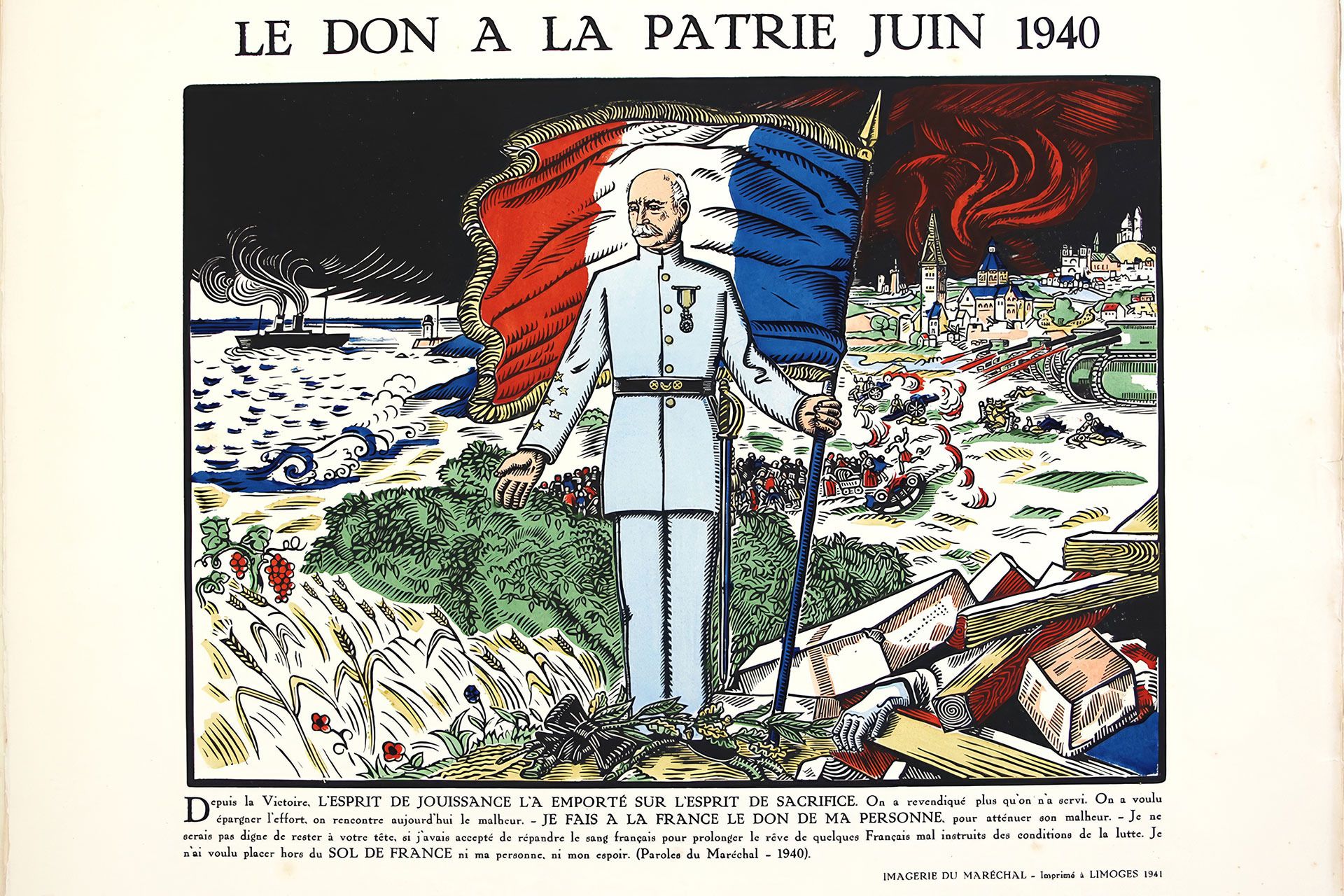
Vichy poster “A Gift to the Fatherland, June 1940.” Limoges, 1941
In May 1940, German troops defeated France. The “strange defeat,” described and analyzed by historian Marc Bloch, came as a surprise and shock both to most French politicians and to the entire French society, not to mention the million soldiers taken prisoner by the Germans. In early June, the political class along with the sitting government panicked and retreated from Paris to Bordeaux. On June 17, 1940, the French heard a monotonous elderly voice on the radio: “I offer myself to France to ease its suffering.” This was the Marshal of France, Philippe Pétain, addressing them.
A hero of the legendary Battle of Verdun, he had resisted the Germans and led his people to victory in World War I. The majestic figure of Pétain on a white horse during the triumphant parade on the Champs-Élysées in 1918 was immortalized in French history and in the memory of millions of French people. But this time, the marshal was decidedly not among the victors.
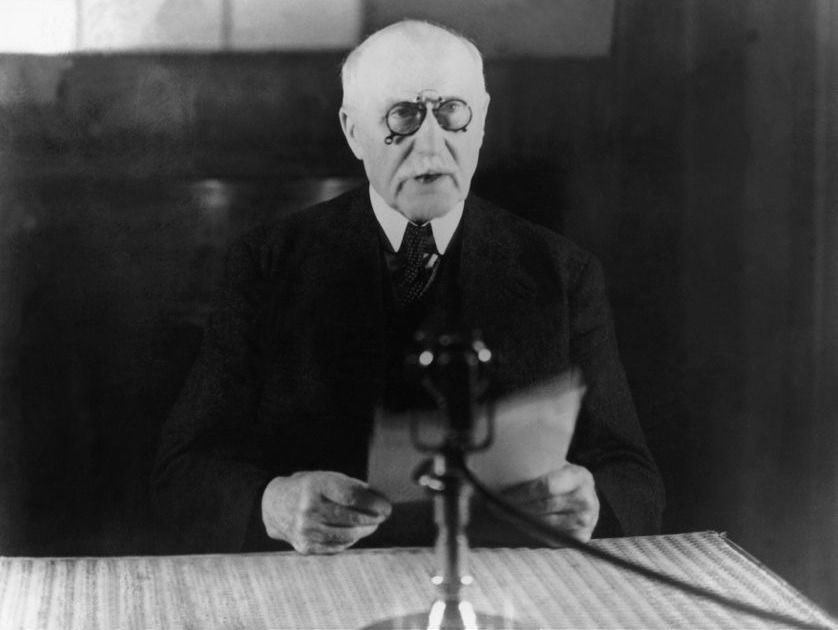
Pétain speaking on the radio (between 1940 and 1944)
“It is with sorrow that I tell you today that we must cease hostilities,” he announced to his compatriots as a national catastrophe unfolded before their eyes.
From early June, Marshal Pétain exerted all his efforts to persuade Prime Minister Paul Reynaud to send Hitler a proposal for a ceasefire.
Unlike a significant number of ministers who hoped to devise a plan to evacuate to Algeria and other French colonies to continue the fight, the old marshal was convinced that participating in a second war in thirty years would cause irreparable damage to the French people.
Threatening to resign and provoke a governmental crisis, Pétain succeeded in forcing Reynaud’s departure and took over the government. On July 10, 1940, the French parliament deputies gathered in the casino building in Vichy voted to grant extraordinary powers to the new leader of France. Thus began the most tragic period in modern French history — four years of the Vichy regime.
After the armistice, France was divided into two zones. In the north and northwest was the German occupation zone with its capital in Paris, and in the south and southeast was the free zone controlled by the Vichy regime. The Germans could not have hoped for a better outcome from their lightning blitzkrieg: they got everything they wanted and even more.
First, they had at their disposal a loyal French government ready not only to cooperate but also to provide its administrative and police resources to manage the country. A great stroke of luck was the duo leading this government: Marshal Pétain and his Prime Minister Pierre Laval. The former inspired trust in the concerned French society — his undeniable reputation and authority gave hope for a favorable resolution to the catastrophic situation. The latter, thanks to his opportunism and energy, made every effort to strengthen Vichy-Nazi collaboration and played a key role in the government’s policies.
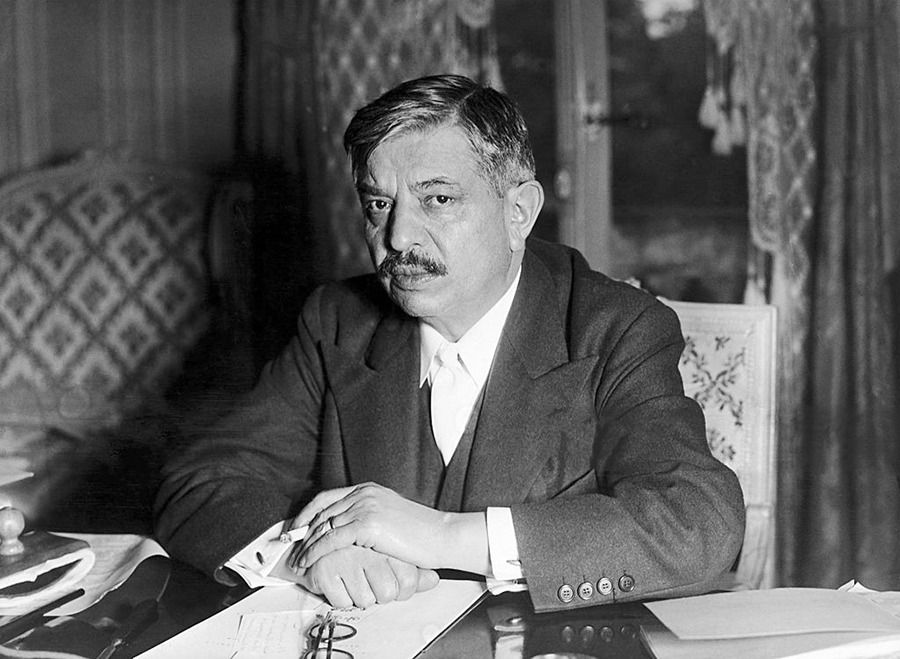
Pierre Laval, 1940. Photo: Wikipedia
Secondly, Hitler gained strategically necessary territory to continue the war and expansion. The Atlantic coast of France — Normandy and Brittany — was a crucial platform for attacking Britain, while French natural resources — food and industrial — eased the burden on the German war economy. Philippe Pétain was perfectly suited to the role of father of the nation, once again coming to France’s aid in a difficult moment. Unlike genuine French fascists such as Jacques Doriot — founder of the French Popular Party (PPF), who fully adopted Hitler’s and Mussolini’s political codes — Pétain did not evoke disgust or disobedience among the French. Many of them believed until August 1944 that their savior was fighting on two fronts — on the one hand defending France while negotiating with the Germans, and on the other buying time for the Allied landing and liberation of the country. In reality, the elderly marshal was a far more complex political phenomenon.
***
Pétain was a representative of another, bygone era. A man of the 19th century, he was born in the French provinces in 1856 and, after a brilliant military career, settled in Paris. Pétain never voted in his life, always despised parliamentarism and politics, adhered to Catholic and traditional values, and did not believe in Alfred Dreyfus’s innocence. Despite this, the marshal tried to avoid affiliation with ideologically close far-right movements, leagues, and parties such as Charles Maurras’s Action française or Colonel de la Rocque’s French Social Party.
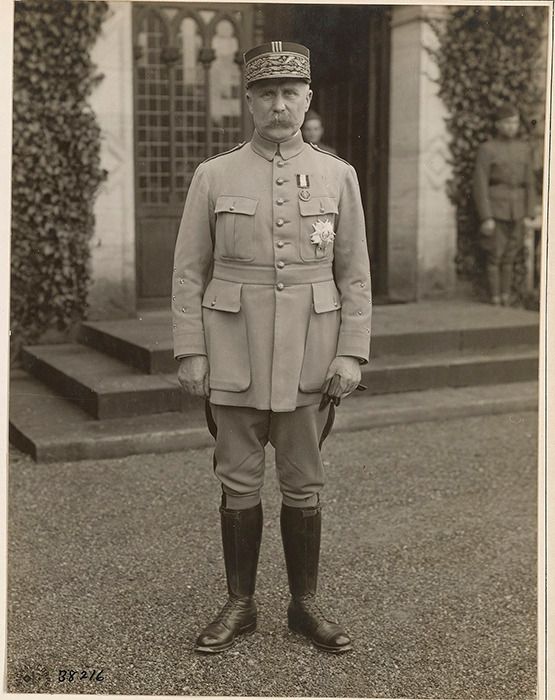
Philippe Pétain in 1918. Photo: Wikipedia
On February 6, 1934, a far-right demonstration took place in Paris, triggered by numerous corruption and political scandals. It united a wide range of anti-parliamentary and anti-republican movements and parties and nearly turned into a coup. During clashes with the police, over a thousand people were injured, fourteen protesters and one policeman were killed.
Although the demonstrators were eventually dispersed, the government crisis was not long in coming. Gaston Doumergue, a former president of the country, a respected and authoritative figure capable of forming a “national unity government” in this difficult moment, was appointed the new President of the Council. Among the many politicians who received ministerial posts was Marshal Pétain, appointed Minister of Defense. The Verdun victor hesitated for a long time but ultimately accepted Doumergue’s invitation. For the marshal, it was not about politics, which he continued to deeply despise, but rather about service to the homeland, another rescue in dark times: “I am at France’s disposal. But I have never been involved in politics and do not want to be.” And, it must be admitted, Pétain did not intend to waste time in his new role.
Hitler’s rise to power and his plans to modernize the German army seriously concerned Pétain. The French army had not undergone reform for many years and was gradually weakening amid hopes for universal disarmament. It was not prepared for a possible renewed German invasion.
At 78 years old, Pétain understood better than any French politician the challenges facing France and Europe regarding army reorganization and rearmament. The marshal prophetically warned that in future wars, aviation and heavy armored vehicles would be the main weapons, and that the army would be equipped with mobile tank and motorized rifle units without which modern warfare was impossible. Trying to change the deplorable state of what was once the strongest European army, Pétain developed a radical military reform that included creating a powerful professional army, building new fortifications, modernizing armaments, and increasing and accelerating their production.
Seeking to secure France’s borders, the Minister of Defense attempted normalization and rapprochement with Fascist Italy, concluded a military agreement with Poland, and repeatedly stated the need for close cooperation with British and American allies.
By November 1934, Gaston Doumergue’s government resigned. In his ephemeral nine months in office, Pétain did not complete his military reform but managed, despite resistance from major political parties, to initiate modernization and rearmament of the French army. More importantly, the marshal confirmed and strengthened his reputation, including within military circles. Not to mention the Germanophobic and nationalist movements, for whom the war hero in power became a true favorite. Against the backdrop of the leftist Popular Front’s victory in the 1936 parliamentary elections, right-wing and conservative circles discussed the possibility of creating a new nationalist party around Pétain’s figure; some even considered an authoritarian coup under the marshal’s aegis. But the short period in government ultimately disillusioned Pétain with politics and elites incapable of any reforms.
However, the marshal’s ambitions, despite his age, did not wane. The more inevitable a new war in Europe seemed, and the more aggressive Hitler’s Germany became, the stronger Pétain’s desire to return to an important post grew.
***
In 1939, the Spanish Civil War ended. The rise to power of General Franco, combined with the tense international situation, was a warning sign for Édouard Daladier’s government. Since the beginning of the fratricidal Spanish war in 1936, France had maintained diplomatic relations exclusively with the Republican Popular Front government (Frente Popular), the equivalent of the French Front populaire. Meanwhile, President of the Council Léon Blum avoided direct military support for the Spanish leftist colleagues, adhering to a policy of non-intervention and limiting support to accepting refugees, logistics, and humanitarian aid.
But Franco’s victories in 1937 and 1938, culminating in the capture of Barcelona in January 1939, nevertheless forced the French government to consider the possibility of recognizing Francoist Spain and normalizing relations with it. After all, it was not just about good relations with a neighbor but about minimizing the risk of war with a potential ally of Adolf Hitler. Such a diplomatic mission required an ambassador with the appropriate status. Anti-French sentiments were on the rise in Spain, where the Francoist press mercilessly lynched the neighbors for supporting the Republicans. For Daladier, Pétain was perfectly suited as a diplomatic trump card in the border Spanish city of San Sebastián, where the French representation opened in March 1939.
Sending Pétain to Spain was an excellent diplomatic move — the Spaniards despised the French as much as they respected the elderly marshal for his military achievements.
Moreover, Pétain knew his Spanish colleagues well — in particular, General Jordana, Foreign Minister of the Francoist dictatorship. Despite the cold reception and disdain from the authorities (Franco did not even grant the French ambassador a formal visit), Pétain managed to settle in Spain, establish relations with the Spaniards andpolitical elites. His energy commanded respect — he was remembered for his car tour through Spanish villages and handing out cigarettes bearing his name to Spanish soldiers. He made unprecedented efforts to ensure Spain’s commitment to stay out of the war and for Daladier’s government to meet de facto all the conditions set by Franco’s government. Even though these very conditions were, to put it mildly, contrary to France’s military and economic interests.
For example, Franco demanded the return of everything the Republicans had managed to take to France — from weapons and gold to political activists. Finance Minister Paul Reynaud actively resisted any repatriation of Spanish bullion and assets before signing a neutrality declaration, believing that Spanish funds in France were the only leverage against Franco. Using all his prestige and authority despite his relatively low political rank, Pétain ultimately convinced the government to transfer most of the gold to Spain. Which, it must be admitted, did not bring France any closer to its diplomatic goals.
Marshal Pétain and Baron de las Torres, Franco’s interpreter, in Burgos, March 26, 1939. Photo: Wikipedia
The marshal’s diplomatic mission was not successful. After six months in Spain, Pétain had not achieved true normalization of relations with Spain, let alone a guarantee of Spanish neutrality in the event of a new European war. But this experience once again demonstrated to him the power of his political image, style, and personality, which commanded respect in France and around the world.
The marshal realized how loyal the French General Staff and military were to him, and how weak and led astray Parisian politicians were, unable (from his point of view) to make serious decisions.
The embassy in Spain was the final stage in forming Philippe Pétain’s political image, without which it is impossible to understand why he became France’s last hope in June 1940. It also explains the blind trust of the French, most of whom could not imagine what the collaboration organized by their national hero with the Germans would turn into. They say ambitions come with success. In the marshal’s case, this is undoubtedly true.
***
On September 4, 1939, three days after the German invasion of Poland, Spain officially declared its neutrality. However, this was not due to the efforts of the French ambassador but because Franco fully understood the consequences of entering the war. Spain, ravaged and devastated by three years of civil war, could not afford to participate in another slaughter.
France and Britain declared war on Germany, beginning the “Phoney War.” On May 10, 1940, Hitler invaded Belgium, Luxembourg, and the Netherlands; three days later, the “Panthers” entered France through the Ardennes. Paul Reynaud, heading the government after Daladier’s March resignation, urgently summoned Pétain to Paris — on May 16, the marshal was appointed his deputy. On June 6, General de Gaulle joined the government, receiving the position of Undersecretary of State for War and National Defense.
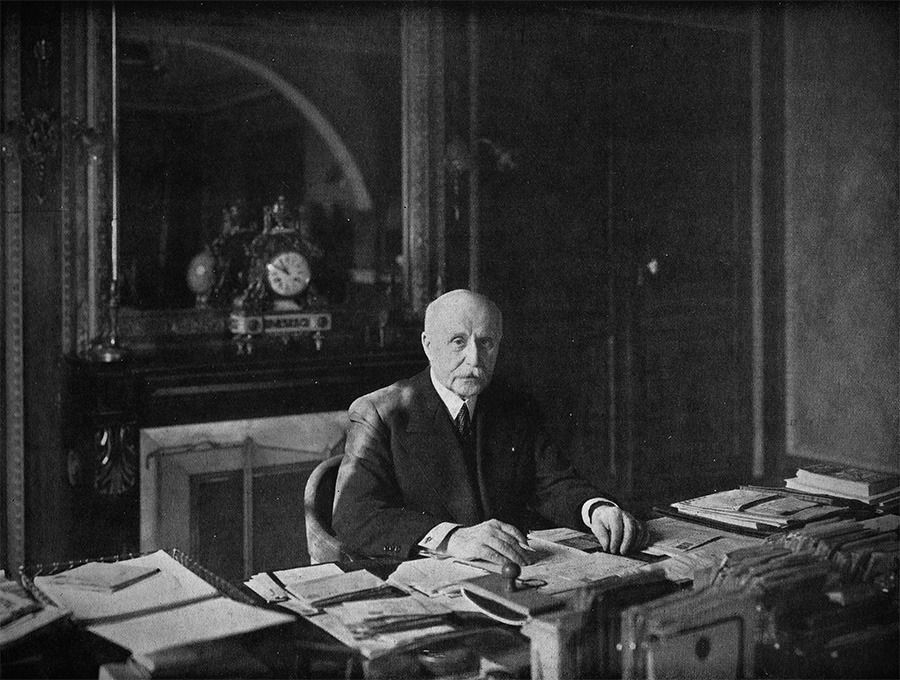
Pétain, Deputy Chairman of the Council, in his office in May 1940. Photo: Wikipedia
Pétain and de Gaulle knew each other well from World War I. Did they realize, while in Bordeaux with the fleeing government, how much their paths would diverge? On June 17, Pétain headed the Council of Ministers and signed an armistice with Hitler, agreeing to cooperate with the Germans. On June 18, de Gaulle, fleeing to London, delivered one of the greatest speeches in French history, calling on his compatriots to resist and continue the fight. By August 2, 1940, de Gaulle was sentenced to death in absentia by the Vichy military tribunal.
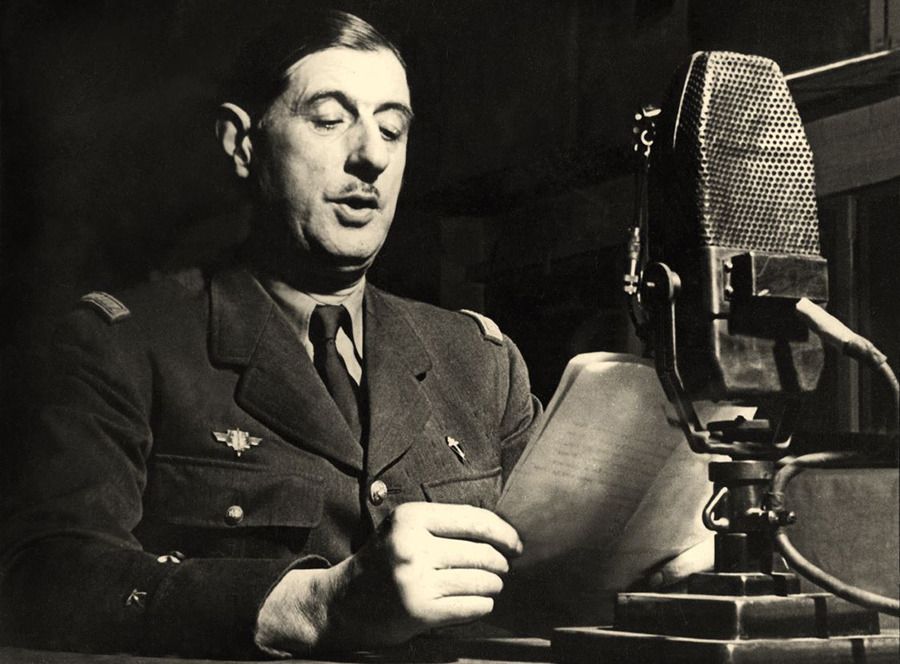
General Charles de Gaulle speaking on the BBC in London, 1941. Photo: Wikipedia
Five years later, de Gaulle and Pétain switched places. The general headed the provisional government after France’s liberation, while the marshal found himself in the dock. In September 1944, Pétain was forced to retreat with the Germans.
Together with the remnants of the Vichy government, the marshal found refuge in the Sigmaringen castle, where he remained until April the following year. Soon Pétain had to move to Switzerland. When he learned of the inevitability of the trial against him in Paris, the decision was immediate — to surrender at the French border to defend his honor in court. After all, the marshal was convinced he had nothing to reproach himself for.
During the trial, which opened on July 23, 1945, the 89-year-old Pétain delivered only one opening speech outlining the main points of his defense. This speech gave rise to the theory that became the credo of the marshal’s supporters — the “shield and sword” theory. Pétain chose a sophisticated rhetorical formula that cast him not as an accomplice of the Third Reich but as someone who resisted it: “I used my power as a shield to protect the French people.” Then came an even more controversial statement: “While General de Gaulle continued the fight beyond our borders, I was preparing the way for liberation, preserving a suffering but living France.”
In 1954, these statements, unconfirmed by any documents, would be included in Robert Aron’s book “History of Vichy,” where the occupation period was portrayed from the perspective of very modest French archives and documents available to the author. Aron supported Pétain, believing that the Vichy regime preserved France and protected the French from the Germans while awaiting the Allied landing and Liberation. As for the numerous anti-Semitic and xenophobic laws, repressions, and other Vichy atrocities, the historian had no doubt — the guilt and responsibility lay with Germany, which forced the French authorities to comply with Nazi policies. After all, if it weren’t for Pétain, France would have been a real Poland! How else to explain, for example, that three-quarters of French Jews survived the Holocaust?
So does it mean that Pétain was indeed the lesser evil? That deep down he never accepted the German occupation and simply hoped to buy time for the Allies?
Things were, to put it mildly, quite different. Countless historians, from Robert Paxton to Laurent Joly, many of whom, including Paxton, worked extensively with German archives, have shown that Marshal Pétain and a significant part of his government had their own xenophobic, ultraconservative project to transform French society. This project had roots in internal French socio-political conflicts: the French Revolution, the separation of church and state, the Dreyfus Affair, the Popular Front’s victory, and the May 1940 fiasco.
In fact, Pétain managed to unite in his government various nationalist, conservative, and far-right movements for whom this “divine surprise” was an opportunity to take revenge and get even. Revenge against whom? Against those whom writer Charles Maurras called the “four confederate states”: Protestants, Jews, Freemasons, and métèques (foreigners). It was these foreigners, outsiders (others), who became victims of laws and decrees that at best restricted their rights and at worst sent them to Drancy and then Auschwitz.
Historian Robert Paxton, who became a real scapegoat in far-right and conservative circles, proved that most of the anti-Semitic laws and decisions made by Vichy were initiatives of the government itself, not the result of German pressure. It was French anti-Semitism that became one of Pétain’s policy vectors.
No German participated in the “Vel’ d’Hiv Roundup” — the largest single deportation of French Jews. The 12,884 Jews arrested, including elderly people, women, and children, were caught by the Paris police carrying out government orders.
Using German archives, Paxton was able to fully analyze the role the Nazi leadership assigned to occupied France. The Germans wanted to concentrate as few people and resources as possible in France, relying on its own capabilities and cooperation from the Vichy government. Even after the Wannsee Conference, the country’s strategic position pushed the “final solution to the Jewish question” to the background, leaving the main priority to exploiting French resources, preparing for a possible enemy landing, and maintaining “calm” conditions.
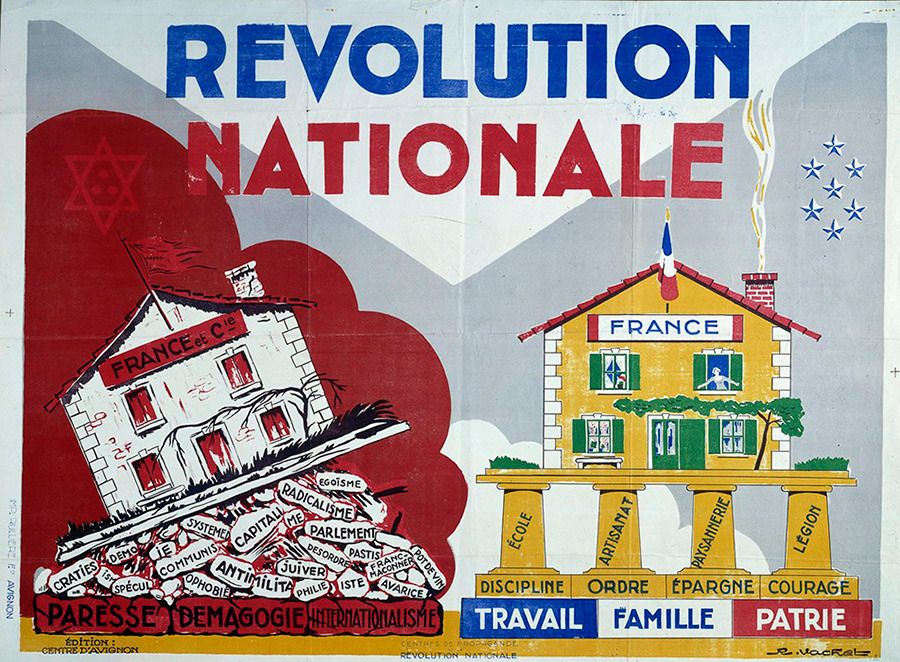
How then to explain Marshal Pétain’s zeal? The truth is that the Verdun victor truly had his own vision of what “his” France should look like. This vision was articulated in the “National Revolution” project launched by the Vichy government from late 1940. A Catholic France, cleansed of foreigners and communists, living thanks to the fertile lands of its villages — this France looked very much like the country where little Philippe grew up in the 1860s. A country he never managed to return to.
Propaganda poster promoting the National Revolution and denouncing the Third Republic, supposedly a victim of capitalism, communism, speculation, Jews, and Freemasons. Photo: Wikipedia
General de Gaulle pardoned the marshal but sent him to the Île d’Yeu to serve a life sentence. Philippe Pétain died in 1951 at the age of 95.
***
Many have tried to define “Pétainism,” “Pétain-de Gaullism,” and other ideological currents associated with Pétain’s figure. To this day, there are historians, writers, journalists, and politicians ready to defend France’s savior, who almost became its gravedigger. For four years, for the first and (so far) only time in its history, the country was ruled by the far right — and this period undoubtedly became a crucial element of the political identity of those who, willingly or not, inherited the values, ideas, and vision of France characteristic of Pétain’s regime. “Work, Family, Fatherland” instead of “Liberty, Equality, Fraternity” — the main symbol both for Vichy and for those who over these eighty years — from Jacques Isorni to Jean-Marie Le Pen — have in one way or another taken up the baton from the marshal and his like-minded followers.
The most prominent representative of this fan base is Éric Zemmour, a well-known conservative polemicist who ran for president in 2022. Although his chances of coming to power are slim, more and more French people listen to Zemmour’s stories about “French decline” and a France “that no longer exists,” about the “great replacement” of white Europeans by Arabs and Africans, about Muslims threatening Western civilization. It is no surprise that Zemmour, who dreams of expelling immigrants and Muslims from France, claims that “Pétain saved the Jews.” For modern far-right groups to shed their complexes and stigma, they need to justify their predecessors — sometimes rewriting history in the process.
If you enjoyed this article, consider making a donation — one-time or, even better, monthly. Your support helps us motivate our authors and become better with every article.
Our organization is recognized by the Internal Revenue Service (IRS) as a 501(c)(3) tax-exempt, charitable organization, which means that all contributions made to us are tax-deductible to the fullest extent permitted by U.S. law. Individuals may generally deduct charitable contributions of up to 60% of their Adjusted Gross Income (AGI) for cash donations made to qualifying 501(c)(3) organizations. For donations of appreciated assets (such as stocks or other long-term capital assets), the deduction is typically limited to 30% of AGI, based on the fair market value of the asset. C-corporations may deduct charitable contributions of up to 10% of their taxable income for donations made to eligible charitable organizations.
By submitting a donation, you confirm that you have read and accept the following documents: Privacy Policy and User Agreement, and also give consent to the processing of your personal data.
If you would like to unsubscribe from a monthly donation, please email us at: [email protected]