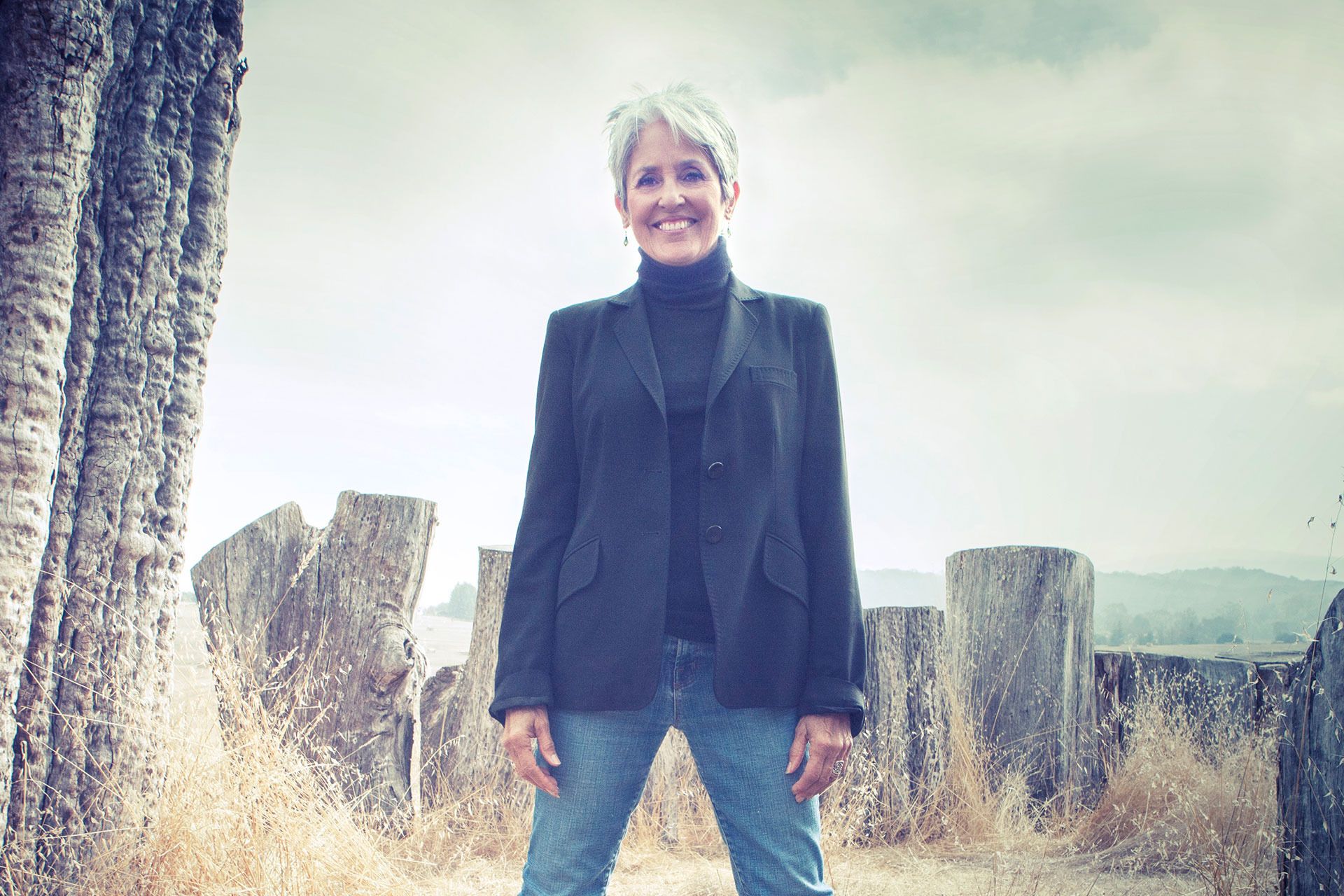
She was imprisoned for her beliefs, refused to perform in the USSR in solidarity with dissident Natalia Gorbanevskaya, donated most of her earnings to charity, sang Bob Dylan's songs better than he did himself, and this year plans a farewell tour with him.
Joan Baez. Photo: joanbaez.com
Joan Baez has often said that she wants to be seen first and foremost as a political activist—and only then as a singer, musician, or poet (choose as appropriate). However, it’s now clear that the beautiful idea to which she devoted much of her life turned out to be a utopia. And her main legacy is music. More precisely, the way she herself sees music—as a space for expression, from the personal to the political.
Joan Baez was born into a family where a conflict between parents and children seemed inevitable—yet it was avoided. Her father, Albert Baez, was an outstanding physicist, contributed to the development of X-ray technology, and played an important role in the U.S. government’s Manhattan Project to create the atomic bomb. But traveling the world thanks to her father’s work (for example, he worked for UNESCO in the early 1950s) and the warm, creative home environment encouraged creativity in every way. Joan claimed that she learned to sing before she could speak—and to dance before she could walk. Even if that’s an exaggeration, it doesn’t seem far off: both Joan’s older and younger sisters also became musicians and political activists.
There’s another important source of her creativity—seemingly far removed from popular culture (at least as we imagine it). Joan Baez’s work is infused with Christian themes, allusions, and references to the Bible. She not only sings African American gospels and spirituals, but also includes Christian metaphors and symbols in her lyrics. The reason is that during her childhood, both her parents, who themselves grew up in families of ministers, embraced Quakerism—a radically pacifist form of Protestantism. Joan took this new religion with utmost seriousness and passion.
As a child, she often moved with her parents to different cities in the U.S. and abroad—Canada, Europe, the Middle East. This semi-nomadic lifestyle influenced her later concert career. It also introduced her to many different American communities, where she often witnessed injustice—and always tried to fight it. Joan argued with teachers if she thought they were unfair to her classmates, and protested against stores that refused to serve Black people. She also faced attacks on her appearance—Joan has Mexican roots on her father’s side. All of these were small acts of civil disobedience, which might now seem a bit ironic—especially given how impossible such actions were in the Soviet Union at the time. But these experiences shaped Joan Baez’s spirit. The flip side was depression and sexualized violence from her father, which she revealed only a year and a half ago.
Still, there were enough hurts as it was. As she recounts in her first autobiography, written at thirty (imagine the level of self-reflection!)
“I was never particularly popular in class because I was the new kid, and also Mexican. I was skinny, tall, and completely brown. I thought I was very ugly. One person threw me a lifeline—our family doctor. He told me I wasn’t just cute, but beautiful. He said the girls in my class whom I envied would roast in the sun to have my skin color. Fine, I agreed, but what about the dark circles under my eyes? He said that’s very fashionable now and women pay money to have such dark eyes. That was the beginning of the end of my childhood and the beginning of the end of the misery I felt every time I saw the skinny, dark ugly duckling in the mirror.”
In high school, she read—or rather absorbed from conversations—quality retellings of Marxism and other leftist thought. Theory fueled practice and gave her ideas for her first songs. Her first act of civil disobedience was refusing to leave school during an air raid drill. As a senior, Joan explained that she didn’t want to participate in this charade because she didn’t believe the Soviet Union would attack the United States.
Fame came overnight and was all-consuming: “the barefoot Madonna with an unearthly voice,” as her first review put it, published, incidentally, in the student one-day newspaper Harvard Square (and it’s no coincidence that the first critics noted many references in her musical technique to an imagined Middle Ages, to the traditions of bards and minstrels). Starting to perform at the very end of the 1950s, Joan anticipated the folk revival phenomenon in American culture of the next decade. She recalls that she somehow sensed: even if only for a short time, folk music in modern arrangements would become incredibly popular—not only old hits, but new creations as well. Ernest Hemingway managed to hear her and compared her voice to “the purity of a mountain spring.”
In 1962-1963 came worldwide recognition: her face on the cover of Time magazine, a Grammy nomination, and official status as the most popular folk singer. She accepted this success not only with gratitude, but also with doubt: what if this was an attempt to tame her? So she set off on a concert tour of the southern states, where she ended up in jail several times for sit-ins—a popular form of nonviolent action for civil rights in 1960s America. Again, in Joan’s own words:
“My mother has already been to jail with me twice. We took part in a sit-in together. She said she didn’t know if it would do any good, but it might encourage other mothers to do the same. And that’s what happened. During our next stint in jail, there were three women with us in the cell who admitted that thanks to my mother, they found the strength to fight for their beliefs.”
Joan was a natural talent. She never studied music professionally (nor did she spend a single year in college), but with perfect pitch, she developed a complex vocal technique on her own—it’s enough to say that by her fourth album, she performed an operatic part. Bob Dylan recalled that during the endless performances of the early 1960s, there wasn’t a song whose melody she couldn’t pick out on the guitar by ear.
The U.S. counterculture movement is a topic that deserves a separate discussion. Joan didn’t just immerse herself in it as a nourishing environment, she helped shape it. Soon after her first and instant fame, she invented her own genre of what in Russian would be called “author’s song.” Beyond direct statements, legendary protest songs like We Shall Overcome feature a unique imagery of protest: individual metaphors, comparisons, and other literary devices are understood by listeners strictly in a certain context. Thus, another protest song is, seemingly, the especially lyrical (Joan herself calls it “tender”) composition What Have They Done to the Rain.
An important part of the folk revival and political song movement of the 1960s was the friendly exchange of many songs, which seemed to lose their author and belonged to everyone and no one at the same time. Joan believed that copyright was less important here than the performance itself. Small changes in arrangement, a few words, but most importantly, in intonation, made it seem as if the song belonged to someone else (at least for the duration of the concert). Again, from her autobiography:
“It was normal for us to exchange songs before a concert. Someone might ask me for a song I wanted to perform. I gladly gave it, advising how best to sing it—and then I might take someone else’s song for myself. Now I think we wanted to emphasize: in our creativity, it was the people’s voice that spoke. At least, the part of the people we knew and identified with. After all, it’s much harder to suppress a collective author than each one individually.”
She later embodied this metaphor in the famous song Here's to You, written with Ennio Morricone and dedicated to the executed labor rights activists Sacco and Vanzetti: it’s performed at a marching pace, and by the end it feels as if the people’s choir joins Joan’s voice.
Another detail of the context. Many political songs of the 1960s trace back to the “red decade” of U.S. history—the 1930s. The connection was made through new performances of these songs at concerts. People responded to the lyrics and melodies of their grandparents—or even their own childhoods.
It’s wrong to think that all of Joan Baez’s creative work was political and protest-oriented. Like any true artist, she doesn’t fit into boundaries or frames—except those she sets herself. She helped bring back the ballad genre with a personal perspective. The song as a story, confession, and reflection on what concerns her personally. And a melancholic mood comes at just the right time: what’s happening around can’t be liked, and Joan says so directly.
One of the brightest chapters in Joan’s life and career is her complicated collaboration with Bob Dylan. She not only performed his songs better than he did (by Dylan’s own admission), but also introduced him to the world of the music industry she already knew. It all ended with a painful breakup, about which Joan wrote one of her best-known songs, “Diamonds and Rust.”
Her activism was aimed not only against the U.S. war in Vietnam but also against political repression in the Soviet Union: in 1976 she released the song “Natalia,” dedicated to Natalia Gorbanevskaya—one of the seven protesters against the Soviet invasion of Prague in August 1968. And at a concert in Paris in the late 1970s, she performed Bulat Okudzhava’s “Union of Friends,” which was seen almost as an anthem of the dissident movement. At the same time, Joan Baez and Bob Dylan’s circle (and even John Lennon’s) very likely included Soviet agents—this topic still awaits open archives, published memoirs, and its own researcher. This hypothesis is discussed in the fascinating documentary book by historian Jon Wiener “Gimme Some Truth: The John Lennon FBI Files,” published in 2000.
During those years, but certainly before the start of the Soviet war in Afghanistan, Joan passionately wanted to perform in the USSR, even willing to do it for free. The Soviet side agreed to all conditions except one. Joan was required to promise not to perform the song about Natalia Gorbanevskaya, and if asked, not to confirm she was the author. Of course, she refused.
Her portrait would be incomplete without mentioning her philanthropy. For many years, while performing concerts in Latin American countries, she donated all her fees to charities supporting those in need. The amount she has given away far exceeds what she kept for herself. She prefers not to name exact figures, but it certainly exceeds $10 million. Among the main recipients of her help are Greek and Chilean democrats during the dictatorships in those countries, funds supporting healthcare and education in Africa, and single mothers and teenage mothers in her own country.
It’s important to note that Joan herself never supported violent actions. And this seems closely tied to a particular feature of her performance style. Whatever the content of the song, she almost always sings with introspection and lyricism. It’s a persistent call, but not for action—instead, for pausing and reflecting, tinged with gentle sadness. This technique can be compared to Tolstoyan defamiliarization, when you look at old things in a new way—only it’s about the listeners. Her singing is an attempt to change the world, starting with herself. Listen to her today—they are worth it.
If you enjoyed this article, consider making a donation — one-time or, even better, monthly. Your support helps us motivate our authors and become better with every article.
Our organization is recognized by the Internal Revenue Service (IRS) as a 501(c)(3) tax-exempt, charitable organization, which means that all contributions made to us are tax-deductible to the fullest extent permitted by U.S. law. Individuals may generally deduct charitable contributions of up to 60% of their Adjusted Gross Income (AGI) for cash donations made to qualifying 501(c)(3) organizations. For donations of appreciated assets (such as stocks or other long-term capital assets), the deduction is typically limited to 30% of AGI, based on the fair market value of the asset. C-corporations may deduct charitable contributions of up to 10% of their taxable income for donations made to eligible charitable organizations.
By submitting a donation, you confirm that you have read and accept the following documents: Privacy Policy and User Agreement, and also give consent to the processing of your personal data.
If you would like to unsubscribe from a monthly donation, please email us at: [email protected]