An effective way to stop Russian military provocations could be NATO’s shift to a proactive strategy. So that it’s not European countries fearing the arrival of Russian drones or fighter jets, but rather Russia itself fearing unexpected “visits” on its own territory. Ukraine has already shown how this is done, reaching Russian military and energy facilities thousands of kilometers from its borders with its drones. But will there be politicians in Europe willing to declare their intent to fundamentally dismantle the aggressive empire threatening the entire free world?
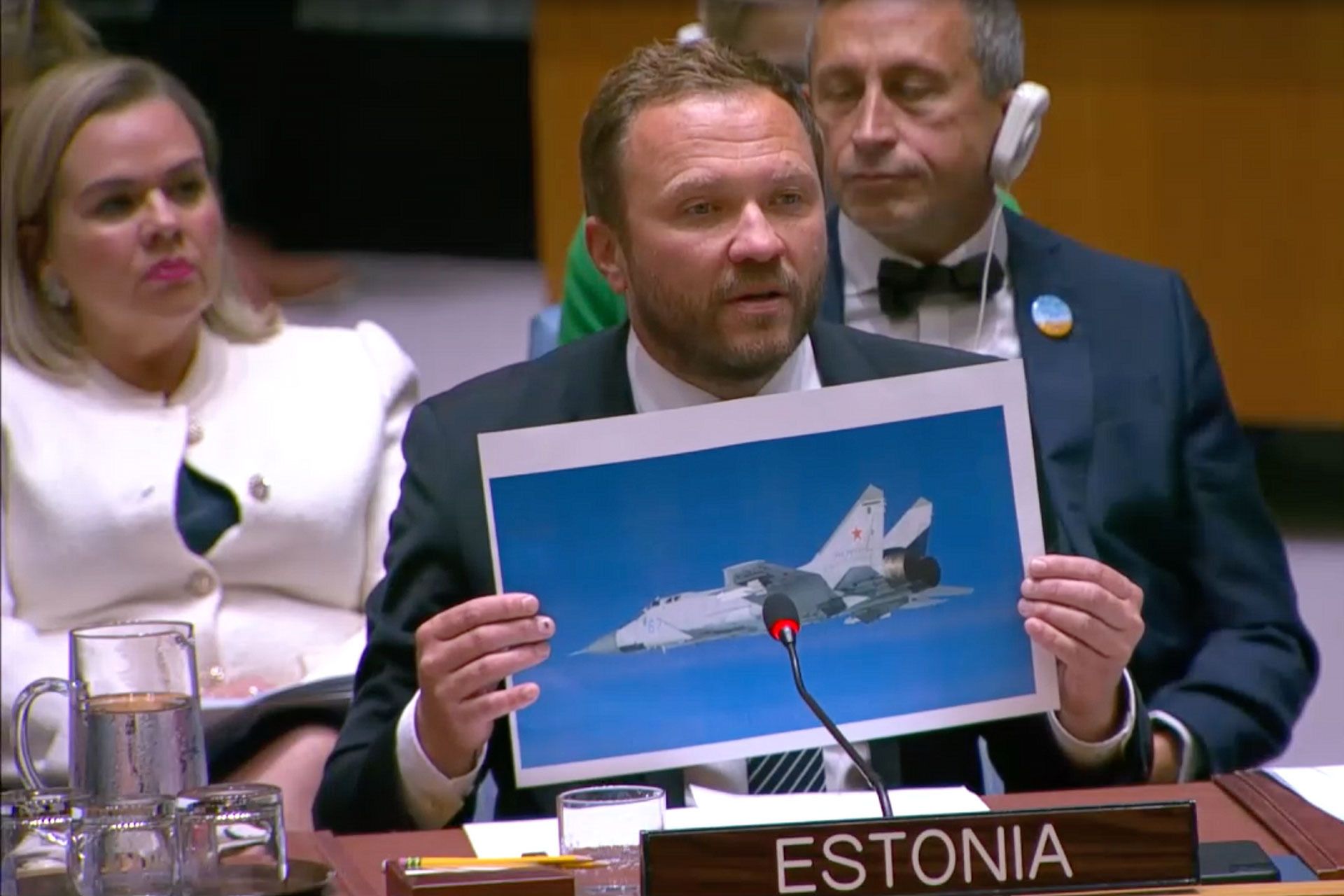
Estonian Foreign Minister Margus Tsahkna at the UN Security Council meeting. Video frame: un.org
On Friday, September 19, three armed Russian MiG-31 fighter jets entered Estonian airspace over the Baltic Sea for 12 minutes – a considerable amount of time by aviation standards. The Russian planes did not provide flight plans and had their transponders turned off. Moreover, they refused to establish radio contact with Estonian air traffic controllers.
The incident was promptly responded to by Italian F-35 fighters stationed at the Estonian Emari base, engaged in NATO’s mission to protect the airspace. They signaled to the Russian aircraft about their violation and then escorted them to their destination – the Kaliningrad region.
For residents of large countries, this incident might seem minor. However, considering that the MiGs could have been carrying hypersonic Kinzhal missiles, their flight time to Tallinn would have been only a few seconds.
No one knows what the current Russian leadership is thinking. Shelling and bombings of another European capital – Kyiv – have become routine news over the past three years.
In response, Estonia initiated an emergency meeting of the UN Security Council, held on September 22. Foreign Minister Margus Tsahkna reminded: “Just a few days ago, 19 Russian drones entered Polish airspace, and a Russian strike drone remained in Romanian airspace for an hour. These are not isolated incidents but part of a broad escalation strategy by Russia both regionally and globally. Such behavior requires an international response. And it is incompatible with the responsibilities of a permanent member of the UN Security Council.”
The minister’s last remark is especially important, and apparently it was the reason why no resolution was adopted following the meeting. Most participants – the US, UK, France, Germany, Sweden, Ukraine, South Korea, etc. – certainly supported Estonia’s concerns. The Chinese representative spoke very diplomatically, calling for “restraint” from all sides. Meanwhile, the Russian delegation, as has happened many times before, accused all critics of “Russophobia.”
If Estonia had proposed a condemning resolution, Russia would have simply vetoed it, thus halting all further discussions, as happened in 2022 during the debate over the full-scale invasion of Ukraine.
These days, celebrations marking the 80th anniversary of the UN’s founding are taking place at its headquarters, but the mood is not very festive. The current situation points to a deep crisis within the UN structure, where the organization is unable to protect international law if a permanent Security Council member violates it. There is no mechanism to exclude a member or strip its veto power. Thus, the UN risks repeating the fate of its historical predecessor – the League of Nations – which failed to prevent World War II.
UN Security Council meeting, September 22, 2025. Video frame: un.org
Estonian media, as usual, publishes a wide range of assessments of the incident. From those who demand shooting down Russian fighters violating the country’s airspace, to those who call for calm and seeking an effective response at the international level, primarily within NATO.
By the way, politicians from other NATO countries – Germany, the Czech Republic, and Lithuania – are firmly determined: they advocate for tough retaliatory measures. They often recall the 2015 incident when Turkey, also a NATO member, shot down a Russian fighter that had entered its airspace. After that, Russia did not declare war on Turkey, limiting itself to temporary economic sanctions. However, that was a different era, before the full-scale Russian invasion of Ukraine, which has greatly intensified the confrontation between Russia and NATO.
Nevertheless, almost all proposed Western countermeasures remain reactive in nature. Even radical ideas like completely blocking Russia’s access to the Baltic Sea by shifting Finland’s and Estonia’s maritime borders. Theoretically, this could hinder the movement of both Russian combat aircraft and the “shadow fleet” transporting Russian oil. But this would conflict with the same principles of international law that provide for neutral waters. And again, a vicious circle arises, as Russia, a permanent Security Council member, would veto such a decision.
An effective way to stop Russian military provocations could be NATO’s shift from a reactive to a proactive strategy. So that it’s not European countries fearing the arrival of Russian drones or fighter jets, but rather Russia itself fearing “unexpected visits” on its own territory. Ukraine has already shown how this is done, reaching the aggressor’s military and energy facilities thousands of kilometers from its borders with its drones.
In the development of modern drone technologies, Ukraine has indeed managed over the years of war against it to surpass many NATO countries still relying on traditional weapons from the last century. Even President Trump has expressed interest in acquiring Ukrainian drones.
NATO European countries bordering Russia could provide bases on their territory for Ukrainian drones. This would be a strong proactive decision and would force Russia to shift from provocations against neighboring European countries to its own defense. However, many European politicians fear such an “escalation.”
Although the Kremlin officially declared all EU countries “unfriendly” in 2022, in other words, hostile. German Defense Minister Boris Pistorius states that his country should be ready to defend itself against Russian aggression only by 2029, but isn’t that too late?
After all, from the perspective of international law, there is no problem here. Any countries can mutually agree to base their combat units on each other’s territory. Just as Russia does by stationing its strategic aviation in allied Belarus aimed at Europe. So European countries considering themselves allies of Ukraine also have the right to host Ukrainian drones, which would significantly strengthen their defense.
But how far is today’s Europe willing to go with such a proactive military strategy? This is more a question of worldview than military: what is the goal of the confrontation with Russia? The Kremlin has openly made the “special military operation” a goal to destroy Ukraine as an independent state with the right to make its own decisions – about which alliances to join and which not. But will there be European politicians ready to declare their intent not just to contain Russia but to fundamentally dismantle the aggressive empire threatening the entire free world?
Unfortunately, among Western leaders today, there are no figures on the scale of Ronald Reagan and Margaret Thatcher, who effectively forced the USSR to change. The Soviet system could not withstand the confrontation with the West and moved towards “new thinking.” But this required a change of the Kremlin leader, and the current one, like the mythical Koschei, wants to be immortal.
If you enjoyed this article, consider making a donation — one-time or, even better, monthly. Your support helps us motivate our authors and become better with every article.
Our organization is recognized by the Internal Revenue Service (IRS) as a 501(c)(3) tax-exempt, charitable organization, which means that all contributions made to us are tax-deductible to the fullest extent permitted by U.S. law. Individuals may generally deduct charitable contributions of up to 60% of their Adjusted Gross Income (AGI) for cash donations made to qualifying 501(c)(3) organizations. For donations of appreciated assets (such as stocks or other long-term capital assets), the deduction is typically limited to 30% of AGI, based on the fair market value of the asset. C-corporations may deduct charitable contributions of up to 10% of their taxable income for donations made to eligible charitable organizations.
By submitting a donation, you confirm that you have read and accept the following documents: Privacy Policy and User Agreement, and also give consent to the processing of your personal data.
If you would like to unsubscribe from a monthly donation, please email us at: [email protected]