The story of how the Soviet Grinch stole Christmas is telling in many ways. At first, the totalitarian regime shamelessly declared established family traditions to be barbaric. Then, after failing, Stalinism retreated a bit and, as a compromise, offered Soviet citizens a new holiday—with recognizable trappings, but stripped of its original meaning. Soon, the next generation came to perceive the Soviet New Year as an unshakable custom from time immemorial.
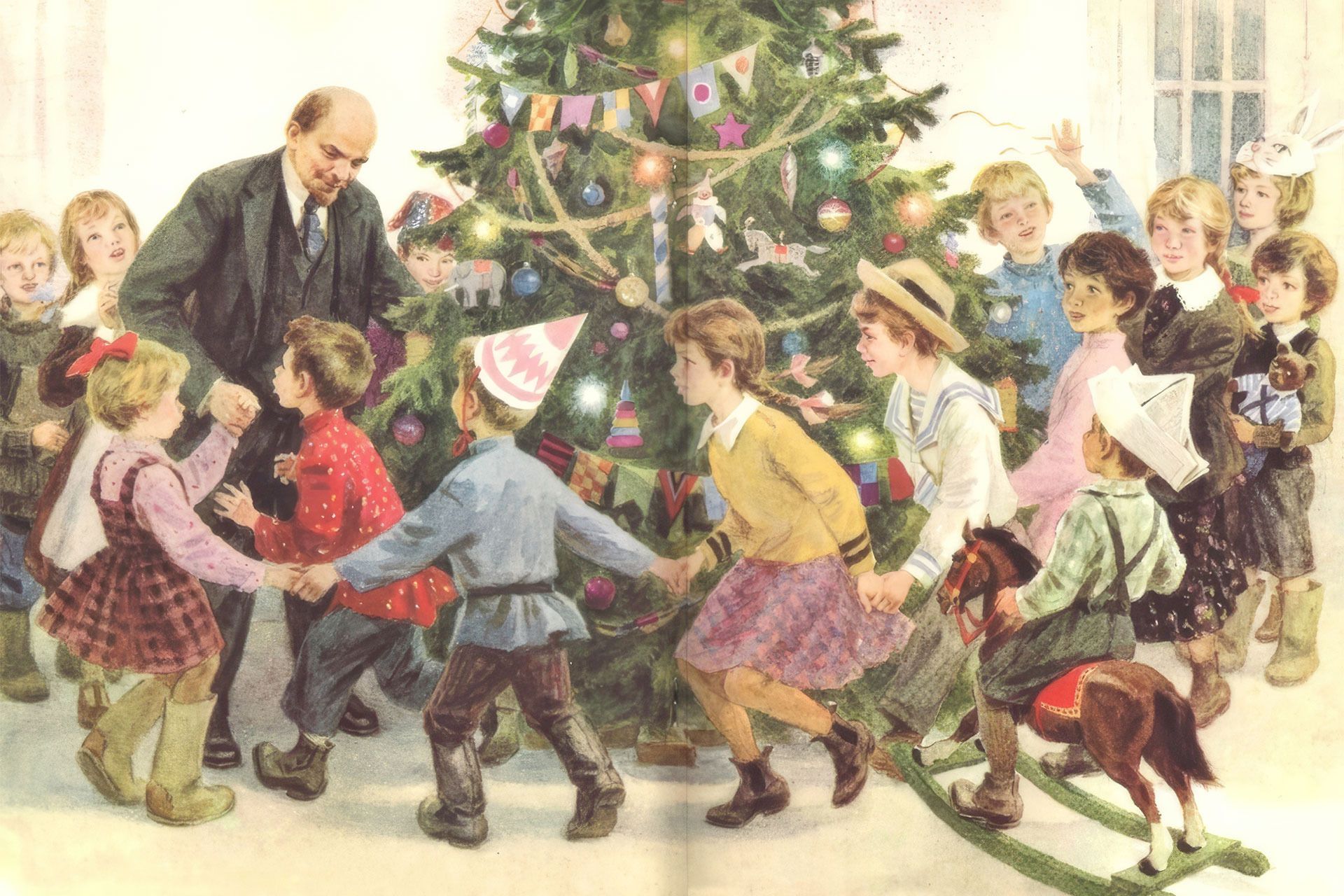
The “canonical” depiction of Lenin’s Christmas tree in Gorki, painted after the dictator’s death. Image: moscowseasons.com
“A drunken Christmas is approaching—old, useless, like old decrepit life itself. After it drags along the old ‘New’ Year—also unnecessary, harmful, leading to drunkenness, absenteeism, and illness. These old religious holidays usually don’t go without putting up ‘trees’ for children. […] With a united push, we must ensure that by the end of the Five-Year Plan, the barbaric custom brought in by the German bourgeoisie—putting up ‘trees’—will have disappeared for good.“
This text, which sounds strange to modern readers, was published at the end of 1929 in the Soviet newspaper “Friend of Children.” Its author, a certain R. Bass, was not trying to shock anyone, but rather was simply relaying the current party line. It was believed that the Soviet country should only celebrate Soviet dates. Anything connected to the pre-revolutionary past was to be met with zero tolerance. The working class was to be doubly vigilant toward seemingly harmless remnants, such as celebrating the New Year under a fir tree. As Soviet activists used to say in those years, “We won’t let them hide God behind the Christmas tree.”
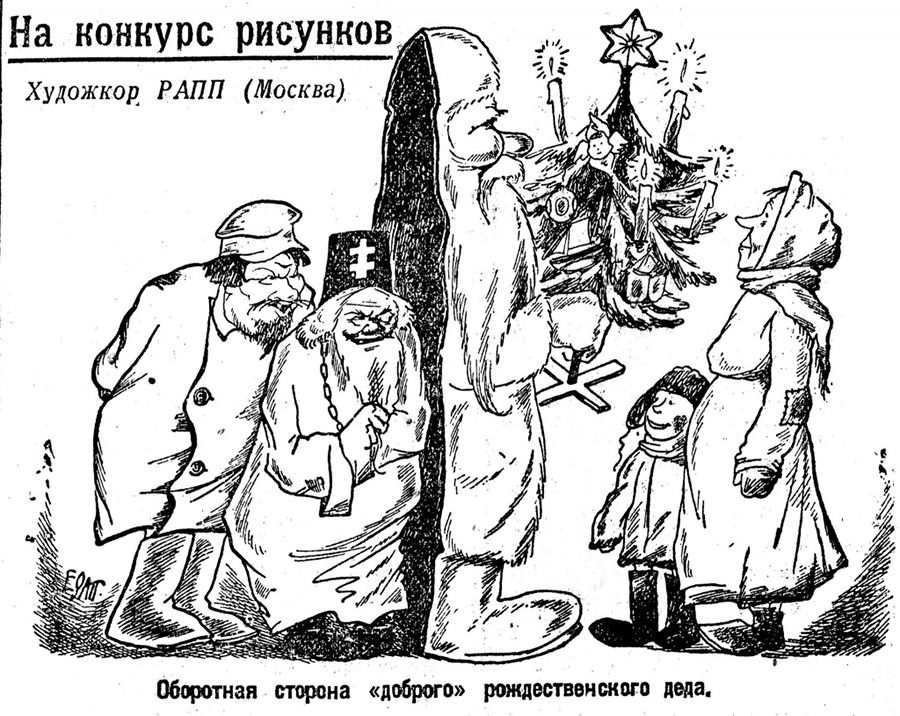
Typical anti-tree propaganda from the late 1920s and early 1930s by the Russian Association of Proletarian Writers. Behind the festive tree and Father Frost hide a priest and a kulak. Image: wikidedmoroz.ru
But by the end of the first Five-Year Plan, things in the USSR turned out differently. The Bolsheviks not only failed to destroy the “barbaric custom”—they appropriated it for themselves. Christmas trees began to be put up for New Year’s all over the Soviet Union, even in republics where such a custom had never existed. Previous attacks on Christmas trees—like the article quoted above—were conveniently forgotten. Why did the Stalinist authorities make such a reversal?
An Anti-Crusade
First-generation Bolsheviks are often portrayed as distilled atheists, determined from the start to eradicate the church and religion at any cost. The reality was a bit more complicated. Yes, the new leadership of the country consisted entirely of staunch atheists. Yes, among them were loud professional God-fighters like Yemelyan Yaroslavsky or Demyan Bedny—people who, as a famous film character would say, “couldn’t eat” because of their personal aversion to Christianity in all its forms.
However, the prevailing opinion in the RCP(b) at the time was that a centralized anti-religious campaign was unnecessary. It was thought that the Decree on the Separation of Church from State and School from Church, adopted on February 5, 1918, was sufficient. With proper explanatory work, the people would supposedly abandon outdated cults in favor of building a new society.
The masses need to be given the most diverse material. We must approach them in every possible way to interest them, awaken them from their religious slumber, shake them up from all sides, by every possible means.
- from a letter by Vladimir Lenin to members of the Politburo, March 1922
But the masses were in no hurry to “awaken.” Contemporaries remembered May 1, 1921: that year, May Day coincided with Orthodox Easter. Even in big cities, some young people preferred religious processions to official Soviet rallies. People continued to attend church and celebrate Orthodox holidays.
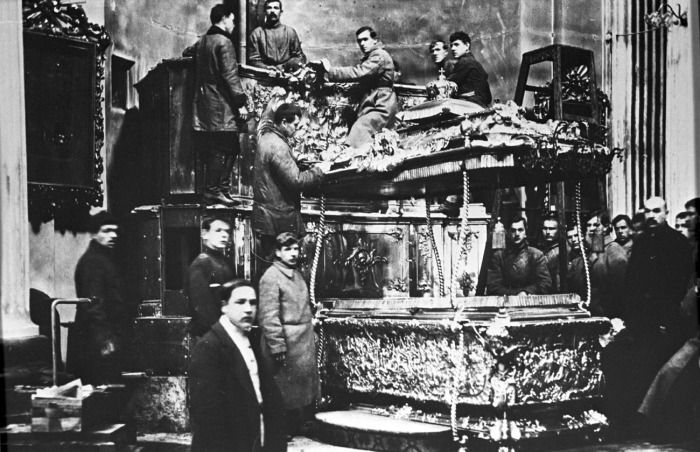
Bolsheviks opening reliquaries with the relics of Orthodox saints at the Alexander Nevsky Lavra. Petrograd, 1922. Photo: kulturologia.ru
The situation was complicated by the fact that the new regime officially described itself not as atheist, but as secular. Religion was formally considered a private matter—no one was yet forced to renounce God outright. In the 1920s, the authorities even nominally recognized the non-working status of major Orthodox holidays (albeit according to the Gregorian, not the Julian calendar). Replacing religious dates with new, ideologically correct holidays like May Day, the October Revolution, or the Overthrow of Autocracy dragged on for almost a decade.
In 1922–1923, the Bolsheviks did attempt an anti-church offensive. This included the split in the Russian Orthodox Church into “Tikhonites” and “Renovationists,” a loud campaign to confiscate church valuables, and the staged Petrograd Trial against clergy and active parishioners of the northern capital (not only Orthodox, but also Catholics). Finally, grassroots Communist activists started the tradition of “Komsomol” Easters and Christmases. On church holidays, pro-Bolshevik youth would hold their own marches near churches, mocking believers.
Here is a whole heavenly collection: different gods from all times and peoples. There is also the god “Capital.” Next to him are a priest, a tsar, and a bourgeois, and a little further away a worker with a hammer, a peasant with a plough, and a Red Army soldier with a rifle. […] We approach the monastery. We form a circle. The burning of all the gods begins, and the youth dance and jump over the fire around the bonfire. The event continued in the club, which was decorated with the slogan: “Until 1922, Mary gave birth to Jesus, and in 1923—a Komsomol girl.”
- Kursk newspaper “Komsomolets,” January 1923
The effect of such actions was dubious. In their reports, participants in godless campaigns from various cities reluctantly admitted that passersby rarely joined them, and many openly defended the believers. In some places, like in Yekaterinburg on January 7, 1923, parishioners gave their opponents a good thrashing.
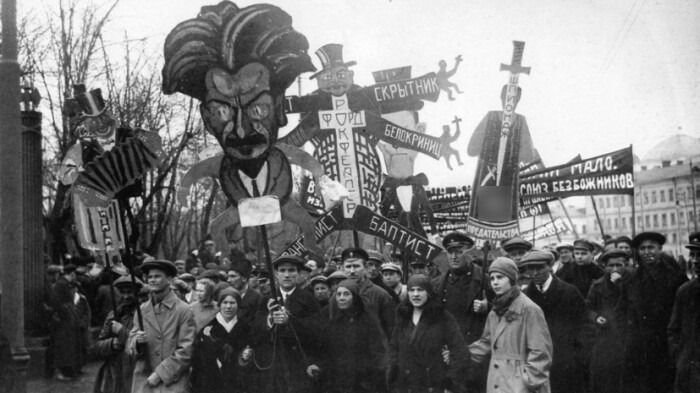
Anti-religious demonstration in Alexander Garden. Moscow, 1928. Photo: kulturologia.ru
In April 1923, the 12th Congress of the All-Union Communist Party (Bolsheviks) concluded that “deliberately crude measures and mockery of objects of faith and worship do not hasten but rather complicate the liberation of the masses from religious prejudices.” So for a time, the Bolsheviks limited anti-religious propaganda to posters and atheist lectures among activists on the eve of church holidays.
Unforgiven Sunday
The Bolshevik attitude toward religion, as with many other issues, changed at the end of the 1920s during the “Great Break.” Joseph Stalin then defeated the inner-party opposition and ended the NEP. The regime took a course toward rapid industrialization, which also meant abandoning any recognition of civil liberties.
We still have such a minus as the weakening of the anti-religious struggle. We also have, finally, the terrible cultural backwardness […]. All these and similar minuses must be eliminated, comrades, if we want to move forward at a more or less accelerated pace
- from Stalin’s speech at the 15th Congress of the CPSU(b), December 3, 1927
By that time, the USSR already had the “League of Militant Atheists,” overseeing atheist propaganda and activity in various republics and regions. But it was not the fanaticism of local zealots that hit believers the hardest, but the bureaucratic decisions of the top leadership.
First, by 1930, all dates associated with Orthodoxy disappeared from the list of non-working days—the last to go was Christmas. Second, at the same time, the Council of People’s Commissars introduced the “continuous workweek”. This was an experimental system where months consisted first of five- and then six-day weeks, without the key Christian Sunday. As a result, with the new calendar, believers “lost” movable Orthodox holidays. Even fixed holidays—like Christmas—became difficult to celebrate, even with close family.
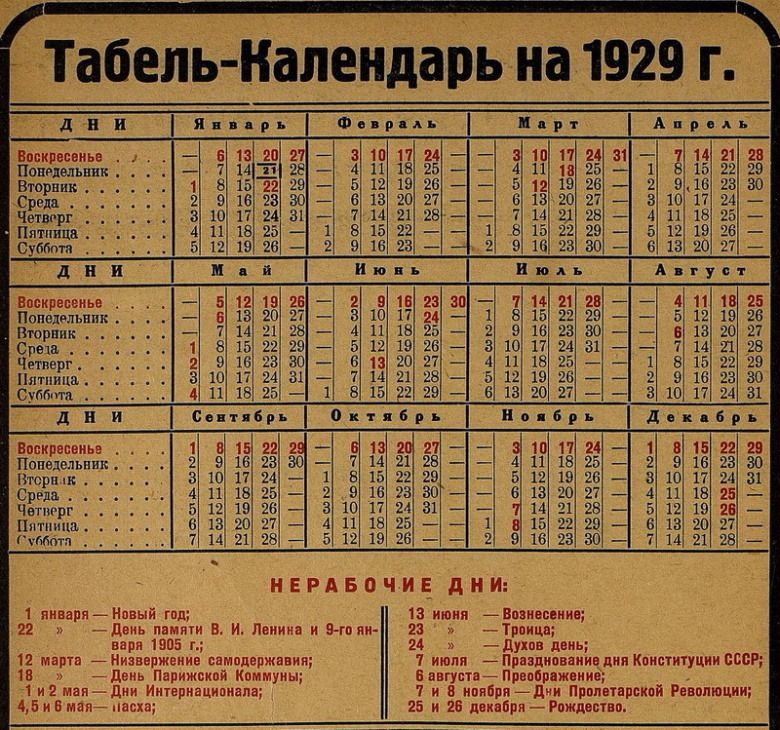
Non-working days in the USSR in 1929: as you can see, religious holidays are still mixed with revolutionary ones. Image: livejournal.com / sagittario
On the other hand, people became attached to official holidays. Even the most ardent anti-Soviets had no other legal reason to gather for feasts except May Day, the anniversary of the October Revolution, and Lenin’s Memorial Day.
[In the 1930s] it became even harder to gather together. Someone always had to work the next day. Our meetings with friends and family were reduced to state holidays: May 1, November 7. No one talked about Christmas anymore
- Elena Skryabina, Russian linguist, second-wave émigré
On January 24, 1929, the Politburo approved a resolution “On Measures to Strengthen Anti-Religious Work”. The document launched not only large-scale persecution of believers but also a fight against what Stalin called cultural backwardness—that is, anything that could be linked to religion. And the Bolsheviks chose a concrete, tangible target—the Christmas tree. Soviet leaders who had grown up at the turn of the 19th and 20th centuries saw the green beauties not as a harmlessly secular New Year’s symbol (the modern version did not yet exist), but as a symbol of unequivocally superstitious Christmas.
“Only Friends of Priests Are Ready to Celebrate the Christmas Tree”
The first major actions by the authorities were timed to Christmas Day, December 25, 1929. Apparently, many Orthodox believers still continued to celebrate the holiday at home on the usual date, ignoring the fact that after the 1918 calendar reform, the secular and church calendars in the country were 13 days apart.
Soviet officials, in typical totalitarian fashion, realized it would be hard to break the habits of generations raised under the tsar. They decided to focus on children in big cities, whose religious parents usually kept them home on December 25 for the holiday and didn’t let them go to school. Therefore, the authorities preemptively declared the cherished date “Industrialization Day.” Younger schoolchildren were expected to show awareness: go help at enterprises and give the money they earned to adults.
Together with the workers, we, 30 pioneers from the “Pishchevkus” base, went to the 3rd tobacco factory. We split up among the workshops and got to work. Some kids carried boxes in the warehouse, others helped the women workers with packing machines. […] The 32 rubles we earned [about $60 at the official exchange rate] we give to the collectivization of our sponsored village
- from a report in the Leningrad newspaper “Lenin’s Sparks”
Similar actions took place in Moscow and other major cities. Not all teachers sent children to do unpaid labor. For example, in the capital’s schools, pioneers, according to surviving reports, were kept in class: they put on amateur concerts or were made to paste up propaganda wall newspapers. In any case, the replacement for the usual holiday with a tree, feast, and gifts was unconvincing.
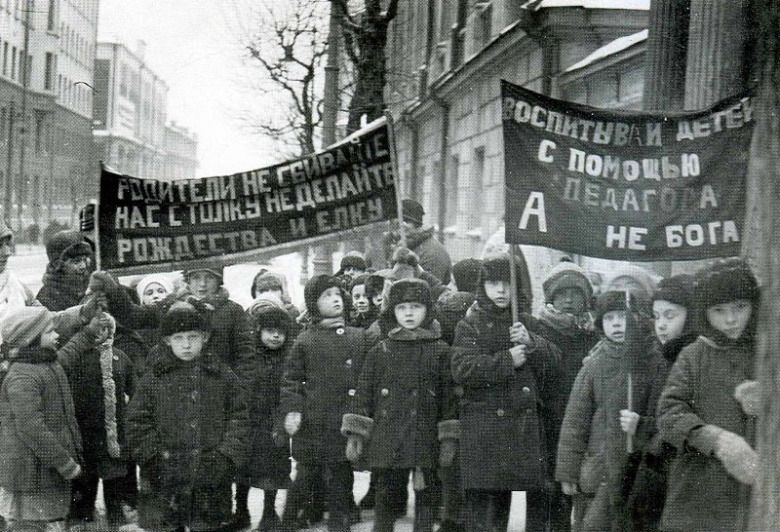
“Parents, don’t confuse us—don’t celebrate Christmas or put up a tree,” “Raise children with the help of a teacher, not God”: kindergarteners at an anti-Christmas demonstration. Moscow, 1929. Photo: Wikipedia
But the anti-Christmas campaign pleased some adults—mainly Futurist poets and those from related schools. After the “Great Break,” literary innovators gradually fell out of favor. Many authors—even propagandists like Vladimir Mayakovsky—saw attacks on Christmas and Christmas trees as a chance to regain the regime’s trust. For several years, the Bolshevik activists loved the choppy lines of former Futurist Alexander Vvedensky:
We will not allow them to cut
the young fir tree,
we will not let them destroy the forest,
to cut it down for nothing.
Only friends of priests
are ready to celebrate the Christmas tree.
You and I are enemies of priests.
We don’t need Christmas
In eight lines, Vvedensky rather deftly combined the two main points of anti-tree propaganda. First, putting up a tree means succumbing to the spirit of priestly obscurantism; second, cutting down the forest harms the native Soviet environment. True, this saved neither Vvedensky’s career nor his life. In the 1930s, he was arrested and exiled on charges of counterrevolution. In 1941, while again imprisoned, he died.
Soviet writers also tried to create more serious anti-Christmas works. In 1930, “The Tale of the Christmas Tree” by Pavel Barto (the future husband of the much more famous children’s poet Agniya) was published. The author first idyllically described the world around the pine tree: a hedgehog sleeps, squirrels play, crossbills build nests. Then comes a tragic ending—a bearded old man rides into the forest on a horse and cuts down the tree, ignoring the suffering of the cute birds and animals.
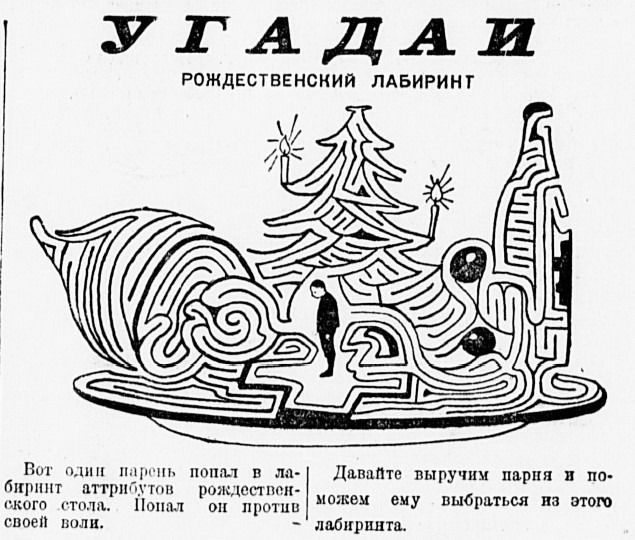
Another example of anti-Christmas propaganda for children: the holiday is compared to a sinister labyrinth from which the unfortunate victim must be helped to escape. “Pionerskaya Pravda,” 1929. Image: vatnikstan.ru
While poets and writers denounced the harmfulness of Christmas trees and other priestly relics, Soviet journalists complained that unconscientious citizens were in no hurry to abandon superstition. In the early 1930s, few big-city newspapers went through the winter without a couple of satirical pieces. The stories were always the same: at such-and-such a market, Christmas trees are being sold in the most outrageous way, and at such-and-such a “Children’s World” store, old-fashioned tree ornaments are being sold. What a disgrace, where are the responsible comrades, please take action.
Life with the Christmas Tree Became Happier
All this campaigning did not entirely work. The authorities and their supporters found it relatively easy to scare people away from attending church (especially since in the 1930s churches were being demolished en masse). It was much harder to force people to change their home traditions. Yes, Christmas was no longer widely celebrated. But many still secretly tried to put up a tree in a corner, roast a goose, or observe some other simple ritual.
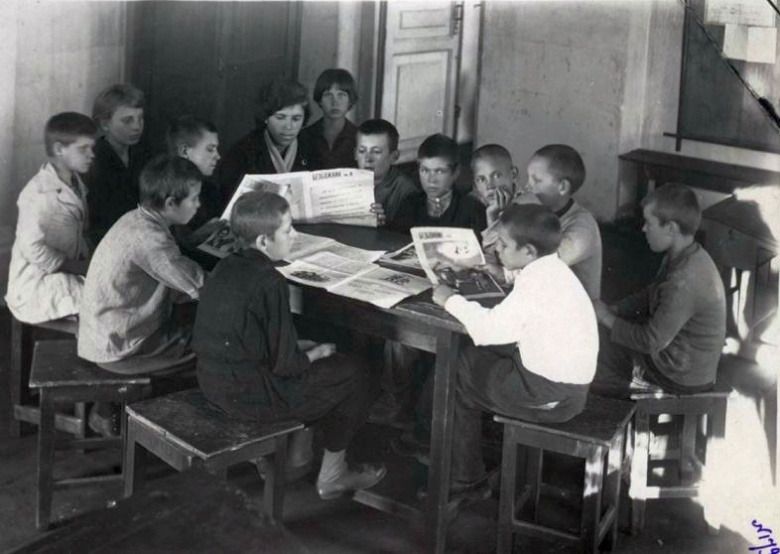
Circle of Young Atheists at Special School No. 11 in Murom, 1930s. Photo: Wikipedia
The Communists could not offer the population an attractive alternative ritual. All experiments with anti-religious Komsomol amusements failed to catch on even with the indoctrinated working youth. A telling example is the “anti-Christmas” of 1929 at the Leningrad “Electrosila” factory. On the holiday, a “godless masquerade ball” was held for employees. But according to reports from their vigilant comrades, most participants went on to celebrate Christmas at home in the traditional way.
The bright holiday of Christmas was banned, and anyone who dared celebrate it could pay dearly […]. But our mother, who grew up before the revolution—not a particularly religious person, but one who valued tradition—never once left my sister and me without a Christmas tree.
- Irina Tokmakova, Soviet children’s writer
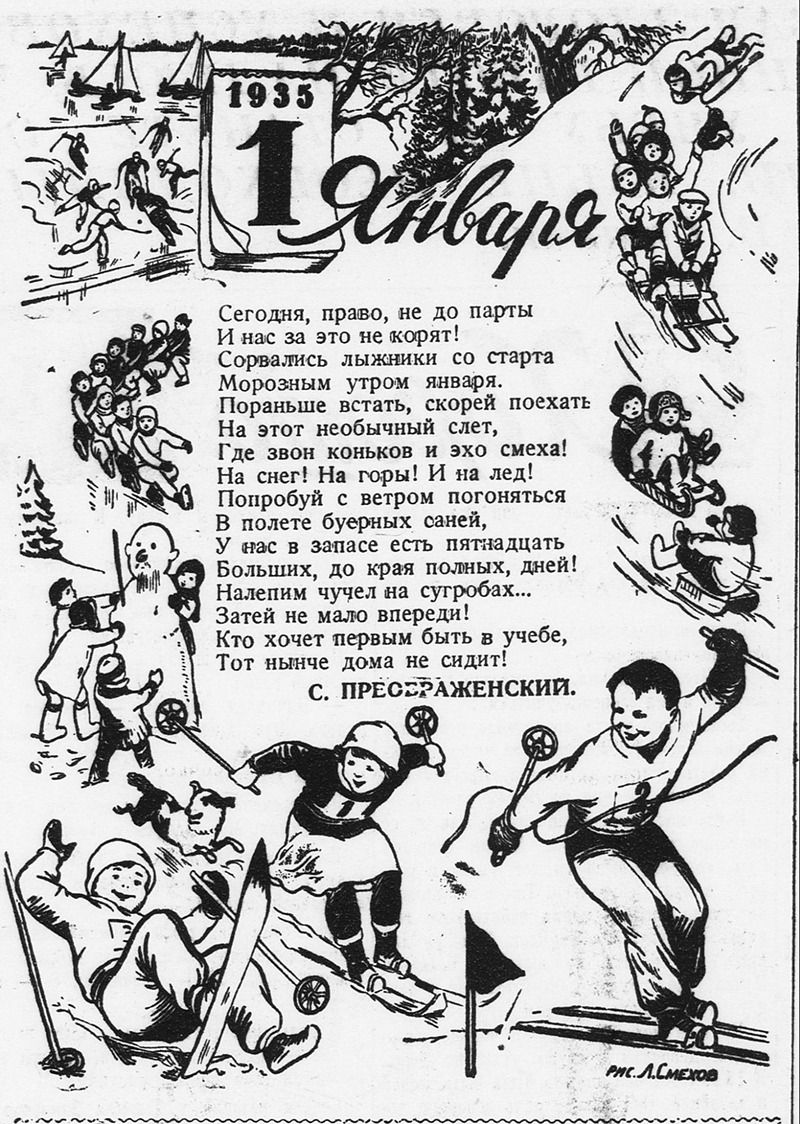
A subtle turning point came at the end of 1934. Before the coming New Year, the editorial board of the main Soviet children’s newspaper, “Pionerskaya Pravda,” unexpectedly congratulated its readers: “Goodbye, 1934! Hello, 1935! Hello, new year of joy!” There was still no mention of bringing back Christmas trees; pioneers were instructed to greet the first day of the new year with a sports festival—on skis, sleds, and skates (at least no longer forced labor at a tobacco factory—small mercies).
“Transitional” New Year in 1935: the Christmas tree is not yet rehabilitated, but having fun is already allowed. Image: vatnikstan.ru
But a year later, a veritable Christmas miracle occurred. Stalin rehabilitated children’s morning parties with trees and gifts. Officially, the initiative came from then-second secretary of the Ukrainian Communist Party, Pavel Postyshev. Incidentally, a grim figure—one of the organizers of the Holodomor and initiator of the Great Terror of 1937–1938, in which he himself soon perished.
In pre-revolutionary times, the bourgeoisie and officials always arranged a tree for their children on New Year’s. Workers’ children looked with envy through the window at the brightly lit tree and the rich children having fun around it.
Why do our schools, orphanages, nurseries, children’s clubs, and pioneer palaces deprive the children of working people in the Soviet country of this wonderful pleasure? Some “leftist” extremists have denounced this children’s entertainment as a bourgeois invention
- from Postyshev’s open letter in “Pravda,” December 28, 1935
Later, under Nikita Khrushchev, the authorities spread the myth that Postyshev acted on his own initiative—almost at the request of his gravely ill young son. Naturally, such independence was impossible in Stalinist practice. Postyshev acted entirely in line with the Leader’s mood, who a month earlier had declared that life had become better, life had become more joyful. Against this backdrop, proposing something life-affirming and at the same time taking a jab at “leftist extremists” was more than party-appropriate.
Stalin Thinks of Us
The message, already coordinated with the Kremlin, was effectively an order. In the capitals of regions and republics, Komsomol secretaries immediately began frantically putting up Christmas trees in schools, kindergartens, cinemas, and skating rinks. Rank-and-file activists rushed to buy decorations and prepare trees for the holiday. No one remembered anymore that Christmas trees were supposed to be a tool for priests and capitalists to deceive the people, or that cutting down trees harmed innocent hedgehogs and crossbills.
After “Postyshev’s rehabilitation,” New Year’s trees appeared even where they had never been seen before. A modest celebration at School No. 1 in Namangan. Uzbek SSR, 1936.
Teachers waited for clear instructions, fearing something might go wrong. But in most cases, despite the lack of time, they managed to hold tree celebrations. Decorations appeared out of nowhere, gifts were found, poems and holiday programs were improvised on the spot. Enthusiasts, at their own risk, revived previously taboo songs. For example, this happened with the half-forgotten by the 1930s song “In the Forest a Fir Tree Was Born,” written before the revolution by poetess Raisa Kudasheva to a German folk tune.
The Soviet press, which had previously scolded the illegal trade in Christmas trees, now joyfully reported on the huge lines in the few department stores in big cities. Official writers, who had only yesterday condemned religious intoxication, suddenly remembered Vladimir Lenin’s example. It turns out that in 1924, Ilyich had put up a tree for children in Gorki near Moscow!
Vladimir Ilyich wanted a Christmas tree for children in Gorki for the New Year of 1924. In early January, a tree was set up in the winter garden of the Big House. Children of Gorki staff, the state farm, and the village of Gorki were invited. […] Vladimir Ilyich sat in an armchair and watched the children play and have fun with a smile. For them, it was a real holiday
adapted from the account of Lenin’s niece Olga Ulyanova
Nadezhda Krupskaya tried to dispute this narrative. Lenin’s widow rightly pointed out that Ilyich was seriously ill that winter and barely understood what was happening around him. The Bolshevik leader did not organize the party—he was simply brought there by chance, and there were no more than a dozen children. But in 1939, Krupskaya herself passed away, and no one could stop the spread of the myth of Lenin as the father of all New Year’s tree parties. In fact, it was in one of these adaptations that the phrase “New Year’s tree” first appeared, even though the event actually took place not on January 1, but on January 7 (or December 25 by the Julian calendar).
Of course, court flatterers did not forget about the living “chief” leader. The New Year’s canon had yet to be created, and Communist poets wrote less about trees, gifts, bunnies, and Father Frost, and more about praising the best friend of Soviet children—beloved Comrade Stalin.
New Year. Over the peaceful land
The clock strikes twelve times.
Welcoming the New Year in the Kremlin,
Stalin thinks of us.
He wishes us good luck
And health in the New Year,
So that our people may become
Happier and richer…
- Sergei Mikhalkov, 1946
***
The story of how the Soviet Grinch stole Christmas is telling in many ways. At first, the totalitarian regime brazenly invaded people’s homes and declared their established family traditions to be barbaric. Then, after failing, Stalinism retreated a bit and, as a compromise, offered Soviet citizens a new holiday—with recognizable trappings, but stripped of its original meaning. Soon, the next generation came to see the Soviet New Year as an unshakable custom from time immemorial.
A classic late-Stalinist children’s party in the Pillar Hall of the House of Unions. The holiday is now an official day off. Moscow, 1948. Photo: Sergei Vasin / MAMM / MDF
What’s especially striking is how shrewdly Stalin chose the moment for this substitution. By the late 1930s, many people in the USSR—especially city dwellers—were already weary of constant mobilization and secretly longed for some peace and bourgeois comfort. And then Joseph Stalin “heard” his people, giving them the coveted simulacrum in the form of the Christmas tree.
Surviving diaries from the mid-1930s reveal an astonishing paradox. Many contemporaries saw the return of the green tree as a good sign, as a symbol of the Soviet system evolving into something more humane. Of course, Stalin himself had very different plans.
For the New [1937] Year—two joys: one domestic, the other political [the adoption of the “democratic” Stalin Constitution of 1936]. The Christmas tree is permitted and even recommended, and everywhere there is Christmas tree enthusiasm, a Christmas tree bacchanalia. Decorations are being made in a rush, “Children’s World” is packed with queues, store windows sparkle with beautifully decorated trees, everywhere there are cheerful conversations on the topic—it’s wonderful!
- Nikolai Ustryalov, lawyer, former White Guard and émigré, later theorist of “Smenovekhovstvo” and re-emigrant to the USSR (executed September 14, 1937)
Main sources for this article:
Dushechkina E. “The Russian Christmas Tree: History, Mythology, Literature”
Yeka L. “Don’t Send Me for Vodka and Don’t Arrange Christmas Trees”: The Fight Against Christmas in Soviet Children’s Press of the 1920s–Early 1930s
Kozkina A., Shvets D. “How the Bolsheviks Fought Christmas”
Lebina N. “Soviet Everyday Life: Norms and Anomalies”
Maisuryan A. “Only Friends of Priests Are Ready to Celebrate the Christmas Tree!”
Okunev D. “Let’s Arrange a Good Soviet Tree”: How Stalin Allowed the Celebration of New Year
If you enjoyed this article, consider making a donation — one-time or, even better, monthly. Your support helps us motivate our authors and become better with every article.
Our organization is recognized by the Internal Revenue Service (IRS) as a 501(c)(3) tax-exempt, charitable organization, which means that all contributions made to us are tax-deductible to the fullest extent permitted by U.S. law. Individuals may generally deduct charitable contributions of up to 60% of their Adjusted Gross Income (AGI) for cash donations made to qualifying 501(c)(3) organizations. For donations of appreciated assets (such as stocks or other long-term capital assets), the deduction is typically limited to 30% of AGI, based on the fair market value of the asset. C-corporations may deduct charitable contributions of up to 10% of their taxable income for donations made to eligible charitable organizations.
By submitting a donation, you confirm that you have read and accept the following documents: Privacy Policy and User Agreement, and also give consent to the processing of your personal data.
If you would like to unsubscribe from a monthly donation, please email us at: [email protected]