For a long time, people dreamed that one day wars would cease. Hope especially grew after one or another major military conflict that claimed many lives. Then it became obvious to everyone that war is some kind of integral evil that, like a whirlpool, sucks everything into itself. And this evil should have no place in human life.
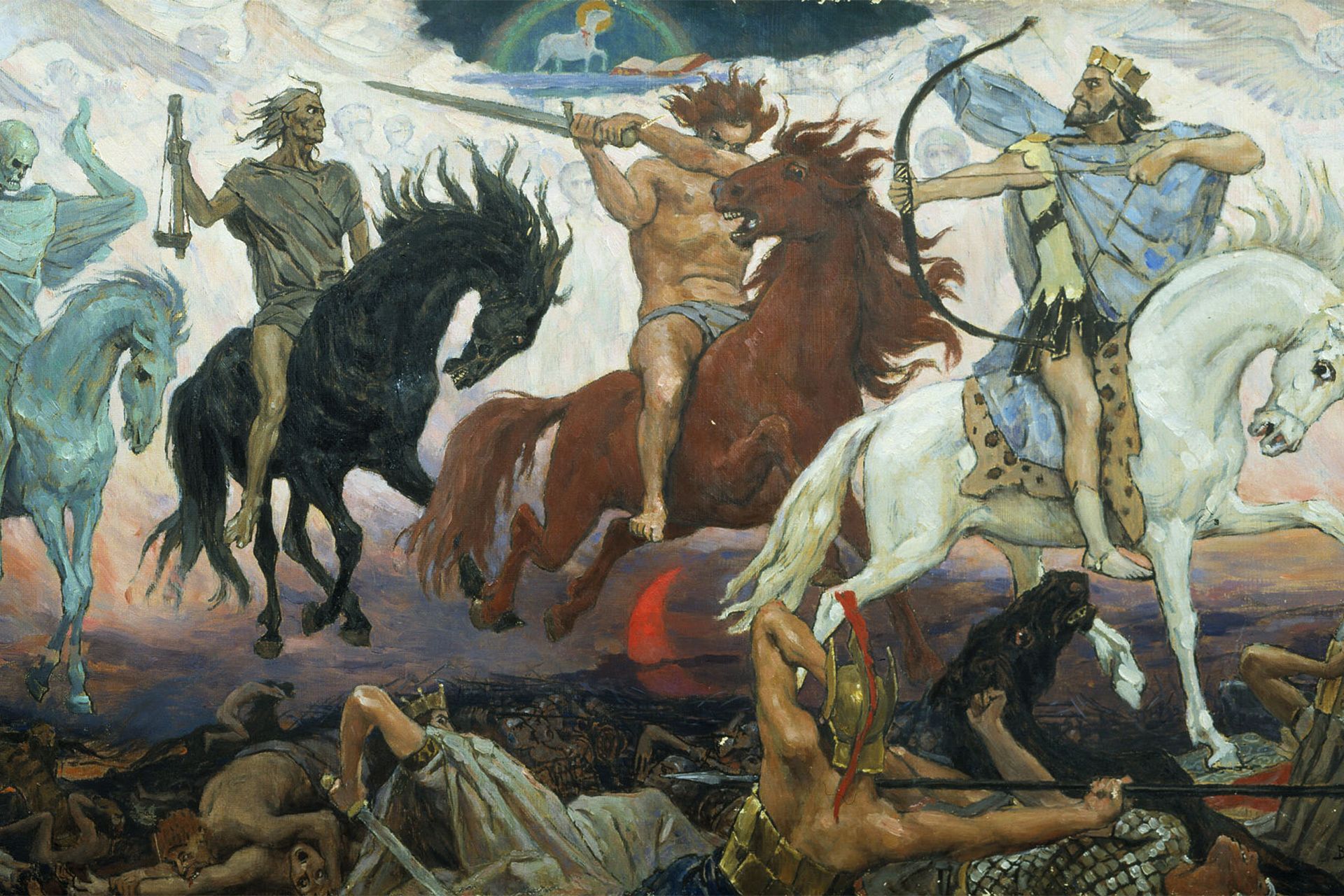
Viktor Vasnetsov “Warriors of the Apocalypse” (fragment), 1887.
Probably, one can say that in the past, on average, each generation (70–80 years) experienced at least one major war. It turns out that the “horses of the Apocalypse” as certain stages of a single process usually swept through during each serious geopolitical clash, and every person in one way or another at least once in their life found themselves witnessing the total victory of the forces of aggression and death. Let us recall these stages, following one after another: conquest ambitions (the white horse), the active combat phase (the red horse), the destruction of the economy (the black horse), hunger and death (the pale horse). In this sense, one can say that in the life of each generation there was usually its own local apocalypse, so it is quite justified to perceive the Revelation of John the Theologian as a myth that repeats in history.
In the Bible, in Psalm 36 it says that “the meek shall inherit the earth and delight themselves in an abundance of peace”. These words can be understood literally: whoever wages war perishes, and the one who remains on earth is the one of peaceful spirit, the one who does not want to fight, who avoids bloodshed. Heroism in this sense is far from always justified. However, avoiding war, especially in the era of the “revolt of the masses”, guarantees nothing: you may be seized against your will and sent to the front.
Therefore, just as war is a collective phenomenon, the cessation of wars can also be only the result of collective efforts.
What efforts might these be?
The theorist Kant against practical politicians
Immanuel Kant, in his treatise “Perpetual Peace”, written in 1795, draws attention to the fact that states as such are meant to guarantee citizens security and protect them from arbitrariness, yet states themselves are in a state of incessant wars with one another and, therefore, the state cannot guarantee citizens’ security. How can this be ended?
Kant proposes approaching the issue thoroughly and rationally, as he always does. In six “preliminary” and three “definitive” articles of the treatise, the philosopher formulates fundamental principles that lead, if not to complete, then at least to partial eradication of wars.
Kant points to the primacy of international law over national law. Also, in the future geopolitical order, in his opinion, the protection of property and constitutional rights of every country (small or large, it does not matter) and the promotion of preserving its financial non-enslavement must be ensured. Standing armies must be completely abolished. The civil constitution of every state must be republican. Republicanism, according to Kant, is the state principle of separating executive power (government) from legislative power; this principle is opposed by despotism-the principle of the state’s arbitrary execution of laws given by the private will of the ruler. The law of nations will be based on a federation of free states. The rights of people as citizens of the world are ensured by the conditions of “universal hospitality”. This means that any citizen of any country has universal rights and freedoms, and states are obliged to respect these rights and freedoms. This also guarantees the possibility of free movement of citizens between countries without fear of suffering legal harm.
Kant proposes treating the project of establishing “eternal peace” as a goal. He, making a certain excursion into history, points to providential signs in the historical destinies of peoples.
The establishment of peace on earth is the moral goal of humanity, since “war is evil because it creates more wicked people than it destroys”.
Of course, the author of “Perpetual Peace” can be challenged. And this challenge will be, first of all, from the standpoint from which the question arises: to what extent can law in general restrain the “dark energies” of a person? “There is no peace for the wicked (Isa. 57:21)”, says the prophet Isaiah. Just as within one state law as such is far from always capable of putting up a barrier against crime, so in relations between states it may be insufficient. For example, G. S. Pomerants notes in one of his articles that if a country experiences an eclectic mixing of different cultures, religions, ethnic groups, and there is a strong property disparity, this leads to hidden chaos, which must be restrained by a strict police system. Pomerants includes Russia among such countries, in particular. In a sense, it is not surprising that from time to time this chaos expands outward, beyond the borders of the state.
In Kant’s time, politicians could only smirk at his proposals. And the treatise itself, as some commentators note, is in some respects ironic in character. However, the philosopher’s thought in it is, as always, strict and convincing. It seems that Kant took this project very seriously.
At the same time, history was moving along its own track: military conflicts continued, and soon the Napoleonic Wars engulfed Europe, claiming a total of at least 3 million lives.
Bonhoeffer and the possible fruits of ecumenism
From somewhat different positions, and in some ways similar ones, theologian Dietrich Bonhoeffer approached the question of ending wars. In his report “The Church and the World of Nations”, delivered at the ecumenical conference of 1934 on the Danish island of Fanø, he expressed the following thought:
the pact between the Church and the state on mutual recognition and cooperation should include a clause that the state undertakes not to start a war. Then the Church can be loyal to this state and interact with it.
A single body representing all confessions (“The United Church Union”) should act on behalf of the Church. Bonhoeffer emphasizes that this is not so much a nominally legal body as an entity expressing the essence of the evangelical message to the world. It is important that, in order to carry out this pact on its side, the Church must be united and speak on behalf of all Christians. That is, the international and interconfessional components of church life in this matter must be more important than the national and confessional components.
States (according to Bonhoeffer, this is the “World of Nations”) are not required to be united, but may join this agreement, each in turn. Here lies the boundary of relations between Church and state, in which the Church, through its earthly component, acts as a single political subject. Then, of course, such a phenomenon as chaplaincy will, according to this pact, be fundamentally impossible.
In Hitler’s time, such an agreement, as well as a unified church position on a political issue, were unthinkable. Need it be said that Bonhoeffer’s lonely voice was not heard?
Bonhoeffer was executed by hanging on April 9, 1945, in the Flossenbürg concentration camp.
The Second World War claimed more than 70 million human lives.
The prophet Isaiah and the “sacred foundations” of peace among nations
It is worth focusing on the question of how feasible the proposed projects are. Is there something more in them than just pious ideas? What else can they be based on? Immanuel Kant spoke of Divine providence. And if one tries to seek a foundation in Holy Scripture, one can recall the famous prophecy of the prophet Isaiah: “He shall judge among the nations, and shall decide disputes for many peoples; and they shall beat their swords into plowshares, and their spears into pruning hooks; nation shall not lift up sword against nation, neither shall they learn war anymore” (Isa. 2:4). The prophet Micah echoes him in approximately the same words (Mic. 4:3).
Both of these prophecies can be perceived as if in two temporal layers. First, perhaps they refer to the hope for a peaceful life of Israel with other peoples upon the return of the Jews to the Holy Land in the post-exilic era (2,500 years ago), when the cruel Assyrian and Babylonian conquests ended, the captivity ended, and now one could begin life in peace, as if from a clean slate. And secondly, this is a distant, eschatological perspective in which the Kingdom of God will appear in fullness, and all conflict issues will somehow be resolved.
The prototype of these messianic expectations in both cases is the peaceful reign of King Solomon, son of David. Under Solomon, as is known, the state of Israel flourished, and peaceful life with other peoples was established. Later, the peaceful path of Jerusalem is often contrasted with the military-conquering, imperial path of Babylon.
It is important to emphasize that the messianic idea of extending the Kingdom of God to other peoples was originally always peaceful.
King Solomon enters Jerusalem on a donkey. The donkey has since ancient times been associated precisely with peaceful rule, unlike the horse; the horse is an attribute of a military commander, a conquering king. Therefore, Jesus Christ, entering Jerusalem on a donkey, was greeted as the King of peace, not of war. Beneath the surface of the event of greeting the peaceful King, who opens a peaceful kingdom, lies the same opposition between the peaceful, non-war “path of Jerusalem” and the imperial, conquering “path of Babylon”. Although Jesus also foretells the imminent destruction of Jerusalem and many wars, He Himself reactivates precisely the peaceful “Solomonic narrative”, in which peoples can live without war. Therefore, the Church’s preaching of the peaceful meek spirit of Christ is, as it were, the Church’s self-presentation (where the spirit of Christ is, there is love and freedom).
The “receding horizon” of metamodernity
Moving from era to era, through cultural layers, changes of political regimes and economic formations, humanity has grown up to the present times.
Culturally, of course, there was its own evolution and its own shifts: the Middle Ages were replaced by the Renaissance, which in turn prepared the era of modernity, and modernity in the second half of the 20th century gives way to postmodernism, although it continues to remain in dialogue with it.
There is a reproach against modernity from postmodern philosophers. It consists in the fact that modernity, with its divisions into science and religion, the general and the particular, faith and reason... is responsible for the totalitarian regimes of the 20th century, which, by departing from genuine wholeness, when totality was replaced by totalitarianism, relied on emphasizing the needs and values of certain groups in society to the detriment of taking into account the private interests of all.
However, modernity also gave us obvious advantages: republican and democratic approaches in politics, universal ethical principles, civilizational norms, a critical approach in thinking, scientific and technological progress, humanism, and education.
Postmodernism, in the person of Lyotard and other philosophers (postmodernity is an era, while postmodernism is its intellectual base, a formed social movement), proposes to отказаться from everything universally significant, from the metanarrative as such, in order to reduce possible repressive force to zero. At the same time, such criticism means both “passing through” modernity, pushing away from it, and further fragmentation, in which the subject of thought and action as such disappears.
However, there are opinions that postmodernity as an era is also ending, giving way to something new.
In 2010, Dutch philosopher Robin van den Akker and media theorist Timotheus Vermeulen proposed calling the era beginning in the 1990s metamodernity.
This period is characterized not only by Fukuyama’s “end of history“ with its emphasis on the spread of liberal democracies, not only by digitalization in technology and socio-economic transformations, but also by a global cultural process in which the opposites of previous eras-modernity and postmodernity-are combined. It is also characterized not by the nihilism of modernity, but by constructiveness, the ability of a person to build their identity and create circles of communication, activity, and poles of attraction. In it, the previously divided consolidation of various opinions, positions, and ideas takes place, a departure from fragmentation and a search for new wholeness, with each person building their own value-meaning universe.
In a sense, our own reasoning in an attempt to combine biblical traditionalism and the religious-philosophical searches of recent centuries with modernity is also imbued with the same desire to find balance, harmony, and dialogue between opposites or patterns far apart from each other.
Metamodernism is characterized by an emphasis on the process of a phenomenon rather than on the final product. Therefore, work on a work of art or a philosophical concept in metamodernism is constant movement, search, and experimentation with a “receding horizon”.
In this sense, we too, reading biblical prophecies, Kant, or Bonhoeffer, should not immediately expect a “final assembly”. In fact, Kant himself called for this. All the projects considered are, first and foremost, a direction of attention and effort. If something is achieved in this direction, then the “horizon recedes”, and there is somewhere to move further.
And what has been achieved? Can one even speak of any achievement?
Actually, yes.
If you look at the countries of the European Union, isn’t this to some extent an illustration of Kant’s “project”?
In the states of the European Union, political systems with established democracy and a system of separation of powers exist. Armies, although expanded in recent times, are still almost absent; the essentially common human rights ensure free movement (“hospitality”) within these countries.
Of course, the Church participates in integration and politico-peacekeeping processes not as strongly as Bonhoeffer may have wanted. It is indeed often hostage to confessionalism and church confessional law. It is hard to imagine the Church acting as a single political subject in dialogue with states. Sometimes the Pope tries to do this, taking on the function of some higher arbiter, the legal successor of the Apostle Peter. But, of course, this is not a unified church position.
A unified church position can be reactivated only when the integral meanings of Scripture, deadened for millennia and obscured by fragmented church tradition, come alive. And here the return of the Jews to the Holy Land, the creation of the state of Israel, helps us precisely to restore broken connections. Israel can serve as that “point of support” through which religious-political relations can be “rebooted”. The hopes of the prophet Isaiah for the return of the Jews to the Holy Land, united with the expectation of the cessation of wars and peaceful life for other peoples then, two and a half thousand years ago, remain these hopes for those living in our time.
Now, in the new conditions, if one seriously tries to approach Bonhoeffer’s “project”, the basic messianic paradigm in church self-understanding must be conceptually changed, taking into account what the world became after the Second World War. The unity of the Church is an additional basis for a possible non-military order in countries with Christian influence.
The special position of Orthodoxy
A question may arise: is there, in connection with these reflections, some special position of world Orthodoxy and Russian Orthodoxy trying to distance itself from it?
Traditionally, Eastern, especially Russian Orthodoxy is contrasted with Western Catholic and Protestant Christianity in that it seems to declare some other path to salvation.
If in the West the emphasis on “Christian Aristotelianism” is significant, in which, according to S. S. Averintsev, there is a line toward mediation of the extremes of division, “toward the presence of ideas in things themselves as their inherent form”, then in the East “Christian Platonism” prevailed with its dual split into the world of ideas and the world of things. Therefore, the soul of an Orthodox person rarely remains in the middle state of “average normality” (as in the West), but gravitates toward the poles: either hell or paradise-there is no third option (and none is needed). It is also suspicious of ecumenism: it thinks of salvation as something exclusively confessional.
In this sense, in Orthodoxy many place more hope in ascetic practice rather than in the “bourgeois” benefits of civilization-the achievements of the Modern and Contemporary eras. Here they seek deification, not a secure earthly life and the triumph of law. Therefore, it is believed that true patristic practice has been preserved only in Orthodoxy. The “dark energies” of sinful passions are overcome here not through law, but through uncreated Divine energies that constitute the inner and outer life of a person.
According to G. S. Pomerants, holiness is born in such times and among such peoples when they need it most. And in Russia, this need is constant. Pomerants also refers to similar thoughts by A. S. Khomyakov: “Rus is holy only through filth”. Roughly about this, it seems, the Apostle Paul also speaks: “where sin increased, grace abounded all the more” (Rom. 5:20). And if one recalls F. M. Dostoevsky, in many of his works the driving force of the plot is the dynamics of the relationship of opposites: holiness and depravity.
This, essentially still biblical, opposition between sin and grace explains, it seems, the phenomenon of Russian holiness, which is born as if in opposition to the surrounding, often criminal and terrible reality.
To be righteous among sinners is much harder than to be righteous among the righteous. This is possible only under direct, close guidance from God, which is very clearly visible, for example, already in the biblical Abraham, living next to depraved Sodom, deceitful Egypt, and unruly local petty kings. In these far from greenhouse conditions, Abraham somehow manages not to lose faith, but to strengthen and develop it. Moreover, perhaps only in this way can something truly valuable crystallize. The God-fighting “natural” is overcome by the otherworldly “supernatural”.
It is known that Russia, in its various forms and on its state, imperial scale, often represents a kind of apotheosis of collective evil, and the church institution can also abet this evil. Russia is therefore often called a source of chaos, the throne of Satan, an anti-world. But paradoxically, within this kingdom of darkness a bright light of eternity can suddenly shine as the light of victory over ultimate darkness-death, as was the case in the life of St. Seraphim of Sarov. Of course, the existence of such beacons of light by no means justifies the huge masses perishing in the personal and collective sins and crimes of compatriots.
Assembling a crystal ball from fragments
Like Russian holiness, Russian culture is also an unusual phenomenon.
But before beginning a conversation about it, one must ask whether Russian culture (and not individual personalities) has passed through the eras of the Middle Ages, the Enlightenment, modernity, and postmodernity, and whether it is approaching metamodernity? Has it freed itself from despotism? Or perhaps it is stuck at one of the stages of its development?
G. B. Gutner, in his report “National Narrative and Responsibility for the Past”, delivered at the St. Philaret Institute in 2017, notes that our national narrative took shape in the 1930s and was fused with the criminal. To adhere to it means to legitimize the crimes of the Stalinist regime.
Right now, Russia is a layered pie in which individual layers often do not mix. From this perspective, one can say that Russian culture has not become a culture of dialogue.
The dialogue of cultures and traditions leads to synthesis, to the search for a new form. Dialogue implies criticism, readiness to accept the new and change (which was especially characteristic of the era of modernity). Whereas the monologic approach leads to syncretism, in which different cultural layers coexist simultaneously, without mixing. For example, European Christianity is, to a large extent, the fruit of a synthesis of Hellenism and the biblical tradition. Islam was also born as a major synthesis, but later became a rigid system of norms established once and for all. Likewise, dialogue is something unfamiliar to Russian cultural and church life. Church teaching, impossible without dialogue between teacher and student, is only just beginning to emerge in the practice of catechesis in some places.
Russia, being a daughter culture in relation to Byzantium, is a periphery of many sub-ecumenes: European, Muslim, East Asian. Therefore, oddly enough, it has long been living in a state close to metamodernity, when it tries to combine distant, difficult-to-combine patterns (as if reaching the point of “final assembly”, toward which others are only heading). At the same time, one can say it gets the “leftovers” from the tables of other cultures, where intellectual food was thoroughly gnawed and chewed before it got here. Without a culture of dialogue, it is all the more difficult to assimilate and digest such food. For example, the surprise of respectable European Marxists and socialists at what Marxism turned into in the Soviet Union is well known.
Russian philosophy is not a continuation of the European tradition, but something its own, original. It appears, rather, as a continuation of literature with an emphasis on the search for existential truth, rather than as a branch of Western philosophy. At the same time, the Russian person has always been in communication with the distant; for them it is completely natural to talk “with Copernicus”, and not only with the neighbor on the stairwell.
Likewise, ecumenism is not entirely alien to the Russian Church. Both Vladimir Solovyov, Fr. Sergius Bulgakov, and Fr. Alexander Men did not avoid communication with other confessions, but hoped for the unity of the Universal Church.
But is this enough for the general cultural-historical “umbrella” space of metamodernity to bud into the projects of Bonhoeffer and Kant? Will the voice of the prophet Isaiah be heard from the depths of millennia? Is the “metaphysical leap” required of a country drowning in many lawlessnesses too great? Is the dense darkness within itself too much to overcome?
Events of recent years show that this will be very difficult to do, if it is possible at all.
If you enjoyed this article, consider making a donation — one-time or, even better, monthly. Your support helps us motivate our authors and become better with every article.
Our organization is recognized by the Internal Revenue Service (IRS) as a 501(c)(3) tax-exempt, charitable organization, which means that all contributions made to us are tax-deductible to the fullest extent permitted by U.S. law. Individuals may generally deduct charitable contributions of up to 60% of their Adjusted Gross Income (AGI) for cash donations made to qualifying 501(c)(3) organizations. For donations of appreciated assets (such as stocks or other long-term capital assets), the deduction is typically limited to 30% of AGI, based on the fair market value of the asset. C-corporations may deduct charitable contributions of up to 10% of their taxable income for donations made to eligible charitable organizations.
By submitting a donation, you confirm that you have read and accept the following documents: Privacy Policy and User Agreement, and also give consent to the processing of your personal data.
If you would like to unsubscribe from a monthly donation, please email us at: [email protected]