More than a hundred years ago, the Bolsheviks seized power in Russia. By the modern calendar, it all seems to have happened in November 1917. But the revolution should have been called the October Revolution. Because the calendar had to be changed from the patriarchal Julian to the progressive Gregorian. And besides, in November 1918 there was a revolution in Germany. It was that one that became known as the “November Revolution”. After all, at first the events in Petrograd were called not a revolution, but a coup. Thus, the creators of the Soviet Union were left with a strange situation in which the main holiday, named October, had to be celebrated in the following month. But in adapting their ideology to any metamorphoses, the Bolsheviks had no equal. They also handled this misunderstanding. And over more than seven decades in power, they firmly implanted in public consciousness a whole series of myths about the Great Revolution, which still have to be debunked to this day.
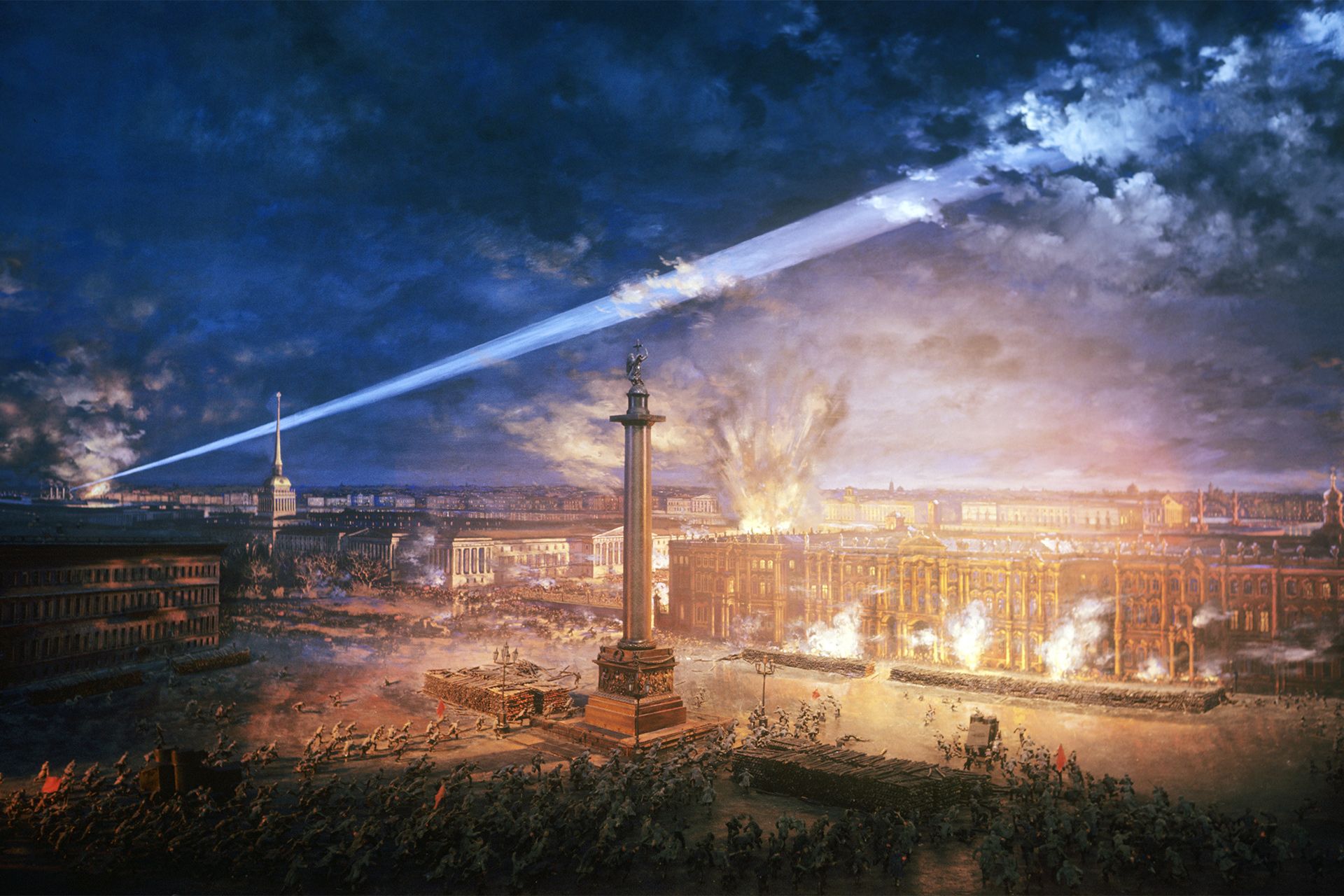
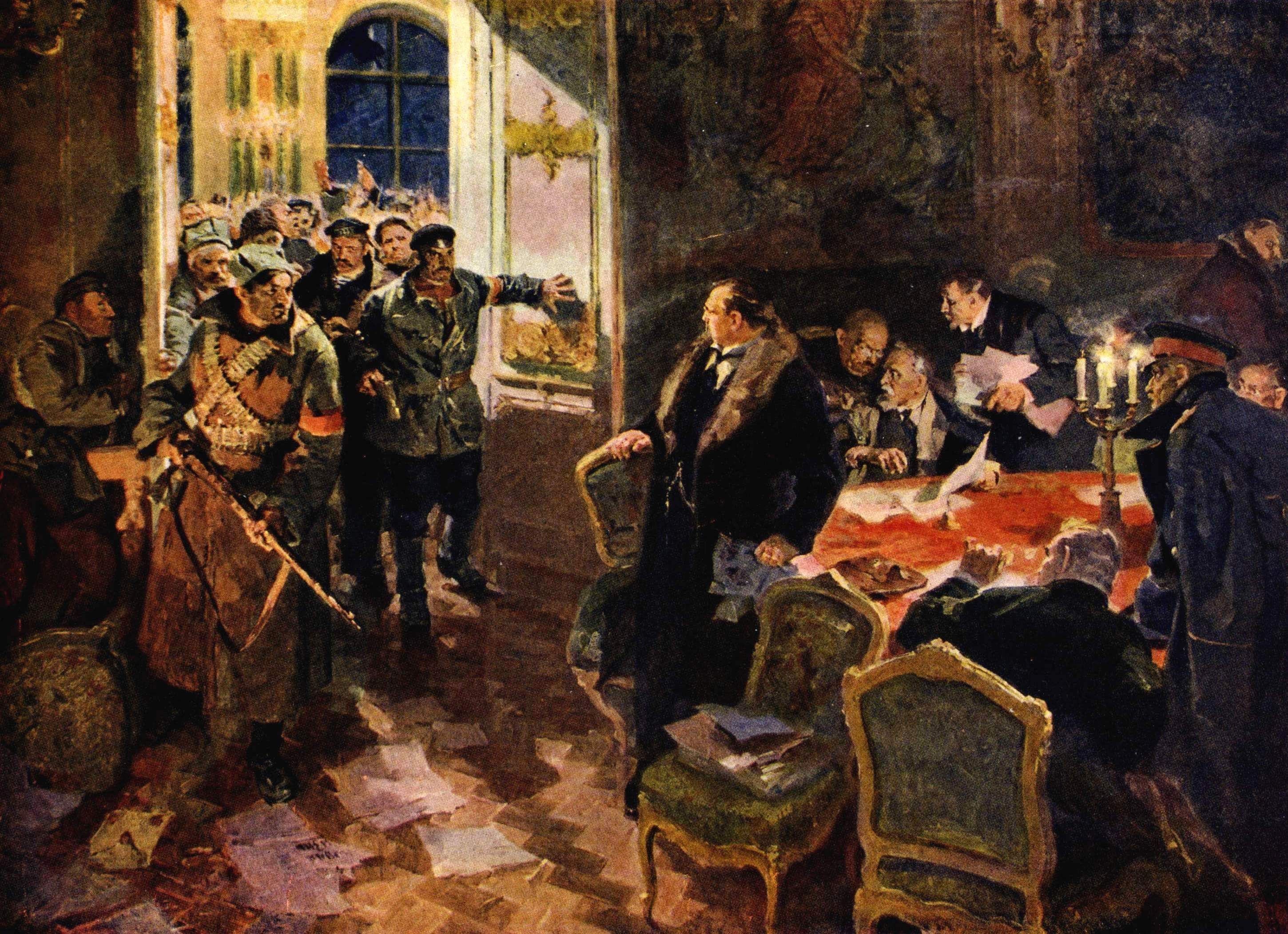
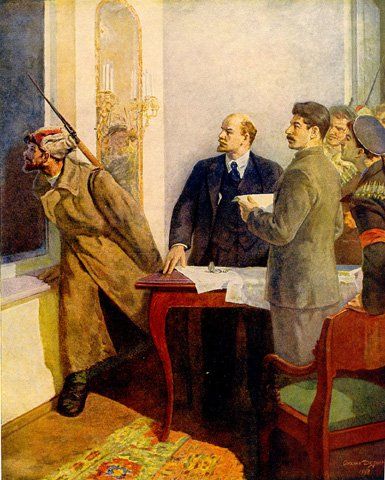
Yefim Deshalyt “Storming the Winter Palace”, 1957.
1. In the autumn of 1917, it was not a revolution, but a coup
Surprisingly as it may sound today, in the beginning the Bolsheviks themselves called their seizure of power a coup, not a revolution. The substitution of terminology came later. And in February 1918, at a meeting of the Central Executive Committee, Lenin himself, mentioning the armed uprising, calmly called it the “October coup”. Joseph Stalin titled his article for the first anniversary of the Bolsheviks’ seizure of power simply and clearly: “On the October Coup”. As early as 1924, Leon Trotsky wrote the work “Lessons of October”. It was intended for the communist parties of other countries. In it, the Bolsheviks shared their useful experience. So, in this text, the phrase “October Coup” appears repeatedly.
But in the autumn of 1917 in Russia everyone knew: the real revolution had taken place in February.
That was when the centuries-old monarchy collapsed. Emperor Nicholas II abdicated the throne. Democratic reforms began. Power passed to the Provisional Government. Elections to the Constituent Assembly were being prepared, and it was supposed to determine the future of the former empire. These were indeed radical changes.
And what happened on October 25 in the old style, or November 7 in the new style? A заранее prepared armed seizure of power by a group of radicals who used units of soldiers and sailors under their control for this purpose. That is a coup.
2.In fact, in the autumn of 1917 there was a counterrevolution
Having come to power, the Bolsheviks immediately declared all political enemies counterrevolutionaries. At the same time, in their agitation among soldiers, Lenin’s followers simplified everything as much as possible. And the hard-to-pronounce word “counterrevolutionary” was replaced with the shorter and clearer “counter”. Such a label was effectively a death sentence. No trial or investigation was required. One had to act in the spirit of “revolutionary consciousness”. And if the Bolshevik leaders declared someone a “counter”, then one was not supposed to argue, but to move immediately to reprisals. The only thing is that in fact it was the Bolsheviks themselves who turned out to be counterrevolutionaries.
To understand how everything changed after the Bolsheviks seized power, it is important to recall in a little more detail what was happening before the October coup. Since spring 1917, various political parties had been openly active in Russia. All kinds of newspapers were being published. Censorship had disappeared. Local self-government bodies were functioning. There was an incredible plurality of opinions. Public discussions were held on any issue.
And what did the Bolsheviks do first after seizing power? They immediately banned the publication of all non-Bolshevik newspapers. There were initially some concessions for publications issued by the Mensheviks and the Left Socialist Revolutionaries. But that too was soon ended.
The Leninists killed freedom of speech, erasing one of the most important achievements of the February Revolution.
At first, the Bolsheviks assured everyone that the future of the country would be decided by the Constituent Assembly, in which representatives from across the country would be elected in open and fair elections. However, as soon as it became clear that Lenin and his associates were in the minority in the Constituent Assembly, the Bolsheviks immediately decided to disperse the deputies by force. That is, one of the key consequences of the February Revolution — the people’s right to elect their own government — was eliminated.
All the other decisions — the liquidation of an independent judiciary, the liquidation of multiparty politics, the liquidation of local self-government — were entirely logical. It was a banal consolidation of the Bolshevik monopoly on power. In other words, all the positive changes that had occurred during the February Revolution were destroyed. And what is that if not counterrevolution?
3. By November 1917, tsarism had already been overthrown, and Russia had been declared a republic
After coming to power, the Bolsheviks faced a difficult problem. They had to convince millions of people that it was Lenin and his associates who overthrew tsarism and created a republican form of government. In reality, the monarchy had already been eliminated at the beginning of spring 1917 during the February Revolution. And in September the Provisional Government declared Russia a republic. The imperial crown, orb, and scepter were removed from all symbols of power. Nicholas II, who had abdicated the throne, was arrested and sent into exile in Tobolsk. A public trial was even being prepared for him.
And what did the Bolsheviks do in this regard?
In the era of Stalin’s dictatorship, the communists resorted to outright falsification. Real events of 1917 were replaced by invented ones, but ideologically correct ones.
From an early age, Soviet children were taught that it was the Bolsheviks who overthrew the tsar and created a new democratic state. In textbooks for high school students, the February Revolution was called bourgeois. And in Soviet terminology, that was a synonym for the adjective “anti-people”. Details about the ban on non-Bolshevik newspapers and the dispersal of the Constituent Assembly were kept quiet. Instead, the Bolsheviks’ role in the liquidation of the monarchy and the creation of a democratic republic was grossly exaggerated. Even though it was an outright lie.
There is another detail. The Bolsheviks had nothing whatsoever to do with the February Revolution. The uprising of the soldiers of the Petrograd garrison was spontaneous and without any participation of politicians. Without the Mensheviks, without the Socialist Revolutionaries, and without the Kadets. And the Bolshevik leaders at that time were either in emigration or in exile. Apparently, such uncontrollable processes as the February Revolution aroused special hatred in Lenin’s followers. It was necessary to erase the historical memory of the details of the main events of February 1917 and attribute all of its achievements to themselves. And in this, the Bolsheviks certainly succeeded.
4. In the autumn of 1917, Lenin was not really in charge of anything
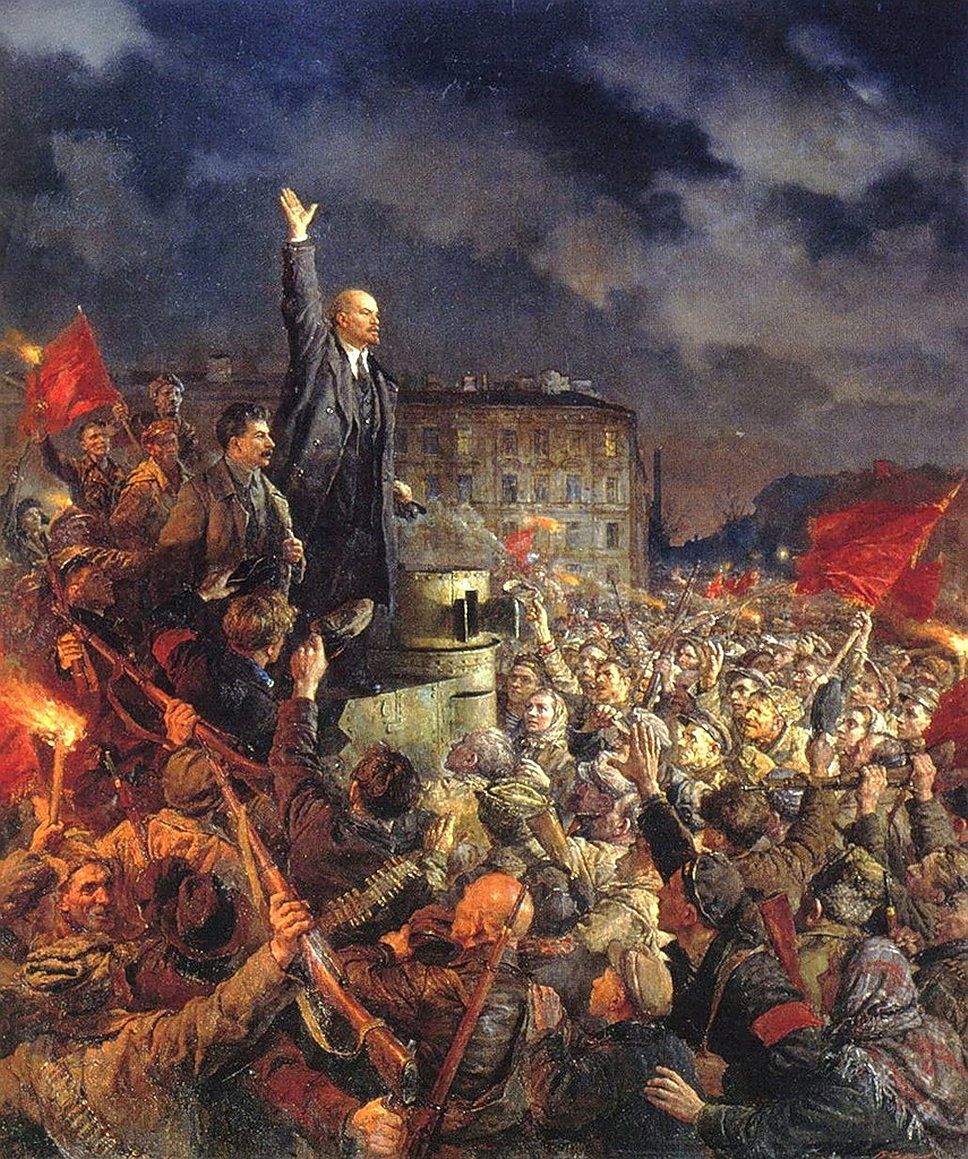
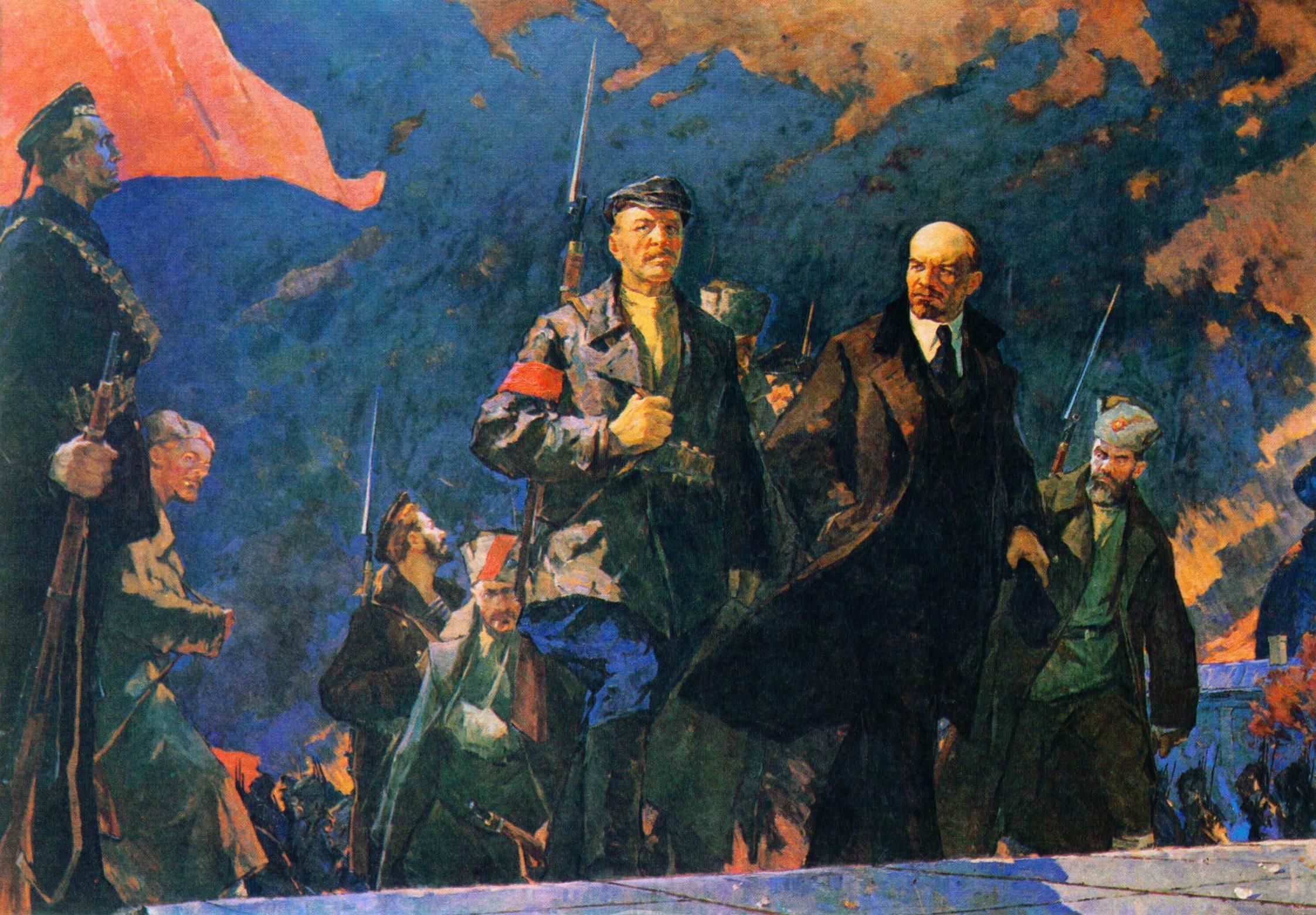
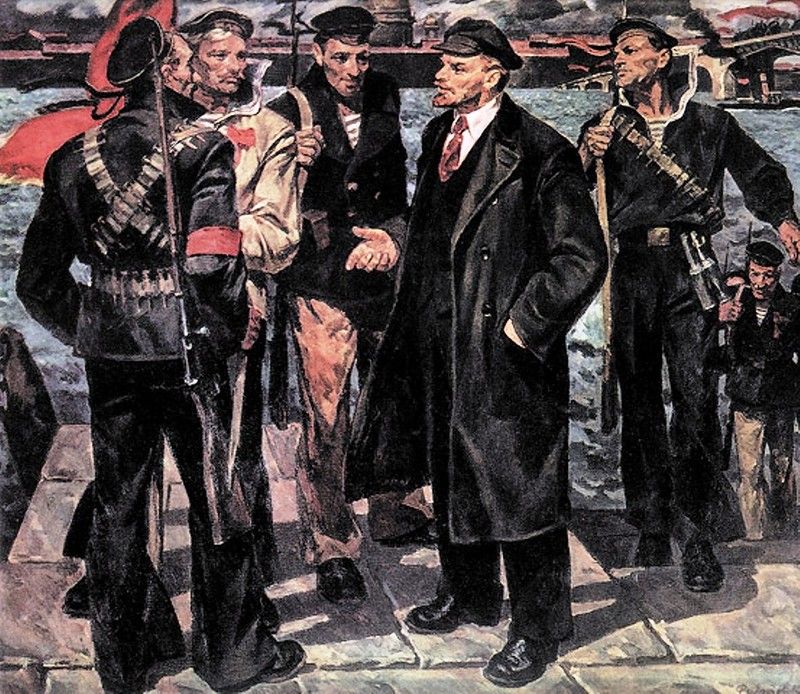
In Soviet propaganda, they confidently spoke about Vladimir Ilyich Lenin’s key role during the October Revolution. Films were made, dozens of paintings were created, and hundreds of books were written in which the Bolshevik leader appears as the direct organizer of the uprising. But in reality, during those decisive days, the nobleman Ulyanov was in charge of nothing.
It should be noted right away that it was Lenin who pushed through in the RSDLP leadership the decision to prepare an armed uprising. And this was against the opinion of his closest associates — Lev Kamenev and Grigory Zinoviev. But Lenin had no intention of directly commanding armed detachments, let alone building barricades or leading the storming of the Winter Palace.
Later, Bolshevik ideologues had to invent an entire theory according to which Lenin, in the decisive days of 1917, had no right to expose himself to any danger. That is why he was in deep underground concealment, in accordance with party discipline.
But in reality, the so-called “leader of the world proletariat” turned out to be a rather mediocre organizer and simply a cowardly leader.
From mid-summer he hid in Finland or in border areas. Lenin was so worried about his safety that he even shaved off his beard and mustache and began wearing a wig. Is such a person worthy of the fame of a leading opposition figure?
At the beginning of autumn, Lenin nevertheless moved to Petrograd. But he was extremely secretive, constantly changed his places of residence, and avoided any publicity. At the end of October, Lenin did personally come to a secret nighttime gathering of Bolshevik leaders on the northern outskirts of Petrograd. It was there that, after hours of debate, he managed to convince his comrades of the need to vote for an armed uprising. And after that, Ilyich... disappeared again! That is, he once again hid in safe houses. On the night of October 25 (or November 7 in the new style), Lenin finally made it to Smolny. There the real headquarters of the uprising was in full swing. But even here Vladimir Ilyich remained a spectator.
Mikhail Avilov “V. I. Lenin in Smolny (in makeup). October 1917” (also known as “Ilyich’s Appearance at Smolny”), 1923.
A painting by Mikhail Avilov, a contemporary of those events, has survived. The canvas is called “Ilyich’s Appearance at Smolny”. The characteristic word “appearance”! Lenin, with his face bandaged for secrecy, sits on a sofa and reads a newspaper. People passing by look at him in amazement. But Soviet people were not supposed to see this almost documentary painting. For them, other, ideologically much more polished canvases on the theme “Lenin at Smolny” were created.
Vladimir Serov “Long Live the October Revolution!”, 1951.Isaak Brodsky “V. I. Lenin Against the Background of Smolny”, 1925.Lenin with soldiers and workers of the revolution. Presumably authored by A. MakarovKonstantin Filatov “October”, 1970.
But in reality, everything was just as in Avilov’s painting! The real orders about what and when to seize were given by Leon Trotsky, chairman of the VRK (Military Revolutionary Committee). The assault detachments themselves were commanded by people such as Vladimir Antonov-Ovseenko. But during the years of the Great Terror, this former tsarist officer was “exposed”. He turned out to be... Correct, a counterrevolutionary and an enemy of the people! Of course, he was shot. Therefore, the names of both Trotsky and Antonov-Ovseenko remained either banned for a long time or were mentioned in lists of enemies of the revolution.
5. There was no storming of the Winter Palace
During the Soviet era, the climax of the October uprising was called the storming of the Winter Palace. Epic paintings were created showing dashing sailors and conscious soldiers storming this citadel of the “old world”. To be safe, a whole series of films was made in which revolutionary fighters fearlessly run across the square, break into the main imperial residence, deal with the servants of bourgeois power, and then arrest the Provisional Government. The crude line “Which of you are the temporary ones? Get down!” was presented by Kremlin ideologues as a truly popular victory. All would have been fine. But in reality there was no storming of the Winter Palace.
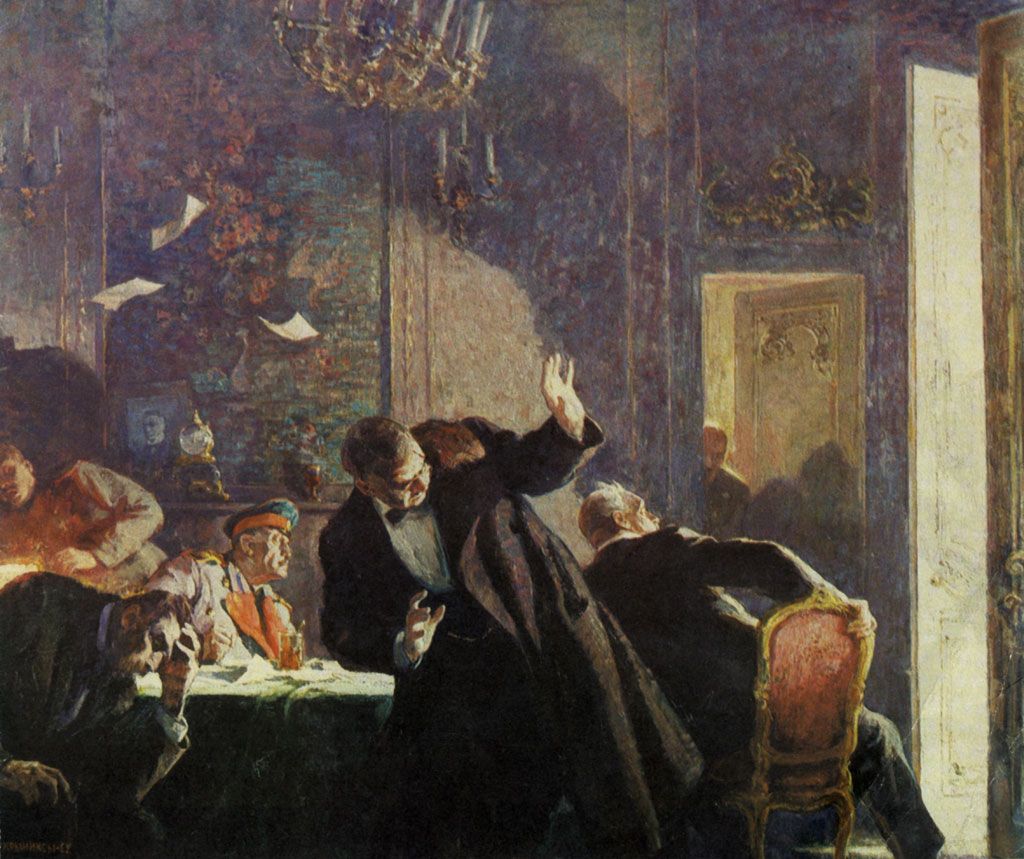
Alexander Lopukhov “Arrest of the Provisional Government”, 1957.
Soviet paintings and films showed massive barricades around the Winter Palace. Entire models were created in which this fortification was accompanied by machine-gun nests and artillery pieces. It was implied that victory required a decisive, powerful assault. Against guns and machine guns. Across the open space of Palace Square. None of that actually happened.
So what was happening in the autumn of 1917 around the so-called storming of the Winter Palace?
Supporters of the Provisional Government tried to prepare the palace’s defense. For this purpose they tried to enlist cadets (students of Petrograd officer schools). But all this was poorly organized. On the night of October 25 (or November 7), most of the cadets left the Winter Palace. In effect, the Provisional Government was left without defenders. However, it was not so easy for the commanders of the Bolshevik detachments to persuade their soldiers to go on the assault. Even though they were opposed by a pitiful handful of cadets. No one among the so-called “revolutionary soldiers” was going to die for nothing.
Let us recall that the Winter Palace is a huge complex of several buildings and thousands of rooms. In the end, the matter was decided by the penetration into the interior of the colossal residence by Antonov-Ovseenko’s detachments. This happened through one of the side palace entrances. Meeting no serious resistance, the Bolsheviks reached the hall where the ministers of the Provisional Government were located and arrested them.
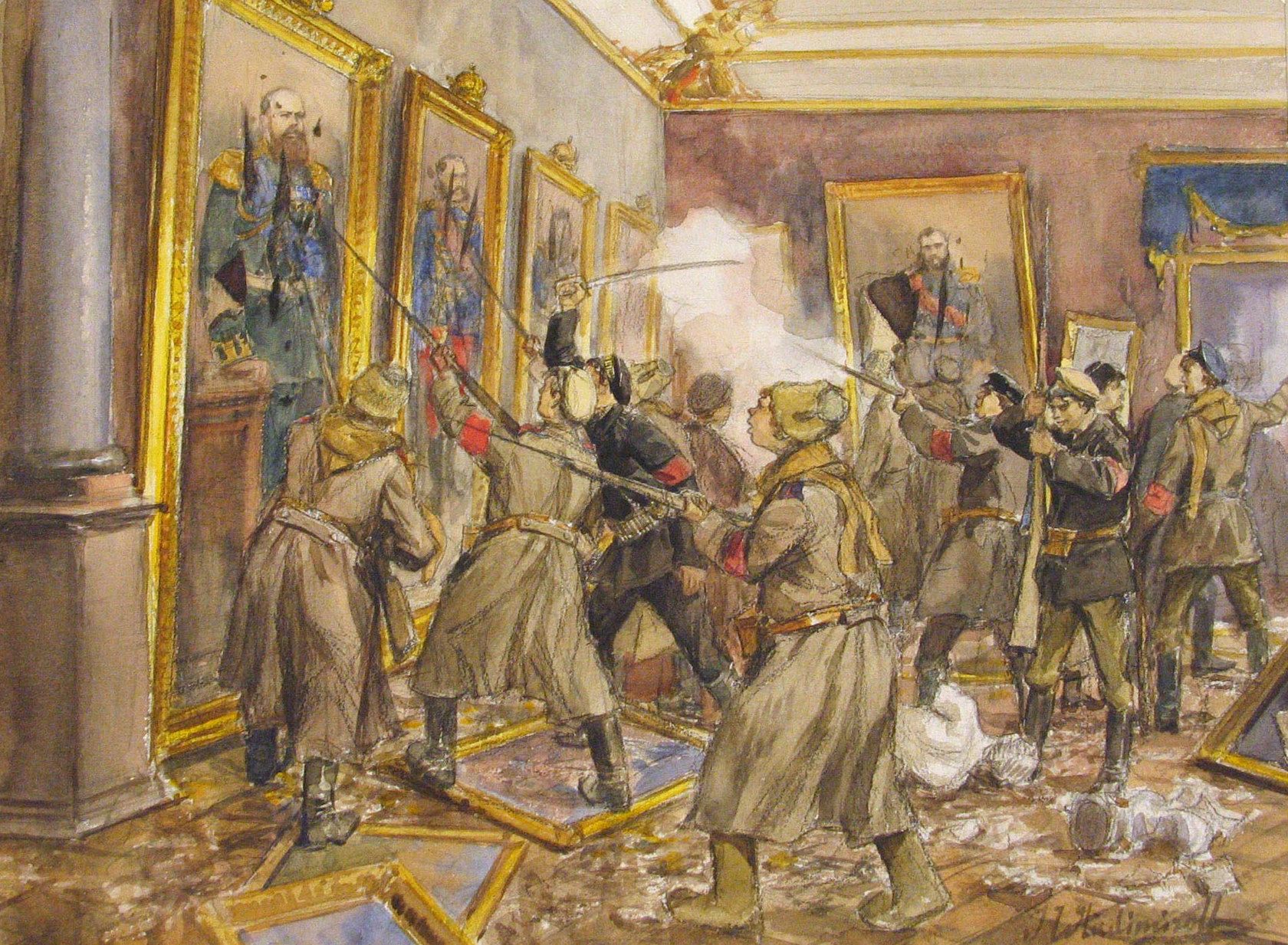
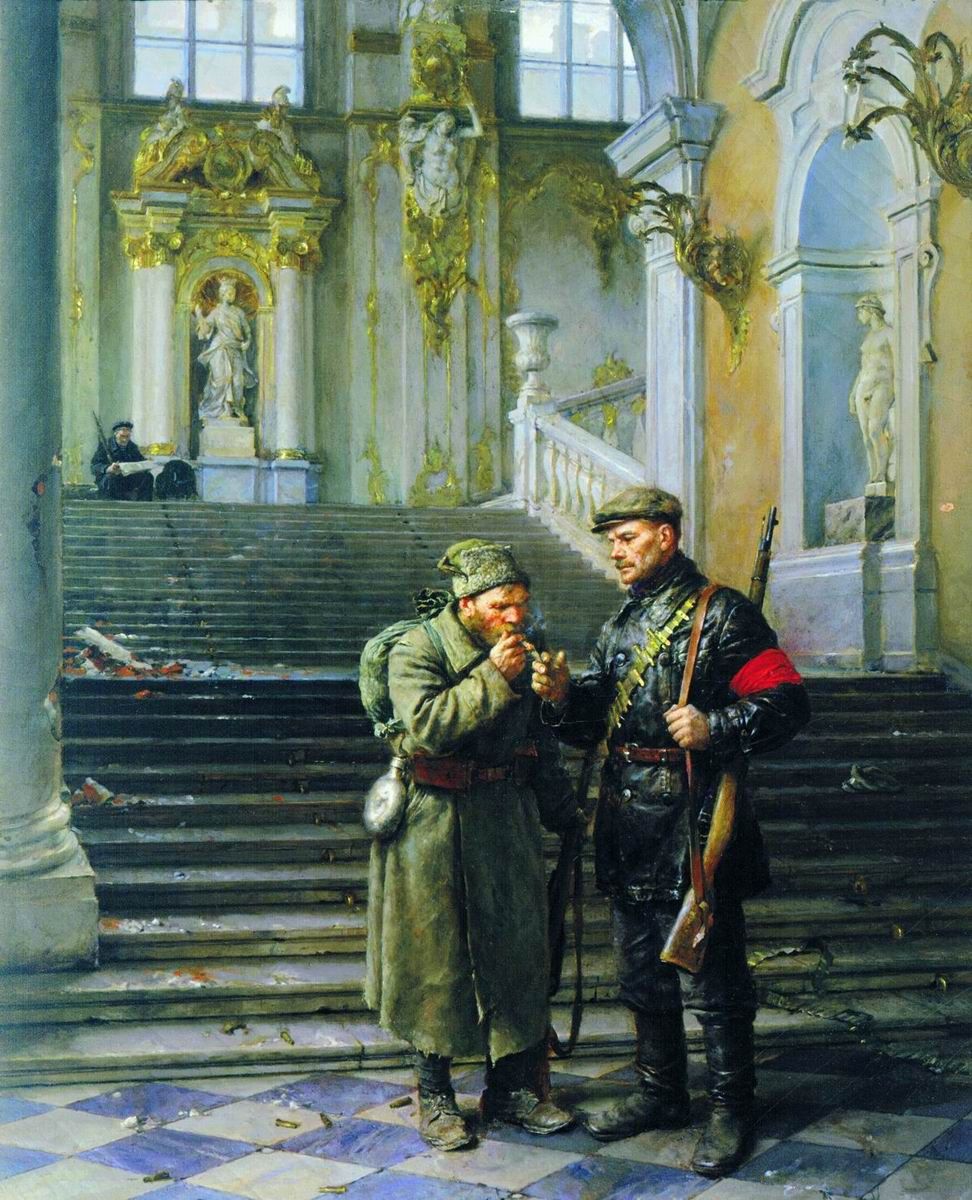
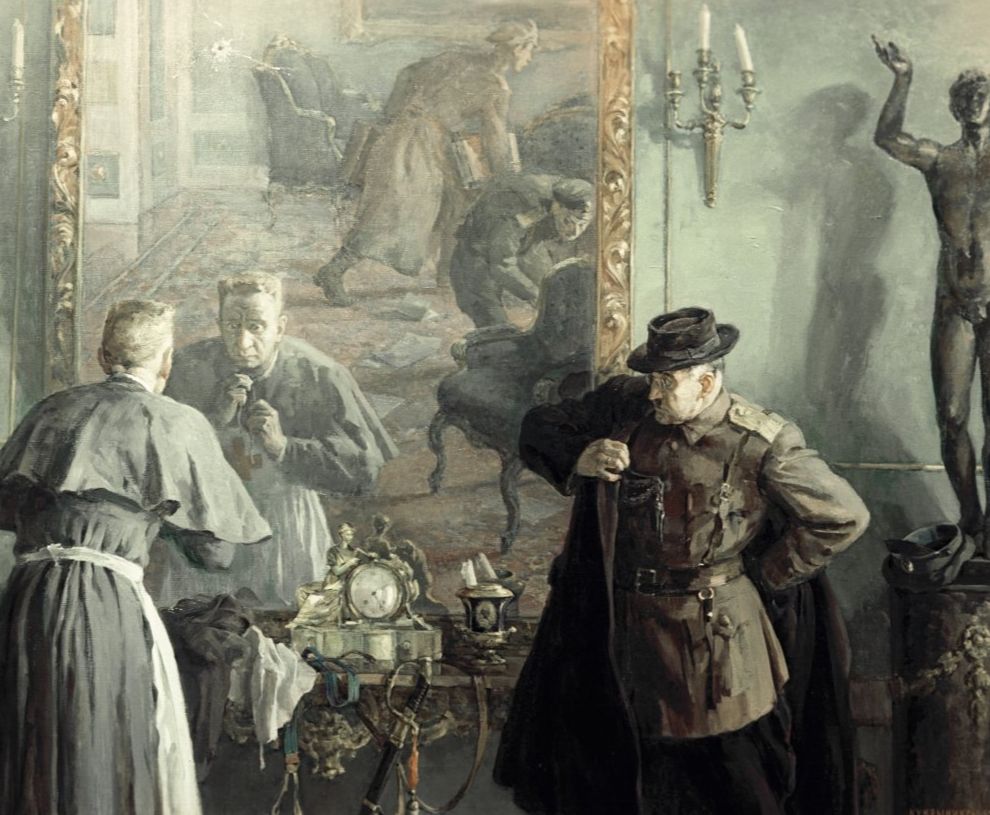
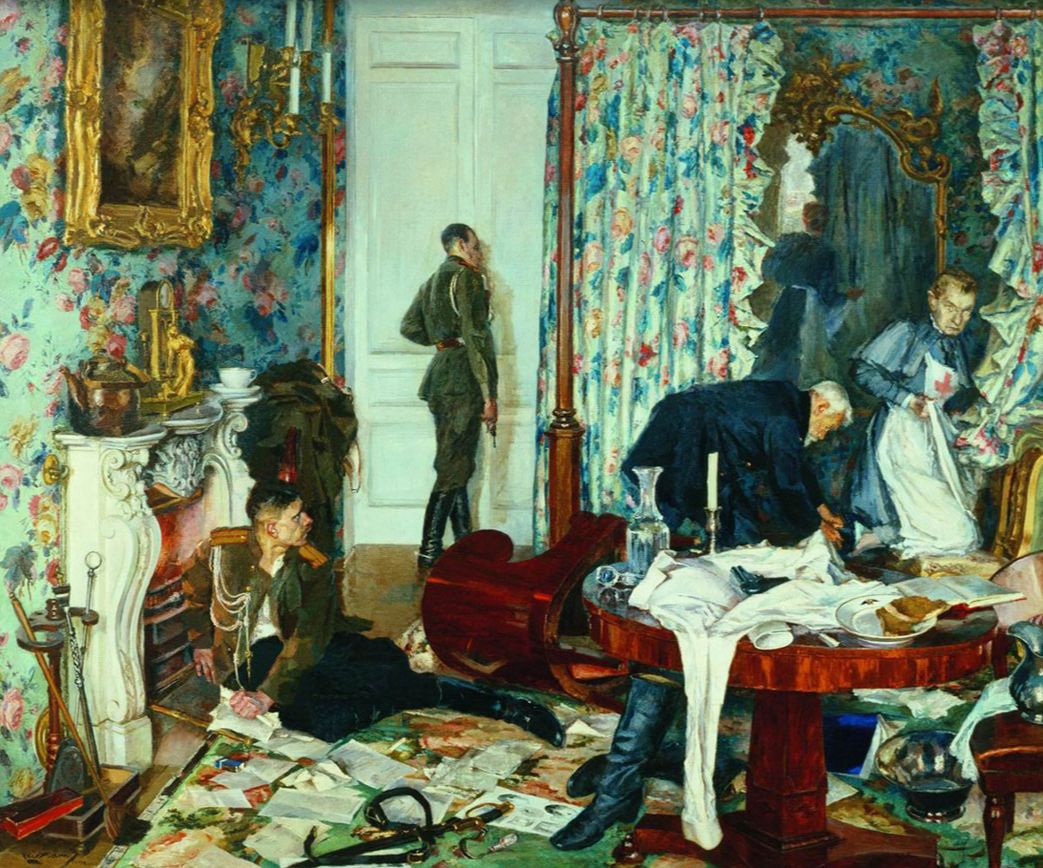
Ivan Vladimirov “Pogrom in the Winter Palace”, 1917-1918.Vladimir Serov “The Winter Palace Is Taken!”, 1954.
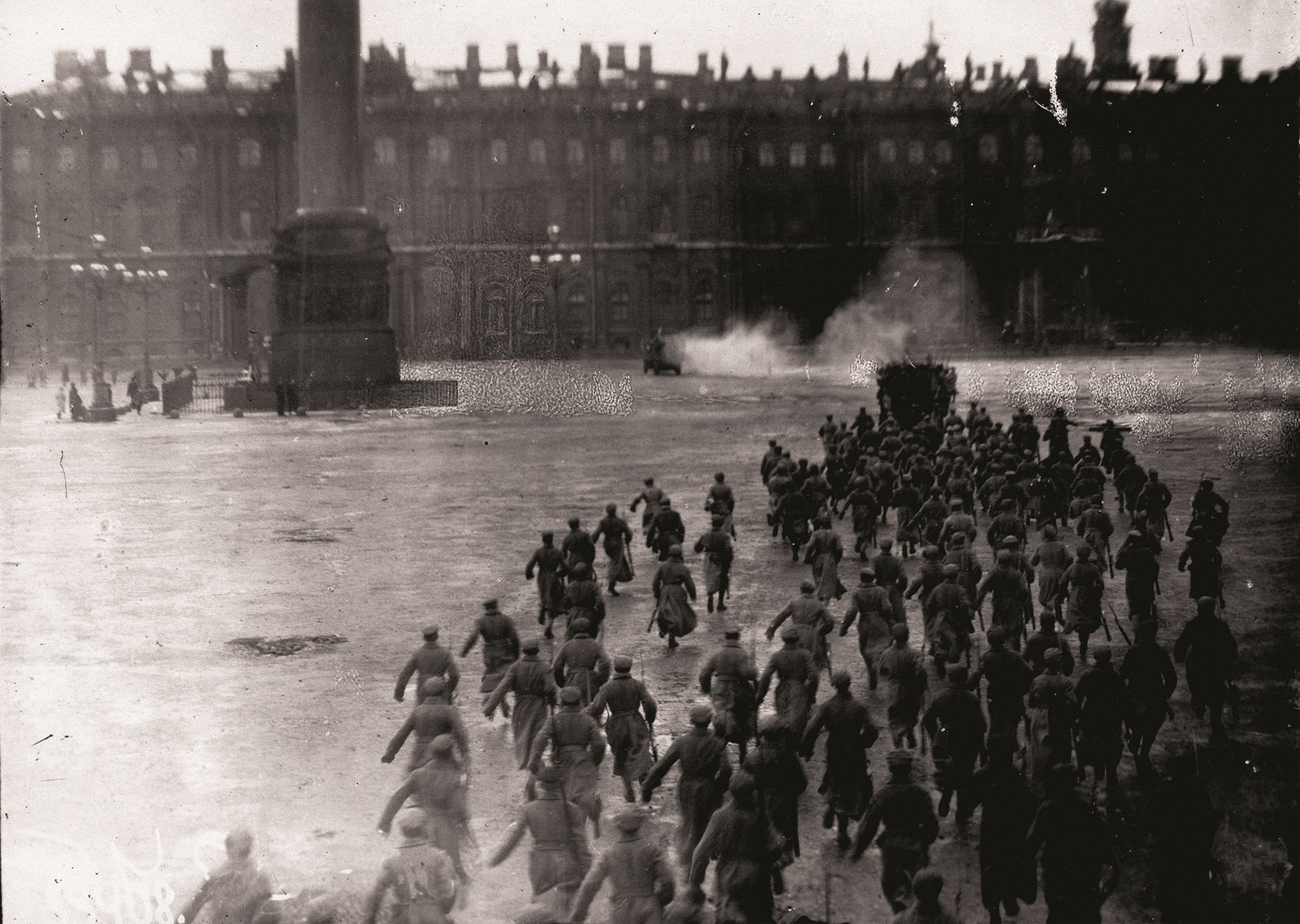
And what about the documentary footage of the storming of the Winter Palace? Specifically across Palace Square, from the arch of the General Staff toward the palace, around the Alexander Column.
The photograph captures a large-scale staged reconstruction of the capture of the Winter Palace in Petrograd, arranged in 1920 in honor of the third anniversary of the October Revolution.
Of course, there was no documentary filming in 1917. The storming footage was first shot in 1920 during a theatrical reenactment called “The Capture of the Winter Palace”.
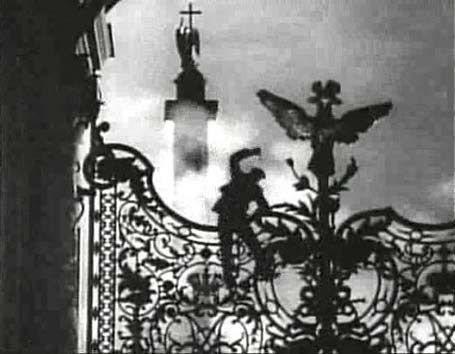
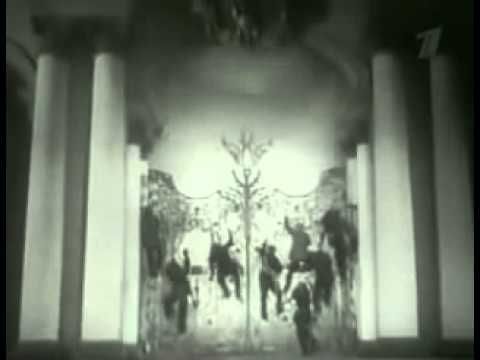
Seven years later Sergei Eisenstein made the film “October”. It included scenes that became canonical. For example, the sailor who climbs the gate grille and throws a grenade into the inner courtyard. Finally, the cementing of the mythology was закреплено by director Mikhail Romm. This happened in 1937 in the film “Lenin in October”. There, an entire group of revolutionary sailors climbs onto the gate. Everything crashes, blazes, and moves. Only none of that actually happened...
Frame from Sergei Eisenstein’s film “October” (1927)Frame from Mikhail Romm’s film “Lenin in October” (1937)
6. Kerensky did not flee in women’s clothing
The most absurd, but at the same time the most understandable myth says that Alexander Kerensky escaped from the Winter Palace dressed in women’s clothing. This rumor itself was probably not even started by the Bolsheviks: according to one version, it was initially spread by Kerensky’s opponents from the monarchist camp. But it was Lenin’s supporters who incredibly inflated the tale about the head of the Provisional Government dressed as a woman.
The reason for the accusations of a shameful escape was his departure from the Winter Palace. But this was not an escape, but an attempt to reach loyal military units in order to call on them to defend the government. However, the real details remained unknown to the mass audience.
As a result, stories about how the cowardly Kerensky frantically pulled on women’s clothes began to accumulate various details.
To the Bolsheviks’ delight, it became a vivid and memorable legend. Kerensky was not only slandered, but also humiliated. He became a symbol of the collapse and failure of the old власти.
To be safe, the version of Kerensky’s escape in women’s clothing was later officially canonized. In 1938, the “Short Course of the History of the All-Union Communist Party (Bolsheviks)”, which served as a kind of ideological Bible for Soviet communists, stated directly that Kerensky had hidden himself in women’s attire. At the same time, artist Grigory Shegal painted the picture “Kerensky’s Flight from Gatchina”. In 1957, the famous cartoon by Kukryniksy, “Kerensky’s Last Exit”, appeared.
Kukryniksy “Kerensky’s Last Exit”, 1957.Grigory Shegal “Kerensky’s Flight from Gatchina”, 1937–1938
Of course, all this story ended up in textbooks. It was illustrated with the images mentioned above. And after some time, the invented plot came to be seen by many as an obvious fact. Although in reality there was neither an escape nor a disguise.
7. The shot from the Aurora. Did it even happen?
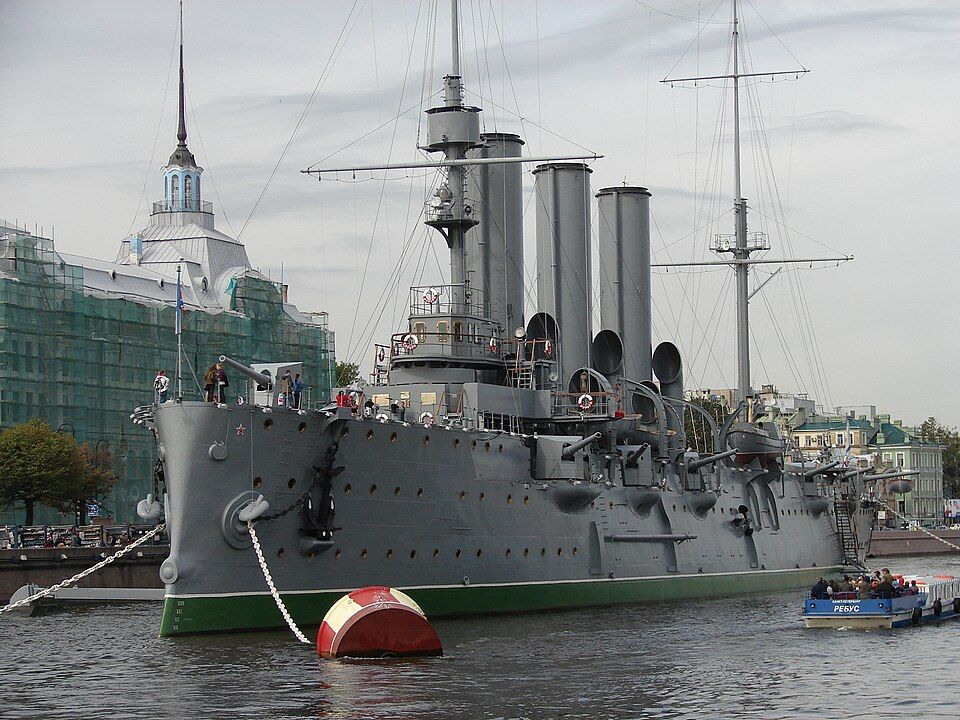
The cruiser Aurora became a symbol of the October Revolution. It was precisely the shot from its gun that served as the signal for the uprising. It was often claimed that there was an entire volley of live shells. Later the ship was turned into an important museum. And generally into a sacred object. Yet in reality, there are still debates about whether there was even that very shot, which became the “harbinger of a new great era”.
In fact, the cruiser Aurora happened to be caught up in the thick of events by chance. The ship needed repairs. That is why it was brought to the Petrograd shipyards.
But during the key events of October 1917, the cruiser was moored much farther downstream on the Neva. Two bridges also separated it from the Winter Palace. The sailors could not even see the key target for firing.
It is interesting that the Peter and Paul Fortress could have played a much more important role. It is located directly opposite the palace on the right bank of the Neva. By autumn 1917, the garrison was under Bolshevik control. The bastions of the powerful fortress had modern combat guns. But no one dared to order an artillery bombardment of the imperial palace. Why? Because the Winter Palace served not only as the meeting place of the bourgeois Provisional Government. Practically from the very beginning of the First World War, it housed a hospital. There were wards for hundreds of wounded. Doctors and nurses worked in the numerous halls of the complex. And this, of course, was no secret. Postcards with photographs of Nicholas II’s daughters, who cared for maimed front-line soldiers right in the imperial residence, were widely circulated.
In short, if shots were fired, they were only blanks. But once again, let us repeat that there is no documentary evidence at all of the legendary volley from the Aurora. What is known for certain, however, is that the sailors, having been heavily agitated (or indoctrinated), brutally killed the ship’s commander in February 1917. For refusing to carry the red flag. But Soviet citizens were not supposed to know all these details. Separate dogmas were invented for them. And any attempt to question the truth of such dogmas was regarded as a counterrevolutionary act. With all the ensuing consequences. And the saddest thing is that these myth-dogmas are still regarded by millions of people as self-evident truths.
Cruiser Aurora on the embankment of Saint Petersburg, 2025. Photo: Public domain
If you enjoyed this article, consider making a donation — one-time or, even better, monthly. Your support helps us motivate our authors and become better with every article.
Our organization is recognized by the Internal Revenue Service (IRS) as a 501(c)(3) tax-exempt, charitable organization, which means that all contributions made to us are tax-deductible to the fullest extent permitted by U.S. law. Individuals may generally deduct charitable contributions of up to 60% of their Adjusted Gross Income (AGI) for cash donations made to qualifying 501(c)(3) organizations. For donations of appreciated assets (such as stocks or other long-term capital assets), the deduction is typically limited to 30% of AGI, based on the fair market value of the asset. C-corporations may deduct charitable contributions of up to 10% of their taxable income for donations made to eligible charitable organizations.
By submitting a donation, you confirm that you have read and accept the following documents: Privacy Policy and User Agreement, and also give consent to the processing of your personal data.
If you would like to unsubscribe from a monthly donation, please email us at: [email protected]