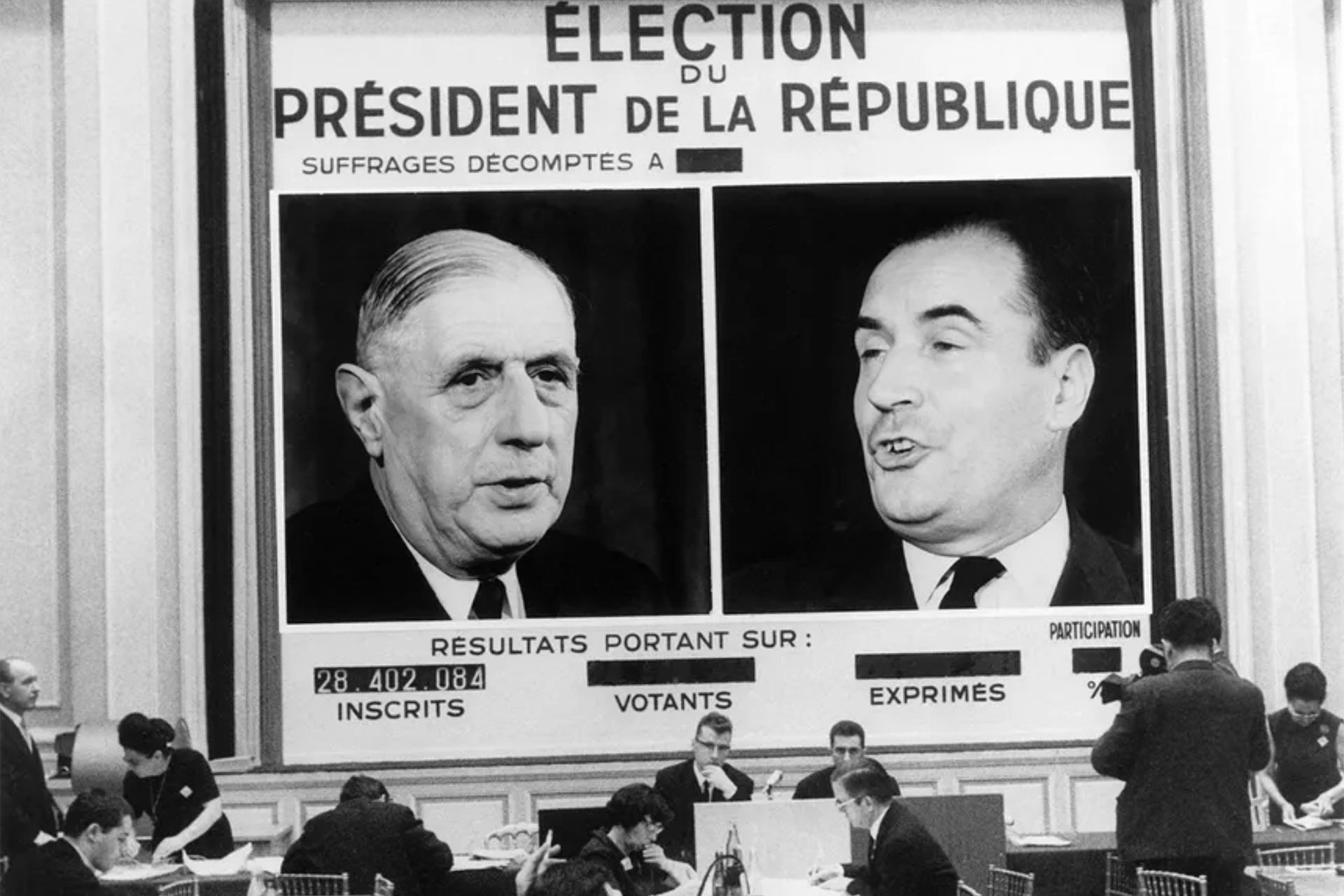
In December 1965, the President of France was elected by popular vote for the first time. This historic event forever changed the country’s political landscape: even today, all attention is focused on the “prophetic” figure of the head of state, and the presidential model of the republic has become deeply rooted in French political tradition. Moreover, General de Gaulle’s dominance was truly challenged at the ballot box for the first time. But how did the French come to feel the need for a nationwide vote for their national leader? And why does this crucial electoral reform continue to poison France’s political life today?
The 1965 presidential election. General de Gaulle won with 44.6% of the vote against François Mitterrand (31.7%). Photo: DALMAS / SIPA
To understand where France’s most important electoral procedure came from, we need to look back at the events of 1962. In March, Charles de Gaulle, who had returned to power four years earlier amid the Algerian War, signed the Evian Accords with the Provisional Government of the Algerian Republic. These agreements ended the seven-year war and de facto recognized Algeria’s independence.
The loss of Algeria—the oldest French colony, which, unlike Tunisia and Morocco, was a full-fledged department of France—enraged French nationalists and the far right, many of whom had hoped that de Gaulle’s return to power would prevent the final collapse of the once-great empire. Massacres of civilians on both sides, terrorist attacks, the exodus of more than a million “pieds-noirs” (Algerian French) from Algeria to France, and the recent mass killing of the harkis (Algerians who collaborated with the French administration), organized by Algerian militants—all these tragedies, in the eyes of many French people, were blamed on de Gaulle.
The Secret Armed Organization (OAS), an underground terrorist group made up of former French soldiers, decided, in response to the general’s “betrayal,” to take radical action: assassinate the President of France. On the evening of August 22, 1962, the presidential car carrying Charles de Gaulle, his wife, their driver, and his son-in-law came under heavy fire from automatic rifles. Miraculously, none of the passengers was hurt, and the failed attack, organized by twelve conspirators, went down in history as the Petit-Clamart assassination attempt. On the morning of August 23, all of France listened in shock to the morning news on national radio. Suddenly, it became clear that even “the greatest of the French,” the man who gave the legendary speech on June 18, 1940 and liberated France from German occupation, was not immortal, not invincible, not immune. Probably, at that moment, the general himself realized his own mortality.
With his unrivaled political instinct, de Gaulle immediately saw the attempt on his life as an opportunity to kill two birds with one stone. First, to give the head of state real popular sovereignty and, second, to solve the problem of legitimacy for his future successor, who would not have the unassailable historical authority of the liberator of France.
The idea was to hold presidential elections by universal suffrage—a concept de Gaulle had cherished throughout his political career. The Petit-Clamart attack plunged French society into fear: people worried about a return to political instability and civil war, and the general was determined to use this to quickly organize a referendum on electoral reform. But how had France chosen its presidents before this?
France’s first presidential election took place during the Second Republic in 1848, when Louis-Napoleon Bonaparte was elected head of state. Just four years after his election, the emperor’s nephew staged a coup in the best traditions of his uncle. The republic was abolished, and the Second Empire began. In 1870, defeat in the Franco-Prussian War led to the fall of the Empire and the return of the republic. In the regime that replaced Napoleon III’s authoritarian rule, the main power was held by the two-chamber parliament and the prime minister (President of the Council), while the president elected by parliament had only formal functions. The liberation of France and the establishment of the Fourth French Republic in 1946 did not fundamentally change the institutional arrangement. The Senate and National Assembly—the two main poles of the country’s political life—continued to elect the president for a seven-year term. Everything changed in 1958, when the agony of the Fourth Republic, triggered by the Algerian War, political instability, and inefficiency, ended with the return of General de Gaulle to power. The condition for this “second coming” was a complete carte blanche to write a new constitution and set up a new system of institutions. The general demanded total freedom of action for good reason: his resignation in 1946 had been caused by deep disagreement with other parties over the new regime’s structure.
In de Gaulle’s view, the disaster of 1940, as well as the inability to resolve the “Algerian question,” were directly linked to France’s chaotic parliamentary tradition—the hated “party regime” that failed the country at its most critical moments. He believed that the sovereignty of the French people, the greatness of France, and the stability of its institutions could only be guaranteed if the country had a true head of state. Although the general’s constitution for the new Fifth Republic did indeed concentrate power in the president’s hands, its founder thought it too bold to propose direct popular elections from the outset. Still, the idea of a stable parliamentary majority working hand-in-hand with a “republican monarch” endowed with popular legitimacy never left de Gaulle’s imagination. The reform, opposed by almost all political parties and public figures, became reality after a solemn referendum on October 19, 1962. After a heated electoral campaign, two-thirds of the French supported the constitutional amendment establishing the election of the president by universal suffrage. Three years later, France would try out this new popular electoral procedure for the first time, replacing the old system where the president was chosen by a college of 80,000 deputies, mayors, and other elected officials.
The election race, which essentially began as soon as the reform was passed, promised to be exceptionally tough. General de Gaulle was, of course, the main favorite. Claiming to stand neither on the right nor the left, presenting himself as the embodiment of France and its people, the aging general was so confident of victory that he did not plan to campaign, did not use his airtime, and announced his candidacy only a month before the election. Thanks to his near-total monopoly of the state media—de Gaulle explained this by the hostility of most of the print press—his chances of victory were indeed high: according to various estimates, more than 70% of the French supported the general in the autumn of 1965. “Every Frenchman was, is, or will be a Gaullist”—this famous quote from the liberator of France seemed truly prophetic. But the opposition was not about to give up without a fight. On the left, François Mitterrand stood against the aging Gaullist regime, supported by the Socialists and Communists. His murky past during the war, ties to right-wing circles, and eleven ministerial posts during the Fourth Republic had badly damaged his reputation—much of the left-wing electorate saw him as an unprincipled opportunist.
But thanks to the return to power of General de Gaulle, whom many French people saw as a threat to the republic, Mitterrand managed to turn public opinion on its head, becoming in just a few years de Gaulle’s main opponent and a defender of democracy.
In 1964, he published the political essay “The Permanent Coup d’État,” in which he accused the general of dictatorial tendencies. The book, which sold hundreds of thousands of copies, helped Mitterrand become the true leader of the opposition to the Gaullists. By the 1965 election, the left had reached a consensus on the need for a single candidate. The Socialists hoped to form a center-left alliance with the Christian Democrats, but deep ideological differences meant that the joint candidacy of Marseille’s mayor, Gaston Defferre, collapsed.
In the context of de-Stalinization in the USSR and the ongoing Cold War, the Communists faced two tasks: to break out of relative political isolation and to avoid a poor result by not running their own candidate. When the Communist Party’s first secretary, Waldeck Rochet, told Guy Mollet, the head of the Socialists, whom they proposed as the joint left-wing candidate, Mollet exclaimed: “But he’s an adventurer!” Nevertheless, the candidacy of the ambitious and charismatic Mitterrand became the obvious choice—beggars can’t be choosers.
From the opposite political flank, another charismatic figure entered the race against the general, hoping to unite all those for whom Marshal Pétain was a true patriot, all those who had been rejected after the Liberation, all those for whom Gaullist policy in Algeria meant a betrayal of France’s interests and greatness. This was the well-known Parisian lawyer Jean-Louis Tixier-Vignancour, a staunch nationalist who, before the war, had been involved in royalist, far-right, and fascist movements in France, openly supported Pétain during the war, and after the war defended former collaborators.
Jean-Marie Le Pen, then still little-known, was appointed head of Tixier-Vignancour’s campaign; he would later become the main architect of the postwar far-right’s transformation. This campaign marked the return of right-wing and far-right ideas to the French political scene, after being discredited by four years of the Vichy government during the German occupation.
The big surprise of the election was the candidacy of Jean Lecanuet, head of the centrist Popular Republican Movement—a progressive liberal Christian Democratic party. Quickly nicknamed the “French Kennedy,” the 45-year-old Lecanuet took a keen interest in his American colleague’s campaign. He was among the first French politicians to truly grasp the power of political communication, which emerged alongside the rise of mass media and especially television. “Tomorrow Jean Lecanuet—a new man... France in motion,” read his campaign poster, which echoed youth and a desire for change.
The political image created by Lecanuet and his team inspired trust among voters and created a sense of closeness—everything de Gaulle, with his imposing and untouchable figure, lacked. Thanks to skillful use of airtime, the French Kennedy’s ratings soared from 2% to 16% in just a few months—a success that quickly began to worry those around the occupant of the Élysée Palace.
The general’s inaction and lack of any campaign cost the Gaullist camp dearly. “Me or chaos”—that’s how French newspapers described the simple choice the 75-year-old de Gaulle, the sole “savior” of France in 1940 and 1958, offered his compatriots in a televised address a week before the first round. According to the president, the “champions of decadence”—the five opposition candidates—would plunge the country into the very chaos he had managed to overcome: the chaos of parties and petty political scheming, harmful to the unity of the French and the greatness of France.
Unlike his opponents, de Gaulle did not propose new reforms or a concrete political program—his legitimacy as a candidate, and as president, was based on the trust and love of the French people. When one of his advisers suggested he appear on television like the other candidates, the general was indignant: “What, do you want me to come and say: ‘My name is Charles de Gaulle?’”
In the end, for him, this election was yet another plebiscite, a referendum on his own person. But many French people were tired of the Gaullist legend, which, despite the efforts of its creators and chroniclers, no longer had the same effect on a new generation with new anxieties and hopes. While de Gaulle sat in the Élysée Palace, convinced he would win in the first round, the other candidates—especially Mitterrand and Lecanuet—traveled the country, holding conferences and rallies, enlivening the monotonous and predictable politics in the regions. Moreover, since 1960, the number of French people with televisions had tripled—by 1964, about 40% of the population. Considering that people watched TV with family, friends, and neighbors, at least half of the French discovered real political debates and candidate speeches, criticizing the government on state television.
Turnout for the first round reached a record 85%. General de Gaulle received 44%, François Mitterrand 31%, and Jean Lecanuet a respectable 15%. Although any modern French politician could only dream of 40% in the first round, on December 5, 1965, the general was far from celebrating. In fact, he was so shocked by the French verdict that in the first hours after the results were published, he seriously told his entourage he wanted to withdraw from the second round. But soon de Gaulle pulled himself together. And although the outcome of the second round was obvious to everyone, a week before it, the incumbent president decided to strengthen his position in a televised interview with journalist Michel Droit.
“He is the candidate of the parties,” was how de Gaulle summed up the position of his main opponent, François Mitterrand. In the hour-and-a-half interview, broadcast a week before the second round, the incumbent president spoke about France’s domestic and foreign policy and, moreover, about his own candidacy and the institutions of the Fifth Republic he had founded. Explaining his position on the political spectrum, de Gaulle uttered a phrase that became legendary: “France is everything at once. The left is not France! The right is not France! France is all the French together.” He alone could claim to be above party politics, for, in the General’s view, no one in French history—except perhaps Joan of Arc—had made the greatness and well-being of their country such a priority. This also explains the introduction of presidential elections by universal suffrage—the power to choose a leader outside party influence, driven only by the interests of their compatriots, had to be in the hands of French citizens. Otherwise, the party regime would return to France, and another national catastrophe would be inevitable.
All these arguments, as well as the long history linking the aging general to the French people, undoubtedly played a role on December 19, 1965, when the first presidential election in French history by universal suffrage ended with Charles de Gaulle’s victory in the second round. Both Tixier-Vignancour and Lecanuet had called for votes against the incumbent government.
François Mitterrand, the “one-time” left-wing candidate, finished the race with a more than respectable silver medal and 46% of the vote. He would go on to use this success to join the Socialist Party, rebuild it, unite the left, and lead them to victory in the 1981 presidential election, against all expectations.
The general, for his part, confirmed both his status as the biggest and most powerful political figure in France and the success of his creation—the Fifth Republic and its institutions. In 1965, no one could yet imagine the “Red May” that would sweep away the exhausted Gaullist regime three years later. Presidential elections quickly became the French people’s favorite political event, which they saw as a true popular vote, a moment of unique national unity, and a real opportunity to influence the country’s future.
Sixty years later, the situation has changed dramatically. The French have had many occasions to be disappointed in the “prophetic” figure of the president, who failed to live up to the people’s hopes. Just think of Mitterrand, who promised socialism but was forced to announce unprecedented budget cuts. Or Chirac, who ignored the French rejection of the European constitution in the 2005 referendum. Not to mention Emmanuel Macron, who set out to reinvent French political life but ended up being a blend of all his predecessors rolled into one.
Presidential elections have truly become the only hope for real political change, which has led to a complete suffocation of French politics, which only comes alive for the election of a new president.
This suffocation has taught seasoned French politicians to come alive only for presidential elections—since announcing your intention to run, let alone officially declaring your candidacy, has become a surefire way to ensure longevity on the political stage.
The Olympic wisdom “the important thing is not to win, but to take part” most accurately describes the political absurdity into which the presidential elections have plunged France. This is especially clear today, in 2025. Political instability, the lack of a parliamentary majority in the National Assembly, and a government crisis have redirected the disillusioned gaze of the French away from parliamentarism and toward the upcoming 2027 presidential election, which may bring some clarity to the current institutional chaos. Every day, politicians from across the spectrum announce their candidacies and intentions to run for president, as if the election were not two years away, but tomorrow.
Why have presidential elections poisoned French political life? How did it happen that the “party regime,” against which General de Gaulle wrote the new constitution, has returned to the republic? And can the upcoming elections restore the lost stability and trust in French democracy? Perhaps the founder of the Fifth Republic could have answered these questions. But the Fifth Republic itself is unable to find the answers today.
If you enjoyed this article, consider making a donation — one-time or, even better, monthly. Your support helps us motivate our authors and become better with every article.
Our organization is recognized by the Internal Revenue Service (IRS) as a 501(c)(3) tax-exempt, charitable organization, which means that all contributions made to us are tax-deductible to the fullest extent permitted by U.S. law. Individuals may generally deduct charitable contributions of up to 60% of their Adjusted Gross Income (AGI) for cash donations made to qualifying 501(c)(3) organizations. For donations of appreciated assets (such as stocks or other long-term capital assets), the deduction is typically limited to 30% of AGI, based on the fair market value of the asset. C-corporations may deduct charitable contributions of up to 10% of their taxable income for donations made to eligible charitable organizations.
By submitting a donation, you confirm that you have read and accept the following documents: Privacy Policy and User Agreement, and also give consent to the processing of your personal data.
If you would like to unsubscribe from a monthly donation, please email us at: [email protected]