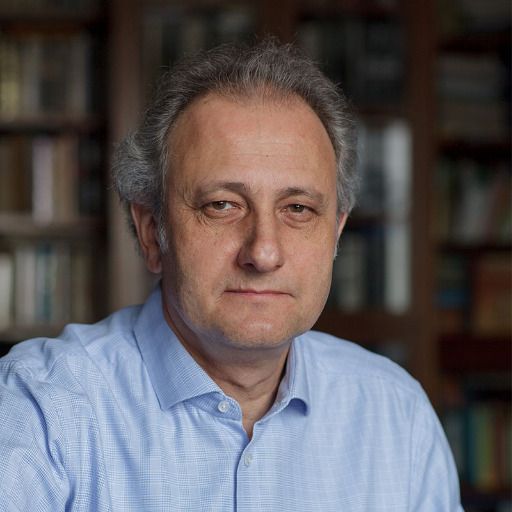
We, Soviet children, were incredibly lucky. We went through patriotic education with books by Vasily Bykov and Boris Vasilyev, Samuil Marshak and Lev Kvitko. And our early youth was not overshadowed by works of Vladimir Medinsky, Oleg Roy, and unknown authors included in the “List of Patriotic Works Created by Contemporary Writers and Recommended for Extracurricular Reading” published last week by the Ministry of Education.
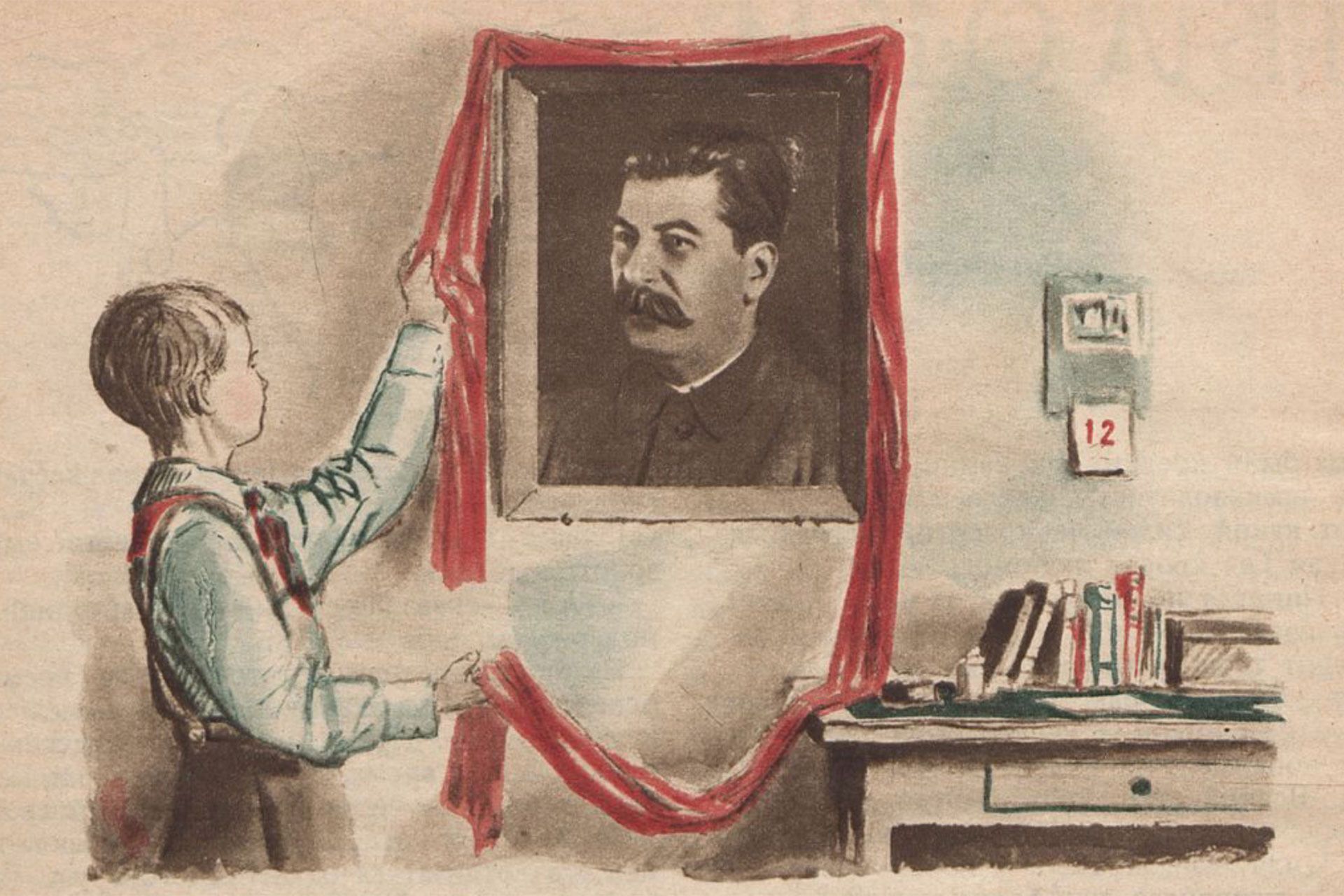
Magazine “Murzilka”, No. 12, 1937. Illustration by V. Zhitenyev
The formation of this strange list with sections like “Commanders of Holy Rus” and “Z for ours” featuring some Shorokhov instead of Sholokhov coincided with initiatives to introduce “Conversations about Important Things” in kindergartens and to teach songs by Shaman and Gazmanov in schools and preschools. Honestly, it’s better, like in the 1970s, to sing “Either Birch or Rowan” in kindergarten and “El pueblo unido jamás será vencido” at school than “I am Russian, and I will go to the end” or “Yesaul, Yesaul” (or whatever else Gazmanov sings).
At least in the Soviet lists of patriotic literature and song practice, there was an educational purpose. If I had to choose between Medinsky’s “War. Myths of the USSR” and Brezhnev’s “The Small Land,” I would undoubtedly vote for Leonid Ilyich. After all, that book was written by worthy ghostwriters.
If I were in charge of the Ministry of Education, including in the framework of restoring traditional values, I would turn to the Soviet heritage, not only the well-known classics. For example, if you need to cultivate hatred toward an internal enemy, you can study the experience of the late 1930s. I can share masterpieces from my personal home collection of children’s books and magazines.
“Murzilka,” No. 4, April 1938 — take note, methodologists:
Enemies of our life, enemies of millions, —
Trotskyist spy gangs crept toward us,
Bukharinites, cunning snakes of the swamps,
An embittered rabble of nationalists.
They rejoiced, bringing us shackles,
But the beasts fell into Yezhov’s traps.
A loyal friend of great Stalin,
Yezhov broke their treacherous circle.
The serpent’s hostile breed was exposed
Through Yezhov’s eyes — the eyes of the people.
Yezhov ambushed all venomous snakes
And drove out the vermin from dens and lairs.
The entire scorpion breed was crushed
By Yezhov’s hands — the hands of the people.
Author unknown; the poem has the character of an editorial front page.
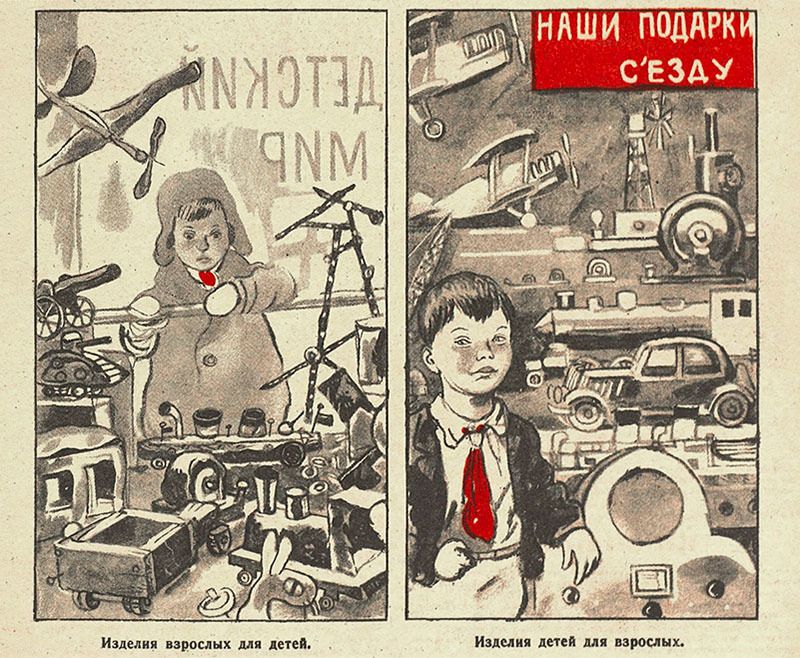
Some State Duma deputies, eager to instill traditional values in babies from birth (which almost succeeds when the poor infants are crowned with pilotkas), as well as the Ministry of Education, claim that the foundations of love for Putin and a thousand-year history are laid from the first days of life. Then there is a chance that years later, young men and women entering adulthood will become soldiers or masters of finished metal products.
“Crocodile“, No. 2, January 1937. Illustration by L. Ganch
The experience of several generations of Soviet children shows that such massive spiritual state violence and all-encompassing indoctrination did not always achieve the desired result, often fostering double consciousness and cynicism in young people. Moreover, the self-criticism of the “elites,” characteristic of today’s establishment as well, did not allow seeing the world solely through “Yezhov’s eyes”: those very eyes kept changing, while children’s minds could not keep up with the kaleidoscope of changing names, disappearing commissars, and amendments to the Great and Small Soviet Encyclopedias.
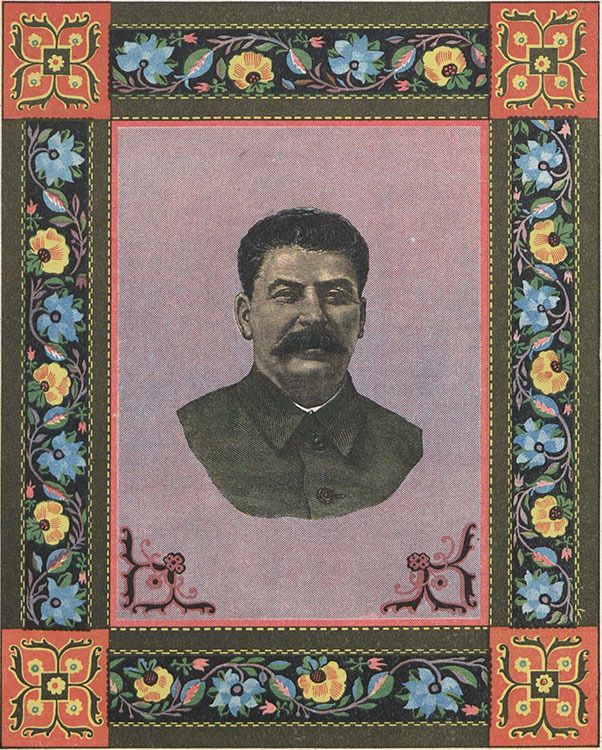
The recently approved “Fundamentals of Language Policy” by Putin also require promotion among children. In particular, it is necessary to convey ideas about the multinational nature of the restored empire. Georgia has not yet returned to its native harbor, but one can turn to the aforementioned issue of “Murzilka” and dream a little retrospectively by reading a poem by the well-known poet of that time, Nikolai Berendgof, about how a girl from the historical-geographical region of Kartalinia (which includes Tbilisi, Borjomi, and most importantly Gori) wove a carpet portrait of Comrade Stalin.
Magazine “Murzilka,” No. 4, April 1938
In the context of the return of Stalinism elements to current politics and the widespread desecration of the memory of repression victims, this work takes on special significance. Not to mention that it serves as a model for the Ministry of Education and the State Duma’s fantasies about the content of “Conversations” (and songs) about “important things.” The excerpt shows the tirelessness of a teenage girl mastering a traditional female craft and glorifying the head of state:
She woke with the clear dawn,
Wove ring upon ring,
So the carpet would smile
With the beloved face.
A year of such useful activities passed. And then:
A year passed, and the pre-dawn
Wind whispered to me: “It’s time!”
The leader smiled back at me
From the precious carpet.
There is some ambiguity in this poem. This type of poetry experience can be adopted within the propaganda of payments to pregnant high school girls — a national cause, as V.I. Matvienko said, a matter of the “demographic special forces.” However, the poem ends only with a distant contact:“The leader sends me a greeting / From the distant Kremlin.”
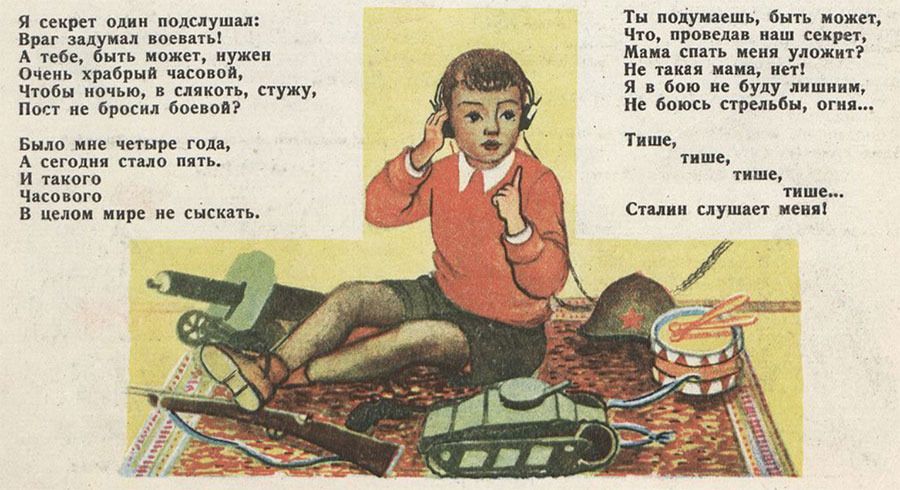
Since the campaign against cosmopolitans had not fully begun in 1938, “Murzilka” published a poem by Kh. Levina “translated from Hebrew,” in which a five-year-old Jewish boy offers his services as a guard to the head of state because:
I overheard a secret:
The enemy plans to wage war!
And maybe you need
A very brave guard,
Who won’t abandon the post
At night, in slush and cold?
Magazine “Murzilka,” No. 4, April 1938. Illustration by E. Endrikson
My personal collection contains many such wonderful magazines, including “Chizh” and “Yozh,” which have less educational literature and more examples of wonderful children’s poetry and illustrations. But even there, you can find something about enemies.
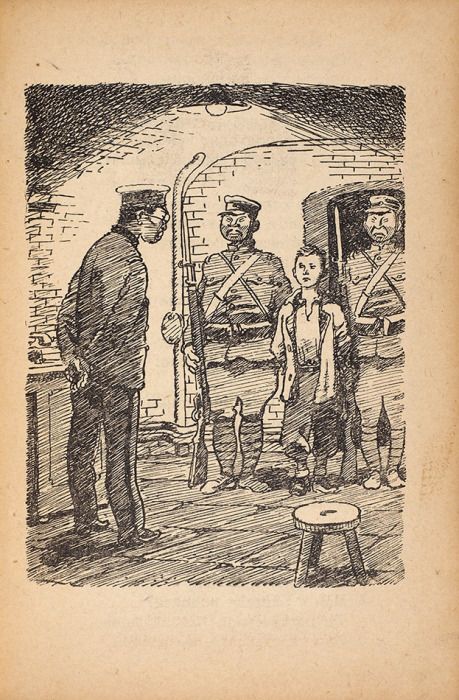
Here is another useful example — Sergey Mikhalkov’s poem “Misha Korolkov” with excellent illustrations by Konstantin Rotov. A year later, in 1940, the famous artist would be imprisoned. The work tells about a boy hero who was interrogated by the Japanese. Again, it is relevant considering the approaching victory day over Japanese militarists, and Japan is classified as an “unfriendly” state. The story of the pioneer’s rescue is not entirely clear, but that doesn’t matter because the Kremlin master works miracles:
The stars began to fade in the sky.
It’s bright outside, like daytime.
Comrade Stalin says:
- We will bring back all comrades!
S. Mikhalkov, “Misha Korolkov”. Illustration by K. Rotov. Detskizdat, 1939.
Sergey Mikhalkov was a great master of ideologically precise verse, conveying the essence of the highest leadership’s policies in an accessible form not only to children but also to adults. For example, his description of the nuclear doctrine perfectly suits explaining today’s version to the masses:
TASS informed the world,
Simply, modestly, without pomp,
That, well, the atomic bomb —
Is yours and is ours!
Yes, indeed!“
Or like this, in 1951, not in “Murzilka” but in “Pravda”:
There will be bombs! Bombs exist!
Everyone must keep this in mind.
But it’s not in our plans
To conquer other countries.
Neither the British,
Nor the Germans,
Nor the Dutch —
Yes, yes, yes!
Don’t be afraid,
Calm down,
Don’t worry, gentlemen!
It seems that such simple words were used to explain the party and government policy to Stephen Witkoff…
The campaign for nationalizing private enterprises can also be explained to kids in accessible poetic form. And here again, Sergey Vladimirovich comes to the rescue:
And grain runs out of sacks
Not to the merchant’s storehouse.
And DneproGES belongs
Not to a private person.
And if curious kids want to learn about the flaws of the Western world, they can again turn to the legacy of senior Mikhalkov. Though poems about America are temporarily out of favor now, they might come in handy if Trump imposes sanctions and relations sour again:
So that no foreigner
Learns the terrible truth,
Americans publish
A colorful magazine.
Well, it’s nothing. We respond with counter-propaganda. For example, we hit their dollar. To its boastful claim:
I can buy everything I want,
I favor some, order others executed,
I’ve seen Greece, I’ve been to China, —
Can any ruble compare to me?
Our talking national currency answers in Mikhalkov’s interpretation:
I am the people’s ruble, and I am in the hands of the people,
Who build peace and call the world to peace,
And to spite all enemies, I grow stronger year by year.
Step aside — the Soviet ruble is coming!
“Crocodile”, No. 7, March 1950. Illustration by I. Semyonov
The extensive campaign against “foreign agents” also needs to be explained to younger schoolchildren. Here, one of Agniya Barto’s poems will help. She doesn’t have much propaganda poetry, but there are bright examples. “Foreign Agent” is an analogue of either a spy or a slanderer, seeking discrediting information. The sample lines for the Ministry of Education also mention America, but Agniya Lvovna could hardly have foreseen the Putin-Trump meeting in Anchorage:
Yesterday, someone approached the kids
In a Moscow park
Someone with a camera,
Someone from America.
The “foreign agent” wanted to photograph sad Soviet children on Moscow streets for slanderous purposes. But he failed — the kids saw through the hireling’s plan:
The kids laugh loudly,
The shoot failed.
And now the children’s crowd
Says in the park:
- Look, Alik is crying.
They’ll film it for America.
The main thing is, imitating Barto’s educational work and launching a tender for poems about “foreign agents,” don’t forget to replace America with Europe. And have a backup plan in case relations with the USA worsen.
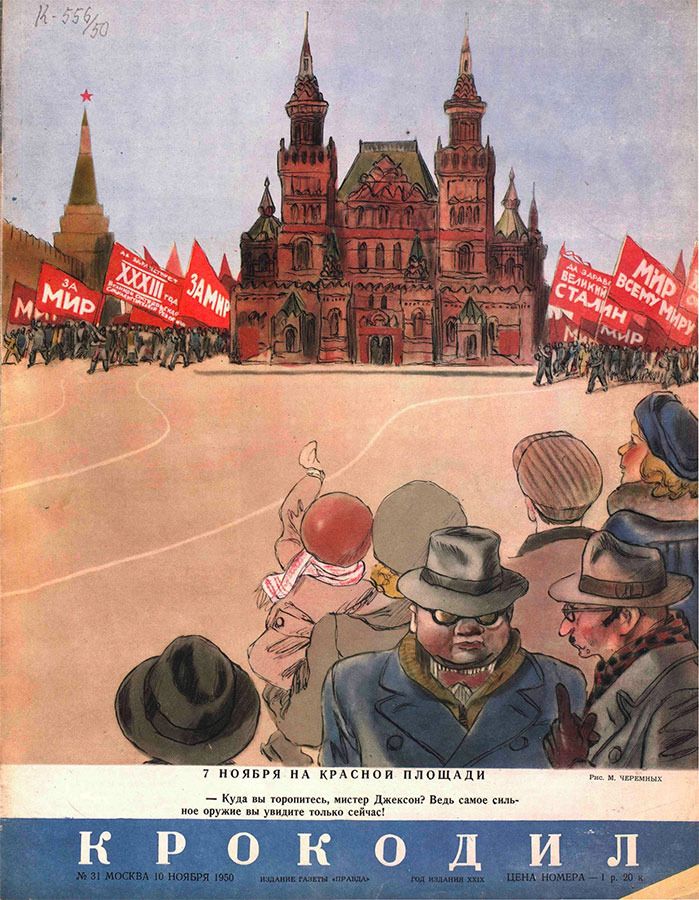
Cover of “Crocodile,” No. 31, November 1950
This is how propaganda work should be done — there is experience, there is a legacy left by previous generations. There is plenty to add to the lists of patriotic educational literature — it’s time to return to the roots and origins!
So let us help our authorities
In cities and villages
To bring happiness to the people
On our native land!
You couldn’t say it better than Sergey Vladimirovich.
If you enjoyed this article, consider making a donation — one-time or, even better, monthly. Your support helps us motivate our authors and become better with every article.
Our organization is recognized by the Internal Revenue Service (IRS) as a 501(c)(3) tax-exempt, charitable organization, which means that all contributions made to us are tax-deductible to the fullest extent permitted by U.S. law. Individuals may generally deduct charitable contributions of up to 60% of their Adjusted Gross Income (AGI) for cash donations made to qualifying 501(c)(3) organizations. For donations of appreciated assets (such as stocks or other long-term capital assets), the deduction is typically limited to 30% of AGI, based on the fair market value of the asset. C-corporations may deduct charitable contributions of up to 10% of their taxable income for donations made to eligible charitable organizations.
By submitting a donation, you confirm that you have read and accept the following documents: Privacy Policy and User Agreement, and also give consent to the processing of your personal data.
If you would like to unsubscribe from a monthly donation, please email us at: [email protected]