Events of recent years have forced Europe to rethink its security concept. It is not just about the current contradictory activity of President Trump and his entourage, from which numerous claims against Europeans arise, including the most surprising ones. These disagreements did not start yesterday – not even during Trump's first term. The Obama and Biden administrations did not spare the traditional rhetoric about transatlantic solidarity, but in reality pursued the same line of distancing from old allies. The US position on supporting Ukraine from the first days of the war, when Trump was still far from the White House, left a strange and ambiguous feeling that occurs when true goals do not coincide with declared ones. In general, the revision of transatlantic relations has been going on for a long time, but today it has sharply touched on such a sensitive issue as Europe's security and NATO's prospects.
It hardly makes sense now to discuss whether NATO was well or poorly organized more than 70 years ago. Obviously, with the US withdrawing from European affairs, the previous concept of American guarantees looks outdated and shaky, and the notion of a “united West” is gradually becoming history. This understanding is widespread in Europe, and no one disputes that they will have to rely only on themselves. Nevertheless, creating a European security system requires not only time and money but also political will and strategic meaning. Today, three questions can be highlighted that Europeans must first answer for themselves – and their near future depends on this.
What to do with NATO, what war to prepare for, and what about Ukraine?
First, it is necessary to understand what to do with the North Atlantic Alliance. It can be assumed that Washington would accept such a NATO reform scheme: Europeans continue to buy American weapons (Alliance countries are the most important arms market for American manufacturers; the US share in military supplies to Europe reaches 64% and has grown in recent years) – but fight on their own if the need arises. At the same time, the US retains control over allies through key points such as information technology (which is currently almost 100% American in European armies), cybersecurity, satellite reconnaissance, and missile technologies. The overall US contribution to NATO programs is currently estimated at 70–80%, indicating significant and multifaceted European dependence on Washington.
Separately, nuclear weapons must be mentioned. France and the UK possess modest arsenals of their own (London is not fully autonomous in its use and has a so-called “dual key” with the US); on the territory of Germany, Belgium, the Netherlands, and Italy (and also Turkey, but it makes no sense to mention it in the context of European security) American nuclear weapons are deployed, the decision to use which will, of course, be made exclusively in Washington.
Thus, the idea of Europe gaining strategic autonomy implies an ambivalent attitude toward NATO. On the one hand, the Alliance cannot be abolished overnight without security failures. Cooperation with the US must continue, possibly even increasing direct payments for interaction with Americans where necessary. On the other hand, nothing prevents an immediate reduction of dependence on Washington, particularly in arms production. It is obvious that European taxpayers' money should primarily go to orders for European, not American, manufacturers.
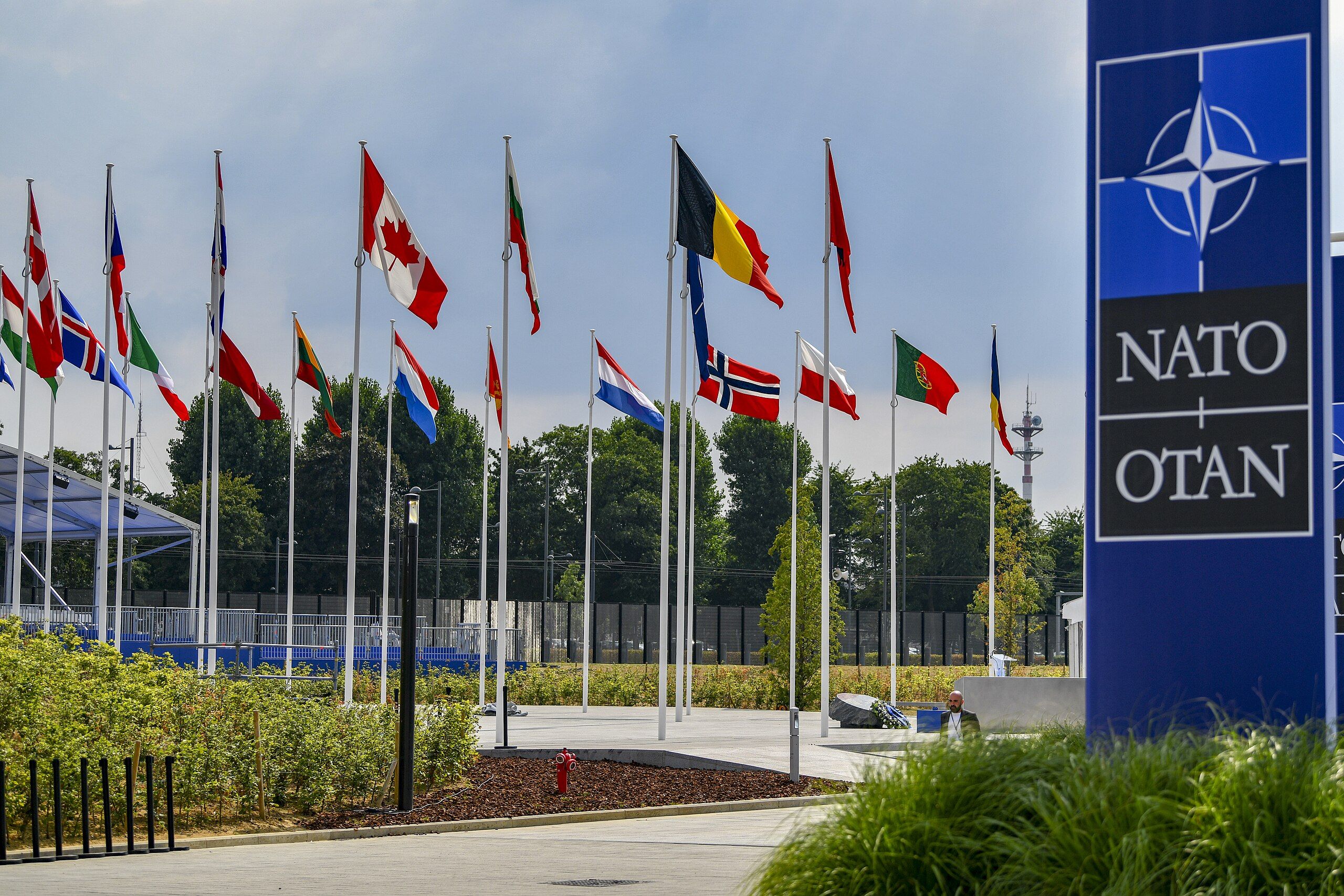
NATO member country flags in front of the headquarters in Brussels. Photo: wikipedia
In March, unexpected statements were made by the defense ministers of Portugal and Germany about the possibility of reconsidering the decision to purchase American F-35s. From the outset, it was doubtful that Europeans would terminate the existing contract, and Berlin later confirmed that the agreement remains in force. Nevertheless, the very fact of doubts is very telling. With deepening contradictions between the US and Europe, American high-tech weapons, which are fully integrated into the US military ecosystem at the software and service level, could be remotely paralyzed from Washington. Put simply, no European F-35 will take off to defend Greenland if the Pentagon wants to prevent it.
At the extraordinary EU summit on March 6, the figure of 800 billion euros in investments in European security was named, of which 150 billion is expected to be raised through a solidarity loan. Specifically, this concerns arms production and communication systems, cybersecurity, logistics, and the creation of a large group of satellites. This investment project is still in progress, but at the approval stage, it is unlikely to face serious objections. It does not imply an immediate abandonment of NATO but a gradual organization of a parallel security system.
Second, the question “what war are we preparing for” must be answered. The traditional approach, justified during various Western interventions in the early 21st century, would involve creating effective and mobile brigades consisting of artillery, armored, and infantry units operating with complete air superiority. But the war in Ukraine has completely changed these ideas. Now, with conventional clashes and an extended front line, it is a drone war, which creates a depth of several dozen kilometers and forms a “dead zone” with practically no possible movement. Relatively inexpensive mass-produced devices easily destroy modern expensive military equipment, and the use of artificial intelligence will further increase their effectiveness.
For Europe, this presents a difficult strategic planning question, and currently, there is no institution that could handle it. It is much easier to agree on investments in large-scale production, for example, of artillery shells, the shortage of which was acutely felt in the first two years of the war in Ukraine, place orders within EU countries, create new jobs, and rejoice at GDP growth. But it may happen that the war on the EU’s eastern borders will follow a scenario where the need for drones is much greater than for shells.
Third, Europe must decide its stance on Ukraine. This problem is much deeper than simply showing solidarity with a European country subjected to unjust and brutal aggression, even if solidarity implies significant and gratuitous aid. It is necessary to understand the timeline and form in which Ukraine can be integrated into the European security system. On the one hand, its army is fighting a hard war with modern methods against Europe’s potential enemy, and this experience is invaluable. On the other hand, the war continues, its outcome is unclear, and Ukraine’s accession to the EU and NATO takes time. It is difficult to agree on strategic cooperation under continuous shelling while Kyiv deals with current tasks of holding the front line, military supply, and air defense organization. But even if a truce occurs soon, Europe will have to answer a difficult and unpleasant question: does it primarily want to finance its own security program or the Ukrainian army? Or can this be combined? And if so, how?
A coalition of the willing
It is known that as one of the projects guaranteeing Ukraine’s security against continued Russian aggression after a truce is concluded (if and when it happens), peacekeeping forces formed by allies would be deployed on Ukrainian territory. It is also known that Russia categorically opposes this idea, threatening war with NATO. The main participants in the project are France and the UK, which could unite military units from other European countries under a common command, but it is too early to talk about its real outlines today.
From the perspective of developing a European security system, it would be useful to deploy and manage a large military formation from different countries (tens of thousands of people) without American participation (or with limited participation). Theoretically, Paris and London can organize operational planning, but their potential needs practical confirmation. Moreover, the presence of a “coalition of the willing” in Ukraine as guarantors of peace would facilitate better understanding between Ukrainian military and political leadership and Europeans, but given the progress of truce negotiations, it is premature to discuss the parameters and expected results of a possible intervention.
Nevertheless, the approach announced by France and the UK deserves attention as a prototype of future military coalitions in Europe, where probably only “willing” countries should participate. Indeed, if NATO currently has 32 members, how ready are such diverse countries as Canada, Turkey, and Iceland to unite in defense, say, of Estonia? The problem with the North Atlantic Alliance is not only US withdrawal but also its size, since the formal mutual defense obligation under Article 5 of the Charter does not correspond to the real interests of countries that are geographically and politically very different. The same applies to the EU. If Finland, Poland, Romania, and the Baltic countries feel a threat from the East, Mediterranean countries face much more important migration pressure from the South. There is no point in creating common security frameworks for all, and the “willing” concept could ease tension when, for example, Portugal is obliged by solidarity to participate in a project that does not concern it.
The same applies to the issue of nuclear deterrence. If the question is indeed about replacing American guarantees with Franco-British ones, there should be a list of countries that want this, allowing technical and political work to prepare the relevant treaty.
Time will tell how well Brussels can ensure this approach – or whether Paris and London can unite one or several “coalitions of the willing.”
National armies
Military budgets of European countries are increasing everywhere. In 2024, 23 NATO countries reached the 2% of GDP military spending target, and many exceeded it. For example, Poland’s level was 4.2% in 2024, while Estonia plans to increase its military budget from 3.4% in 2024 to 5% in 2026. In Germany, the Bundestag approved in March 2025 the creation of a special 500 billion euro fund to modernize the army and military infrastructure, lifting previous borrowing limits for these purposes. Many countries have restored conscription systems they had abandoned earlier. These include Finland, Sweden, Denmark, and the Baltic states; Poland has a mass military training program and plans to resume conscription. Something similar is being discussed in Germany.
Obviously, things are going much better and faster at the national level than on issues requiring substantial coordination, which is unsurprising. The EU has no military authority and no competence to create a management center. When discussing the “coalition of the willing” idea, Macron gathered potential participants in Paris, while Brussels could only handle economic aspects of rearmament.
Meanwhile, Europe faces an important contradiction to resolve. On the one hand, history teaches that nations fight, and since there is no single European nation, a common defense project for Europe seems utopian. On the other hand, individually, without pooling efforts, most European countries are too small and have too limited capabilities for combat operations. Although any comparison of current Russian and EU military budgets is conditional, Moscow’s spending is about three times less, but the combat capability of the Russian army is undoubtedly higher, explained not only by historical traditions but also by the advantages of a centralized military command system. Without infringing on national competences, Europe needs to find acceptable forms of coordinating efforts and spending where possible, expanding defense and security cooperation between governments and staffs. Then, in a few years, one could speak of a united Europe as a military force.
If you enjoyed this article, consider making a donation — one-time or, even better, monthly. Your support helps us motivate our authors and become better with every article.
Our organization is recognized by the Internal Revenue Service (IRS) as a 501(c)(3) tax-exempt, charitable organization, which means that all contributions made to us are tax-deductible to the fullest extent permitted by U.S. law. Individuals may generally deduct charitable contributions of up to 60% of their Adjusted Gross Income (AGI) for cash donations made to qualifying 501(c)(3) organizations. For donations of appreciated assets (such as stocks or other long-term capital assets), the deduction is typically limited to 30% of AGI, based on the fair market value of the asset. C-corporations may deduct charitable contributions of up to 10% of their taxable income for donations made to eligible charitable organizations.
By submitting a donation, you confirm that you have read and accept the following documents: Privacy Policy and User Agreement, and also give consent to the processing of your personal data.
If you would like to unsubscribe from a monthly donation, please email us at: [email protected]