Analyzing five key myths surrounding a real event from the 14th century
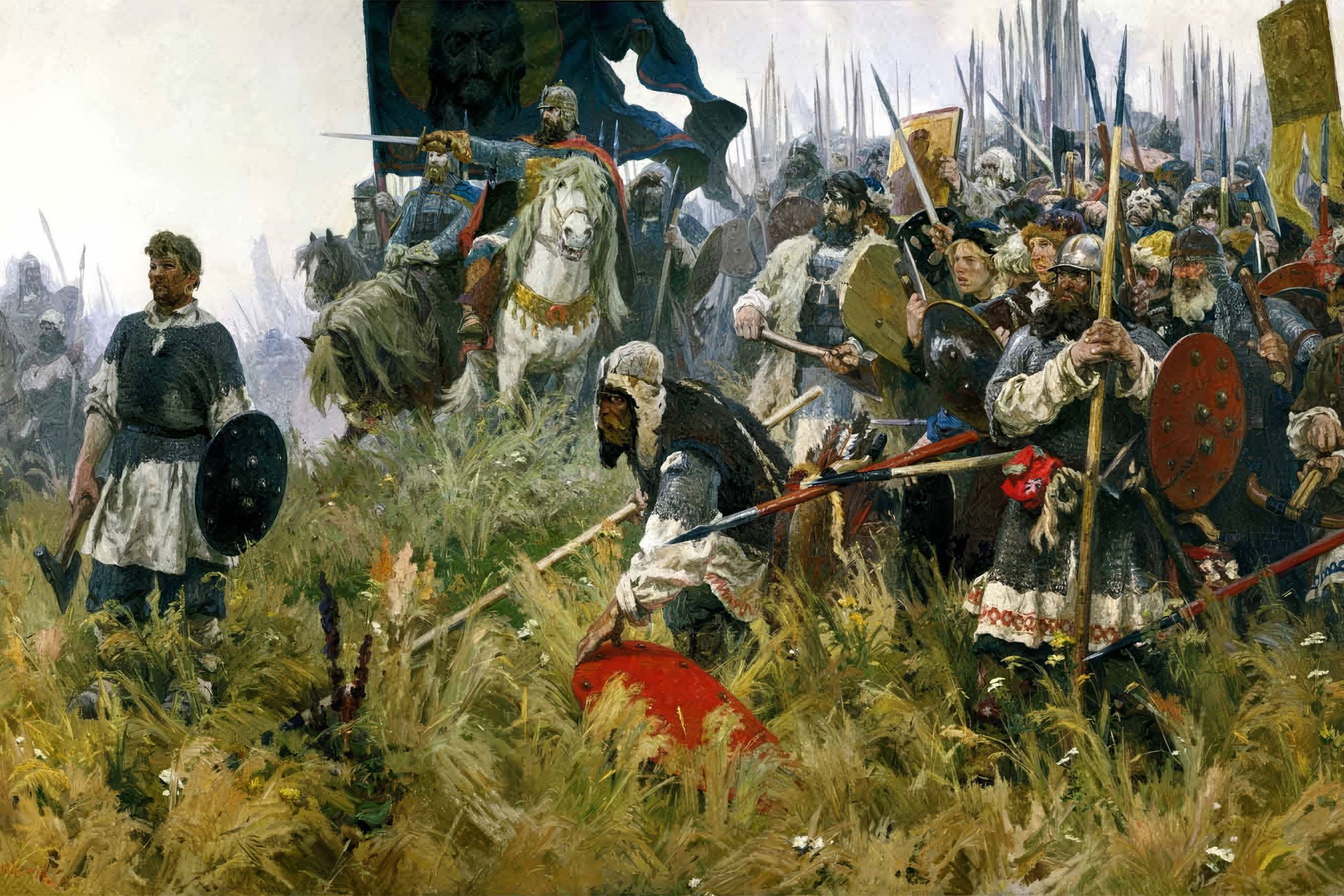
One example of the “Kulikovo myth” in art — Alexander Bubnov's painting “Morning on the Kulikovo Field” (fragment), 1947. With a high degree of probability, the battle was a clash of professional horsemen, and poorly armed foot militia “from the plow” were not present. Image: literaturus.ru
If you were to compile a popular “top 10” or even “top 5” dates from Russian history, the Battle of Kulikovo in 1380 would almost certainly make both lists. Even those who barely passed history in school would confidently recall this medieval battle. Of course: Prince Dmitry defeated the hordes of the Horde Khan, and Rus' almost freed itself from the yoke of the steppe nomads — only a little more pressure was needed. This approach is so familiar that it seems silly even to argue against it.
However, if you keep in mind at least two other dates, the Kulikovo narrative no longer appears unshakable. The end of the Tatar yoke is usually considered to be the standoff on the Ugra River in 1480 — but that happened a whole century after Kulikovo Field. The next significant event in Moscow's history after the 1380 battle was the invasion of Khan Tokhtamysh. In 1382, the Horde not only ravaged Russian lands but also burned their future capital. Agreeably, unpleasant questions arise here: victorious cities do not burn after historical triumphs.
Digging even deeper, it turns out that many of our ideas about the Battle of Kulikovo are constructs created centuries after the victory over the Horde. It emerges that there were no warrior-monks Peresvet and Oslyabya in the Russian army, Prince Dmitry himself was in conflict with the church at the time of the battle, and his clash with part of the Horde was provoked not by patriotism but by a financial dispute. So what was this legendary battle 645 years ago really about?
The adventures of one conflict in the temporal continuum
The Battle of Kulikovo is an episode of medieval history. It is important to remember that it was prepared, fought, and described in primary sources by people with very different perceptions of time, information, material values, and, ultimately, life and death.
Anonymous authors of the chronicles did not aim at a mass audience. Literacy at that time was a privilege of a very narrow circle of people. Therefore, chroniclers wrote for princes, the church elite, and their close associates — recording events dryly so that their records could be used years and decades later as political tools.
Such a brief report was left by an unknown Moscow chronicler as early as the 1380s. Modern science knows it as part of the so-called Moscow-Academic Collection. Later authors referred more to its two extended editions: the Short and the Extensive chronicles about the battle on the Don, written around 1410 and 1425 respectively. These two documents are still factual testimonies, created if not by direct eyewitnesses, then by people personally acquainted with them. There the reader will find neither the thesis of Moscow's sharp rise in power after the battle nor many religious-related narratives that became canonical in the 18th-19th centuries.
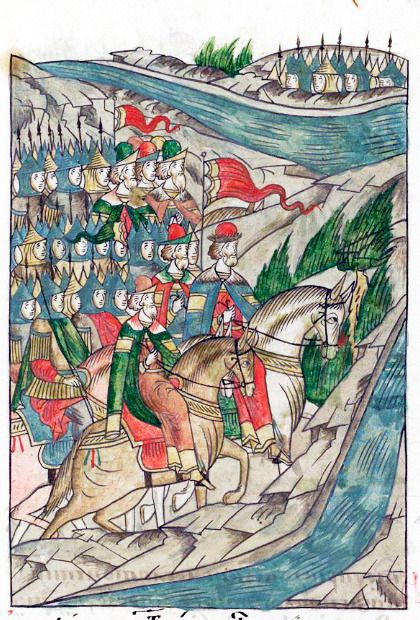
Dmitry Donskoy on the way to Kulikovo Field. Illustrated Chronicle, 16th century. Image: Wikipedia
Medieval literature also knew another genre — epic military tales. Their authors worked more with emotions than facts. The first such work, The Chronicle Tale, was created in Moscow before the end of the 14th century. But even its authors, despite artistic intonations, never mentioned, for example, Prince Dmitry's meeting with Saint Sergius of Radonezh before the battle, the ruler dressing as a common soldier, or the duel of the monk Peresvet with the Horde strongman Chelubey. These plots first appeared in later “Zadonshchina” and especially “The Tale of the Mamai Battle”, written in the 15th-16th centuries with clear involvement of the Orthodox Church.
Over time, “Zadonshchina” and “The Tale” came to be perceived almost as eyewitness accounts of the Battle of Kulikovo, although their anonymous authors lived about 150 years after Prince Dmitry Donskoy. In other words, for them, the battle at the source of the Don was as ancient as the Russo-Turkish War of 1877-1878 is for us. This is noticeable: some editions of the same “Tale” are full of obvious factual errors. For example, the Lithuanian prince named in them is Algirdas, who actually died three years before the Battle of Kulikovo. The Horde leader Mamai is called “tsar” (i.e., khan), although he could not bear this title according to steppe customs. Moreover, the Muslim commander is depicted, apparently for additional notoriety, as a worshiper of ancient Slavic deities.
In other words, the further the 1380 battle receded into the past, the more the descendants “learned” about it. Centuries later, Prince Dmitry began to be called Donskoy, and the battle itself the Battle of Kulikovo (until the 19th century it was usually called the Don Battle or the Mamai Battle). From century to century, the list of heroes grew, unfamiliar details appeared out of nowhere, and the participants’ motivations gained new nuances. Thus, the Moscow state—already united and mighty—created for itself a desired image in the eyes of subjects and neighbors.
Myth 1: Prince Dmitry did not fight against the Golden Horde as such
It seems like a basic question: who commanded the enemy army against Moscow at Kulikovo Field? Many would answer, of course, the Golden Horde Khan Mamai. And this seemingly obvious answer contains two factual mistakes: this man never held the khan title and did not rule the entire Golden Horde.
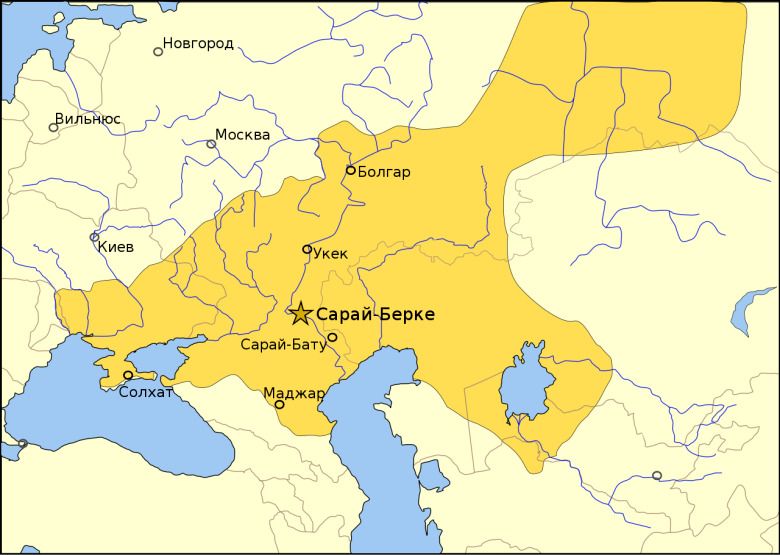
In the mid-14th century, the Golden Horde—also known as Ulus Jochi, the western part of the former Mongol Empire—was experiencing the Great Disorder. Russian chroniclers called the turmoil among their neighbors this name, which led to the partial collapse of their state. Mamai, one of the most successful “warlords,” ruled only part of the Ulus in the 1360s-1370s: the Northern Black Sea region, the Don region, and the Middle Volga. At the same time, the commander was titled simply beklerbek, “prince of princes.” By steppe customs, he could not claim full khan authority because he was not descended from Genghis Khan.
Golden Horde after restoration by Tokhtamysh in the 1380s. Map: Wikipedia / Kirill Borisenko
This nuance was understood not only by the Horde but also by their Russian contemporaries. Chroniclers undoubtedly called Genghisid khans “tsars,” but Mamai was a prince or simply a temnik—that is, leader of a “tyma”, a major military commander. Partially, Mamai solved this problem by finding a puppet Genghisid—a compliant youth named Muhammad Bulak. But the sword of illegitimacy hung over Mamai throughout his political career (spoiler: and this sword would fall at Kulikovo Field).
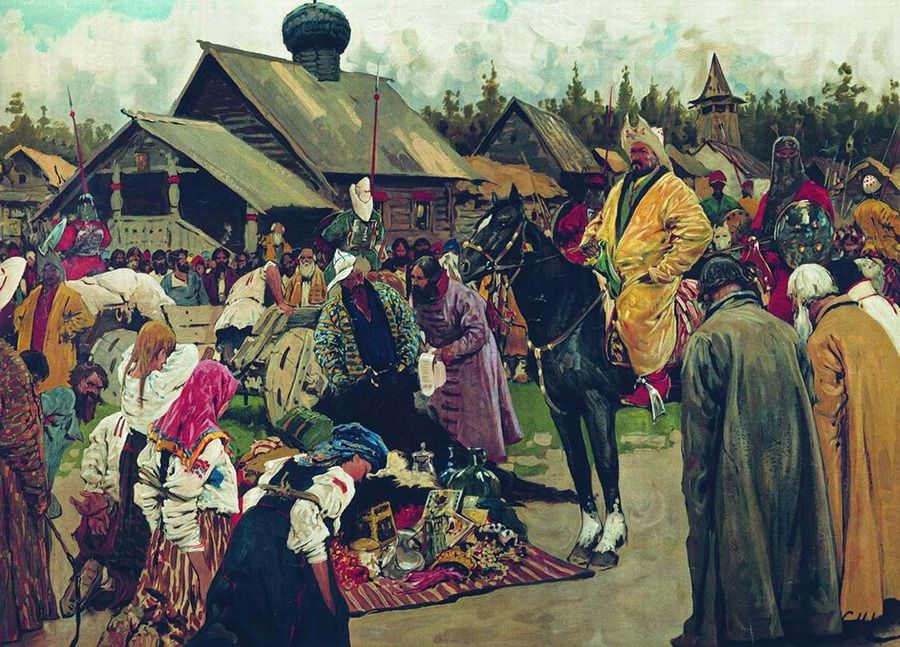
At first, the beklerbek was benevolent toward Moscow. He saw the Russian city as a reliable source of tribute needed for ongoing wars with other steppe nomads. In 1362, the Horde leader himself sent a patent (yarlik) granting the grand princely title to the 12-year-old Prince Dmitry Ivanovich. An unprecedented favor: earlier Russian rulers had to travel personally to the Steppe for the coveted artifact. In 1371, Mamai granted Moscow tax privileges—the tribute became “a ruble from two plows.” According to modern estimates, the payment amounted to about 150-200 kilograms of silver annually—significant but not ruinous for the already wealthy principality.
Horde tax collectors in S.V. Ivanov's painting “Baskaks” (1909). Image: Wikipedia / Museum of the History of Moscow
But by the mid-1370s, relations between Moscow and “Mamai's Horde” soured. Either the beklerbek failed to befriend the growing Dmitry, or the steppe leader feared the future Russian capital and tried to pit it against its sworn enemy, Tver. In 1374, a final “peace agreement” was reached between Mamai and Dmitry, coinciding with bloody conflicts both in the Steppe and Russian principalities. Everyone fought everyone: intrigues, robberies, and betrayals without long-term strategy.
The fate of Nizhny Novgorod is telling. In 1375, for unclear reasons, an envoy from Mamai was killed there along with his entire delegation. In retaliation, the beklerbek stormed and burned the city on the Volga, then friendly to Moscow. Former allies were relentlessly turning into enemies.
Myth #2. At Kulikovo Field they fought for independence from the steppe invaders
As academic historians noted at the end of the 20th century (for example, Anton Gorsky), the immediate unification of Russian lands and a break with the Horde were never political programs of Dmitry Ivanovich. The necessary conditions for this had not yet formed in the late 14th century. Only one document is known where the prince simply admitted the possibility of Moscow's independence from the khans—his will, written in the 1380s. “And God will change the Horde, my children will no longer pay tribute to the Horde, and whichever of my sons takes tribute in his domain, it will be his.
Meanwhile, Dmitry actively worked on an alliance of principalities around Moscow; however, still in tactical, not strategic, interests. It was about mutual assistance amid the “peace agreement” with the Horde. In 1374, the prince successfully held a princely congress in Pereslavl-Zalessky. As a result, he created a kind of “league” of several neighboring states—mostly third-rate appanage principalities like Tarusa or Pronsk.
In 1376, allied troops raided Volga Bulgaria, under Mamai's control (modern Tatarstan). This “Pereslavl League” directly challenged the beklerbek, who then sent Murza Begich's troops against the Russians. The decisive battle took place on August 11, 1378, on the Vozha River (modern Rybnovsky District, Ryazan Oblast). Dmitry Ivanovich took a favorable position on the bank in advance, awaited Begich’s main forces, and suddenly struck the nomads as they crossed the river. The battle quickly turned into a massacre of Mamai’s punitive forces.
Battle on the Vozha River: it is visible that the Russians threw the surprised enemy into the water. Illustrated Chronicle, 16th century. Image: Wikipedia
The failure at Vozha severely weakened the beklerbek’s position. By the late 1370s, he was already losing the war for the Great Steppe to the legitimate Khan Tokhtamysh, and now his richest domain was being plundered by his own tributaries with impunity. Mamai proposed Dmitry to resolve the brewing conflict through compensation: pay the arrears on the “tribute.” The Moscow prince was fundamentally not opposed. Disagreements arose over the specific amount, which Russian chroniclers wrote about explicitly.
And Mamai began sending envoys to Prince Dmitry, asking for tribute as it was paid under Tsar Janibek, not according to their agreement. And the pious prince, to avoid bloodshed, wanted to pay such tribute as Christians could, and according to his treaty with Mamai [in 1371]. But Mamai, prideful, refused.
- Extensive Chronicle of 1425
The “times of Tsar Janibek” meant the mid-14th century. Then the balance of power was clearly in favor of the Steppe, and Russians obediently paid two to three times more than they did by 1380. Dmitry clearly hinted that Janibek had long died, and Mamai was no khan and should be more moderate. But the steppe leader could no longer afford discounts or compromises: it turned out he would have to take what was due by force.
Myth #3. The Battle of Kulikovo was sacred: Russians fought for their faith
Undoubtedly, in the 14th century, when almost all inhabitants were practicing believers, any military or political action in Rus' was simultaneously “Orthodox.” But in the specific case of the Don battle, the religious component should not be exaggerated. Primarily due to the questionable—by the church's standards—status of Prince Dmitry himself.
At the time of the battle, Prince Dmitry Ivanovich was in open conflict with the ecclesiastical authorities. In the winter of 1378, Metropolitan Alexius—titularly of Kiev and de facto of Moscow—died. The natural question of succession arose. At that time, there was no independent Russian Orthodox Church, and Russian primates were confirmed by Constantinople. In the summer of 1378, Metropolitan Cyprian, appointed by the Greeks, arrived in Moscow. But Dmitry Ivanovich was not pleased with the “Varangian” (more precisely, an ethnic Bulgarian)—the ruler saw his own protégé as Alexius’s successor.
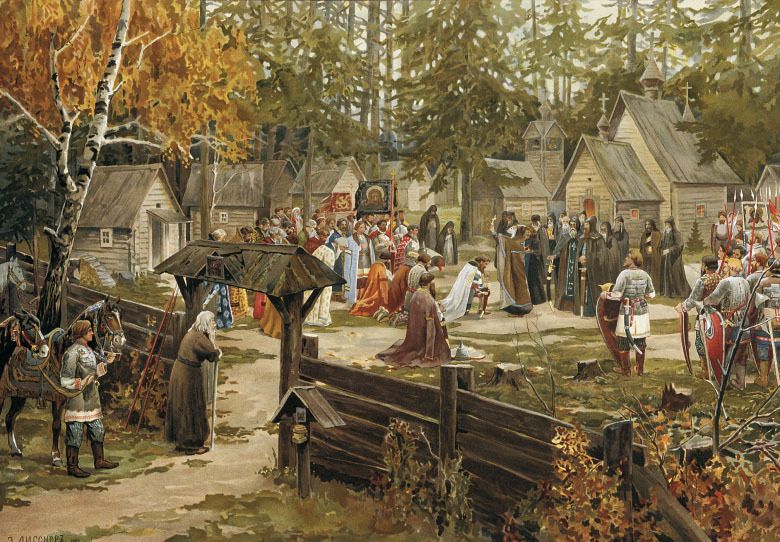
“Sergius of Radonezh blesses Dmitry Donskoy before the Battle of Kulikovo” (Ernst Lissner, 1907). Most likely, this meeting actually took place not in 1380 but in 1378. Image: Wikipedia
The prince decided to remove the obstacle by force. His servants beat Cyprian’s retinue and robbed and expelled the hierarch from the capital. However, the Bulgarian was no coward. He did not abandon his claims to his lawful position and excommunicated in writing all involved in his misfortunes. Yes, later Cyprian reconciled with Dmitry and lifted his previous sanctions. But this happened no earlier than spring 1381, when the metropolitan was finally received in Moscow with full ceremony (and the prince did not cease intrigues against the Bulgarian until his death in 1389).
It is still unclear in what exact status Dmitry stood from the church’s point of view in 1380. Presumably, Cyprian could have anathematized him, i.e., fully excommunicated from all rites and sacraments (a civil death by medieval standards), though not all historians agree with this interpretation. In any case, at the time of the Battle of Kulikovo, the prince was openly at odds with Cyprian. It is doubtful that the abbot of the Trinity Monastery, Sergius—the future Saint Sergius of Radonezh—was eager to honor a ruler who publicly humiliated the lawful metropolitan.
The authors of the Short Chronicle did not detail the church’s assistance to Dmitry. The creators of the Extensive Chronicle only mentioned a letter by which the commander was blessed in absentia by Abbot Sergius. In 15th-16th century sources, this document turned into a personal meeting between the prince and the abbot. A compromise theory suggests that the authors “synthesized” the Battle of Kulikovo with the battles on the Vozha River. Primary sources confirm Sergius’s rendezvous with Dmitry before the successful 1378 campaign; possibly, over time, the more famous Kulikovo Field historiographically “took” this detail from Vozha.
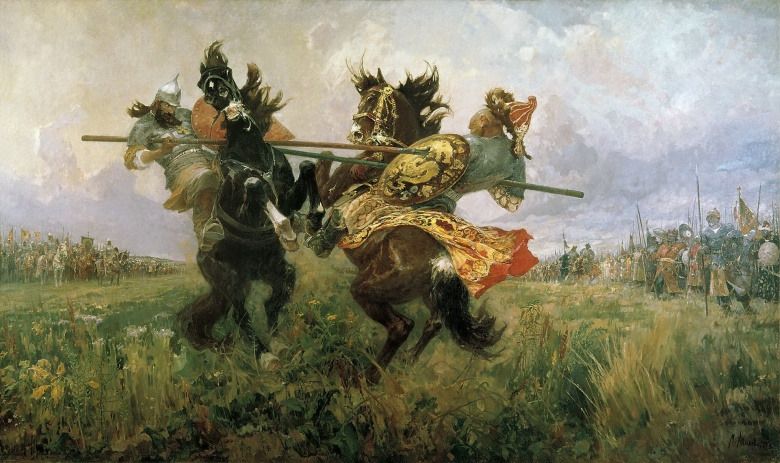
Duel of Peresvet with Chelubey on Kulikovo Field (Mikhail Avilov, 1943). Such a duel was hardly possible in reality. Image: Wikipedia
But another plot related to Sergius causes much more bewilderment. By the early 16th century, it became widely accepted that the abbot not only blessed Dmitry for battle but also reinforced his army with two of his monks, Rodion Oslyabya and Alexander Peresvet. According to the established narrative, both heroically died in the battle, the latter in a personal duel with the formidable Horde warrior Chelubey. Early chronicles only mentioned the former Bryansk boyar Peresvet among other prominent aristocrats fallen in battle. They said nothing about his comrade Oslyabya. Interestingly, Rodion Oslyabya appears alive in Moscow chronicles in the description of an embassy to Constantinople in 1389.
Thus, the story of fighting monks in Dmitry’s army is most likely a late author invention. After all, church canons strictly prohibited monks and clergy from bearing arms and participating in wars. It is also unclear why two of Sergius’s brethren, who were supposed to spend their time in prayer and peaceful work, would appeal to the prince’s retinue—warfare in that era was for professionals.
Myth #4. Tens of thousands of warriors fought on both sides at Kulikovo Field
False ideas about the scale of the battle are the “merit” of 19th-century classical historians like Vasily Solovyov or Vasily Klyuchevsky. Growing up in the era of modern wars, these scholars apparently could not imagine a decisive battle involving thousands, not tens or hundreds of thousands, of participants. Therefore, they accepted without sufficient skepticism estimates from “Zadonshchina” or “The Tale,” which were literary exaggerations.
The first to “reduce” the size of the armies at the Don battle was historian Stepan Veselovsky in the early 1900s. Citing primary sources, analysis of contemporary battles similar to Kulikovo Field, and feudal law, he argued that no more than 6,000-7,000 warriors fought on each side. There is nothing shameful in this: in medieval realities, few states could muster armies larger than 10-12 thousand. It required a significant population and time to find allies and hire mercenaries.
And Dmitry had little time in the summer of 1380. Realizing Mamai was heading to Moscow, the prince quickly gathered his own and allied forces. Within a few months, he assembled an army from Muscovites, allies from the “Pereslavl League,” people loyal to Lithuanian princes Andrey and Dmitry Olgerdovich, and regiments from distant Pskov and Novgorod. They formed the 6,000-7,000 warriors on the Russian side.
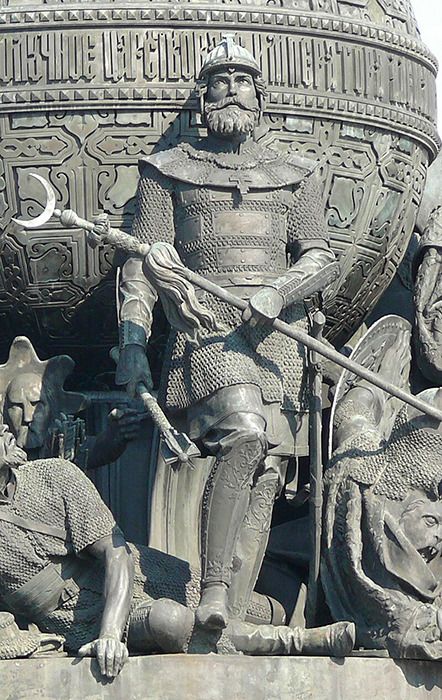
Dmitry Donskoy on the “Millennium of Russia” monument in Veliky Novgorod. Photo: Wikipedia / Dar Veter
The resulting army was culturally homogeneous, though one interesting nuance should be noted. Chronicles from 1408 and 1425 mention among the fallen boyars Andrey Serkizov and Semyon Melik—people with Orthodox names but clearly non-Slavic nicknames. They most likely originated from the Horde but later entered Moscow service and were baptized, receiving new names. And when the moment came, the newly baptized Andrey and Semyon fought against their former tribesmen. Tribesmen—and their diverse allies:
Horde prince Mamai came with his like-minded and all other Horde princes, and with all Tatar and Polovtsian troops, and also hired detachments of infidels and Armenians, and Phrygians, Cherkess, Yas, and Burtas
- Extensive Chronicle 1425
In other words, Mamai hired representatives of various Turkic ethnic groups, Caucasus natives, and even Western Europeans (“Phrygians”) living in Genoese colonies in Crimea. The beklerbek’s army could have been even more diverse. Lithuanian prince Jogaila and Ryazan prince Oleg promised support to the Horde simultaneously. But both either did not arrive or did not want to; possibly, Jogaila and Oleg waited to join the guaranteed winner. So Mamai had to make do with his own people and mercenaries—forces comparable in number to the opponent.
The battle itself was a classic clash of two cavalry armies. Yes, Dmitry’s army was mounted no less than the nomadic Horde, as emphasized by modern researchers like archaeologist Oleg Dvurechensky. The Moscow prince acted preemptively and blocked the Horde’s northern advance at the confluence of the Don and Nepryadva rivers (modern Kimovsky District, Tula Oblast). According to paleobotanical data, forests with several small fields stood here at the end of the 14th century. On one of these fields, between the modern villages of Khvorostyanka and Monastyrshchina, the opposing forces met. The probable battle front corresponded to the number of warriors—not more than 2.5 square kilometers.
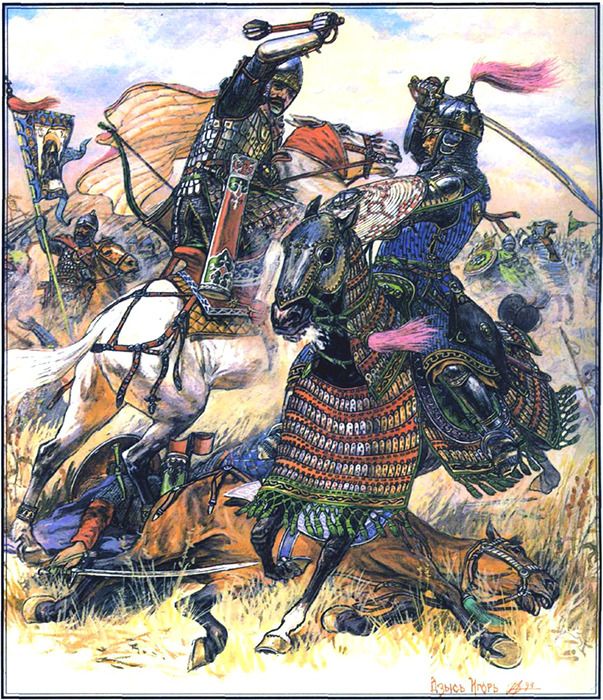
Clash of a Russian (left) horseman with a Horde opponent in a modern reconstruction by Igor Dzys. Image: swordmaster.org
The battle lasted no more than a couple of hours and consisted of a series of mounted skirmishes. At some point, the Russians seemed to falter: the left flank suddenly retreated. The rejoicing Horde and mercenaries rushed after the retreating forces but fell into a trap set by the ambush regiment of Prince Dmitry Bobrok-Volynsky, one of the Lithuanian aristocrats who entered Moscow service. The startled steppe warriors fled, and apparently Muhammad Bulak—the puppet Genghisid under whose name Mamai ruled—died at the same moment. His death only worsened the panic in the beklerbek’s army; the retreat quickly turned into a rout, and the emboldened Russian horsemen, in the chroniclers’ words, “cut the filthy without mercy.” The clash ended with a clear victory for the Moscow prince.
Here, we must recall another classic Kulikovo myth that appeared in the 15th-16th centuries. Allegedly, Dmitry Ivanovich ordered his close boyar Mikhail Brenok to wear the prince’s armor and take command before the battle. The prince himself decided to fight “incognito” as an ordinary warrior. After the victory, servants barely found their lord lifeless among the corpses, while Brenok, playing Dmitry’s role, heroically died.
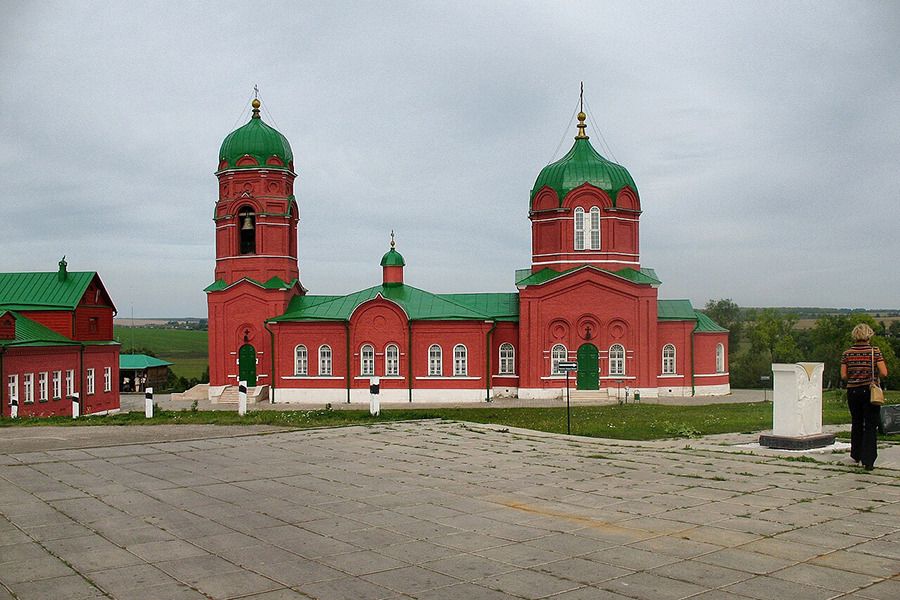
Church of the Nativity of the Blessed Virgin in the village of Monastyrshchina near the battle site—according to legend, the battle fell on the date of this holiday, September 8 (21 by the new style). Image: Wikipedia / Dar Veter Alexxx1979
Of course, this story is an outright fiction, contradicting basic military ethics. It seems especially strange in the medieval context when a commander had to be visibly present under his banner. People fought for a specific leader, and news of his death could destroy morale even in a winning army. Dmitry, as shown by the experiences at Vozha and Kulikovo, defeated enemies not by ferocity but by clever tactical maneuvers.
Myth #5. After Kulikovo Field, Moscow’s unification of Russian principalities became inevitable
The main Kulikovo-era myth should be recognized as the thesis put forward in the 20th century by Eurasianist Lev Gumilev: “At Kulikovo Field came Muscovites, Serpukhovites, Rostovites, Belozersk residents, Smolensk residents, Murom residents, and so on, and from it they left as Russians.” Undoubtedly, this is a beautiful formulation but has little to do with reality.
Yes, in the first couple of years after the battle, Dmitry managed to impose his authority on rebellious princes. In 1381, Oleg of Ryazan, who had previously winked at the Horde, submissively recognized himself as “the younger brother” of his Moscow colleague. But an important outcome of Kulikovo Field was also that pro-Moscow troops crushed the main intra-Horde rebel: Mamai was killed in 1380, and his “separatist Horde” disintegrated. Unity in Ulus Jochi was restored, and the legitimate Khan Tokhtamysh decided to close the issue of Moscow’s unpaid tribute.
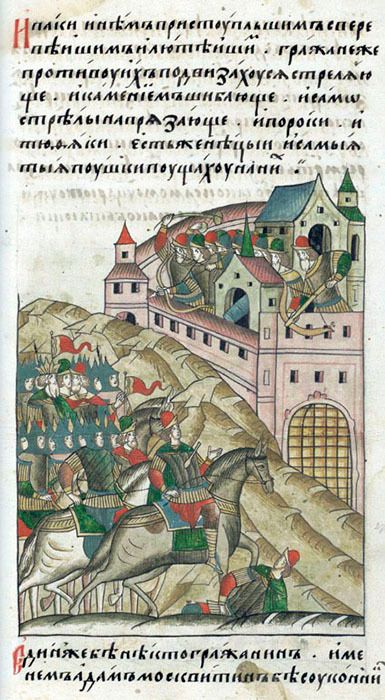
Siege of Moscow by Khan Tokhtamysh. Illustrated Chronicle, 16th century. Image: Wikipedia
Dmitry Ivanovich either missed or underestimated this moment. He evaded transactions with Tokhtamysh but did not prepare for a clash with him. As a result, in August 1382, the khan’s troops passed through Russian lands to Moscow without resistance. Other principalities passively watched the campaign of the legitimate “tsar,” and Dmitry himself fled to Kostroma under the pretext of gathering troops. From August 23-26, 1382, the Horde raid ended with widespread looting and burning of the future capital. Soon, the prince, having returned to Moscow, submissively paid the accumulated arrears to the victors.
Yes, Tokhtamysh left the defeated a patent for the grand princely title and later allowed Dmitry to pass the artifact to his son Vasily by inheritance. But the 1382 fiasco significantly undermined Moscow's authority among other principalities. Oleg of Ryazan returned to independent politics. In 1385, this ruler captured Moscow’s Kolomna and defeated reinforcements from the capital in the now little-remembered Battle of Perebitsk. And after that, how can one seriously claim that “after the Kulikovo victory, Moscow’s leadership as the center of Russian lands was never questioned again”?
These doubts would only finally dissipate in the mid-15th century after the Dynastic War between Dmitry’s descendants. Then the elder branch of Moscow’s Rurikids (the so-called centralizers) would finally prevail over the younger branch (the so-called federalists), supported by non-Moscow principalities, after 28 years of internecine strife. And only Ivan III the Great—the great-grandson of Dmitry Donskoy—would finally unify the East Russian lands and crush the remnants of the Horde.
So, to argue that the Battle of Kulikovo predetermined the entire subsequent course of Russian history is as strange as to claim that, for example, the overthrow of the Romanovs became inevitable after the Decembrist uprising.
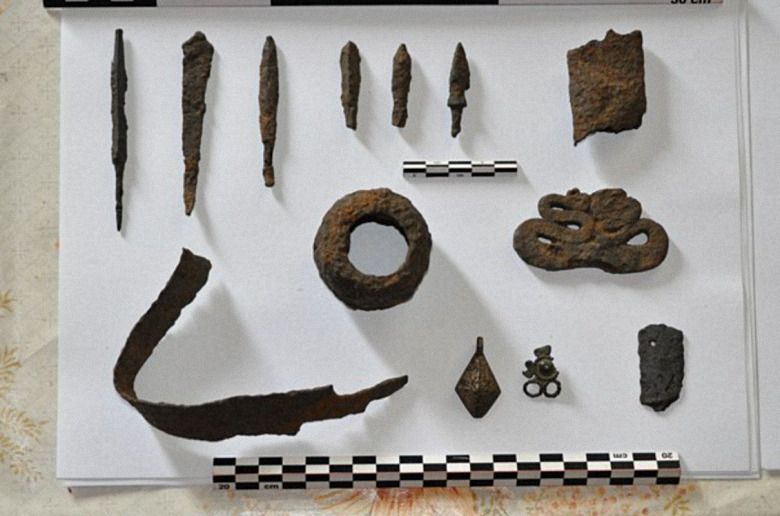
Elements of weapons, clothing, and household items from the 14th century found on Kulikovo Field in 2013. Photo: taii-liira.livejournal.com
At the same time, it is important not to fall into the opposite extreme and claim that the Battle of Kulikovo was a local skirmish or even entirely invented by Moscow court historians. What kind of battle is it if archaeologists now find only rubbish like flints, pectoral cross plates, or chainmail fragments? But it could not have been otherwise after a medieval battle—the victorious armies were always given several days for looting. Moreover, not only for profit: returning the weapons and equipment of fallen comrades to their families was considered a sacred duty of the survivors.
In the pre-industrial era, any more or less intact metal object (even a knife or an axe) represented enormous value. And the idea of leaving swords, helmets, or chainmail to rust in the field never occurred to a medieval person. After all, people who lived and fought in that era had a very different worldview—and it is important to remember this now as we try to understand the logic and motivation of our distant ancestors.
If you enjoyed this article, consider making a donation — one-time or, even better, monthly. Your support helps us motivate our authors and become better with every article.
Our organization is recognized by the Internal Revenue Service (IRS) as a 501(c)(3) tax-exempt, charitable organization, which means that all contributions made to us are tax-deductible to the fullest extent permitted by U.S. law. Individuals may generally deduct charitable contributions of up to 60% of their Adjusted Gross Income (AGI) for cash donations made to qualifying 501(c)(3) organizations. For donations of appreciated assets (such as stocks or other long-term capital assets), the deduction is typically limited to 30% of AGI, based on the fair market value of the asset. C-corporations may deduct charitable contributions of up to 10% of their taxable income for donations made to eligible charitable organizations.
By submitting a donation, you confirm that you have read and accept the following documents: Privacy Policy and User Agreement, and also give consent to the processing of your personal data.
If you would like to unsubscribe from a monthly donation, please email us at: [email protected]