Two autocrats – and Chairman Xi – talked last week in Beijing about the perception of age (at 70, still boys) and eternal life, which will soon become possible thanks to organ transplants; in any case, living to 150 is not a problem at all. However, in the Russian case, the Constitution will have to be changed once again so that the presidential terms of the current head of state are not limited to 2036 but extend much further in time. But that is definitely not a problem.
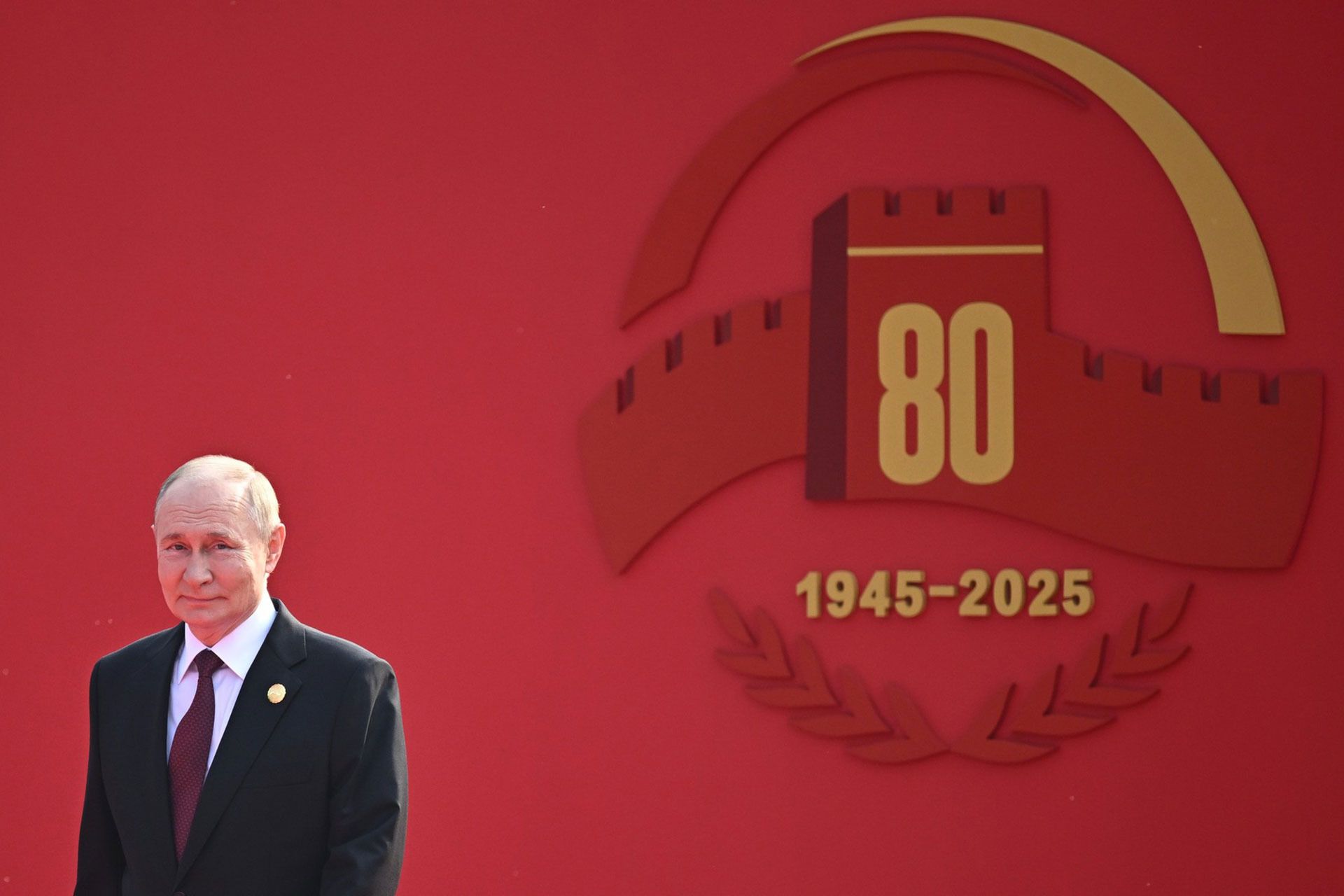
Before the military parade in Beijing on the occasion of the 80th anniversary of the end of World War II. September 3, 2025. Photo: kremlin.ru
“And those who survive will later laugh themselves”
Viktor Chernomyrdin
Thoughts about eternal life are a consequence of the prolonged rule of a personalist and autocratic type leader. This is one of the few things that generally interest such regime leaders. Hence the rumors that somewhere in laboratories “mitochondria are being stretched” (whatever that means) and work is underway to transform the current gerontocracy (which is already a fact if you look at the age characteristics of Putin's Politburo, almost matching Brezhnev's or Andropov's) into an eternocracy. Into the power of the eternal. Into a group of people ruling even longer than Stalin, Salazar, or Franco.
It should be noted that the battle in biolabs for extending political powers and biological rejuvenation does not cause autocrats of all times and peoples to doubt that everyone else, especially young people, must give their lives for them.
This is well reflected in various marching songs. For example, the White Guard song “Boldly we will go into battle / For Holy Rus' / And, as one, we will shed / Young blood!” was borrowed by the Bolsheviks for the Red Army and, by reverse engineering, the words were adjusted: “Boldly we will go into battle / For Soviet power, / And as one we will die / Fighting for it.” “It,” whoever it was, at that time was concerned with personal security and prolonging its life path.
Like, for example, Caudillo Franco, who lived long, went fishing, watched Real Madrid matches on TV, and did not work too actively with documents. It ended with his entourage and doctors tormenting the tyrant’s physical body by refusing to disconnect him from the relevant equipment, and only the insistent demand of his daughter, who took pity on her father, who exclaimed: “How painful it is to die!”, led to Franco’s merciful death.
No less characteristic is the fate of Salazar, who received a special issue of his favorite newspaper and did not know that he was already disconnected—not from equipment, but from the apparatus of power. The march of Spanish legionnaires reflected the attitude towards the young: it was called “Grooms of Death.” Instead of a wedding for life, young people with brainwashed minds had chances for a necrophilic marriage for death for the leader. Stalin was also imagined as an evergreen entity. But back then, no one knew about “mitochondria,” although he spent a lot of time in a pleasant subtropical climate. As a result, as Ilya Ehrenburg wrote: “And we have long forgotten that Stalin is a man; he turned into an almighty and mysterious god. And here the god died from a brain hemorrhage. It seemed incredible.”
The rest, as already mentioned, can successfully depart to the other world. The average life expectancy in Russia in 2023 was 73.4 years (less than 70 for men); for comparison: in Sweden – 83.3 years. So longevity, first of all, is a privilege of a special, very narrow layer. Secondly, now, due to closures, and in some places the lack or difficulty of obtaining statistics, we are unlikely to reliably find out what is happening with mortality structure among young and middle-aged groups.
Perhaps indeed more people now feel like “boys” at 70, but boys still have to live to that age. Very specific processes are happening today in a conflicted world.
Recently, one of the gerontologists stated that by 2035, i.e., by the possible moment of another extension of the leader's powers, life expectancy in Russia will reach 80 years. It was not said by what statistical manipulations this is possible. And how many such promises have we heard over the last 25 years about achieving certain indicators – both in May decrees and state programs – yet the situation does not improve.
One of the known ways to improve is a sharp increase in healthcare spending. But politically, this is impossible in the coming years. So gerontologists can be equated with fantasists and utopians. More precisely, dystopians if you consider the real state of affairs in the country, where doctors' functions are often performed by paramedics.
Decades-long expectations of demographic improvements, which are also conditioned by some historical trends, as well as the general formation of the image of a happy future that is just about to come but never arrives, are described by the metaphor of Samuel Beckett’s play “Waiting for Godot.” They wait for him, but he does not come; doubts even arise whether he should be waited for in that place. Such are the relations of Russians with the future.
The result: downward adaptation as a response to all troubles and shrinking space of freedoms, not even political but everyday ones. Didn’t live well – maybe tomorrow we will. Needed medicines disappeared – we will look for them. Falling into depression – there are antidepressants. Voice communication in favorite messengers cut off – it’s necessary, the state knows better, we will find other means of communication. Gasoline prices rose, shortages began – no problem, we have stood in worse lines. It’s unclear why we endure all this? They say for victory. Sooner or later, at the next turn of the vicious circle, we will have to come to the same conclusion as at the end of the 1980s: “According to new intelligence data, we were fighting ourselves.”
Life is like this – without attempts to think about the reasons for what is happening, ready to accept external circumstances as unchangeable, quietly existing in a near-zero state. With near-zero empathy, near-zero desires, near-zero reflection. This is how both subjects and the authorities live.
And to prevent any thoughts from coming to mind, there is propaganda, uniform textbooks, uniform archaic rituals. TV series feeding exclusively on the juices of the past, because this era cannot create anything of its own – this is not even import substitution (which has been sufficient in entertainment and distraction sectors), but time substitution: “Moscow does not believe in tears. Everything is just beginning.” But everything ended long ago!
Imitations of joy, marches through a Moscow that does not believe in tears – more than a dozen over the summer along the Garden Ring. This Sunday, a procession led by the Patriarch took place from the Cathedral of Christ the Savior to the Novodevichy Convent. And not at all to, as in the immortal film “Pokrovsky Gates,” “look at the frescoes.” But to compensate for this eternal near-zero with a feeling of their own spiritual superiority over others.
Everything grows out of conflict, resentment, from this hopeless “but.” Everything to the rupture of the aorta, hatred of strangers, tearing the telnyashka not on the chest where “Stalin’s profile is on the left chest,” but on the right, not “Marinka en face,” but Putin.
We try to measure this near-zero time (even the weather has become like this in the homeland) in old terms, that is, in minutes, days, weeks, months, but in these three and a half years time has merged. It turned into some endless heavy gloomy day.
Everything is like in the famous dialogue from “Beware of the Car!”: “When will all this end?” – “Never. What do you mean?” We mean these 150 years according to Chairman Xi. Today's autocrats are not satisfied with power; they want to be masters of time while canceling the future.
If you enjoyed this article, consider making a donation — one-time or, even better, monthly. Your support helps us motivate our authors and become better with every article.
Our organization is recognized by the Internal Revenue Service (IRS) as a 501(c)(3) tax-exempt, charitable organization, which means that all contributions made to us are tax-deductible to the fullest extent permitted by U.S. law. Individuals may generally deduct charitable contributions of up to 60% of their Adjusted Gross Income (AGI) for cash donations made to qualifying 501(c)(3) organizations. For donations of appreciated assets (such as stocks or other long-term capital assets), the deduction is typically limited to 30% of AGI, based on the fair market value of the asset. C-corporations may deduct charitable contributions of up to 10% of their taxable income for donations made to eligible charitable organizations.
By submitting a donation, you confirm that you have read and accept the following documents: Privacy Policy and User Agreement, and also give consent to the processing of your personal data.
If you would like to unsubscribe from a monthly donation, please email us at: [email protected]