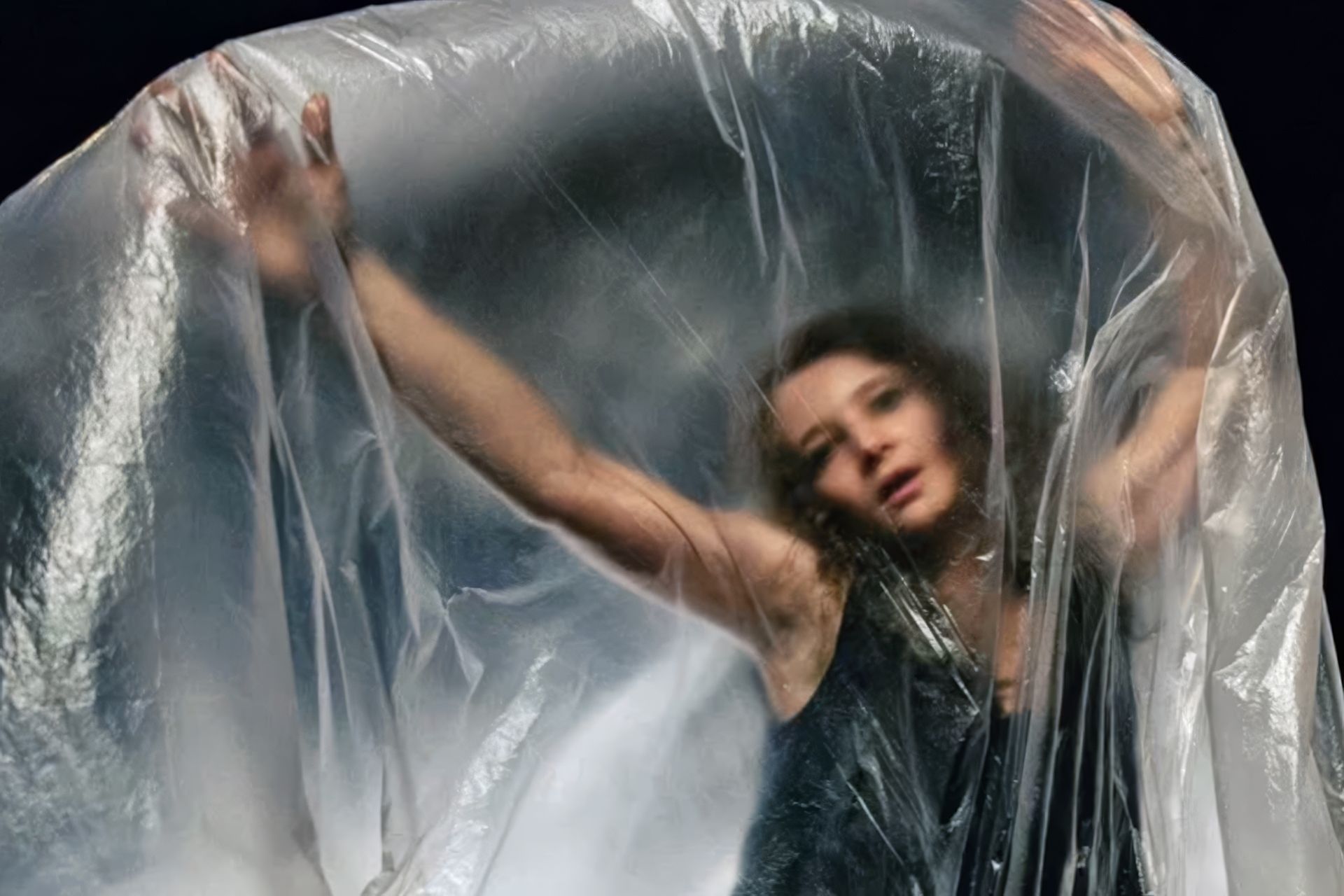
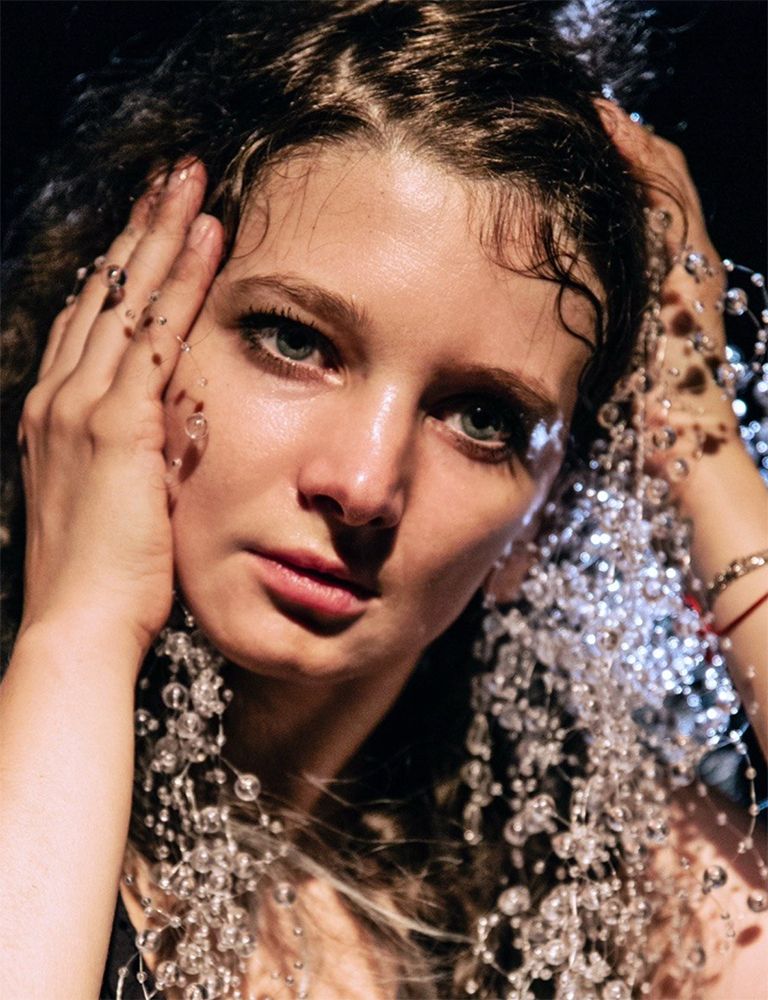
Ester Bol is a legend of the contemporary Russian-speaking stage. She has written more than twenty plays, translated into several languages; before the Russian invasion of Ukraine, they were staged in major and small theaters across Russia, with leading actors and avant-garde directors of every kind eager to work on them. Back then, she was called Asya Voloshina. In the winter of 2022, she publicly condemned the war, withdrew all her texts from the repertoire, and refused royalties in Russia — for which she received all the state-sanctioned curses, persecution, and restrictions on her rights. In exile, she adopted a new name and a new identity — and started life and her career from scratch.
Photo: Porte 9 via Instagram
In France, Ester Bol published Crime #alwaysarmUkraine and “Infrared” (with the publisher Espace d’uninstant), but these texts were originally written in Russian and partly in Ukrainian, and translated by the brilliant theater and film expert Gilles Morel. Nue is Ester’s first experience in a new genre, a new medium, and a new language. In the space of Porte 9 in the Paris suburb of Montreuil, she tries to do what she has never done before: embody with her own body the theater that until now has existed for her primarily in words.
At the beginning, she very clearly and simply explains in the first person the story of the text “Don Quixote — the Author of Dulcinea”. It was written for director Yuri Butusov about ten years ago and was waiting for its moment, but Butusov drowned in Sozopol in the summer of 2025, carried away by the Black Sea undertow. Nue is an attempt to bring Dulcinea out of the play, give her flesh and blood, and stop making her wait.
“I will speak to you — as everyone does — about myself”, Dulcinea says. In the play, she settles accounts with her creator — a man, a knight, the author of her existence. He invented her, sculpted her, and abandoned her, setting off to perform feats so as never to return. Dulcinea was created to wait forever. The imaginary Don Quixote seeks death because the world does not match his notions of beauty and justice. But what happens to the heroine when her author dies?
On stage, Ester Bol herself is there with a microphone, a few objects, transparent film, dishes, some vessels of water, a cave made of foil. Ester spreads cellophane on the table, turning it now into a wedding dress, now into a burial shroud. Venus is born from a transparent cellophane shell. In another episode, she dances with iron plates as if they were shields, puts on beads and sequins as if they were armor. Simple objects form an entire system of transformations: what served as a shell becomes a body, what promised a wedding begins to resemble a funeral. Birth and death here are not opposites, but two states of the same matter. Butusov is present here not just as the addressee of a dedication, but as an absent coauthor of the stage language. Ester simultaneously inherits from him, argues with him, and tries to leave his theater.
How they worked together
Many years ago, I first heard about Asya Voloshina — that was what Ester was called in Russia before the war — from the mother of my close friend, an actress at the Moscow Art Theater. She said it quite matter-of-factly: “A girl has joined our theater, and she’s a genius”. This impression was clearly shared by Butusov, with whom my friend’s mother worked on Ivanov.
Later, he read Voloshina’s one-woman play “Mother” from the stage of the Lensovet Theater: a fifty-year-old man delivered, in the first person, the monologue of a young woman who had survived rape and lost her mother early. Before dying, the mother left her daughter letters for every birthday — up to the age she herself never reached. Critic Elizaveta Avdoshina classifies Ester Bol’s early texts as drama of the new symbolism, characteristic of Natalya Skorokhod’s St. Petersburg workshop. This is theater not so much of action as of reflected consciousness, nonlinear composition, absurdity, and complex symbolic constructions. In it, women talk a lot, trying to understand what is happening to them.
Butusov valued in her texts “freedom, serious human vulnerability”, “pain for the world“. In a thoroughly masculine, militarizing culture, he said: ”Of course, right now we are living in many ways in a female time, and truth is found not in man, but in woman“.
The director did not often appear on the stage of his own productions, but every time he did, it became an event. In the finale of his five-hour Seagull, he danced — and, as journalist Elena Smorodinova recalled, it was a dance “about those who have loved at least once in their lives and suffered at least once in their lives“, about people capable of ”noticing a cloud that looks like a grand piano“.
Excerpt from Yuri Butusov’s production “The Seagull”. Video by the Satirikon Theater
The biggest and probably most important collaboration between Voloshina and Butusov was The Man from Fish, a multi-character production on the main stage of the Moscow Art Theater. “There was and will be no greater happiness in my life”, Ester wrote recently, posting a video recording. It is said that she conceived the play under the impression of Butusov’s Running. The relationship between playwright and director was from the outset not quite the usual one, where one writes and the other stages. Butusov’s theater itself became a source of Voloshina’s dramaturgy, and her texts, in turn, gave him material for developing his own stage language.
Yuri Butusov turned the one-act The Man from Fish into a four-hour visual meditation. The action takes place in a St. Petersburg communal apartment on Karavannaya Street, inhabited by fragile, refined alcoholics, pessimists, and bead players. The apartment owner abandoned her philological ambitions and earns money through real estate services to build a new life for herself and her eight-year-old daughter. She rents rooms to former classmates and to a Frenchman who has come to study architecture. All the dialogues are ironically literary: every character has a novel or dissertation in their past. Butusov plays along with Voloshina: from Dostoevsky and Nabokov to Tarkovsky and David Lynch, literary nods and visual quotations weave into the elegant fabric of “repost-modernism”. But behind this intellectual carnival lies a story about the impossibility of preventing catastrophe.
Smart, sensitive, wonderfully educated people, capable of endlessly discussing literature and history, turn out to be completely powerless in the face of the most concrete injustice: the child welfare authorities, like that same terrible “man from fish”, take away the heroine’s daughter. Everyone adores her, but the child remains somewhere beyond the stage while the adults complain, drink, smoke, dance, tell refined jokes, and do nothing to prevent the catastrophe. This is a story about a generation that loses its country but is unable to protect even one child. And at the same time, it is a play about the impossibility of being a happy woman under conditions of patriarchal, intergenerational trauma and tightening screws.
Full video recording of the preview performance of “The Man from Fish”, Chekhov Moscow Art Theater, summer 2018
Ester Bol has always known how to write female monologues. Piercing, sincere, broken ones, in which a woman tries to speak her own life aloud. One such monologue in The Man from Fish was performed by Elizaveta Yankovskaya — an actress whom this production largely brought to light. And when Ester now includes it in Nue and performs it herself, she brings to the small Paris stage the whole trail of forgotten Moscow context from which she has so carefully tried to distance herself in recent years.
Another large-scale production by Butusov and Bol was created already in exile. In 2024, for the Mikhail Chekhov Riga Russian Theatre, Bol wrote “Gogol. Portrait”, a genre she herself defines as “a play for Yuri Butusov”. The production’s scenography was created by Marius Nekrošius. Here, Gogol’s novella is idiosyncratically supplemented by Van Gogh’s letters to his brother, texts by Proust, Orwell, Leonid Andreyev, and Andrei Bely, allusions to Oscar Wilde’s The Picture of Dorian Gray and The Bottle Imp by Robert Louis Stevenson. If “Mother” was a dialogue with documentary theater and the aesthetics of Teatr.doc, then “Portrait” is probably arguing with postdrama. And once again the playwright and the director are constantly tossing the ball back and forth, adding, rewriting, changing the course of events. According to the plot, the artist succumbs to the temptations of money, fame, and power. In old age he is haunted by ghosts of the unrealized, and a new artist is already laying claim to his place, ready to sell his soul to the devil: the story of betrayal of one’s own gift turns into a political parable about the making of a tyrant. After a series of metaphysical and scenographic transformations, the performance unexpectedly ends with the long and careful preparation of borscht: a pot and vegetables return theater to the simplest bodily actions.
In The Man from Fish there was a great deal of longing for France. One of the monologues, repeated three times in the performance, was an attempt to describe Paris through the movement of a child following the soap bubbles of the Pied Piper of Hamelin. The girl runs past the tip of Île de la Cité, where lovers sit, past the weeping willow that, if it falls, will bring the world down, past Courbet’s Origin of the World, the kissed grave of Jim Morrison, past a sleepy Kurd whose homeland has died, past queues for free soup and neighborhoods where the police are afraid to go, and which are the reckoning for the colonial past. This is the imagined Paris of the Russian intelligentsia, a city of freedom and the equality that comes with it, where another, better life is possible. Today it is especially strange to reread this monologue while standing on the other side of the imagined border. Have you ever been to the tip of Île de la Cité? Have you seen the weeping willow there? The heroes long for Russia, which died a hundred years ago. They are haunted by the image of a huge corpse of a mother who gave birth to them already dead, but whose body is so vast that it has been decomposing for an entire century. One of the characters dreams of writing a novel, a novella, or at least a magazine called “Snow on Karavannaya”.
In an interview with her Czech translator Marina Feltlova, Ester Bol says: “Russia and its contemporary society seem to me a monstrous anomaly. But I am from there myself, and I feel that I must resist that internal Russia that exists within me”. In Crime, one of the first plays published under her new name, Ester Bol admits that she has long since stopped dreaming of that snow. What worries her much more is the Kyiv graffiti “In our steppes there is more snow than in paradise”. An irreversible shift in coordinates has taken place. The St. Petersburg longing for a vanished Russia has given way to another geography, another war, another responsibility. But now, in a Paris suburb, Ester unexpectedly returns to these texts. Not to restore what was lost, but to understand what to do with all of this.
And what now
In Nue, what carries over from The Man from Fish and other collaborations is not only the text, but Butusov’s very theatrical matter: music, dance, physical etudes, the sudden opening up of stage convention. Each act of The Man from Fish ended with a desperate dance to Venus by the Dutch group Shocking Blue. Huge souls sent torrents of water crashing down on the narrator. All this theatrical machinery, all these dances, repetitions, sudden shifts from irony to despair created something hard to describe in words: the feeling that the performance was at once endlessly intimate and had cosmic scale. In Nue, Ester tries to reproduce this impossible proportion with minimal means, and it is an interesting exercise. If every Butusov production was a disco, then Ester’s new work is a magical sabbath.
At the core of Nue are fragments of Ester’s earlier texts, both old and very new: “Don Quixote — the Author of Dulcinea”, “Infrared”, Crime, “The Man from Fish”. But she does not assemble an anthology; instead she mixes them like the witch’s brew of the “three half-wild women” from “Don Quixote”, reminiscent of the witches in Macbeth. From “Infrared” comes Oksana, a Ukrainian woman telling of a daughter conceived at the front by a man who was soon killed. From “The Man from Fish” comes Yankovskaya’s heroine, reflecting on the common Latin root of the words “embrace” and “understand”. From Crime comes Ignat, a Ukrainian sculptor who lost an arm in the war and tries in his sleep to mold a new one so he can touch the woman he loves. All these characters long for physicality: they want to touch, to embrace, to feel another person. Perhaps it is the same heroine, moving from play to play and retaining one desire — to step beyond words.
Photo: Victoria de RoccoPhoto: Victoria de RoccoPhoto: Victoria de Rocco
Dulcinea also suffers from the absence of a body. Don Quixote locked her in the prison of an incorporeal ideal, turned her into a plaster statue, a pin on a map, an object of knightly worship. She wants to stop being an image created by a man and become a living being. But perhaps it is Ester Bol herself who suffers from being trapped in her own words? She is a playwright, a person who works first and foremost with language. Her plays, as she herself says, resemble adult children who go off to directors and begin developing their own relationships with them. In Nue she tries to return her orphaned characters to where they came from. Or, as she herself says, to reverse the process of birth: to turn adult plays back into embryos. The aquarium with water, the magic sphere inside which a germ can be seen, become the literal embodiment of this fantasy. It is at once an act of care and a rather transgressive gesture: after all, adult children have already lived their own lives.
French allows Ester to address a new audience, but at the same time deprives her of the authority over words she possessed in Russian. She sheds the familiar protection of authorial irony, metaphor, and complex dramatic construction. Perhaps that is precisely why the body becomes so important. It can be present here and now.
Don Quixote invented Dulcinea in order to dedicate his feats to her; she was supposed to remain beautiful and inaccessible while he wandered. Now she herself puts on armor — unsuitable for war — claims the knightly gesture for herself, and begins her own life, unlike anyone else’s. Ester tries to warm the universe, to fill the void left after death and the ruins of war. To play all the great roles, stage all the orphaned plays, find them a better second parent, who may well be herself. The task, as you understand, is impossible, but all the more charming in its audacity.
In the finale, one of the spectators unexpectedly addresses the beautiful Dulcinea in a sonorous baritone, as if Fyodor Chaliapin in a Massenet opera. “Dulcinea“ feels at home in the space of dance, physical etude, and declamation. And perhaps this liberation from the last thing that tied her to the past, from nostalgia, and from the theater as she knew it, happens even against her will. But that desperate rock and roll that, according to numerous accounts, sometimes magically emerged in the joint work of Yuri Butusov and Ester Bol — it also sometimes appears here, inexplicably.
If you enjoyed this article, consider making a donation — one-time or, even better, monthly. Your support helps us motivate our authors and become better with every article.
Our organization is recognized by the Internal Revenue Service (IRS) as a 501(c)(3) tax-exempt, charitable organization, which means that all contributions made to us are tax-deductible to the fullest extent permitted by U.S. law. Individuals may generally deduct charitable contributions of up to 60% of their Adjusted Gross Income (AGI) for cash donations made to qualifying 501(c)(3) organizations. For donations of appreciated assets (such as stocks or other long-term capital assets), the deduction is typically limited to 30% of AGI, based on the fair market value of the asset. C-corporations may deduct charitable contributions of up to 10% of their taxable income for donations made to eligible charitable organizations.
By submitting a donation, you confirm that you have read and accept the following documents: Privacy Policy and User Agreement, and also give consent to the processing of your personal data.
If you would like to unsubscribe from a monthly donation, please email us at: [email protected]