In the interval between his first and second presidential terms, Trump called the criminal cases against him a “witch hunt”, accused prosecutors and judges of political bias, portrayed himself as a victim, and even likened himself to Alexei Navalny. The billionaire president is used to thinking that any case can be won if you have shrewd lawyers and the favor of judges. That is why he is now trying to fill vacancies in the federal district courts with his own protégés. But the sitting judges are not giving up.
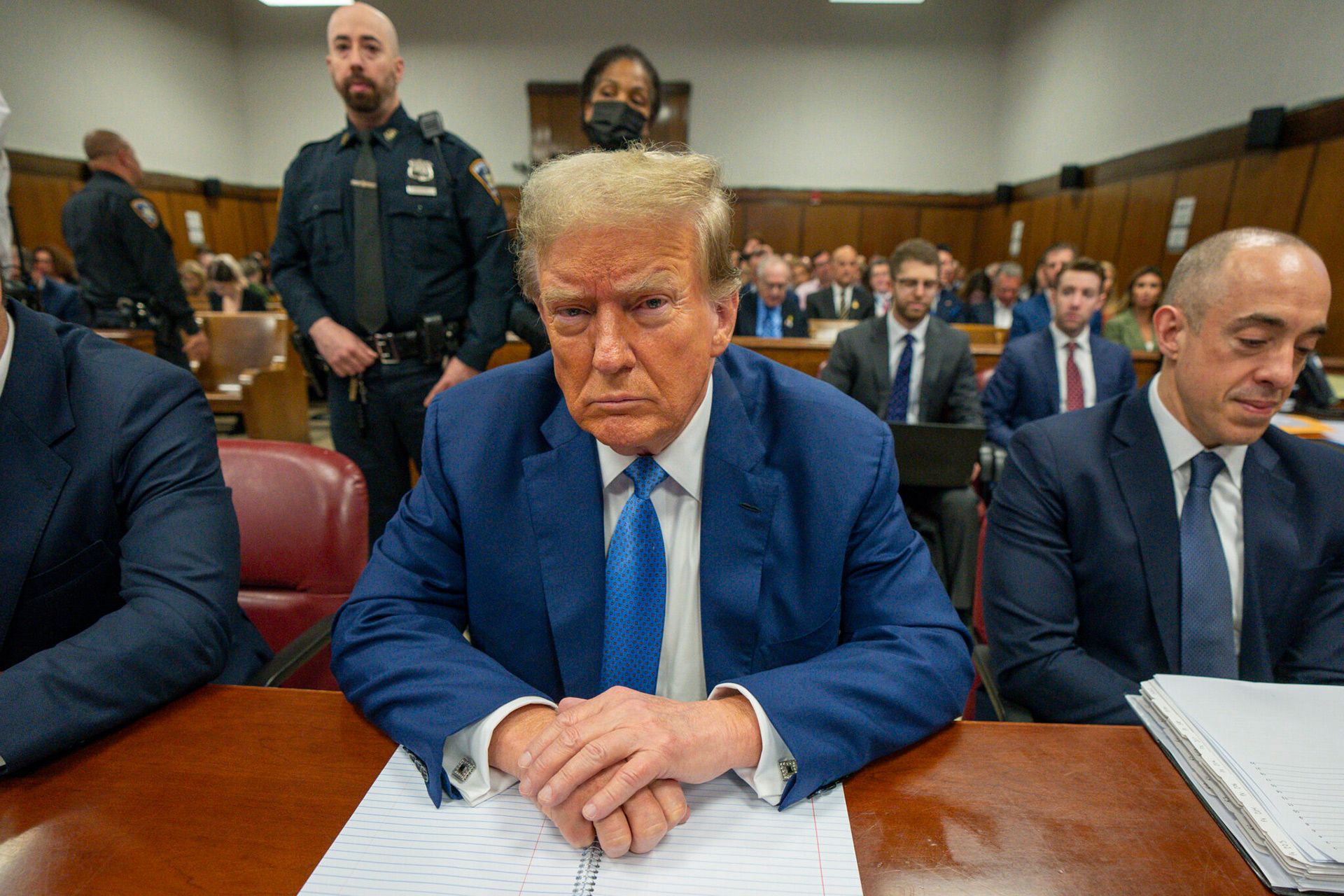
Donald Trump — then the Republican Party’s presidential candidate — in a courtroom in New York, May 20, 2024. Photo: Steven Hirsch, Pool / Getty Images
“See you in court!” Donald Trump heard and said this phrase throughout his life more than 4,000 times. He was a habitual litigator, starting lawsuits over all sorts of things. In 1993, Trump planned to build the Trump Plaza casino in Atlantic City, but the project was blocked by the home of widow Vera Coking, who stubbornly refused to sell her property. The case reached the New Jersey Supreme Court, but taking the widow’s little house away did not work out. In 2012, he accused Miss USA contestant Sheena Monnin of defamation — she claimed the pageant results had been rigged — and won five million from her. In 2015, Trump filed a lawsuit for one hundred million dollars against Palm Beach County over the noise of planes flying over his Mar-a-Lago estate, which he had to endure. The case dragged on until he became president, and the airspace over Mar-a-Lago was closed.
He was not only a plaintiff many times, but also a defendant. He was accused of money laundering, racial discrimination in renting housing, violations of antitrust law, not to mention endless business disputes with competitors and partners. As a private individual and entrepreneur, he won 92 percent of cases.
But even in the presidential chair, when he handed business management over to his children, he had no peace. He issued an order — the courts immediately stopped its implementation. He genuinely could not understand how that was possible, since he was the highest authority in the country. Just as Richard Nixon did not understand when he said: “What the president does cannot be illegal”. During Trump’s first presidency, his administration was a defendant in 246 lawsuits, of which it lost 192.
He left the White House with two impeachments behind him (the second time, the Senate fell just ten votes short of a guilty verdict) and the threat of criminal prosecution in several cases at once. In August 2022, the FBI raided his home in connection with the unlawful retention of classified documents. In October 2023 and April 2024 he had to appear in court in New York in two other criminal cases. He also attended court hearings in Florida and Georgia, where he was photographed in front and profile as a defendant. And finally, he lost more than 60 lawsuits in various states over alleged fraud in the 2020 election.
However, thanks to a combination of circumstances, during his first term he was able to radically reshape the composition of the U.S. Supreme Court. Now conservative justices hold a six-to-three majority over the liberals. It was this majority that last June secured the decision that “the president cannot be held liable for exercising his core constitutional powers, and he is entitled at least to presumptive immunity from prosecution for his official acts”. After this decision, special counsel Jack Smith, who was investigating the president’s actions on the day of the January 6, 2021 Capitol attack and had dragged the investigation out for a long time, tried to convince the court that Donald Trump had acted in this case not as president, but as a presidential candidate, but after Trump was elected to a new term, he resigned.
Trump called the criminal cases against him a “witch hunt”, accused prosecutors and judges of political bias, portrayed himself as a victim, and even likened himself to Alexei Navalny. “Navalny — that’s a very sad situation, and he’s very brave”, he said in a Fox News interview in February of the year before last, shortly after Navalny was killed in prison. “But that happens in our country too. We are becoming a communist country in many respects”. And on his blog on the Truth Social platform, he put it this way:
“The sudden death of Alexei Navalny made me even more aware of what is happening in our country. It is a slow but steady process in which corrupt far-left politicians, prosecutors, and judges are leading us down the path to destruction”.
On the very first day of his second term, Donald Trump signed 26 executive orders, many of which were immediately challenged in court. Later, new lawsuits were filed against the new orders in courts across the country. Usually in such cases, the court as an interim measure temporarily prohibits enforcement of the order until the case is heard on the merits. Moreover, a federal district court injunction applies throughout the United States regardless of where it is issued. This practice, in English nationwide injunction, took shape in the second half of the 20th century and is used when the defendant is the U.S. government. From 1963 to 2001, federal courts issued 127 such rulings, of which 64 were in response to Trump’s executive orders issued during his first presidential term.
At present, about 400 lawsuits have already been filed against Trump’s second-term administration and individual federal agencies. Trump 2.0 was especially angered by James Boasberg, chief judge of the federal district court for the District of Columbia, who blocked the deportation of 238 Venezuelans to El Salvador for 14 days; the Trump administration calls them members of the criminal gang Tren de Aragua.
As the legal basis, the 1798 law on “alien enemies”, passed under John Adams, was used. The law gives the president the right to “apprehend, restrain, secure and remove as alien enemies any alien or citizen of the hostile nation or government, being of the age of fourteen years and upward, who shall be within the United States and not actually naturalized”. The United States was then at war with France, and the text of the law says it applies only in wartime, but even then it was received ambiguously. It is precisely this law that President Adams and Vice President Jefferson discuss in the series John Adams:
Jefferson: Why tarnish your already shaky reputation by assaulting the freedoms for which we fought together? Are you going to expel from the country all the French people in the United States along with others who had the misfortune to express their own opinions?
Adams: Well, if an opinion means splitting the nation at a time when we should be united, then yes, I will do exactly that. In the interests of national security, Thomas.
Jefferson: You cannot protect the country by attacking every person’s right to speak freely and without fear. You are trampling the Constitution.
Adams: These laws were demanded by the representatives of the people. Do you want me to be deaf to the voice of the people? You are the president of the Senate, Thomas. Of course you will respect the decision of the majority, as I do.
Jefferson: I cannot preside over a witch’s assembly.
The Trump administration claims that the Tren de Aragua gang “declared war on the United States”, but experts believe its presence in America is greatly exaggerated. The deportees were denied due process, and there is no way to verify whether they all belong to the gang. At the very moment Judge Boasberg issued his ruling, the planes with Venezuelans were already in the air. El Salvador’s president Nayib Bukele responded to the judge’s decision with a cheerful post: “Oops, too bad... too late”, accompanied by a crying emoji. The next morning he posted a video on X of the planes arriving and the harsh escorting of their passengers, explaining to Salvadorans that it was a good deal: Americans pay for the upkeep of each prisoner “a very small price for them, but a high one for us”.
President Trump, meanwhile, erupted on his blog in an angry tirade, venting his hatred of judges on Boasberg:
This far-left deranged judge, a troublemaker and agitator, unfortunately appointed by Barack Hussein Obama, is not an elected president, he did not WIN the popular vote (by a lot!), he did not WIN IN SEVEN SWING STATES, in 2,750 counties against 525, HE DID NOT WIN ANYWHERE! I WON FOR MANY REASONS, I HAVE A MANDATE OF HISTORIC PROPORTIONS, BUT FIGHTING ILLEGAL IMMIGRATION MAYBE IS THE NUMBER ONE REASON FOR THIS HISTORIC VICTORY. I am simply doing what the VOTERS want me to do. This judge, like many other corrupt judges before whom I was forced to appear, should be IMPEACHED!!!
Yes, federal judges are appointed for life. The president can appoint them, but cannot fire them. They can be removed only through impeachment. House Republicans immediately, that same day, introduced a resolution bill to impeach Boasberg, accusing him of exceeding his authority and creating a constitutional crisis. The judge is accused of “knowingly and deliberately using his position to achieve political goals”, while the president is acting within his powers as commander in chief because there was “an invasion” of U.S. territory.
That was too much for U.S. Supreme Court Chief Justice John Roberts. “For more than two centuries it has been established”, he says in a statement released by the Supreme Court’s press service, “that impeachment is not the proper response to disagreements over the substance of a judicial decision. For that purpose, the ordinary appellate process exists”. Roberts spoke publicly for the first time since 2008.
If in his first term Trump was simply unprepared for the presidency and hired staff piecemeal, now he has an army of highly qualified legal fixers behind him. They came up with another way to rein in unruly judges.
STOP NATIONWIDE INJUNCTIONS NOW, BEFORE IT IS TOO LATE. If Chief Justice Roberts and the Supreme Court of the United States do not correct this harmful and unprecedented situation IMMEDIATELY, our country will face a very serious problem!
In the end, the case reached the U.S. Supreme Court. On June 27, 2025, the court ruled that federal courts do not have the authority to issue universal injunctions, on the grounds that “Congress has not granted federal courts such authority”. The disputed order now continues to be enforced pending consideration of the lawsuit on the merits.
But not everything is always easy. Lately, the Supreme Court has begun to show independence.
On February 20, this areopagus decided that the International Emergency Economic Powers Act (IEEPA) does not give the president the right to impose excessive tariffs, since those tariffs are essentially taxes, and the power to levy taxes belongs exclusively to Congress.
The president was enraged by the court’s decision. He called the judges who voted for it “a disgrace to the country”, “idiots and lapdogs of pseudo-Republicans and radical-left Democrats”. But the decision had to be carried out; moreover, importing companies gained the ability to recover their losses from the government. They have now been reimbursed $28.5 billion already, and another $166 billion plus bank interest is awaiting payment.
In April, the White House suffered another blow: the Supreme Court ruled unconstitutional the presidential order restricting birthright citizenship. The president personally came to court for oral arguments. But his presence did not help.
Finally, on September 15, a month and a half before the midterm elections, the Supreme Court blocked the application of new U.S. Postal Service rules regarding mail voting. Under those rules, announced on August 25, state election commissions were to upload the names and addresses of mail voters to a special citizenship-verification portal, and mail ballots would not be sent to states that failed to provide those data. But the Constitution says that organizing elections on their own territory is the prerogative of the states, not the federal government.
Trump was also let down by especially reliable members of the Supreme Court. The president was sure he would manage to find a replacement for the 76-year-old Samuel Alito, but he made it clear that he was not planning to retire anytime soon. No signals came from the 78-year-old Clarence Thomas.
Now it is already clear that these two will retire under a new Senate, in which Democrats hold the majority and which will not confirm judges favored by Trump.
If a Democrat becomes the new president, the current balance of power in the Supreme Court — six conservatives to three liberals — could shift to four to five in favor of the liberals.
Cases brought by the Trump administration in lower courts also began to collapse. For example, on November 20, federal district judge Leonie Brinkema issued a preliminary injunction against building a triumphal arch in Washington without congressional approval. Earlier, Judge Tanya Chutkan froze the construction. (These are two different cases.) Whether it will begin in the foreseeable future is unknown to anyone now. One after another, the government began to lose cases on unlawful deportation, as well as on resisting immigration agents, even though the fight against illegal immigration is the pride and joy of Trump’s domestic policy.
Another fresh example is the attempt by the U.S. Department of Justice to influence the results of the Senate election in Alaska. There, in addition to incumbent Republican Senator Dan Sullivan and Democrat Mary Peltola, the ballot included an independent candidate named Dan Sullivan. Federal authorities, suspecting the second Sullivan was a spoiler, demanded that the results not be certified if the “real” Sullivan lost. However, on the eve of voting day, the federal district court dismissed the Justice Department’s lawsuit. Peltola ultimately received more votes than both Sullivans and the fourth candidate combined, and the subject of the lawsuit disappeared, as a result of which the Justice Department withdrew its appeal. It is clear that these setbacks irritate the president.
Trump is used to thinking that any case can be won if you have shrewd lawyers and the favor of judges. That is why, until the end of the lame-duck session — until mid-December — he is trying to fill vacancies in the federal district courts with his own protégés.
Because of the time shortage, the Senate is holding group hearings on confirming these appointments. It is a grotesque spectacle. Here is Democratic Senator Chris Coons asking Trump nominee James Sullivan:
- Mr. Sullivan, could you tell me what the 22nd Amendment says?
- Senator, uh, if I remember correctly, and I keep it in my heart because the head sometimes doesn’t remember, but uh, if I remember correctly, it’s uh, oh my God... wow...
- No person shall be elected...
- Ah, yes. Sorry. Thank you. Thank you. Uh, no one can be elected uh more than twice, as far as I remember, to the office of president.
- Was President Trump elected and did he serve as president twice?
- Uh, President Trump was officially recognized as the winner in 2016 and 2024.
- Is he eligible to run for president again in 2028?
- You see, Senator, as a candidate for the federal district court, I believe it would be a violation of Canon 5 for me to express an opinion on such a question...
(Canon 5 of the Code of Conduct for United States Judges states: “A judge should refrain from political activity”.)
And here Democratic Senator Richard Blumenthal asks all the nominees for federal judgeships — there are six of them sitting before him — the same question.
- Who won the 2020 election?
- Senator, President Joseph Biden was officially recognized as the winner of the 2020 election.
- Who received the most popular votes?
- Senator, I’m not entirely sure about the results of the popular vote. President Biden was officially recognized as the winner.
- You don’t know how many popular votes he got?
- I think news reports said that Mr. Biden got more votes...
And so on in the same vein. It is quite obvious that these judges are selected on the basis of personal loyalty to the president. In 1801, after losing the election to Thomas Jefferson, President John Adams, on the eve of his rival’s inauguration, stayed up until late at night signing appointment orders for judicial posts, including the position of Chief Justice of the Supreme Court, for his political supporters. These appointees became known as “midnight judges”. History is repeating itself.
However, in general, one can say that the U.S. judicial system withstood the test and fulfilled the role of the last bastion on the road to “imperial presidency“.
If you enjoyed this article, consider making a donation — one-time or, even better, monthly. Your support helps us motivate our authors and become better with every article.
Our organization is recognized by the Internal Revenue Service (IRS) as a 501(c)(3) tax-exempt, charitable organization, which means that all contributions made to us are tax-deductible to the fullest extent permitted by U.S. law. Individuals may generally deduct charitable contributions of up to 60% of their Adjusted Gross Income (AGI) for cash donations made to qualifying 501(c)(3) organizations. For donations of appreciated assets (such as stocks or other long-term capital assets), the deduction is typically limited to 30% of AGI, based on the fair market value of the asset. C-corporations may deduct charitable contributions of up to 10% of their taxable income for donations made to eligible charitable organizations.
By submitting a donation, you confirm that you have read and accept the following documents: Privacy Policy and User Agreement, and also give consent to the processing of your personal data.
If you would like to unsubscribe from a monthly donation, please email us at: [email protected]