At the end of November, the annual conference of the Sakharov Center project “Country and the World: Russian Realities-2026” took place in Berlin, traditionally bringing together leading political scientists, philosophers, analysts, journalists, and representatives of expert Russian centers abroad. The “Sakharov Center” sums up the year, but in fact it is talking about the future. A discussion of this level is, in principle, impossible in Russia today, so being among friends and colleagues on these November days in Berlin is not just an honor and a privilege, but also a wonderful opportunity to assemble from the puzzle pieces of assessments and opinions a coherent mosaic of the world picture and find answers to the 10 most significant questions about the country’s tomorrow.
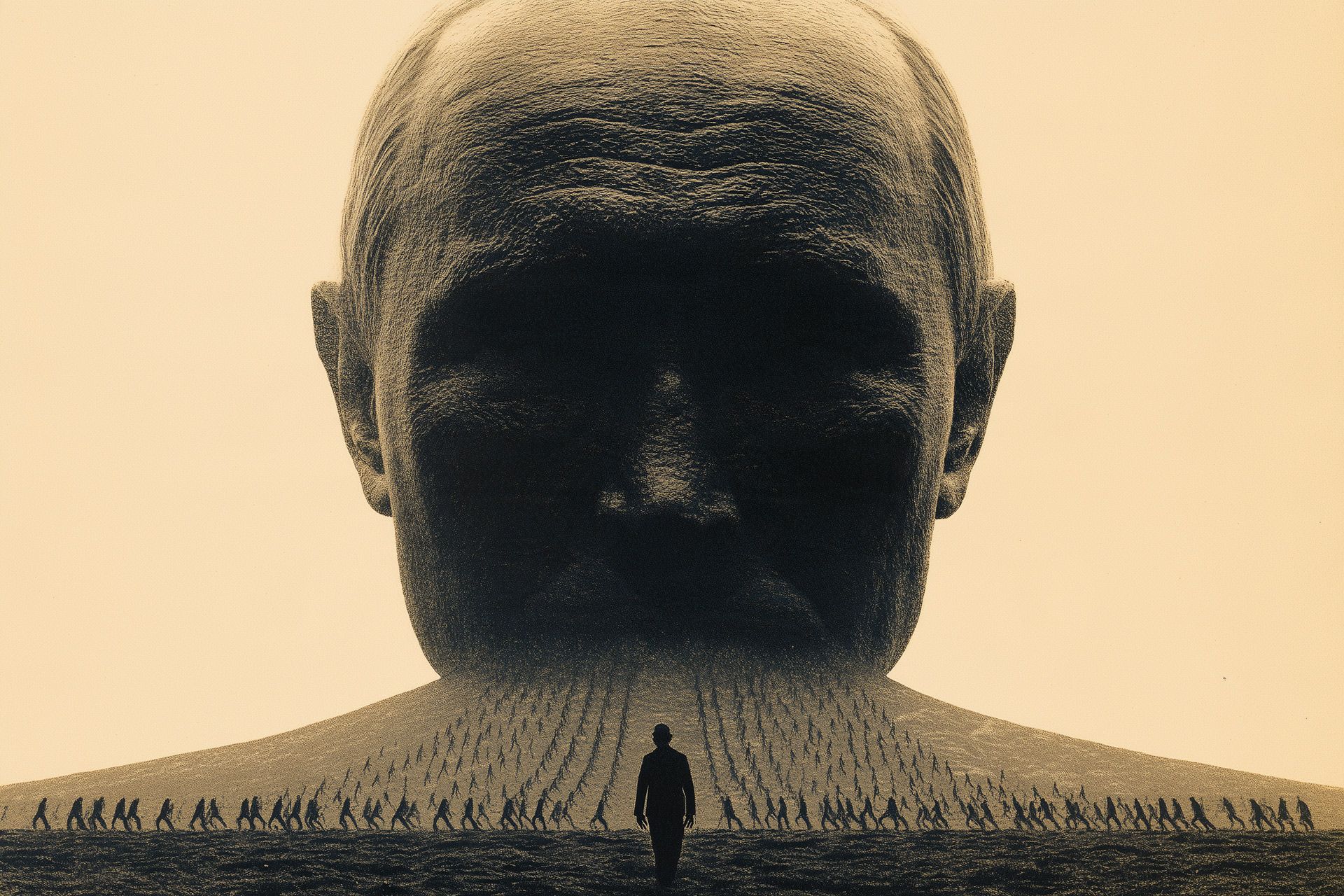
Image: Midjourney / n.evernow for MostMedia
Who is to blame?
Professor, educator, sociologist Alexey Levinson, head of the sociocultural research department of the Levada Center does not believe that the answer to this question is obvious for Russians right now. According to the data he cited, more than 90% of Russian citizens believe that their country is not responsible for the war it unleashed. Only 6% of Russians think that Russia should be held accountable for the deaths and destruction in Ukraine, 65% believe that the United States and NATO should be responsible for the consequences of the war, and 11% of the country’s citizens believe that Ukraine itself is responsible.
When asked directly, “Are people like you responsible for the deaths and destruction in the war?”, only 11% of Russians answer “yes”, 57% — “no”, and 25% — “to some extent”. Sociologist Lev Gudkov describes this state of mind among Russians as a “moral catastrophe”.
At the same time, the majority of the population still fearsmobilization. These fears are strongest among men (53%), women under 25, and women 65+ (67%). Society is convinced that there is no need for mobilization in the country. That is what 75-78% of citizens under 25 and 61-77% over 65 think. Interestingly, 85-88% of young people would readily support a hypothetical decision by Putin to end the military conflict. Women 65+ think the same way (86%), while men 65+ are more bellicose (only 52%).
But if, together with ending the conflict, Vladimir Putin decided to return the conquered territories to Ukraine, his support would immediately drop: among young people to 43-50%, and among the older generation to 25-30%. Just put the bayonet into the ground — wonderful, we support it. But on our terms, we give nothing back. Other conditions for ending the war, in the view of the majority of the population, would mean admitting defeat and being wrong.
How has the war’s plot changed?
Director of the Re:Russia project, political scientist Kirill Rogovhas long and closely followed the evolution of the Russian political regime, which he has given a special term — “military Putinism”. In the first stage of the war, when the Kremlin realized that it did not have a combat-ready army capable of fighting for long, no algorithm for replenishing manpower, and no economic potential for waging a multi-year war, the regime tried to improvise.
Realizing that sanctions had hit the economy and that the elites and the population were not ready for war, the Kremlin began to create, in effect, a second, parallel army, which ultimately entered into conflict with the Defense Ministry. It is important that this conflict was not technological, but ideological. Yevgeny Prigozhin promoted the concept of total mobilization war, the restructuring of the elites and of the entire life of the population, while Vladimir Putin still wanted to remain within the framework of the “special military operation”: the rear lives an ordinary life, and somewhere far away a colonial war is being fought. This stage of “military Putinism” ended with the death of the “Kremlin chef”.
Despite the strong sanctions shock, the Russian economy initially had no problems with war spending; the Kremlin would begin spending reserves much later. In the summer of 2023, Russia saw rapid economic growth, a “military boom”. The regime as a whole coped with sanctions, and the unpopular mobilization model proved unnecessary. The appearance of peaceful life in the rear, ostentatious loyalty to the regime, the commercialization of recruitment for the front, and the display of confidence in one’s own strength are the main characteristics of the second stage of “military Putinism”, which ended at the end of 2025.
According to John Maynard Keynes’s work “The Economics of War”, military spending benefits the economy only at the first stage. But when all production capacity and labor are fully drawn into the military industry, either the war itself must end, or reserves will have to be drawn from the civilian sector, resulting in inflation or the freezing of deposits. At present, Russia is following exactly this scenario.
By 2026 it became obvious to everyone that military spending was becoming excessively high and that the contract-based paid recruitment system was not designed for such a long period. The Russian army advances slowly, literally burying villages under corpses. The war has become an insanely expensive project, with 40% of the “war money” spent on paying for deaths. As a result, the regime has run into problems paying for the war, public sentiment and the situation in the civilian economy have worsened, and the war has turned into a burden for the regime itself.
Has the system turned into a special service?
Political scientist, visiting researcher at the Carnegie Russia Eurasia Center Berlin, Ekaterina Schulmannreminds us that in 2022 it was precisely those parts of the state machine that aroused suspicion among the security services — the financial and economic bloc, big business, and the regional bureaucracy — that helped it survive the military shock and not collapse. The силовые structures turned out to be much less prepared for war because of negative кадровая selection and a low level of professionalism. But in 2023 the bureaucracy realized that war was a profitable business. New niches opened up, new career elevators started — and it became clear that life could go on, there was plenty of money, and we should keep fighting.
The sanctions regime cut off the elites’ access abroad, so repression intensified in 2024 to keep them under control, legislation was tightened, and arrests began. In 2025 the war dragged on, and hopes for a quick and profitable end to it did not come true. Expectations that the president would reward the loyal patriotic elites faithful to him also did not come true. Today, nomenklatura repression is beginning to take on a new quality. It affects the family members and clans of the elites and is accompanied by confiscations. This destroys the administrative traditions on which the careers of the nomenklatura had previously been built. Loyalty no longer guarantees the social and financial status of an official and their close circle.
In 2026, an authoritarian regime under an external threat it cannot cope with shrinks to the size of a repressive apparatus. Today the regime has three “legs”: the “accountants” (the financial and economic bloc building state capitalism), the “PR people” (propaganda media and authors of the “dictatorship of deception”), and the “security police” (the special services, the силовой bloc).
In the conditions of a war that cannot be won or stopped, the FSB has become the decisive force in different spheres of the country’s life, turning into a “full-cycle agency”: its influence on domestic political processes is growing, the internet lives under censorship, and elections are accompanied not only by record fraud but also by physical violence and criminal prosecution. The FSB’s main tools are killings and imprisonments.
Russia increasingly resembles Iran, and the FSB resembles the IRGC. In the face of external and internal threats, ayatollahs and civilian officials become less important to the regime than the силовики.
But guarding and governing are not the same thing. The FSB lacks administrative and economic skills, and if the “third leg” devours the other two, will it replace them? And the main question is what role the president will play in this, whether he will retain the function of arbiter.
Does the regime need a new Constitution?
Political analyst, publicist, author of the book “The Closing of the Russian Mind” Andrey Kolesnikovreminds us thatin 2020 Russia effectively experienced a constitutional coup: elements of nationalist-imperial ideology were incorporated into the text of the Constitution, the regime took a decisive step toward totalitarianism, and as a result the “state-civilization” entered into direct conflict with the civilized state.
In 2023, talk began that it would be good to change the Constitution as well. Justice Minister Chuychenko said that the rights and freedoms of citizens are now “not quite the right approach”. He also argued that no country has a ban on ideology; only Russia has taken on these “increased obligations”. At the same time, the far-right billionaire Konstantin Malofeev proclaims that the state must be sacralized, and that the “liberal constitutions” disliked by Malofeev were invented by Freemasons. The state is everything: Benito Mussolini said the same thing in 1925.
What is happening now is a reinvention of the nation: the Kremlin regime has adapted its people to itself. The Kremlin is building a community called “citizens of the special military operation”. The motherland is not Russia, but the special military operation and Putin. The nation has been reduced to a group of subjects of a sultanate, imitating obedience to everything the authorities do and supporting the special military operation as a way of existence for the state machine. Those who do not support the special military operation are traitors, enemies, outcasts.
Francoist Spain needed about 30 years to consolidate the regime. In Russia, the legal vacuum is being filled with repressive laws, and the result is a structure of a total “state-civilization”.
We see attempts to push the president to enshrine in the Constitution the achievement of mature Putinism — to remove “rights and freedoms” from it. This is understandable: if the hot phase of confrontation with the West turns cold, the силовой bloc will need “active measures”.
Closer to 2030, these efforts will lead to the dismantling of the 1993 constitutional model with its priority of human rights and freedoms.
What does Russian business think on the eve of the fifth year of war?
Meeting of Vladimir Putin with representatives of Russian business circles on the evening of February 24, 2022
The restrictions on internet use have strongly affected the life and work of business, and an unpleasant piece of news was the federal center’s unwillingness to take part in repairing refineries. Taxes are rising every year, the process of a forceful redistribution of private property is gaining strength, and the seizure of business is effectively underway. All this negatively affects the feelings of major market players. They understand that there will be no return to normality. The old life will not come back even when the war ends. War fatigue is intensifying and reaching monstrous proportions. We see the erosion and collapse of the rules that the system itself once established, and whose resources are exhausted. Putin does not deliver results, so contempt for him among the elites is growing.
Business elites are not split for the main reason: only something whole can split into parts, while the elites are atomized; they have no image of the future, and they have been unlearned from making decisions and taking responsibility.
What do political elites feel?
Journalist, columnist for Riddle, special correspondent for Meduza, Andrey Pertsev is sure that the entire political administration is in a state of constant stress. If earlier political elites had hopes that Trump would help the Kremlin, Zelensky would disappear somewhere, and that an agreement with Ukraine would be possible, now these hopes have collapsed. Political administrators do not feel like actors or subjects of the political plot; they just sit and wait. At the same time, they see how easily the Kremlin handed over powers and levers of control of the entire system to the силовики, which are unable to resist. In fact, even Sergei Kiriyenko does not oppose the FSB.
Officials accustomed to a corruption-based model of work are having a hard time today — there is little money, and the risk of ending up behind bars has increased many times over. There is no motivation, few people want to join the ranks of administrators, and many want to leave the system. The diagnosis of the system is stress.
What moods exist inside the Z audience?
Journalist, writer, researcher of Z-propaganda Ivan Filippovis sure that the Z community has long stopped looking to the future. What victory will be like, and whether there will be one, is unknown. The future is imagined by them with the formula “we’ll squeeze the village, we’ll hold the forest plantation”. The mood of the Z audience fell sharply in the spring of 2026, when Putin was told that no one in the army uses Telegram. For the Z community, which considers Telegram the nervous system of the Russian army, there came a moment of revelation and longing.
Starting in March 2026, the “Z-people” increasingly began to remember human rights. The Z community wants a democratic future with a mighty army. The main source of their grief and depression is not incoming strikes and shelling, but the understanding that the system cannot adapt to difficulties, does not respond to new challenges, and is simply inefficient. Two years ago, the “Z-people” fell in love with Belousov after his words, “It’s okay to make mistakes, but not to lie”. But now they see that the system has not changed. As a result, the Z community, which likes a Russia at war and dislikes a sleeping Russia, is becoming increasingly radicalized.
System transit: will the successor be a security officer?
Political scientist, head of the analysis of transformation processes department at NEST Centre, Nikolai Petrovrefutes the long-held Western view that in Russia everything is controlled by the силовики. Vladimir Putin is 74 years old, and his associates are about the same age. The Kremlin urgently needs a generational смена to breathe new life into the system. But the Putin model of governance does not imply the reproduction of personnel. The people Putin appoints must have been known to him for more than 20 years. Putin knows only his relatives, bodyguards, and the children of his associates, and it is among them that he looks for personnel for his appointments.
A process of regime transformation is now underway, and a generational смена is taking place. Putin is replacing experienced and effective people with those who are personally loyal to him but completely incapable of making independent managerial decisions.
Putin does not need FSB representatives who are loyal to the corporation rather than to him personally. His choice is adjutants, family members.
Putin is doing well with vertical power structures, but poorly with horizontal ones. His well-known and understandable method of controlling the силовики is to set them against one another. But a system living in a mode of internal conflict must have a regulator, and that regulator previously was always Vladimir Putin personally. The problem of transit is that there is no one to replace him with, and this is a threat to the entire system.
Is Putin’s economy still resilient?
Economist, co-founder of the CASE Center, Vladislav Inozemtsev is sure that the main reason for the resilience of the Russian war economy is its market nature and the absence of excessive bureaucratization. Sanctions have not been able to inflict critical damage on it. The money the government injects into the economy in exchange for lost lives compensates for the deaths. The economy still has a large margin of safety.
At first, the sources of financing for the war were previously accumulated reserves, which grew thanks to high commodity prices in 2022. Then taxes were raised — on profits, personal income tax, and VAT. Now this stage is coming to an end: the state will increase public debt and carry out money issuance, and for some time these measures will still make it possible to finance the war. There is still some margin of safety, but it is not eternal. It is clear to everyone that the end of the war will be perceived positively by business and the population.
Today the government is experimenting without a long-term strategy. Tax increases harm the economy more than sanctions. In general, the country’s development under wartime conditions is impossible.
What choice do we have?
Political philosopher, publicist Alexander Morozov recalls: earlier everything was clear: in the Russian Federation there was authoritarianism, in the West democracy. Now, to the shock of the war entering its fifth year, thanks to Trump there has been added the feeling that the whole world is walking over a precipice on a glass walkway. All the supports and foundations of modern political systems are unstable, their fate is in question, they are dissolving in the fog of history. Can civil society influence national governments or, even more so, global institutions? Or will it be MAGA? Or teenagers with drones?
The world is going through major trials. Civil society has two possible courses of action. Either, once again, as between 1976 and 1985, ignore everything that is happening and live one’s private life, not paying attention to what ideology Putin’s regime has — it doesn’t matter. We are seeing around us the scenario of retreat into intellectual underground, into a conditional philosophy faculty; European intellectuals are now crawling into this hole.
The second strategy is to defend the value system of liberal democracy that underlies European civilization. Perhaps the new reality will crush us, but we will meet it with our visors up.
A recording of all the presentations and discussions from the conference will be published on YouTube on the channel “Country and the World”.
If you enjoyed this article, consider making a donation — one-time or, even better, monthly. Your support helps us motivate our authors and become better with every article.
Our organization is recognized by the Internal Revenue Service (IRS) as a 501(c)(3) tax-exempt, charitable organization, which means that all contributions made to us are tax-deductible to the fullest extent permitted by U.S. law. Individuals may generally deduct charitable contributions of up to 60% of their Adjusted Gross Income (AGI) for cash donations made to qualifying 501(c)(3) organizations. For donations of appreciated assets (such as stocks or other long-term capital assets), the deduction is typically limited to 30% of AGI, based on the fair market value of the asset. C-corporations may deduct charitable contributions of up to 10% of their taxable income for donations made to eligible charitable organizations.
By submitting a donation, you confirm that you have read and accept the following documents: Privacy Policy and User Agreement, and also give consent to the processing of your personal data.
If you would like to unsubscribe from a monthly donation, please email us at: [email protected]