The Ukrainian Ministry of Culture and the Ministry of Foreign Affairs officially demand that Ilya Khrzhanovsky’s film “DAU” be removed from the Venice Film Festival program. The festival leadership refuses. What is the vulnerability of both sides of the conflict?
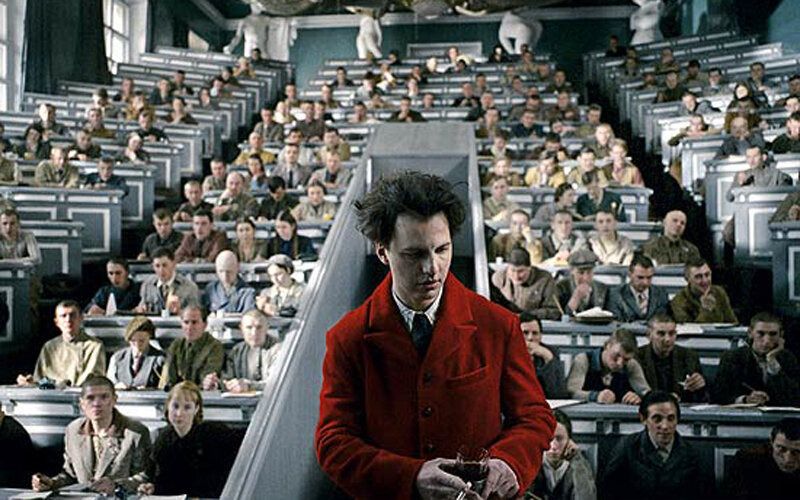
A frame from the film “DAU” (dir. Ilya Khrzhanovsky, 2018)
A few days ago, the Ukrainian ministries of culture and foreign affairs expressed protest over Ilya Khrzhanovsky’s film “DAU” taking part in the Venice Film Festival. “While Russia continues its war of aggression against Ukraine, systematically destroying our cities, cultural heritage, and national identity, granting one of the most prestigious cultural platforms to a project linked to the Russian state and its networks of influence sends an extremely alarming signal... Every prestigious venue that hosts a project financed by the Kremlin becomes a kind of test for Moscow: how far are international institutions ready to tolerate Russia’s crimes”, the authors write. And at the end they add that international cultural projects financed by the EU “must ensure compliance with democratic values, which are not respected in modern Russia”.
An unprecedented uproar broke out on social media. Ukrainians were accused of lying, of using their status as victims of aggression for ugly purposes, of trying to impose censorship at the international level, of disregarding the very notion of “art”, and much else, up to equating Ukraine and Russia in terms of dishonest information warfare. What can one say to that?
The Ministry of Culture and the Ministry of Foreign Affairs, of course, went too far by describing the situation, to put it mildly, implausibly. First, “DAU” was by no means financed by the Kremlin, not even in the worst nightmare. Second, the project is not connected to any Kremlin networks. Moreover, Ilya Khrzhanovsky left Russia at the start of the war and even renounced Russian citizenship in protest. So if anyone has claims, it certainly is not the director.
Another question is that Russian oligarch Sergei Adonyev, who invested a cosmic sum in “DAU”, has been under Ukrainian sanctions since October 2022. In addition, one of the central roles was played by Teodor Currentzis, whose career in Russia was tied to support from state and quasi-state structures. Of course, this is not enough to speak of a connection between the project and Kremlin networks, but neither can these facts be dismissed entirely by declaring the film an independent territory of art. And in that sense, the Ukrainians can be understood.
Teodor Currentzis in the film “DAU” (dir. Ilya Khrzhanovsky, 2018)
As expected, Venice responded with a refusal — saying the film is not Russian, the director is not a citizen of Russia, and the festival does not intend to exclude works on national or geographic grounds. True, at the very beginning of the letter they noted that they are aware of Ukraine’s tragedy. And they did not notice how they contradicted themselves — they know that Russia is waging a war of aggression, but they do not want to exclude works on national grounds. And they had never even heard of any Adonyev.
And so it becomes a conversation between the deaf and the blind. Ukraine speaks of war and cultural influence. Venice speaks of artistic freedom and the inadmissibility of censorship. And the furious debaters are mixing apples and oranges. By accusing Ukraine of trying to censor the international cultural space, opponents of the Ukrainian position somehow pretend that Ukraine is proposing to ban the film because of its author’s passport. But Ukraine is well aware of Khrzhanovsky’s citizenship and nowhere in its statement do the authors say anything about the director. They are talking about something else entirely — that a work of culture has not only content, not only a director, producer, actors, screenwriters, etc., but also an origin, a history (including a financing history), and a system of connections.
A frame from the film “DAU” (dir. Ilya Khrzhanovsky, 2018)
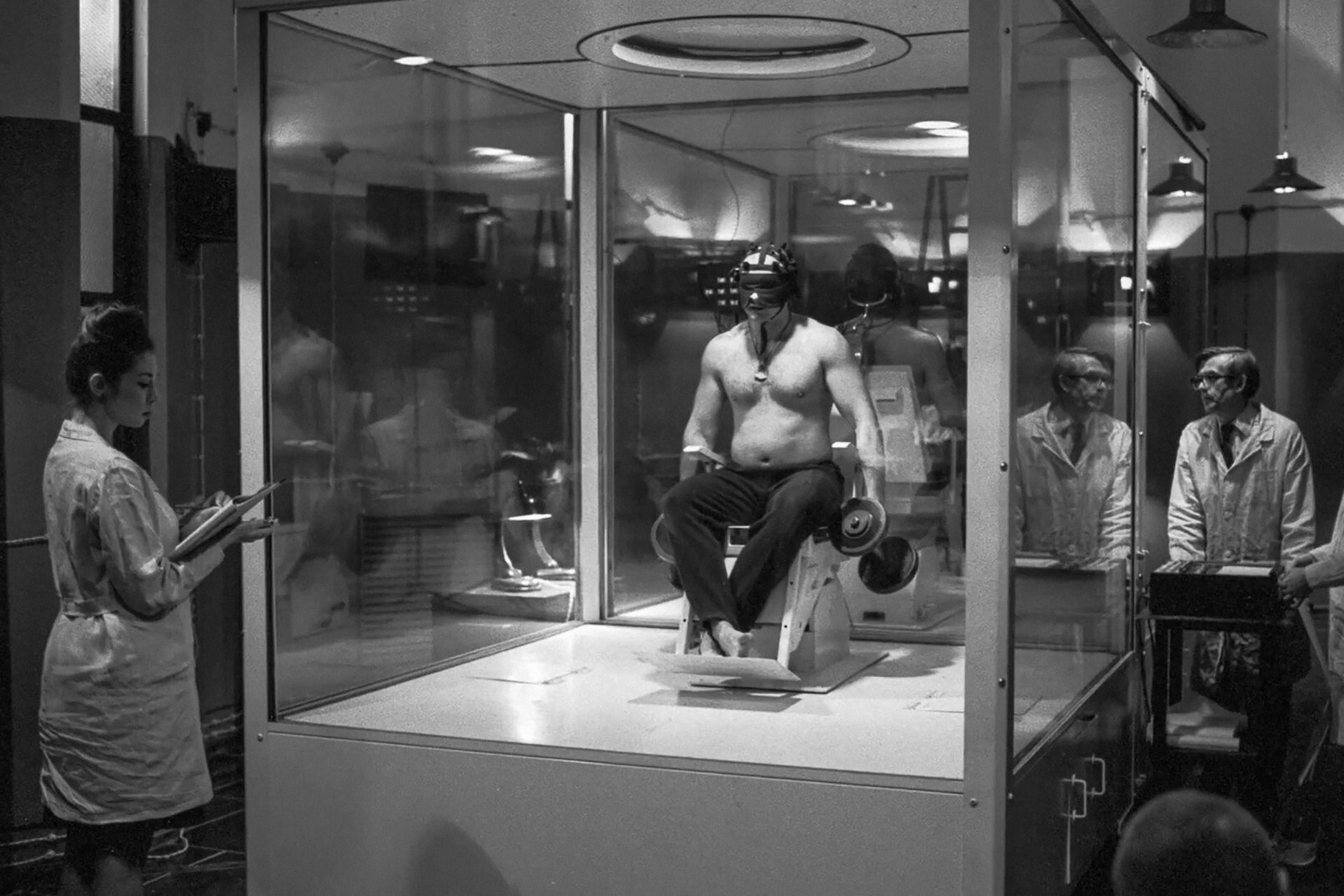
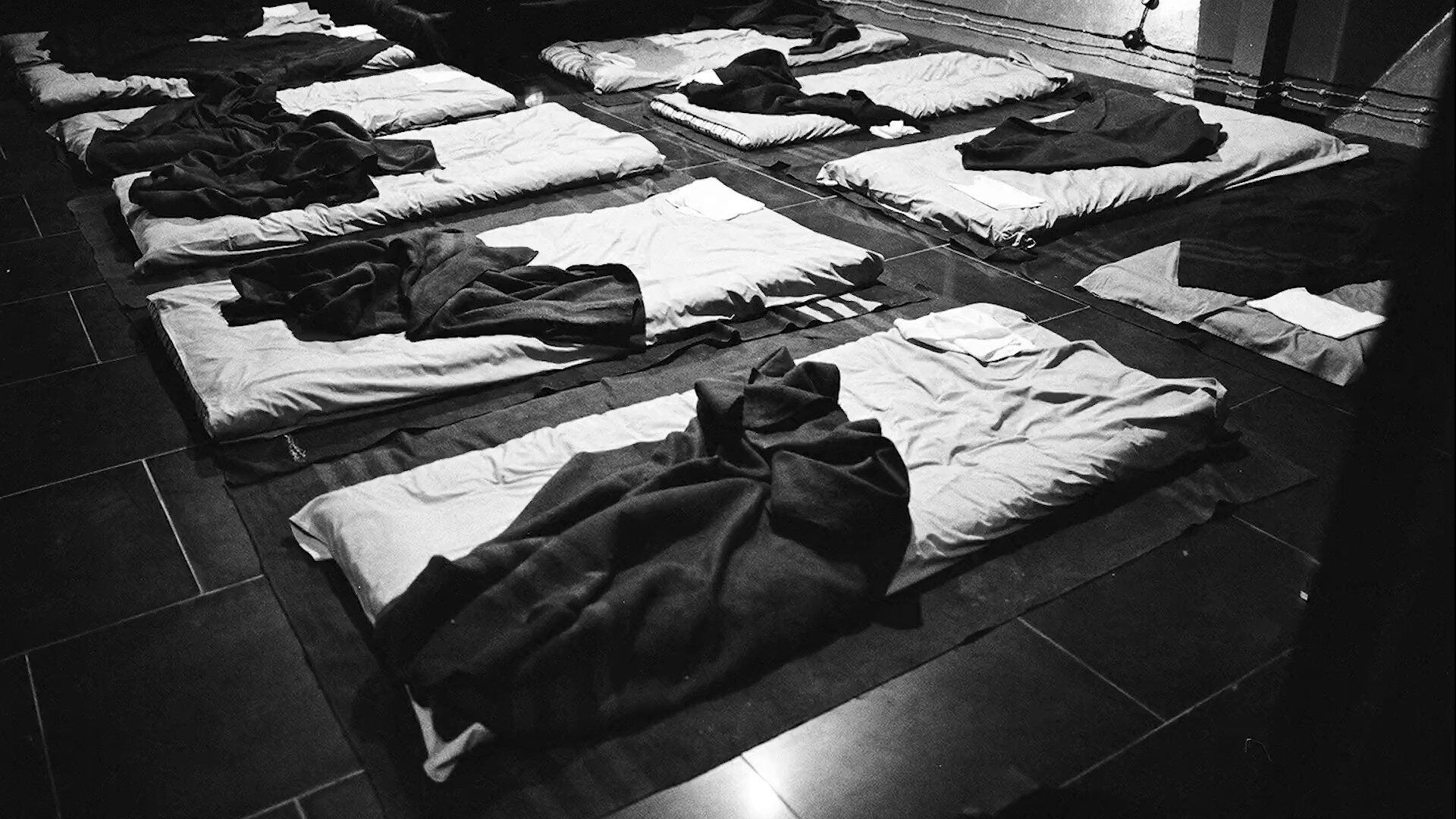
That is why Ukraine sees “DAU” not only as a film about totalitarianism, but also as an example of cultural appropriation. “DAU” was filmed in Kharkiv in 2008–2011. On the grounds of the abandoned Dynamo swimming pool, a gigantic Institute was built — a closed model of Stalin’s Soviet Union, in which people lived for months under the laws of an invented era. Kharkiv here turned out to be a convenient set for reconstructing the USSR — its space was turned into a Soviet past, and the project even received Ukrainian state support. After the full-scale invasion, the perspective changed dramatically.
If before 2022 it was customary to consider everything that once existed within the Russian Empire or the Soviet Union as material of “Russian culture”, then after 24.02.2022 this view lost its innocence.
For Ukrainians, many questions that once seemed insignificant or even nonexistent have become painfully acute. Russian missiles are physically destroying Kharkiv, while the imperial narrative that Ukrainians see even where it most likely does not exist seems to strip the country of its separate history. Symbolically, of course, it does.
And the hardest thing is trying to explain this to non-Ukrainians, even the most pro-Ukrainian and anti-Kremlin among them. They see the war, they know it, they condemn it, but they cannot penetrate the depth of the pain, the depth of long-standing Ukrainian grievances that have grown and strengthened over several centuries “thanks to” Moscow’s diktat and pressure. No, they cannot. The phrase “imperial consciousness” has become worn out, and lately it has even become somewhat awkward to say, but the unwillingness to understand and accept Ukrainians’ attempts to wall themselves off from Russian culture with a reinforced concrete wall is exactly that. More precisely, it is not even unwillingness, but inability.
On the set of “DAU”. Photo: kinopoisk.ru
Both sides’ positions are vulnerable. The Ukrainian side ignores the fact that Khrzhanovsky renounced Russian citizenship in protest, that Adonyev’s money was invested in “DAU” long before the annexation of Crimea (and the new, “Venetian” “DAU” consists of material shot in 2008–2011), and that Khrzhanovsky did not create any Kremlin narrative. The festival’s position is that culture is never “above the fray”; it is part of politics, especially during a war at your doorstep, and it does not stop being politics just because the Venice Festival management wants to communicate only in the language of aesthetics.
At the same time, both sides are arguing without hearing each other. Venice responded to an accusation Ukraine did not make — that it was demanding national censorship. Ukraine, in turn, reduced a complex ethical question to a banal dispute over whether Khrzhanovsky is a Russian director. Venice is right that works cannot be excluded from competition because of their authors’ origin. Ukraine is right that the origin of the money and the cultural perspective of a work do not become irrelevant just because it is art.
It should be said that the Ukrainian protest itself and the Venice Festival’s refusal to agree with it are quite ordinary. Before major film festivals and during them, someone is always protesting: the left protests against Israeli films, women protest against the dominance of male directors, Ukrainians protest against films from Russia or linked to Russia. But Russian public pages rushed to express outrage over the Ukrainian protest as if it were at least Armageddon. And they accuse Ukrainians not only of misleading presentation of information — on that no one would even dare argue — but also of the methods themselves. Some even went so far as to say that Ukrainian propaganda methods are no better than Russian ones. Is that true? It is roughly like saying about Russia’s shelling of Ukraine: do not imitate criminal Russia, do not follow its example. A kind of cultural pacifism in wartime.
It seems that in the fifth year of the war, Ukrainians can afford to speak out against a film made with money from a sanctioned Russian oligarch.
In the same way, Russians were outraged by Ukrainians who did not appreciate Zvyagintsev’s speech at the closing of the Cannes Film Festival — “how could Ukrainians not thank him for the obvious message — a demand that Putin stop the war?!” They could, and very much so. Right now Ukrainians need support, even where they are overdoing it. They want the world to shout: “Putin is a bloody killer!” rather than “Mr. President, stop the slaughter!” The difference may seem small, but it is small only to those who are not in Ukraine, who do not sleep in the metro, whose children and husbands are not at the front, not under shelling, whose homes in Russia and Europe are perfectly intact. They want calm, thoughtful analysis. And Ukrainians are not capable of that right now. Not understanding this means lacking the heightened empathy that wartime requires.
A frame from the film “DAU” (dir. Ilya Khrzhanovsky, 2018)
And as for the film “DAU”, we will talk about it separately later. Quite a lot has already been written about the ethical problems of this project. People who witnessed the filming described chilling things about the regime that prevailed there, and in Ukraine a criminal case was opened against the director after it became known that orphaned children had taken part in the shoot. The case was opened “on the facts of torture, as well as the production or dissemination of works that promote the cult of violence“. Part of ”Dau. Degeneration“ contains a five-minute scene in which medical experiments are performed on children.
But the essence of the current conflict has nothing to do with the film’s plot. It has its own plot, namely: can a work of culture live in a vacuum, and can viewers and judges fail to take into account the context in which it reaches people? Such disputes have been going on since the time of Aristotle, and everyone has long since given their own answer. In any case, there are still more questions than answers.
If you enjoyed this article, consider making a donation — one-time or, even better, monthly. Your support helps us motivate our authors and become better with every article.
Our organization is recognized by the Internal Revenue Service (IRS) as a 501(c)(3) tax-exempt, charitable organization, which means that all contributions made to us are tax-deductible to the fullest extent permitted by U.S. law. Individuals may generally deduct charitable contributions of up to 60% of their Adjusted Gross Income (AGI) for cash donations made to qualifying 501(c)(3) organizations. For donations of appreciated assets (such as stocks or other long-term capital assets), the deduction is typically limited to 30% of AGI, based on the fair market value of the asset. C-corporations may deduct charitable contributions of up to 10% of their taxable income for donations made to eligible charitable organizations.
By submitting a donation, you confirm that you have read and accept the following documents: Privacy Policy and User Agreement, and also give consent to the processing of your personal data.
If you would like to unsubscribe from a monthly donation, please email us at: [email protected]