Society, raised on “traditional values” and contempt for difference, has grown hardened and blind, walling itself off from those who are not like everyone else with a barrier of indifference. And children with disabilities pay the highest price for this.
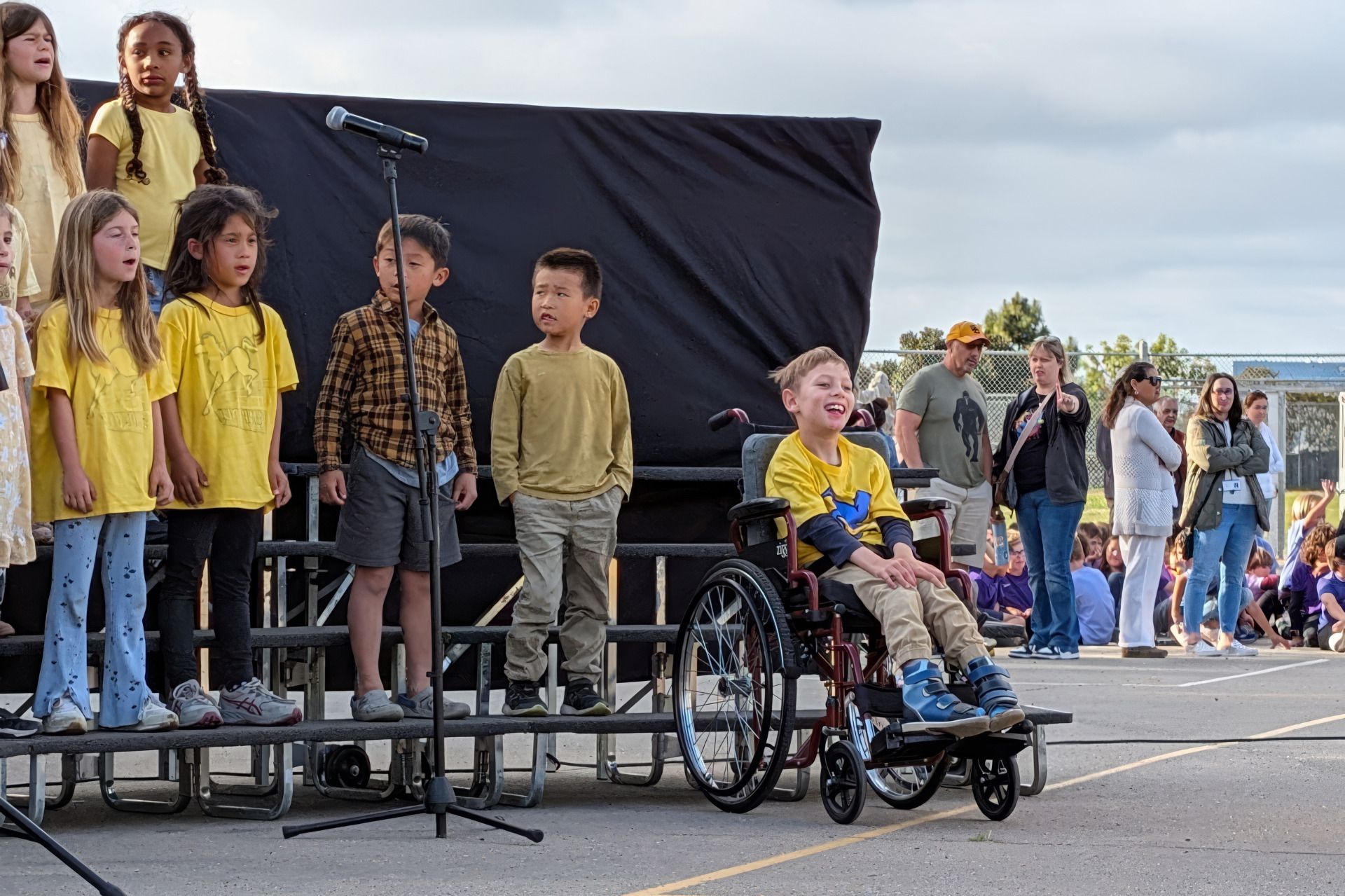
At a school concert in California, far right — David Novichkov. Photo from the personal archive of Ekaterina Novichkova
According to official data, at the beginning of 2025 there were about 779,000 children with disabilities in the Russian Federation, 57,000 more than the previous year. Almost a third of children with disabilities live in state boarding schools or orphanages — and often face violence and physical coercion there. Meanwhile, those who try to draw attention to what is happening often find themselves targeted: daring to expose the problem outside the walls of the institution, they become defendants in criminal cases.
Such stories are not exceptions but part of the social norm. Instead of protecting the most vulnerable, the state sometimes becomes a source of pain itself. And the dismissive attitude toward people with disabilities inevitably affects public sentiment.
“Russia, Russia!”
In August 2018, a group of teenagers in the Ural city of Beryozovsky lured 20‑year-old Dmitry Rudakov — a young man with a disability due to cerebral palsy — behind some garages “for a beer.” They forced him to strip, mocked him, kicked him in the head until they killed him. A girl from the group recorded the incident on video and later boasted to a friend that they had “taken out a drug addict.” Dmitry was targeted because of his speech impairment. And they finished him off under the slogan “Russia! Russia!”.
This is no accident. It is the result of state-cultivated ultra-patriotism, imposed on children from preschool age. In kindergartens, “Victory parades” take place, in schools — “classes of military glory” and “lessons of courage”, where they talk about strength, victory, and enemies. But children are rarely taught that strength is not the right to kill the weak, but the protection of the vulnerable. They are instilled with pride in the “power,” but not taught respect for the person next to them. As a result, under the flag of such pseudo-patriotism grows a generation unable to distinguish true courage from violence, with cruelty disguised as strength and pride in the country.
When teenagers finish off a disabled person shouting “Russia!”, it is no longer just a crime. It is a signal: something terrible has become embedded in the very core of national upbringing. And if society cannot realize what it has instilled in these children, tragedies will repeat.
Another story occurred in Udmurtia at the end of 2019. The 13-year-old boy with a severe form of cerebral palsy suddenly lost his mother — the only person who cared for him. For a whole week, the disabled teenager remained alone next to his mother's body, suffering from hunger and thirst. He could not speak but desperately called for help — banging and trying to attract attention with noise. Neighbors behind the wall heard him but paid no attention. No one came. No one thought: what about the sick child, why is he screaming?
Exhausted, the boy decided to save himself. He reached the kitchen and managed to turn on the tap, wanting to drink. He could no longer turn off the water — he fell out of his wheelchair and could not get up again. Ice-cold water flowed onto the floor, soaking his motionless body, but even this went unnoticed. The apartment was on the first floor, so the water only flooded the basement — neighbors didn’t sense trouble. When finally — only after a week! — rehabilitation center teachers raised the alarm (no one opened the door for their scheduled session), it was too late. The boy died of hypothermia and dehydration next to his mother's body. The report tersely stated: cause of death — accident. But in fact, he died from the indifference of those around him.
Too often, people prefer not to intervene, even when they hear a cry for help. Especially if the suffering is someone else's, and even more so if disabled. In this vast country, compassion has atrophied to a dangerous level.
Torture instead of help
In 2015, a horrifying story emerged about Moscow Psychiatric Hospital No. 15: orphaned children were tied to beds there. Volunteers took photos showing teenage orderlies tightly fastening the fragile arms and legs of a lying child with straps. The scandal reached the authorities, and an investigation confirmed that “restraint” was used as a method of disciplining unruly patients. The children's ombudsman protested, the medical staff defended themselves… But do these official procedures make it any easier for the children who cried themselves to sleep tied to their beds at night?
Unfortunately, such methods are not uncommon. In 2024, the parents of an 8-year-old boy from Chelyabinsk sounded the alarm: they were admitted with their son to a psychoneurological dispensary for examination but received him mutilated. The child begged: “Dad, take me away, they tie me up and beat me here!” Blue marks from ropes were on the boy’s wrists, bruises and bite marks on his body. Meanwhile, the parents had to go to court to gain the right to take their son home — the dispensary management refused to release the “unruly patient.”
Another symbol of state cruelty were the recent deaths of children in St. Petersburg psychoneurological boarding school No. 10. In spring 2023, human rights activist Nyuta Federmesser reported that at least seven seriously ill orphans died there from starvation and inadequate care. The children in the state institution literally perished from hunger. Volunteers from charitable organizations were not allowed in, although there was a catastrophic shortage of hands: the management feared publicity more than the death of those in their care. And the children faded away one by one. Official reports named “multiple organ failure” and “brain edema” as causes of death — the word “hunger” was not mentioned. But calling things by their proper names means admitting: the state showed criminal cruelty and negligence, allowing the deaths of seven children.
So why has the concept of inclusivity — the acceptance of people with special needs into ordinary life — not taken root in Russia?
Alienation instead of acceptance
Inclusion is banned, like other “hostile” foreign words. People here are still surprised when they see a child in a wheelchair on the playground. Parents of healthy children sometimes demand the removal of a special-needs child from near their kids. Even simple gestures toward those “different” sometimes meet deaf incomprehension. For example, in 2019 in Moscow, residents of one apartment building repeatedly vandalized a ramp installed for a boy in a wheelchair: they coated the lock with varnish, punctured the tires, and eventually destroyed the structure completely.
Our family lived in Montenegro for several years, and once at a playground, a Russian-speaking boy approached my son David, who moves around in a wheelchair, and asked: “Is he sick?” It seemed like a normal children's question, but it already carried alienation, as if disability was something shameful, something that should be outside the norm.
Our compatriots often do not explain to their children that disability is not a disease but a condition a person can be born with, live with, develop, and be part of society.
At the American school where my son currently studies, in two years we've never encountered such attitudes. There, from an early age, children are taught that “different” does not mean “worse,” and that friendship and support matter more than external differences.
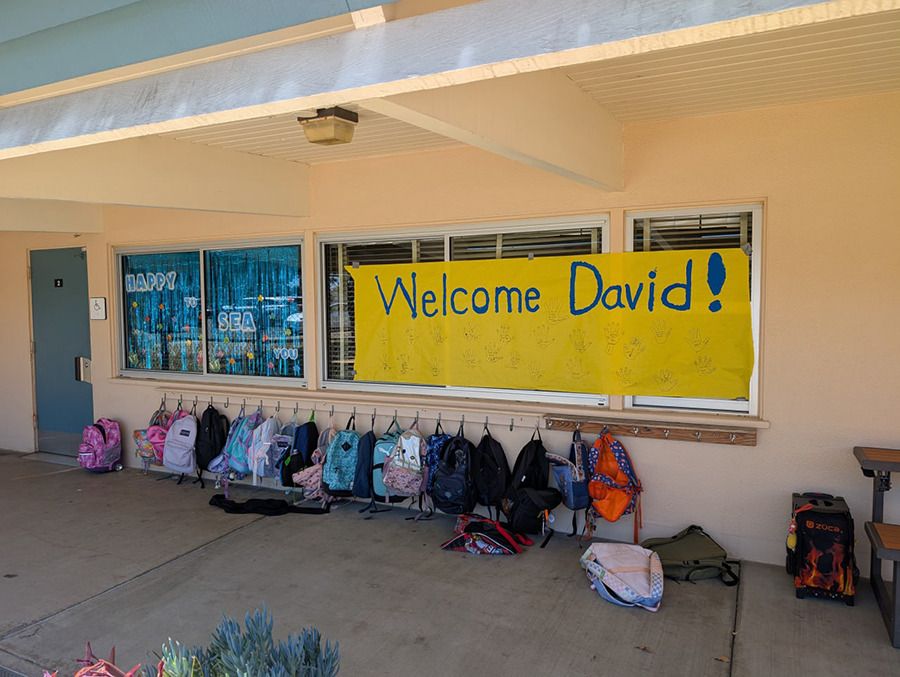
This is how a child with a disability is welcomed at school in the USA. Photo from the personal archive of Ekaterina Novichkova
In the US, inclusion is not a declaration but everyday reality. The state does not skimp on the vulnerable: children with disabilities have individualized educational programs developed, considering their characteristics and needs. Families are provided with professional social workers paid from the budget — and these specialists do not just “look after” but strive to earn trust and gratitude. People with disabilities are helped not just to survive, but to live — including organizing shared living arrangements to combat loneliness. Society here is built around respect, not contempt. And a child, even with a severe diagnosis, can be happy.
In Russia, however, people with disabilities are second-class citizens. A culture of cruelty grows everywhere — in indifference on stairwells, aggression on playgrounds, violence behind closed institutional doors. Even legally, “the different” continue to be excluded: from September 1, 2025, people with autism in Russia are officially banned from driving regardless of the form of disorder or level of independence. This is not a system glitch — it is a deliberate system.
If you enjoyed this article, consider making a donation — one-time or, even better, monthly. Your support helps us motivate our authors and become better with every article.
Our organization is recognized by the Internal Revenue Service (IRS) as a 501(c)(3) tax-exempt, charitable organization, which means that all contributions made to us are tax-deductible to the fullest extent permitted by U.S. law. Individuals may generally deduct charitable contributions of up to 60% of their Adjusted Gross Income (AGI) for cash donations made to qualifying 501(c)(3) organizations. For donations of appreciated assets (such as stocks or other long-term capital assets), the deduction is typically limited to 30% of AGI, based on the fair market value of the asset. C-corporations may deduct charitable contributions of up to 10% of their taxable income for donations made to eligible charitable organizations.
By submitting a donation, you confirm that you have read and accept the following documents: Privacy Policy and User Agreement, and also give consent to the processing of your personal data.
If you would like to unsubscribe from a monthly donation, please email us at: [email protected]