October 7 is the anniversary of one of the most horrific terrorist attacks of modern times, the attack by the Hamas group on Israel. Three years ago, at the Supernova Sukkot Gathering music festival, as well as in neighboring towns and kibbutzim, militants killed more than 1,200 people of different nationalities and took 251 hostages captive in the Hamas-controlled Gaza Strip. But the Western world marks this date mainly with events in support of Palestine, not Israel. The slogan of one such action in Germany states it plainly: “It did not begin on October 7”. Over time, the view has taken root in the world that the massacre at Supernova and in the neighboring kibbutzim was something fleeting and inevitable, and that fundamentally Israel is to blame for everything itself. We examine how appropriate and well-founded the claims against the Jewish state are.
A pro-Palestinian demonstration by American youth. May 15, 2021. Photo: Beth LaBerge / KQED
Zionism is a racist or fascist ideology
Last Sunday, the British “Greens” marked themselves with a notable document. At the conference in Brighton, the party adopted a resolution in which Zionism was called “a form of racism”, an ideology of an “ethnonationalist Jewish state”.
The sharp statement predictably provoked an equally harsh response from Jerusalem. The leader of the British Greens, a born Jew named Zack Polanski, was banned from entering Israel, and the local Foreign Ministry said it regarded the notorious resolution as a call for the destruction of its state. Indeed, one point of the document declared the need for “a single Palestinian state throughout the entire territory of historic Palestine”, which inevitably implies the liquidation of Israel.
The anti-Israel narrative in the activities of the British Greens is nothing new in itself. Six months ago, ahead of local elections in the United Kingdom, the party bet specifically on Judeophobia rather than the environmental agenda. And the bet paid off: the party drew the ultra-left and pro-Islamic electorate away from Labour, winning a record 18% of the vote for itself and a majority in five municipal councils at once. What matters more here is something else: what is Zionism as an ideology, and why, in the view of Israel’s critics, is it so pernicious?
Activists of the English Greens at an LGBT pride parade. Bristol, July 14, 2018. Photo: Wikipedia / Bristol Green Party
Zionism is a characteristic product of Europe’s development in the 19th century. At that time, more and more educated people were inclined to think that every people should live in its own separate nation-state. One can recall how, in the same era, the peoples of the Balkans won independence from the Ottoman Empire, or how Italians and Germans overcame their former fragmentation and created unified monarchies.
A similar idea also came to Jewish intellectuals. Only their civic nationalism differed from other European ones by a striking feature, due to the dispersed settlement of Jews. They wanted to gather their compatriots into a nation-state not in Grodno or near Warsaw, but on some vacant territory outside Europe. It was also stipulated that the state itself was a matter of the distant future, and that first the Jewish emigrants would have to settle the new homeland and unite there into a civic nation. This concept, in which it is hard to find anything racist or fascist, was called Zionism by Dr. Nathan Birnbaum on April 1, 1890.
Zionism served more as an “umbrella” than as a single dogmatic ideology. Within it, general Zionism, which advocated a normal democratic state of the Western type, labor Zionism, which assumed greater attention to issues of social justice, and revisionist Zionism, closer to national-conservative ideas, quickly emerged. These three pillars later formed the basis of the party system of future Israel.
Far from all Jews accepted any of the listed versions of the new ideology. The ultra-religious part of the community insisted on a literal interpretation of sacred Jewish texts: allegedly, recreating Ancient Israel before the coming of the promised messiah is a grave sin. Other opponents of Zionism (ironically, Birnbaum, the author of the concept, later joined them) criticized the project from rational positions. It was argued that Jews from different countries were already too far apart from one another, and that it would be better for them to integrate into “their” states while preserving cultural autonomy.
Portrait of the Zionist leader Theodor Herzl on a 100 Israeli lira banknote issued in 1968. Photo: Wikipedia / Bank of Israel
In the 2020s, opponents of Israel often speculate about the last circumstance. They say that if Jews themselves oppose Israel, then such a position cannot be anti-Jewish in principle, and “anti-Zionist” does not mean anti-Semitic. But first, by the 21st century anti-Israel views had firmly become marginal among world Jewry. And second, the concept of “fighting not Jews but Zionists” was created back in the 1970s by politicians whose anti-Semitism was beyond dispute — Western neo-Nazis and, at the same time, the leadership of Andropov’s USSR . Simply after 1945 it became somewhat improper to openly call oneself an enemy of Jews, and “anti-Zionism” looked like a more preferable brand.
However, words should not distract from the essence. General Zionism is a liberal ideology whose essence is that Jews have the right to their own state. Therefore, “anti-Zionism” is a form of anti-Semitism; its supporters, if they want to see the people they dislike at all, want to see them in the form in which they existed until the mid-20th century: a fragmented, semi-assimilated, and eternally persecuted minority.
Israel is a colonial state
Of all the accusations against Israel, this one seems to be the main one. It also explains why, over the past 70-80 years, Western anti-Semitism has noticeably shifted to the left. If Jews were once associated with an incomprehensible religion, “racial” depravity, and domination in revolutionary parties, today they are dressed in pith helmets — as supposed invaders of чужой land and oppressors of the local indigenous people.
Even the founding fathers of Zionism inadvertently gave grounds for criticism of their cause here. In the 1890s, the movement’s leader Theodor Herzl and his supporters had a rather vague idea of Palestine, where they wanted to resettle their compatriots. It was believed to be a sparsely populated and underdeveloped part of the Ottoman Empire, ideal for development from scratch — settlers would not bother anyone here. A characteristic quote attributed to several Zionist pioneers is well known: “The Jews are a people without a land, and Palestine is a land without a people”.
Jewish settlers working in an agricultural commune, 1920. Photo: Wikipedia
At the same time, two important caveats should be made. First, there was no territorial entity called “Palestine” within the Ottoman Empire. These lands were divided among several sanjaks (governorates), and their borders were constantly revised. In addition, the local Arabs lacked national consciousness. Up until the 1940s, intellectuals in Damascus and Beirut interpreted “Palestine” as an archaic concept from Roman times, which the British authorities gave new life to after the collapse of the Ottoman Empire. It was claimed that the Arabs themselves did not need a separate Palestine; for them these lands were simply the south of historical Syria (Ash-Sham), and in the future they should become part of a “real” Arab state.
Second, Jews lived in the region before the beginning of Zionist settlement (aliyah). By the 1880s, among the 300,000 to 450,000 inhabitants of what are now Israel, the West Bank, and the Gaza Strip, Jews made up 5-8%, according to various estimates. So the concept of a “colonial seizure of Palestine by Zionists” does not initially hold up against the facts. Palestine — as a single entity with clear borders and a national consciousness among the local Arabs — did not exist in the 19th century, and a significant Jewish community had lived there since time immemorial.
Basel Street in Tel Aviv, 1939. Photo: Wikipedia / Zoltan Kluger
Moreover, until the end of the 1930s, Jewish settlers (“the new Yishuv”) consistently adhered not only to strict legalism in relation to the authorities; until 1918, Ottoman authorities, and after that the British administration of Mandatory Palestine. They clearly sought peaceful coexistence with the Arabs. All lands intended for development were bought from the lawful owners, and Jewish colonization itself was concentrated in the northwestern part of present-day Israel, which was of little interest to the Arabs. These areas were traditionally considered either rocky or swampy and equally unsuitable for agriculture.
“We are not uprooting and do not want to uproot the Arabs from this land. We want to show them the way to a better life. And we will continue to do this until they understand that we have a common interest in the revival of the Middle East and that this task can be achieved only on the basis of a strong Palestine with Jewish participation”.
- Chaim Weizmann, leader of the Zionists in the 1920s, future first president of Israel
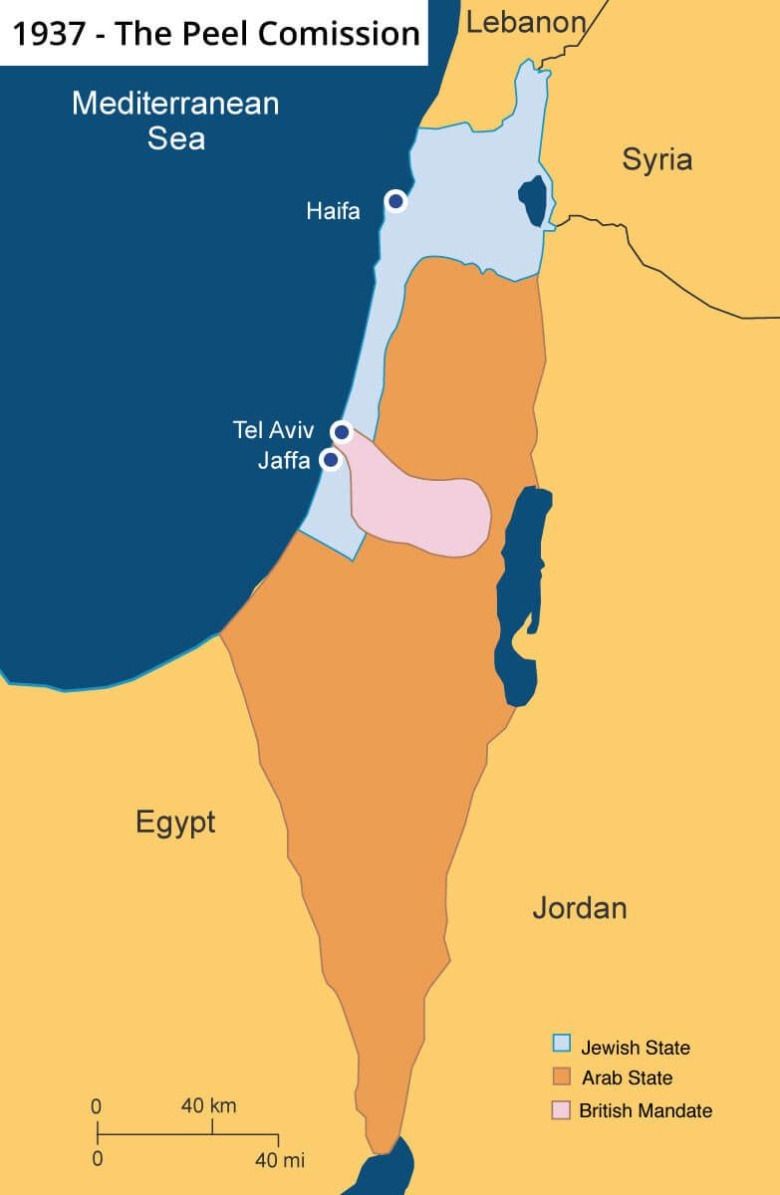
However, Jewish passionarity (their share of the region’s population grew from 8 to 32%) by itself was destroying the patriarchal way of life of the local Arabs. As early as the 1920s, Muslims carried out a series of anti-Jewish pogroms, culminating in the 1936-1939 uprising. In response, the British Crown representative Lord Robert Peel proposed dividing Mandatory Palestine into two parts: Jewish and Arab-Muslim. Moreover, the Jews were to receive less than a quarter of the total territory — the very northwestern part that they had developed with their own efforts. The Jews agreed with Peel, but the Arabs rejected the plan. Their leaders firmly insisted that after the British left, the mandate territory should be entirely incorporated into a revived Syria or some other future Arab state.
Peel’s plan to divide the region between Jews (blue) and Arabs (orange). Pink marks the zone of international control, which would have included Jerusalem, Bethlehem, and other important religious centers. Image: honestreporting.com
After World War II, the British prematurely gave up the mandate over the troubled territory and handed the decision on the Palestinian issue to the young UN. The situation with the Peel plan repeated itself: the Jews agreed to a two-state solution, and the Arabs again categorically refused. But the outcome was different: on November 29, 1947, the UN General Assembly approved the division of the former Mandatory Palestine into two already equal parts by an absolute majority of votes (33 in favor, 13 against, with ten abstentions). The Arab states responded to the decision by attacking the newborn Israel, but the Jewish state not only held out, it also retained more territory than the original plan had envisaged.
Israel’s tangled prehistory bears little resemblance to “normal” colonialism — whether Spanish in Mexico or Peru, British in India or Australia, or Russian in Siberia or Central Asia. European Jews were not helped in developing new lands by any metropolis; on the contrary, both Ottoman and British authorities repeatedly obstructed Jewish migration to Palestine. The settlers followed the laws of the administrations of the time, did not provoke conflicts with neighbors, and were willing to accept an Arab state in Palestine even before the Palestinians themselves.
The newly found land was needed by the Jews not for sources of raw materials and sales markets, but for their own life as a new civic nation. Moreover, in the late 1930s and early 1940s, only resettlement to future Israel gave European Jews guarantees of physical survival. So there is no basis here for speaking of the malicious seizure of a foreign country for selfish gain.
Israel is an occupying state
This accusation in particular has much more basis than the previous one. Since 1967, Israel has indeed exercised military control over territories to which its sovereignty does not extend. The point is that this was not the result of Jewish expansionism, but of Arab attempts to destroy their state by military means.
By the end of spring 1967, the situation in the Middle East had become heated. The authorities of two states neighboring Israel, Syria and Egypt, were demonstratively moving troops to the border, accusing the Jews of preparing for war and initiating border provocations. In mid-May, Egyptian President Gamal Abdel Nasser forced the withdrawal of UN peacekeepers from the Sinai Peninsula and announced a naval blockade of Israel in the Straits of Tiran (which was already an act of war under international law). Then Jordan joined the Egyptian-Syrian alliance.
There are no longer any emergency international forces protecting Israel. And we will no longer show restraint. From now on, there will be no more complaints to the UN. Our only method of pressure on Israel will be total war and the destruction of the Zionist entity
- from the Egyptian radio broadcast “Voice of the Arabs” of May 18, 1967
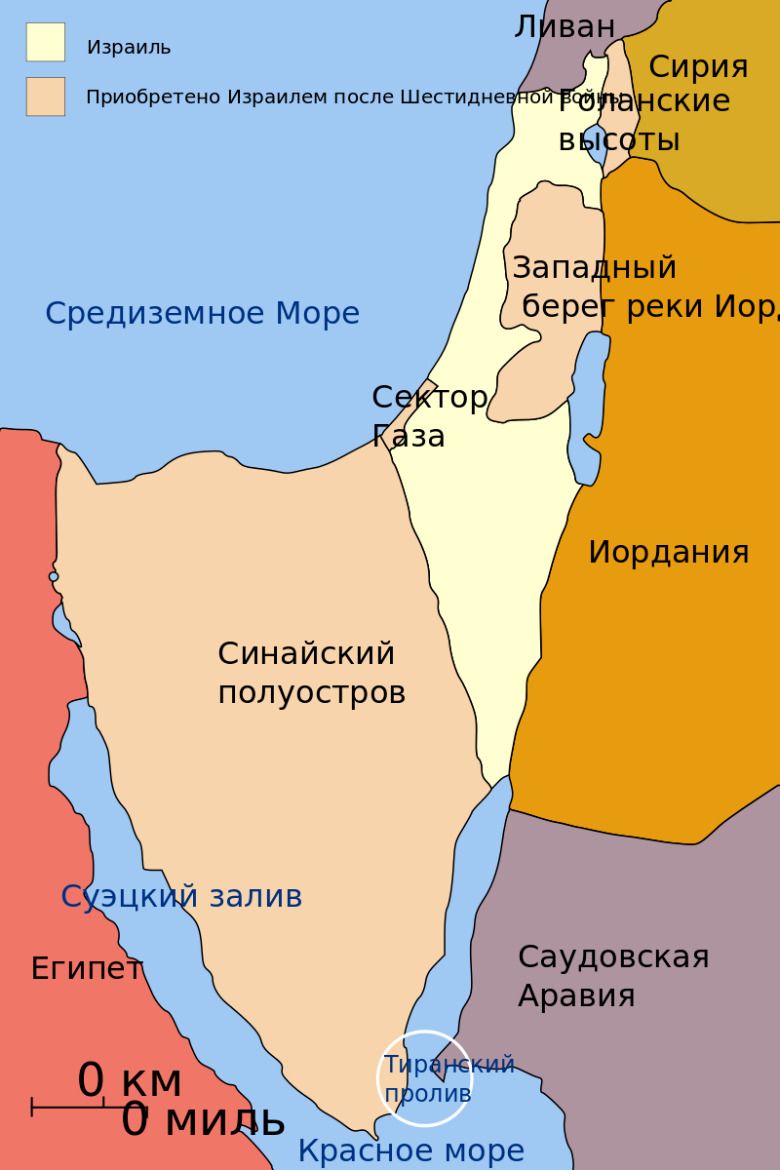
In the difficult situation, the left-wing government of Levi Eshkol, then operating in Tel Aviv, decided to strike first. And during the Six-Day War of June 5-10, Israel achieved a crushing victory. First, the lands intended for a future state for Palestinian Arabs, the Gaza Strip and the West Bank of the Jordan River, came under its control; after the 1947-1949 war, they had been controlled by Egypt and Jordan, respectively. Second, the victors gained parts of the sovereign territory of unfriendly neighbors: the Egyptian Sinai Peninsula and the Syrian Golan Heights.
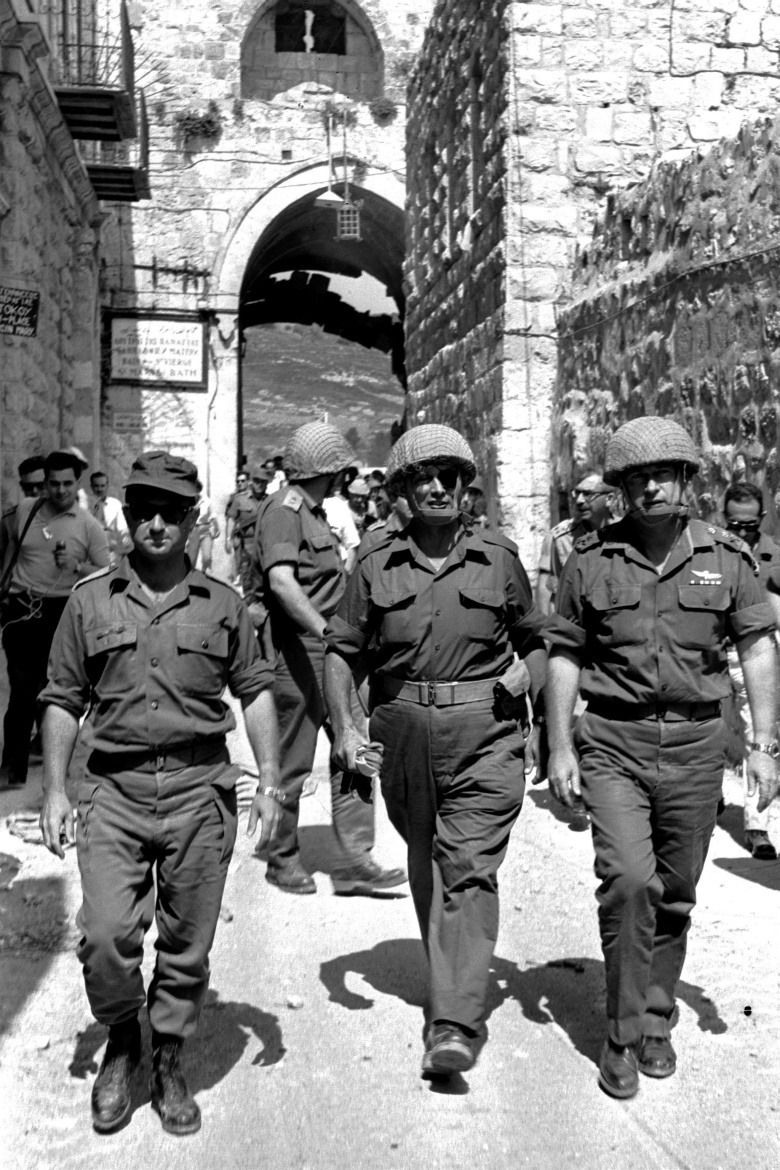
Israeli General Moshe Dayan (center) in the quarters of Jerusalem recaptured from the Jordanians, June 7, 1967. Photo: Wikipedia / Ilan Bruner
On October 6, 1973, the Egyptians and Syrians tried to take revenge by military means. The allies unexpectedly attacked Israel, but during the three-week Yom Kippur War they did not succeed — the conflict ended along the previous line of demarcation. So the Israeli authorities continued to control four foreign regions, which in total exceeded the area of their lawful territory by several times.
The Israeli political class split over the question of the future of these unexpected trophies. Left-wing and liberal forces saw them as bargaining chips and a tool of pressure on neighboring states. It was stated that any form of annexation of Gaza, the Golan, Sinai, and the West Bank was unacceptable and that they should be returned in exchange for full peace and normalization of relations with Egypt, Jordan, and Syria.
Right-wing nationalist circles insisted that nothing should be given to anyone. Supposedly, all the “new regions” had been obtained through the just defensive war of 1967, they created a natural security belt and made it possible to settle new repatriates. Starting in 1974, Jewish nationalists began establishing settlements in the occupied territories — first with the state’s lukewarm resistance, and later with its increasingly active support.
Territories occupied by Israel as a result of the 1967 war. Map: Wikipedia / Rafy
In the end, the history of the four regions developed differently. The largest trophy, the Sinai Peninsula, Israel voluntarily returned to Egypt under the Camp David Accords on September 17, 1978, in exchange for peace and the establishment of diplomatic relations. But at the same time Cairo flatly refused to take back Gaza, just as Jordan refused the West Bank (also known by its historical name Judea and Samaria). In words, both Arab states fully supported the resistance of their Palestinian brothers, but in practice they had already distanced themselves from their movements — the “freedom fighters” behaved far too unpredictably.
Efforts by the Israeli authorities to build bridges with Syria also came to nothing. As a result, in 1981 the Knesset decided to annex the Golan Heights — as a region with a compact population and strategic importance; in 1949-1967 the Syrians systematically shelled Israel from there. As early as 1980, the Israelis decided the fate of East Jerusalem, separated from the rest of the West Bank, in the same way. Only it was important not strategically, but symbolically, since it is in the eastern part of the ancient city that most of the places sacred to Judaism are located.
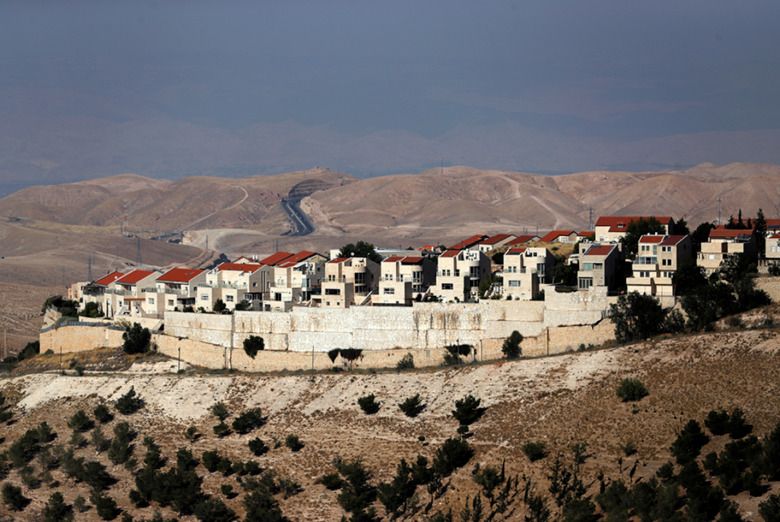
The Jewish settlement of Maale Adumim in the West Bank near Jerusalem. Photo: Ronen Zvulun / Reuters
The Gaza Strip and the West Bank, however, remained in limbo. No one was in a hurry to take them away from Israel, and the Israelis could not annex the two regions — because of the millions-strong, rapidly growing, and mostly disloyal population. Establishing settlements there seemed to the authorities in Jerusalem the best of the worst options, since it guaranteed partial control over the two troubled territories even after the formal reconciliation of the parties in 1993-1995 under the terms of the Oslo Accords. International accusations of occupation were consistently countered by the Israeli authorities with the argument that only states can be occupied, and that in Gaza or on the West Bank no states had existed after 1947.
The “Judaization” of the West Bank is essentially creating colonial relations between Israeli Jews and Palestinian Arabs. This will have more serious consequences than simply, as diplomats say, “an obstacle to peace”. The readiness of Israeli society to give up Sinai for peace was encouraging, but the problems concerning the West Bank are much more complicated.
- Peter Demant, Dutch historian
Even here, however, the historical scenarios again diverged. In 2005, then Israeli Prime Minister Ariel Sharon announced the complete withdrawal of Jewish settlements from Gaza. His cabinet considered it too costly and risky to leave its citizens on this overpopulated territory with limited resources. Already in 2007, radical Islamists from Hamas seized power in the Strip — 16 years later, it would be this movement that carried out the massacre of October 7.
On the West Bank and in the annexed regions, neither Sharon nor his successors rolled anything back. By 2026, there are more than 210 settlements in the territories controlled by Israel. About two-thirds of them are on the West Bank. Altogether, about 700,000 people live in them — almost 9% of the population of the Jewish state. And after October 7, 2023, most citizens tend to think that abandoning this controversial practice would threaten worse consequences than continuing it.
Israel is an apartheid state
This point should be considered as a continuation of the previous one. As a rule, most of those accusing Israel of apartheid (with the exception of the most exalted crowd) mean not life in the territory within the so-called “green line”, but what is happening in the de facto occupied West Bank.
As already mentioned, the overwhelming majority of Jewish settlements are located precisely in Judea and Samaria. In the early 1990s, the Oslo Accords between Israeli Prime Minister Yitzhak Rabin and the head of the Palestinian National Authority Yasser Arafat divided the West Bank into three zones: “A” (under PNA control), “B” (under joint control), and “C” (under Israeli control). Their borders were uneven: zones “A” and “B” emerged as patchworks from separate Arab villages and towns, whereas zone “C” formed a continuous mass on more than 60% of the region’s territory.
Zones “A” (red), “B” (red), and “C” (green). Map: Wikipedia / SoWhAt249
Such a scheme was not intended to be permanent, and in the 2000s the Arabs received a number of proposals to revise the borders in their favor. Thus, the plan of former Israeli Prime Minister Ehud Olmert envisaged the liquidation of most settlements and the transfer of up to 95% of the West Bank to the PNA. But Arafat’s successor Mahmoud Abbas considered these conditions insufficient, and Olmert too weak a politician to guarantee their implementation.
As a result, the three zones still exist, which creates a great many difficulties for Arabs without Israeli citizenship on the West Bank. It is hard to survive there without contact with Jewish settlements, but Palestinians — with many restrictions — can only stay and work in zone “A” without the right to permanent residence.
We are constantly being driven out of here. It is hard to live here, we have fewer rights than you do when you [foreigners] come to Hebron. We cannot walk along most streets without permission, take people to the hospital, buy cigarettes, or visit friends
In addition, Israeli civil law does not apply to Palestinian Arabs — any violations are handled by military courts. The situation is worsened by the traditionally nationalist and Islamophobic attitude of the core settlers. Sometimes this takes shape in attacks on Arabs, often with the demonstrative non-interference of Israeli security forces, and after October 7, 2023, such incidents began occurring more often. All this gives critics of Israel, including Israeli human-rights NGOs themselves, grounds to accuse the state of apartheid.
Israelis from the settlements celebrate Purim. Ofra, March 2012. Photo: Wikipedia
At the same time, discrimination here is still based on citizenship, not ethnicity or religion. Arabs with Israeli passports live in Judea and Samaria with the same scope of rights as their Jewish fellow citizens. Another matter is that in Israel’s Arab community the settlements are viewed extremely negatively, and moving there — usually for work or study — happens only in exceptional cases. As of 2022, Arab citizens were registered in 33 settlements. In most cases this involved only a few dozen people, with the exception of the large settlement of Ariel with its university, where 573 Arabs studied.
At present, more than 2.15 million Arabs hold Israeli citizenship. These are mainly descendants of the 160,000 Muslims and Middle Eastern Christians who, for various reasons, remained in the “Zionist entity” after 1949. On the one hand, Israel initially recognized them as its citizens; on the other, one can speak of real equality between Israeli Arabs and Jews only from the mid-1970s. It is characteristic that ethno-religious minorities such as Druze, Circassians, Christians, or the Bedouins of the Negev desert are still considered better integrated and more loyal to Israel than Sunni Arabs proper.
Israel is a genocidal state
In this case, the accusation should be specified. What is meant here is not the topical accusation in the context of Operation “Iron Swords”, announced by the government of Benjamin Netanyahu in response to the invasion of October 7, 2023, but a more fundamental one — that today’s Israel is in principle built on genocide. This refers to the mass killings and expulsions of the Arab population of Palestine during the 1947-1949 war, known as the “Nakba” (“Catastrophe”). By the lowest estimates, the process affected 700,000 people.
Jewish militiamen escort Arabs fleeing with their belongings. Haifa, late April 1948. Photo: Wikipedia / hbvl.be
For the Jews, the first of the Arab-Israeli wars was imposed on them. Most citizens of the newborn state after the Holocaust simply wanted a peaceful life within the borders allotted by the UN and had no claims against the Arabs. Meanwhile, the opposite mood prevailed in the opposing camp. For the Arab elites, the Jewish republic in former Mandatory Palestine was unacceptable by virtue of its very existence, and their leaders did not hide their plans against the unwanted neighbors.
“I hope the Jews will not force us to go to war, otherwise it will be a war of annihilation. A terrible massacre that history will remember just as it remembers the Mongol conquests or the Crusades. We will throw the Jews into the sea”
- Abdurrahman Azzam, Egyptian politician, Secretary-General of the League of Arab States, October 1947
At the Arabs’ instigation, violence against the civilian population became part of that war from the outset, and the Jews quickly responded in kind. All the more so because they were not fighting each other with full regular armies with discipline and regulations, but rather networks of volunteer militias. Israel had two such militias, the Irgun (also known as “Etzel”) and Lehi, and they did not shy away from openly terrorist methods.
Their militants really did systematically destroy Muslim villages whenever they had any pretext, such as rumors of local residents helping the enemy. Or without one — if a particular settlement occupied a “too strategic” position on the map. For example, on April 9, 1948, Etzel and Lehi killed about 150 residents in the Arab village of Deir Yassin near Jerusalem, and forcibly evacuated the survivors to their rear. According to one version, the Jewish militiamen were acting on information that there was a base of phantom Iraqi volunteers in Deir Yassin; according to another, the village was simply too close to the road and posed a risk to communications between Jerusalem and Tel Aviv.
There were many dozens of similar episodes in the history of the 1947-1949 war. Israeli historiography attributed them to the autonomous actions of radicals from Etzel and Lehi and insisted that most Palestinians had still left their homes voluntarily or under the influence of Arab coalition propaganda. Accordingly, Muslim authors emphasized the opposite: Jewish violence was systemic, and it was this violence, except in rare cases, that forced Arab civilians to flee. Most likely, the truth lies somewhere in the middle.
However, other details are also important for understanding the process. As noted above, after the war Israel did not touch the 160,000 Arabs who remained on its territory and granted them citizenship. At the same time, Arab states after their defeat expelled about 800,000 Mizrahim (Middle Eastern Jews), who were initially far from pro-Israeli sentiments. Nevertheless, small Israel accepted and integrated all the Mizrahim, while the huge Arab world utterly failed at the same task in relation to Palestinian refugees.
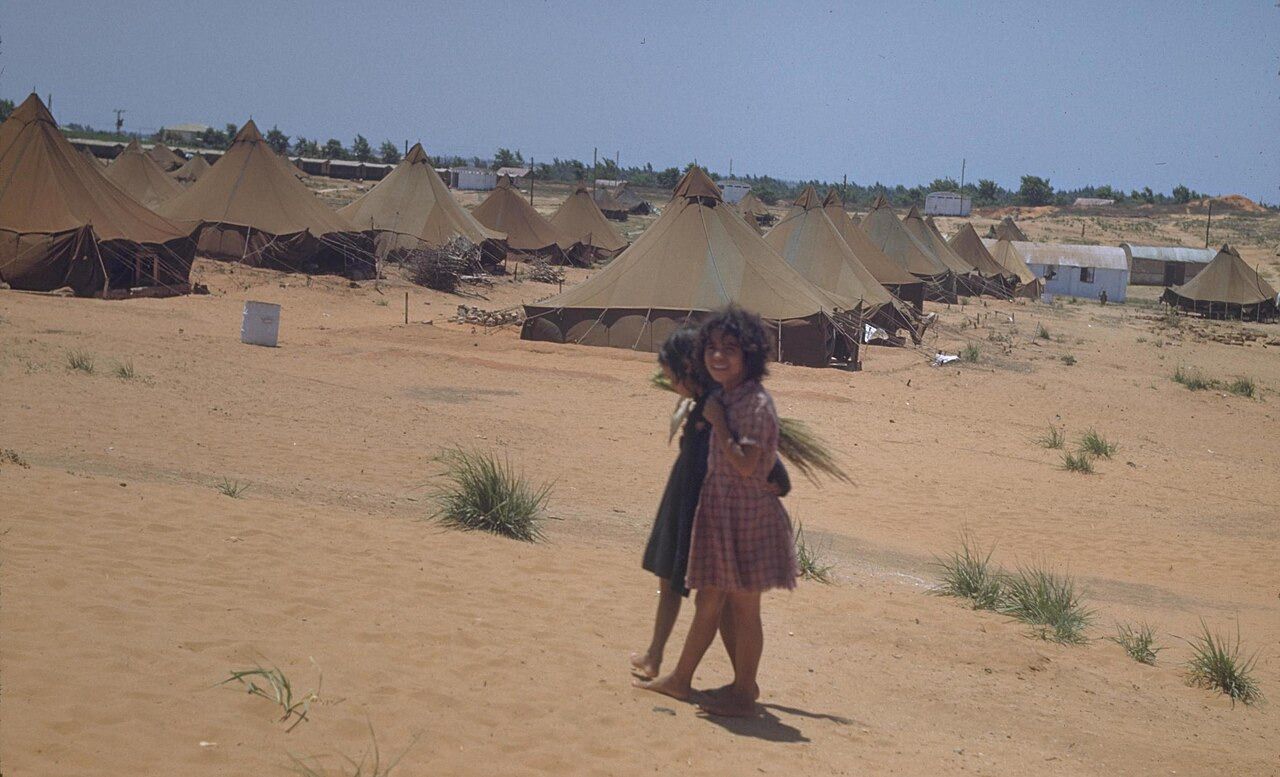
Girls walk through a camp for Jews who fled Arab countries, 1950. Photo: Wikipedia / Seymour Katcoff
Worse still, the relevant UN agency for assistance to Palestinians (UNRWA) chose a deliberately absurd strategy of work. The structure began passing refugee status down by inheritance, and as a result by the 2020s there are about 6 million “hereditary refugees” — that is, almost nine times more than at the end of the war.
Another circumstance is also noteworthy. Initially, the concept of the “Nakba” in the Arabic-speaking environment did not carry the same meaning as it does now. Its author, the Syrian philosopher Constantin Zureiq, meant by “Catastrophe” the fact of the military defeat of the alliance of eastern states by a single Israel. Yes, in the book of the same name Zureiq mentioned the exodus of the Palestinians, but only in passing, as just one manifestation of the larger catastrophe.
The reinterpretation of the “Nakba” in the Arab world stretched over decades, and its current concept took shape only by the 1990s. By then, even the most militant fighters against Zionism had realized that Israel could not be thrown into the sea, and that it was better to appear before the world not as repeatedly beaten aggressors but as innocent victims. And the rebranding worked, at least for part of the Western public.
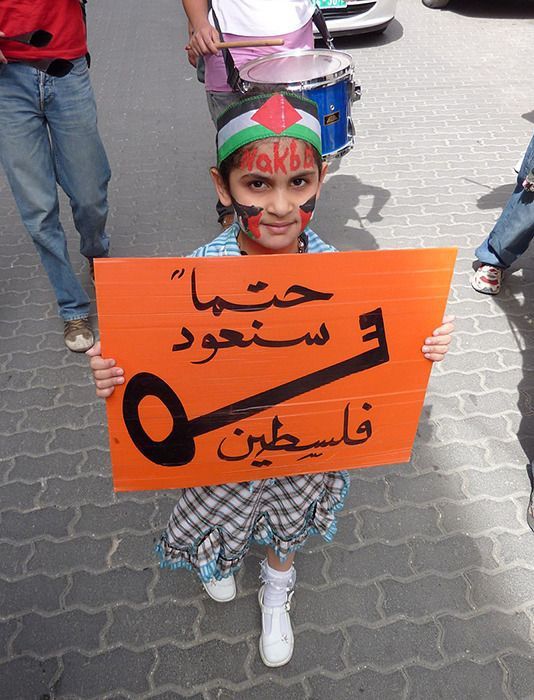
A Palestinian girl with a poster reading “Of course we will return” on Nakba Day (May 15). West Bank, Hebron, 2010. Photo: Wikipedia / Shy halatzi
By the 2020s, everything pro-Palestinian in Europe and North America is perceived as progressive and anti-colonial — up to the slogan “From the river to the sea Palestine will be free”of Hamas extremists, with an obvious hint at the complete destruction of Israel. Of course, this toxic fashion of sending a de facto nonexistent state neither to the river nor to the sea will not help, but it has already seriously distorted the Western world’s understanding of the Middle Eastern conflict.
Main sources for the article
Zhukov P. “The Foundation of Modern Israel”;
Kaplan N. “The Arab-Israeli Conflict: Irreconcilable Versions of History”;
Maryasis D. “Chronicle with an Open Ending: The History of the Palestinian-Israeli Confrontation”;
Rogan Y. “A History of the Arabs, 16th-21st Centuries”;
Finkel E. “Israel: Two Thousand Years Later”;
Shapira A. “The History of Israel: From the Origins of the Zionist Movement to the Intifada”;
Epstein V. “Palestinian Refugees”: The Specifics of Defining the Concept and the Difficulties of Solving the Problem“.
If you enjoyed this article, consider making a donation — one-time or, even better, monthly. Your support helps us motivate our authors and become better with every article.
Our organization is recognized by the Internal Revenue Service (IRS) as a 501(c)(3) tax-exempt, charitable organization, which means that all contributions made to us are tax-deductible to the fullest extent permitted by U.S. law. Individuals may generally deduct charitable contributions of up to 60% of their Adjusted Gross Income (AGI) for cash donations made to qualifying 501(c)(3) organizations. For donations of appreciated assets (such as stocks or other long-term capital assets), the deduction is typically limited to 30% of AGI, based on the fair market value of the asset. C-corporations may deduct charitable contributions of up to 10% of their taxable income for donations made to eligible charitable organizations.
By submitting a donation, you confirm that you have read and accept the following documents: Privacy Policy and User Agreement, and also give consent to the processing of your personal data.
If you would like to unsubscribe from a monthly donation, please email us at: [email protected]