In July 1410, two predatory powers emerged simultaneously in Eastern Europe, and the star of the last romantic crusaders set forever.
The history of medieval Europe is largely a history of wars. Big and small, short and long, with old neighbors and against conquerors who appeared out of nowhere. And only one of these wars entered history as the Great conflict of 1409-1411 in the southern Baltic region. At that time, the Teutonic Order knights were challenged by the Kingdom of Poland and the Grand Duchy of Lithuania.
But what was so great about this war? It did not produce a truly grand empire, lasted a mere two years which was short for its era, and consisted of only one truly great battle — the famous Battle of Grunwald. Nevertheless, its long-term consequences are hard to overestimate: it radically changed the balance of power in the region for centuries and became an important element in several national mythologies: among both the victors, the defeated, and even peoples not involved in the conflict.
Of course, the same event is viewed very differently in various historiographies. So who thought what about this 15th-century battle — and what really happened?
The Master, Brothers, Two Swords
Morning of July 15, 1410. A wide field between three villages: Grunwald, Ludwigsdorf (Lodwigowo), and Tannenberg (Stębark). Today this is the Warmian-Masurian Voivodeship, the far northeast of Poland, but in the early 15th century these lands belonged to the Order of the Brothers of the German House of Saint Mary in Jerusalem, better known as the Teutonic Order. “Teutons,” named after an ancient Germanic tribe once hostile to Rome, was a term medieval Europe often used to refer to all Germans.
Over two centuries in the Baltic, the knights had conducted many conquest campaigns. But this time they were defending their lands. From the south, two longtime foes attacked the Order: Polish King Jogaila and Lithuanian Duke Vytautas (Vytautas the Great). Destroying everything and everyone in their path, the anti-Teutonic coalition forces confidently advanced north toward the Order’s capital Marienburg (modern Malbork near the Polish-Russian border). Cousins Jogaila and Vytautas clearly planned to defeat the crusaders at their main city before their allies could arrive.
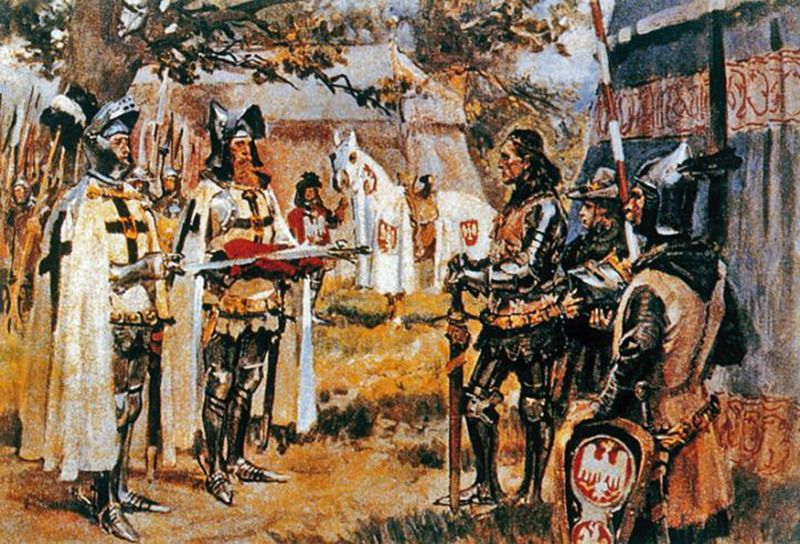
Scene of the sword gift in Wojciech Kossak’s painting (1909). The envoys, contrary to facts, are depicted in the colors of the Order itself rather than its vassals. Image: Wikipedia
However, the Grand Master of the Order, 50-year-old Ulrich von Jungingen, shattered the enemy’s plans. The commander led the Teutonic army out to meet the foes and caught up with them about 90 km southeast, between Tannenberg and Grunwald. The message was clear: Jungingen did not want to sit behind fortress walls and was not afraid to fight on open ground. Jogaila and Vytautas, despite their numerical superiority, were somewhat taken aback.
Then, according to legend, the master decided to spur his adversaries. He sent two envoys from his troops to their leaders. Notably, both represented not the Teutons themselves but their Polish vassals, the Duchies of Szczecin and Oleśnica. From a medieval perspective, the people of Szczecin and Oleśnica were doing nothing terrible: they were simply serving their suzerain, fulfilling their lawful duty.
“...In the bright rays of the sun, it was clear to see them approaching on tall warhorses covered with caparisons. One bore the imperial black eagle on a golden field on his shield, the other, a herald of the Duke of Szczecin, bore a red griffin on white. The ranks of warriors parted before them, and dismounting, the heralds appeared before the great king within a minute. Bowing their heads and thus paying him homage, they proceeded to business.
- Master Ulrich, — said the first herald, — summons you, Your Majesty, and Duke Vytautas to mortal combat. And, to lift your spirit, as you seem to have little courage, he sends you these two naked swords.
With these words he laid the swords at the king’s feet.”
- Henryk Sienkiewicz, Polish writer (novel “The Teutonic Knights”)
Later, the episode with Jungingen’s strange gift became one of the key details in descriptions of the Battle of Grunwald. Various sources mentioned it: most likely, the master really sent two swords to the enemies before the battle. But what did this act mean? History is written by the victors, and Polish and Lithuanian chroniclers — whose tradition Sienkiewicz continued — had no doubt. The Teutonic leader’s gesture was clearly mockery; the German tried to needle Vytautas and Jogaila, but in the end, he was rightly punished for his pride on the battlefield.
The theory, frankly, seems far-fetched. One doesn’t need to be a medievalist to list a dozen ways to express contempt much more clearly and vividly. Perhaps the devout Ulrich did not want to provoke the foes but remind them of something higher? If so, Vytautas and Jogaila, both newly converted Christians and not the most devout, did not understand the message.
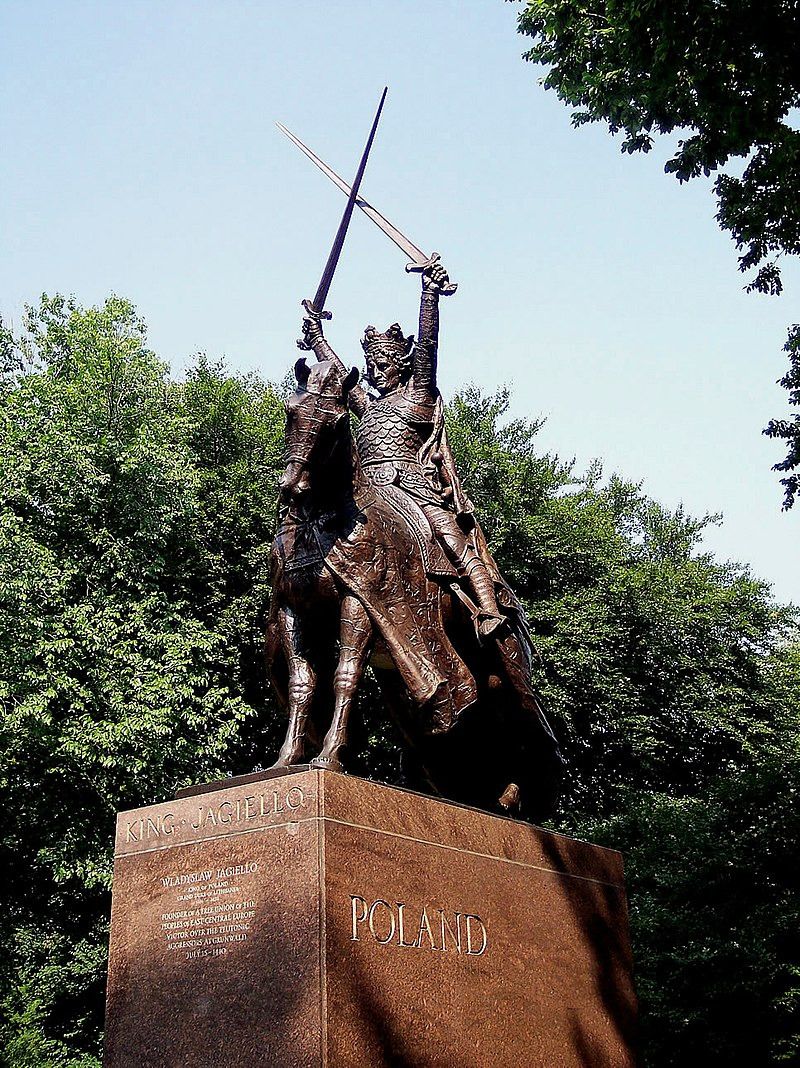
Monument to Polish King Jogaila in New York, 2005. Photo: Wikipedia / Uris
Meanwhile, two swords are mentioned in the Gospel of Luke, at one of the most important moments of the narrative — just before Christ’s prayer about the cup (Luke 22:36-38). Jesus warns the apostles in this passage: “What is written about Me is now being fulfilled.” It’s possible that the pious Jungingen saw in the Grunwald field a higher judgment over his people and the Poles and Lithuanians. And it ultimately became Golgotha for the Teutonic Order.
The Price of an Unpaid Fee
How did the German Order of Jerusalem end up in the Baltic? The connection with the Middle East lasted only for the first couple of decades after the brotherhood’s founding in 1190. The crusaders on the Holy Land were facing tough times, and the Teutonic leadership soon decided to try their luck elsewhere. But neither Venice nor Transylvania proved hospitable for the Germans.
In the 1230s, the Order’s knights arrived near their historical homeland — in Prussia. In the early 13th century, this land was not considered German at all; it was home to the Prussians, a coalition of Baltic tribes. They practiced traditional beliefs, maintained clan structures, and troubled their neighbors, the Poles, with raids. Their king Conrad I invited the crusaders to settle on his borders, promising them autonomy over lands conquered from the Prussians.
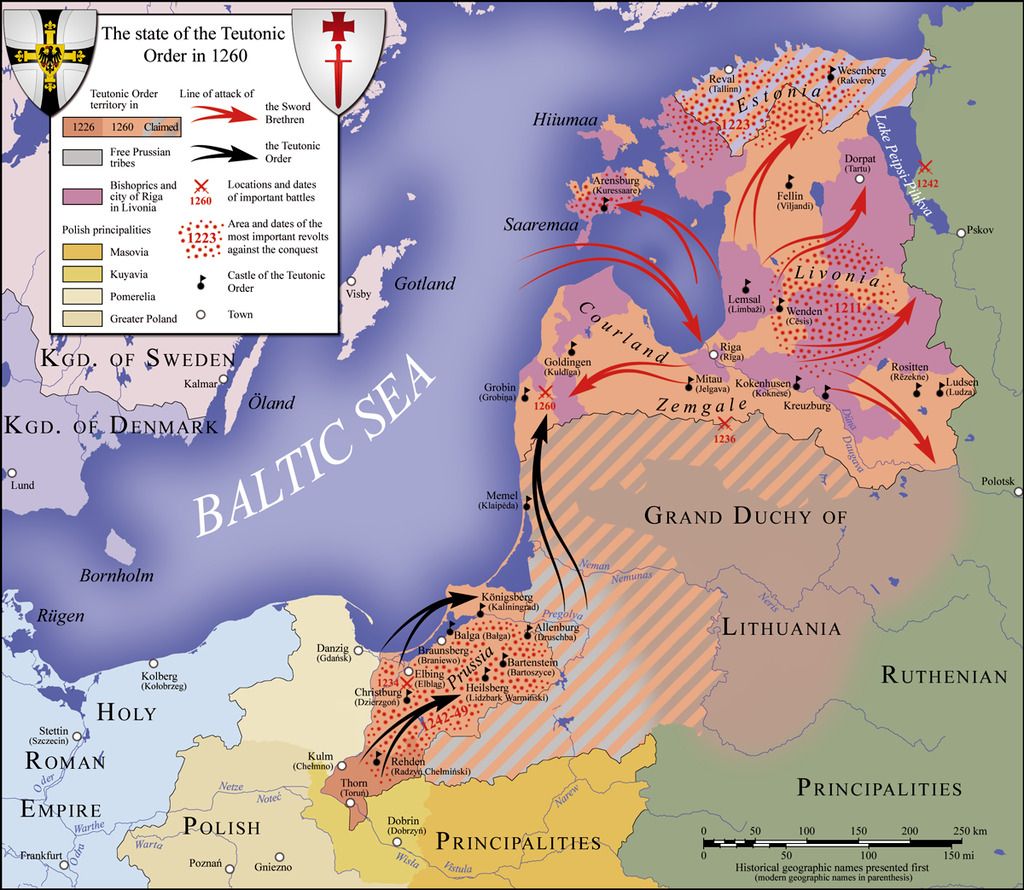
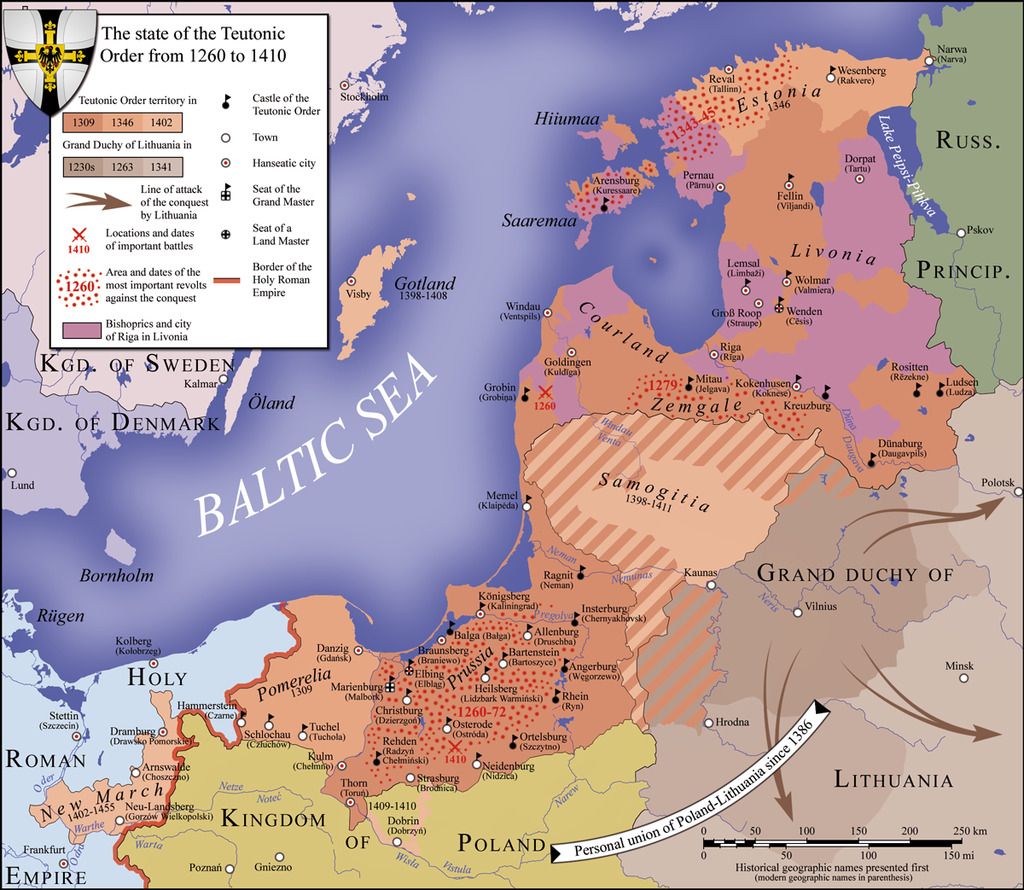
Teutonic expansion in the 13th century. Map: Wikipedia / S. Bollmann
The Teutons accepted Conrad’s offer. On one hand, they could govern themselves on new territories; on the other, they were “gifted” with a just war in the eyes of a medieval Catholic. What could be holier for Christ’s warriors than to convert wild pagans to the true faith? This struggle promised honor throughout Christian Europe and, consequently, an influx of volunteers and generous donations.
By the 1280s, the Order had conquered the Prussians and effectively founded its own state in the southern Baltic. It was then that the knights established a number of modern cities in northern Poland and the Kaliningrad region of Russia as their fortresses: Toruń, Chełmno, Elbląg, Königsberg (Kaliningrad), Pillau (Sovetsk), Tapiau (Gvardeysk), and many others. But the Teutonic Drang nach Osten did not stop there. The crusaders faced a new opponent — pagan Lithuania.
The Lithuanians were a far more dangerous enemy than the Prussians. Unlike their pacified distant relatives, by the 1230s they had developed a proto-centralized state. They could build fortresses, fight field battles, and—most importantly—conduct diplomacy: first with the principalities of Northeastern Rus’, then with their southern neighbor Poland. It’s no surprise that Teutonic campaigns against this new foe often ended in painful defeats, such as in 1298 near Treiden (modern Sigulda, Latvia). Sometimes the Order had to halt expansion and, as in the 1320s, defend against pagan raids.
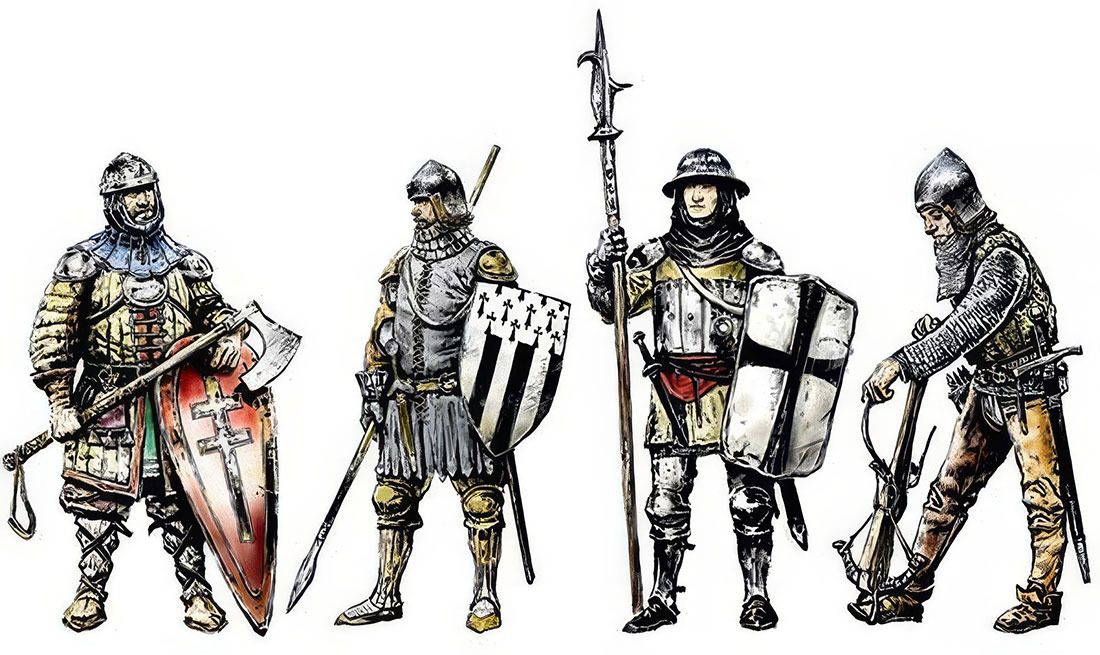
Reconstruction of European infantrymen’s appearance at the turn of the 14th-15th centuries: Lithuanian, Pole, Teuton, and mercenary crossbowman. Image: vokrugsveta.ru
Worse still, by that time the Teutons had lost a reliable rear to the southwest. Throughout the 13th century, the Kingdom of Poland grew stronger, and the Order’s state transformed from a reliable defender to an obstacle complicating Poland’s access to the Baltic Sea. In 1308, open conflict erupted between the sides. Western neighbors from the German Margraviate of Brandenburg attacked Polish Gdańsk. The Teutonic knights initially fulfilled their alliance obligations and expelled the Brandenburgers from the city. But Polish King Władysław I refused to pay the crusaders’ requested fee for the mission; in retaliation, the Teutons slaughtered local Poles in Gdańsk and kept the city, renaming it Danzig.
After the Gdańsk incident, relations between the Order and the kingdom rapidly deteriorated. Former partners became implacable enemies.
Fake Baptism and the Fatal Vow
Meanwhile, Poland’s relations with Lithuania slowly warmed throughout the 14th century. By the late 1370s, the two states had settled all disputes and increasingly cooperated—primarily against the Teutonic Order.
However, the confessional factor long hindered the Polish-Lithuanian union. The dukes in Vilnius feared baptizing their country, believing adherence to paganism was the core of Lithuanian independence. But in 1385, this barrier fell: Lithuania and Poland signed the Union of Krewo. The treaty stipulated that Lithuanian Duke Jogaila would convert to Catholicism (taking the name Władysław) in exchange for marrying Polish Queen Jadwiga and, accordingly, his own coronation as King of Poland.
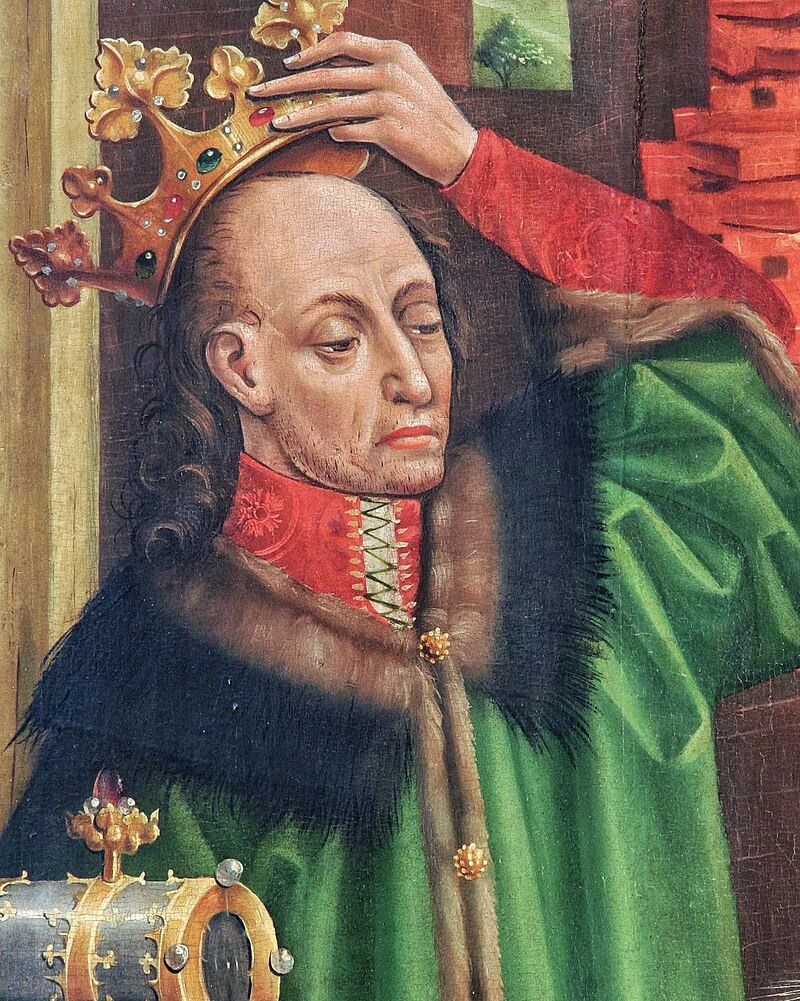
King Władysław II (Jogaila), fragment of the Wawel Cathedral fresco. Image: Wikipedia
Between 1386 and 1389, the entire Grand Duchy of Lithuania underwent a voluntary but forced baptism following the union. Almost all of Europe rejoiced—the last major pagan stronghold had finally fallen. But the Teutonic knights lamented: it seemed the Poles had achieved in one document what the Order had failed to do at the cost of many wars. Most importantly, Christian Lithuania rendered the crusaders’ presence in the Baltic pointless. After all, against whom were they to bear their cross now?
In despair, the Germans tried to convince the Vatican that the baptism of their old enemies was a ruse, and in reality, the Lithuanians remained vile pagans. It’s not that the knights were entirely slandering: local aristocrats had indeed previously accepted Christianity (both Catholic and Orthodox) for political reasons, only to often return to polytheism. But Pope Urban VI cared little for the new flock’s piety. Lithuania was now within the Church, period—no more crusades against this country.
Meanwhile, a full-scale conflict was brewing in the Baltic—the Teutonic Order sought control over the entire Baltic coast. The knights wanted to secure land corridors from Prussia both to the German principalities and to their “enclave” in Livonia, a region at the border of modern Estonia and Latvia. Thus, the question of Samogitia, the coastal part of Lithuania, de facto controlled by neither the Order nor the Grand Duchy of Lithuania, became acute; its population continued practicing paganism even after 1389. Gaining this region would open new opportunities for forced Christianization and simultaneously push the duchy deeper inland.
Teutonic expansion in the 14th century: showing how Lithuania and Samogitia “interfered” with the territorial integrity of the Order’s lands. Map: Wikipedia / S. Bollmann
At the turn of the 14th and 15th centuries, the Order was led by Conrad von Jungingen: not a fanatic crusader by spirit, but a pragmatist and skilled diplomat. In 1404, the Grand Master seized the moment to impose a treaty favorable to the Germans on Lithuanian Duke Vytautas—cousin of the Polish King Jogaila. In exchange for their elaborate promises of assistance and good neighborliness, Vytautas ceded coveted Samogitia. It seemed the Teutons were keeping pace with the times and had learned to achieve their goals with pen rather than sword.
However, Conrad died in 1407. According to legend, the old man suffered from gallbladder disease; doctors prescribed sexual activity as medicine, but the warrior-monk loyal to his vows of chastity made in youth refused to break it. The Order’s chapter (assembly of the leadership) elected Conrad’s younger brother, Ulrich von Jungingen, a far more warlike man, as the new Grand Master.
Rumor had it that Conrad, on his deathbed, even bequeathed his comrades never to elect a relative as successor. They disobeyed—and were soon cruelly punished for it.
By Mutual Consent
In early 1409, an anti-Teutonic uprising erupted in Samogitia. Lithuania officially reassured the Order in a “there’s no such thing” manner: we are not responsible for wild pagans.
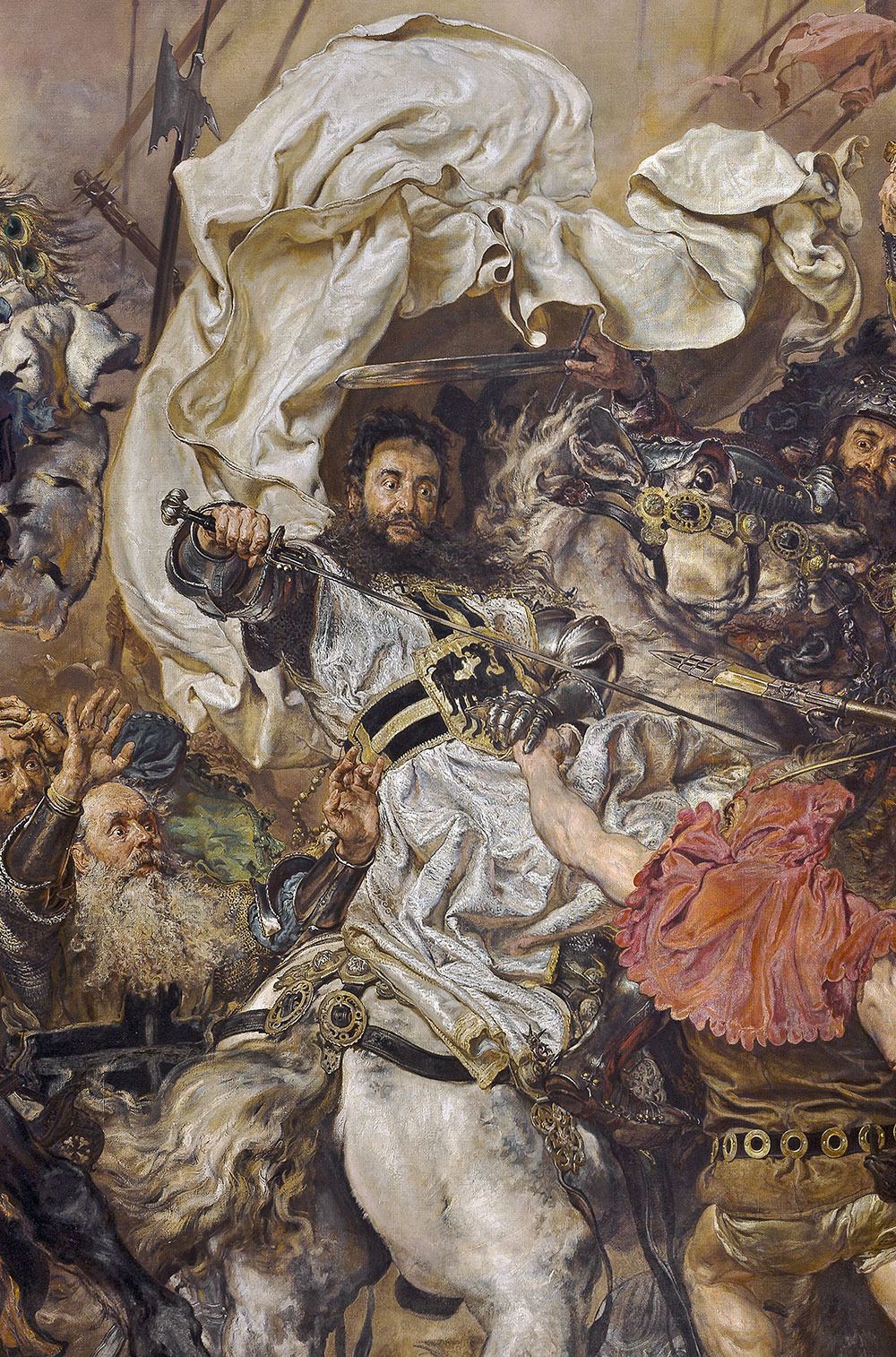
Death of Ulrich von Jungingen in Matejko’s painting. Image: Wikipedia
But Jungingen the Younger had no illusions about his neighbors. Spies in Vilnius reported that Vytautas publicly promised his close allies a swift war against the knights— “until they run to the sea and drown in it themselves.” In summer 1409, the Order officially declared war on both Lithuania and Poland, to which the Germans also had territorial claims:
“Better to strike at the head than the limbs, better on inhabited land than abandoned, and better on towns and villages than forests, turning the weapon meant against Lithuania against the Kingdom of Poland. We see that the damage we suffer in Samogitian land is because of the King of Poland and his intrigues, and no one else.”
- Ulrich von Jungingen
The master was not mistaken about the alliance of the Polish king and Lithuanian duke (officially sealed in 1409), who were cousins. It’s worth noting the insincerity of their friendship—their branches of the Lithuanian dynasty once fought each other fiercely. In fact, Vytautas’s parents were killed by order of Jogaila. But in 1409, both rulers clearly decided that joint triumph over the Order was far more important than childhood grievances.
Still, the chance to avoid a major war remained. The sides initially exchanged local raids and submitted their territorial disputes to arbitration by King Wenceslaus IV of Bohemia. In February 1410, the monarch tried to save the situation with a Solomon-like decision: the Order would keep Samogitia but transfer disputed borderlands to Poland. The Teutons seemed willing, but their opponents rejected the compromise. Ultimately, Vytautas and Jogaila had gathered too many vassal and mercenary troops during the lull to simply disband them.
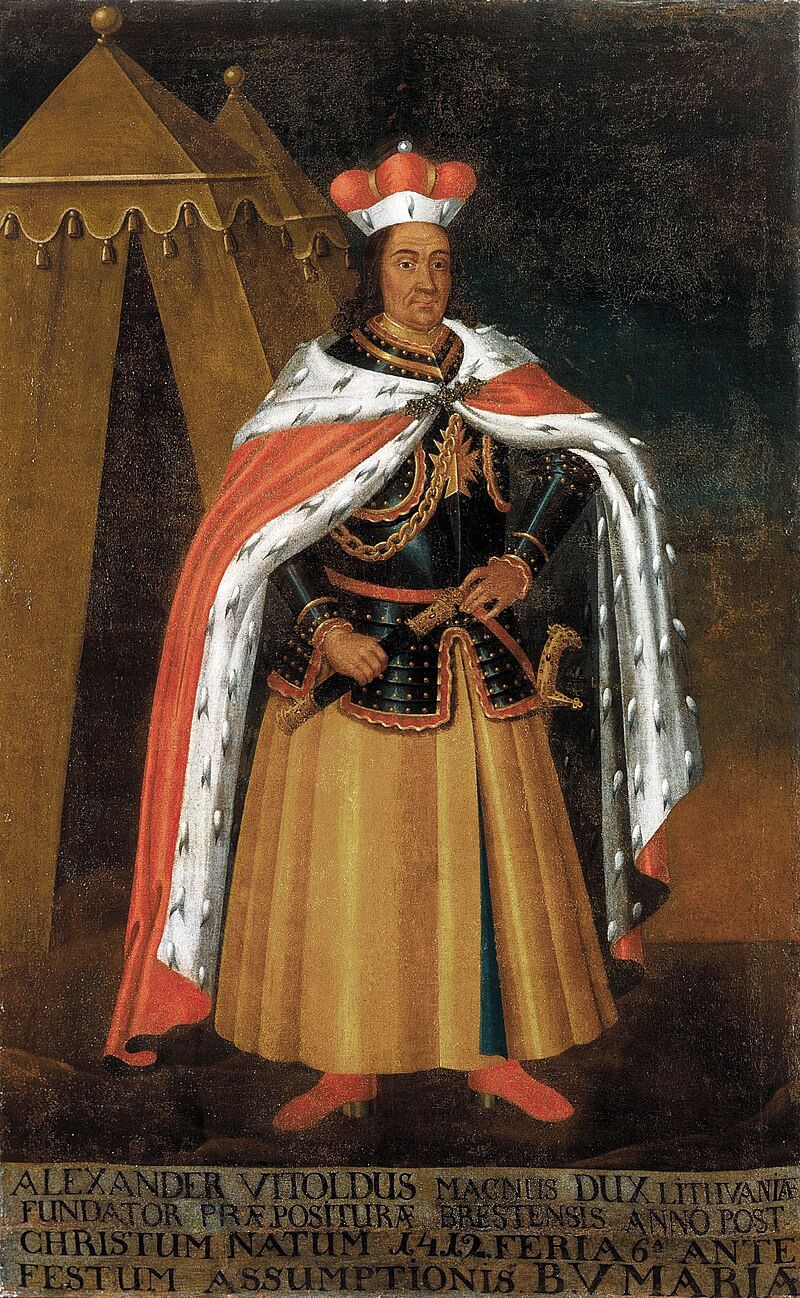
Posthumous portrait of Duke Vytautas by an unknown 17th-century artist. Image: Wikipedia
In June 1410, the agreed truce expired, and the anti-Order coalition immediately acted. Allied forces invaded Teutonic lands and advanced on the enemy capital Marienburg. Their multilingual army left scorched earth, looted churches, and heaps of corpses behind. Even Polish-Lithuanian authors later admitted their troops’ actions were extremely inhumane—several Lithuanians were reportedly hanged on Vytautas’s direct orders, despite his previous tolerance for military crimes.
However, on the morning of July 15, these games ended for the allied army. The forces of the Teutonic Order appeared seemingly out of nowhere on the field between Grunwald, Ludwigsdorf, and Tannenberg. After the aforementioned sword-gifting episode, the two armies charged at each other.
A Battle of Everyone Against Everyone
Years later, the Battle of Grunwald underwent the inevitable: its actual scale was greatly exaggerated by later historians and writers. Even now, publications claim hundreds of thousands of warriors fought on both sides. Naturally, no military genius in medieval Christian Europe could have gathered such a horde, supplied it adequately, and commanded it effectively on the battlefield.
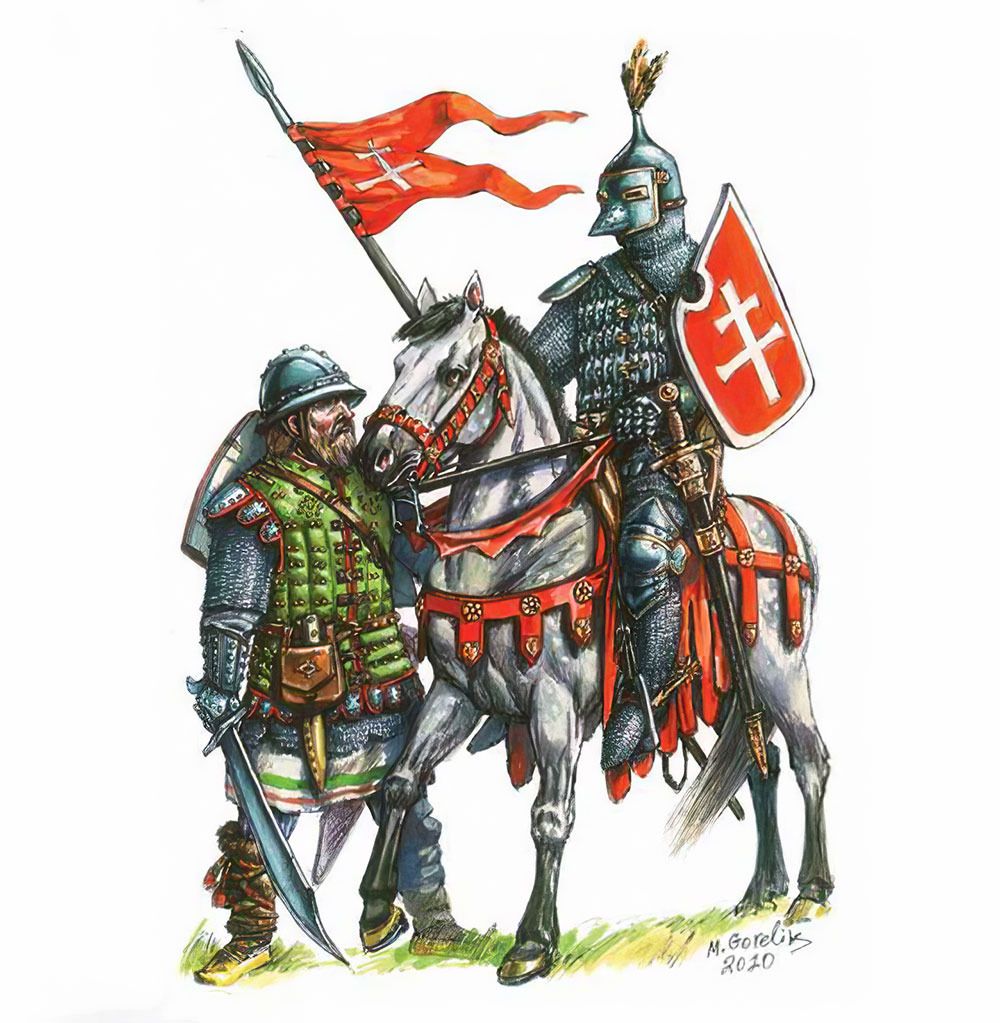
Reconstruction of armament and equipment of warriors of the Grand Duchy of Lithuania at the turn of the 14th-15th centuries: infantryman and cavalryman. Image: varvar.ru / M.V. Gorelik
Still, even taking minimal estimates, on July 15, 1410, two exceptionally large armies for their time clashed. The Teutonic Order fielded no fewer than 11-15 thousand warriors, while the alliance of their opponents had at least 16-24 thousand. Both armies had roughly a 1:2 ratio of cavalry to infantry, with cavalry playing the decisive role.
Ethnically, the Order’s army was only slightly more “German” than the forces of Jogaila and Vytautas, which were “Polish-Lithuanian.” Between one-third and one-half of the cousins’ combined army consisted of various “Rus’” subjects of the Kingdom of Poland and the Grand Duchy of Lithuania—ancestors of modern Belarusians, Ukrainians, and to a lesser extent Russians. This is because one of the roughly 90 banners (roughly battalions) of the combined army represented Smolensk, which in the first half of the 15th century was still part of the Grand Duchy of Lithuania. Alongside them fought mercenaries from Bohemia, Wallachia, Hungary, and other parts of Europe and Asia.
Generally, ethnic diversity in medieval armies was common. The army of Jogaila and Vytautas was remarkable for its rare confessional diversity. Its core was Catholics and Orthodox Christians, but it also included Tatar Muslims (a detachment of the Horde prince Jalal ad-Din who entered Lithuanian service) and pagans (Samogitians and other unbaptized Baltic tribes).
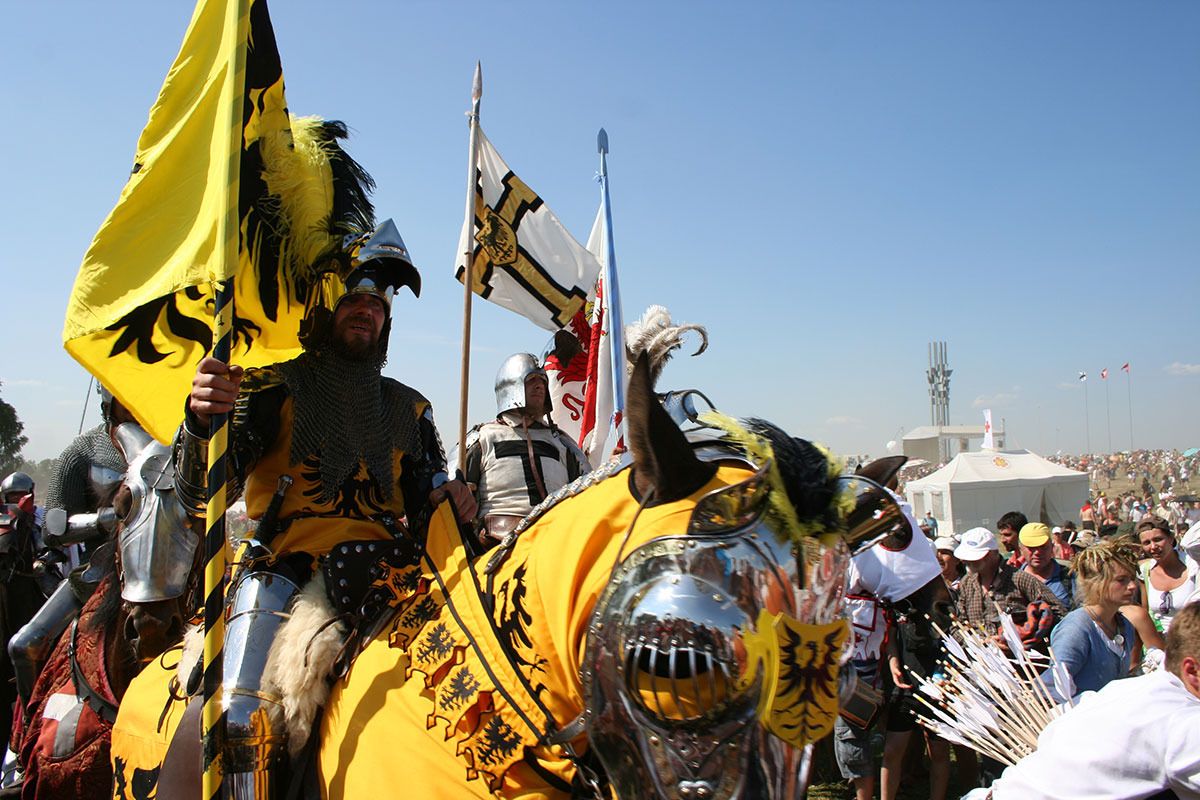
Modern reenactors dressed as Teutonic warriors, 2010. Photo: Wikipedia / Łukasz Niemiec
Ulrich von Jungingen’s army appeared comparatively homogeneous mainly because it was almost entirely Catholic. Moreover, the core of the Teutonic forces—full brothers, “half-brothers,” chaplains, and sergeants of the Order—were all from various German lands. But the knights couldn’t conduct large operations without vassal troops (such as the aforementioned Polish Duchies of Szczecin and Oleśnica), local militias, and mercenaries.
Thus, under the white banners with black crosses on the Grunwald field fought Prussians, Lusatians, Polish subethnic groups, and the same “touring” mercenaries from Hungary and Bohemia as on the opposing side. Finally, among the Teutons were always guests of the Order— Western European nobles voluntarily seeking adventure in what were then considered wild lands. In short, it was a typical medieval battle where participants were motivated by duty or greed, not yet by national consciousness.
A Brilliant Debut Followed by a Ruthless Finale
Ulrich von Jungingen’s actions were risky from the start. His forces were outnumbered by about one and a half times and were heavily fatigued after a rapid march south. Posthumous legends explained the master’s impatience by progressive cataracts: supposedly, he feared total blindness and hurried to defeat the Poles and Lithuanians while he could still see something.
Plan of the Battle of Grunwald: as seen, the main events unfolded not near Grunwald itself but near Stębark (Tannenberg). Map: Wikipedia / stjn
Apparently, Jungingen did have a strategic plan. Moreover, the Germans and their allies partly managed to implement it. Around noon, the battle began when Lithuanian-Tatar cavalry struck the left flank of the Order’s forces. But the Teutons anticipated this move; the attackers faced bombard volleys and crossbow bolts, then a counterattack by elite cavalry under the Order’s marshal (“military minister”) Friedrich von Wallenrode.
Wallenrode’s assault—where there were many Western European “guests”—was successful. The Germans and their allies crushed the enemy’s right flank and broke into the anti-Order coalition’s formations near the village of Tannenberg. Most Lithuanians retreated in panic, while the Poles on the left flank were slow to aid their partners. It’s believed that in this crisis, the Teutonic strike was held at great cost by three “banners” from the far east of the Grand Duchy of Lithuania: Orsha, Mstislavl, and Smolensk. Only then did Polish knights with Czech mercenaries rush to meet Wallenrode (according to popular accounts, future Hussite war hero Jan Žižka fought among them).
“You’re listening to mass, while my lords lie almost all dead, and your men refuse to help them.”
- reportedly a reproach from Duke Vytautas to King Jogaila
Whatever the case, the Teutonic attack faltered. The crusaders’ battle lines collapsed, and worse, Wallenrode himself died in one of the skirmishes. His place was taken by Jungingen personally, whose arrival briefly revived the troops’ spirit; the knights even recaptured one of the Poles’ main battle banners, the Great Kraków Banner. But the imbalance of forces inexorably favored the alliance of Jogaila and Vytautas—their reserves kept arriving, while the Teutons had very limited reinforcements.
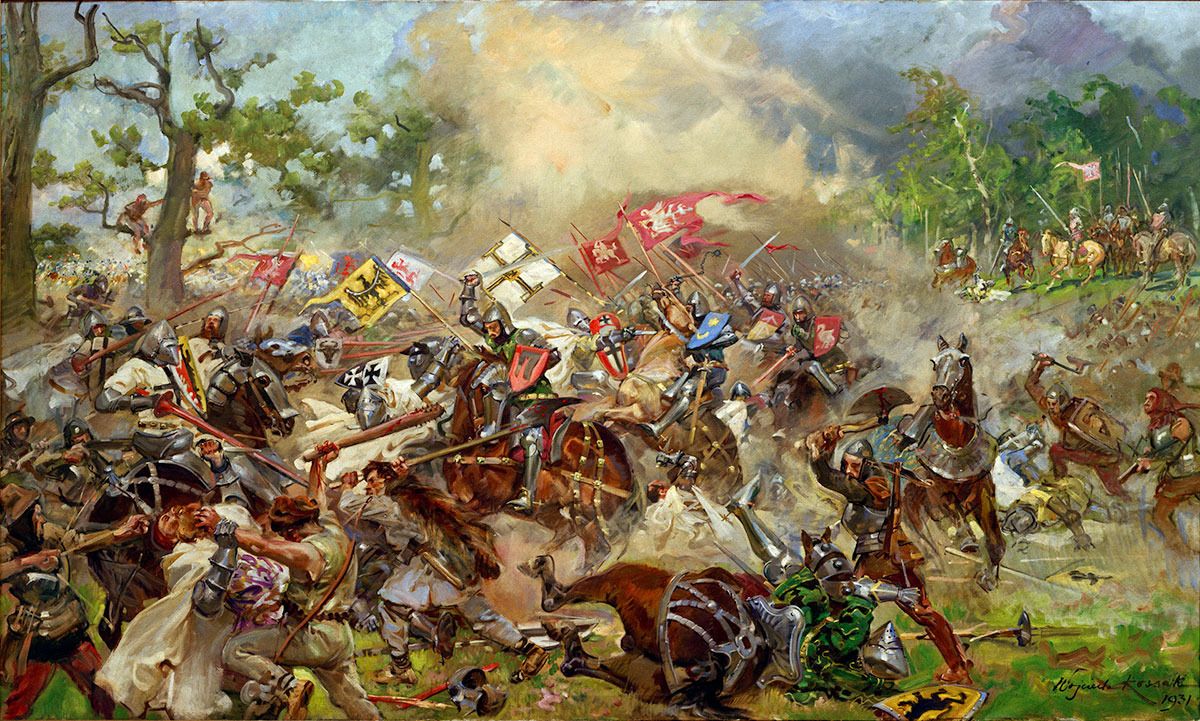
Modern reconstruction of the battle’s decisive moment: the crusaders’ vanguard perishes surrounded by coalition troops. Image: warfarehistorynetwork.com
In a new series of fierce clashes, the Poles recaptured the ill-fated banner. Soon Jungingen himself fell, still unwilling to order a retreat. The death of a commander in medieval battle never boded well for the army—especially since about a dozen senior Order officers died at the same time. Instead of retreating, the knights and their allies had to flee in disorder.
By evening on July 15, the battle ended. The Grunwald field belonged to the Polish-Lithuanian alliance and their diverse allies. Collecting trophies, capturing prisoners, and burying the dead took the victors three long days.
One Victory for Many Peoples
The large size of both armies led to huge losses. Jogaila and Vytautas’s forces lost at least 4-5 thousand killed, while their opponent’s losses likely exceeded theirs by one and a half times. But most importantly, Grunwald shattered the very fabric of the Teutonic Order.
In the battle fell the Grand Master, at least 14 commanders of komturs (fortress commanders), and about 200 full brothers of the organization—more than half of the actual officer corps. Such a gap could only be filled by a massive influx of volunteers from the West. But news from Prussia that spread across Europe discouraged potential recruits from dealing with the defeated.
It was nothing short of a miracle that the remnants of the crusaders under Heinrich von Plauen withstood the siege of Marienburg. In February 1411, the Teutons secured the end of the Great War with the relatively honorable Peace of Toruń: the Order temporarily renounced claims to Samogitia and paid tribute to the victors.
In essence, the Baltic knights were already doomed, though they retained their polity on the European map. In 1466, the Teutons finally acknowledged themselves as Polish vassals. In 1525, the next Grand Master Albrecht Hohenzollern declared himself duke and converted from Catholicism to the nascent Lutheranism, effectively privatizing the lands of the once-great organization. Meanwhile, the Polish-Lithuanian union was at the height of its power, with less than half a century left before the creation of the unified Polish-Lithuanian Commonwealth.
Memory of Grunwald eventually became part of several national mythologies. Abroad, the Polish narrative is more common: the valiant army of the great King Władysław-Jogaila, despite unreliable allies, heroically defeated the Teutonic hordes and forever saved all Slavs and Baltic peoples from them. The Lithuanian tradition (which, by the way, adapts “Grunwald” as - Žalgiris, “Green Forest”), instead emphasizes the key role of Lithuanians in the battle. According to this view, no one fled from Wallenrode; it was all a deceptive maneuver, while the Poles hid during the battle’s most difficult moments. The classic German conception claimed that at Tannenberg the Teutonic knights defended Christian Europe at the cost of their lives against hordes of semi-wild Slavs and Baltic pagans.
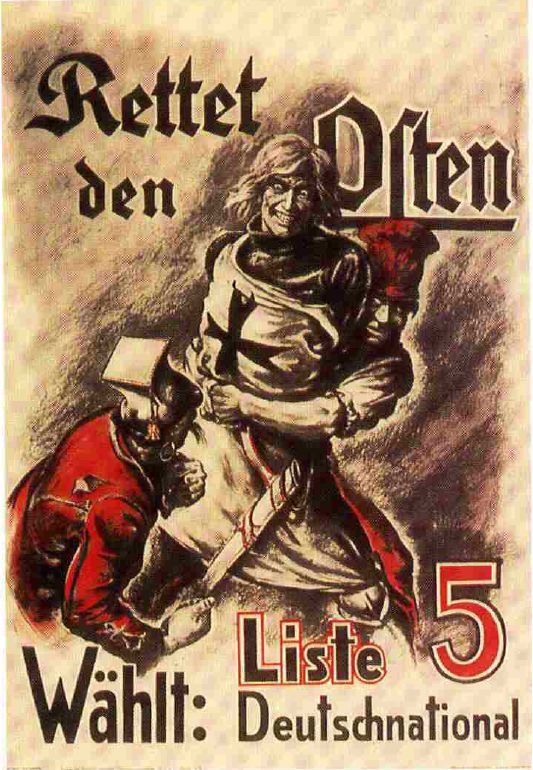
“Defend the East!”: image of a Teutonic knight in revanchist propaganda of the German National People’s Party, 1920. Image: Wikipedia
Finally, relatively recently, historians from Ukraine and Belarus have emphasized that the core of the Grand Duchy of Lithuania’s army at Grunwald was not ethnic Lithuanians but people from various principalities of historical Kievan Rus’, i.e., ancestors of modern Ukrainians and Belarusians.
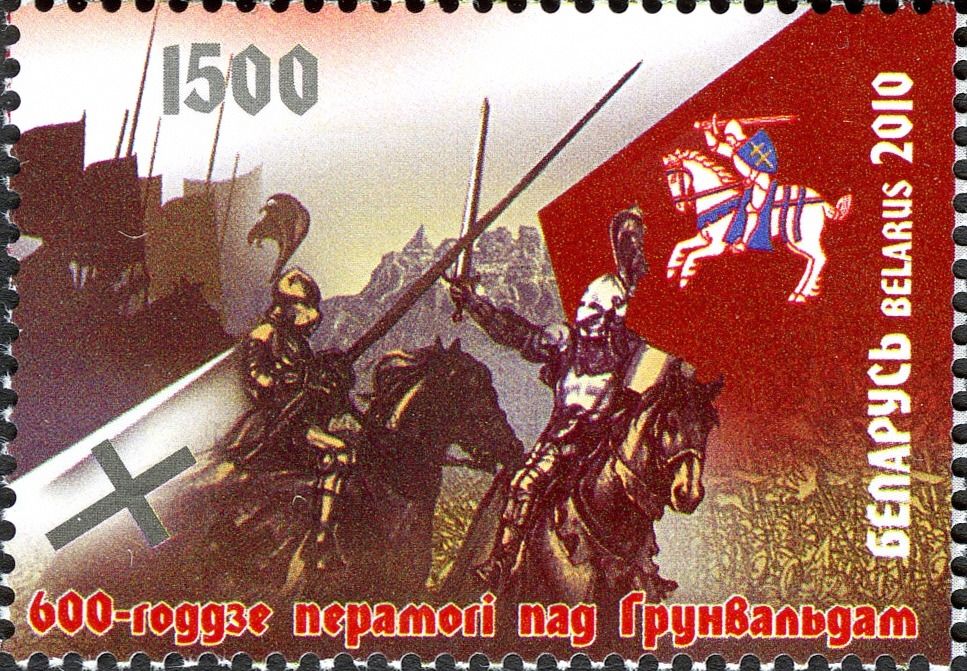
Belarusian postage stamp commemorating the 600th anniversary of the battle, 2010. Image: Wikipedia / Post of Belarus
This approach is well-founded—unlike attempts by the Russian Military Historical Society to equate all “Rusyns” and “Rus’(s)ki” of the 15th century with modern Russians in the contemporary sense of the ethnonym. Still, it would be strange if this venerable organization resisted such temptation.
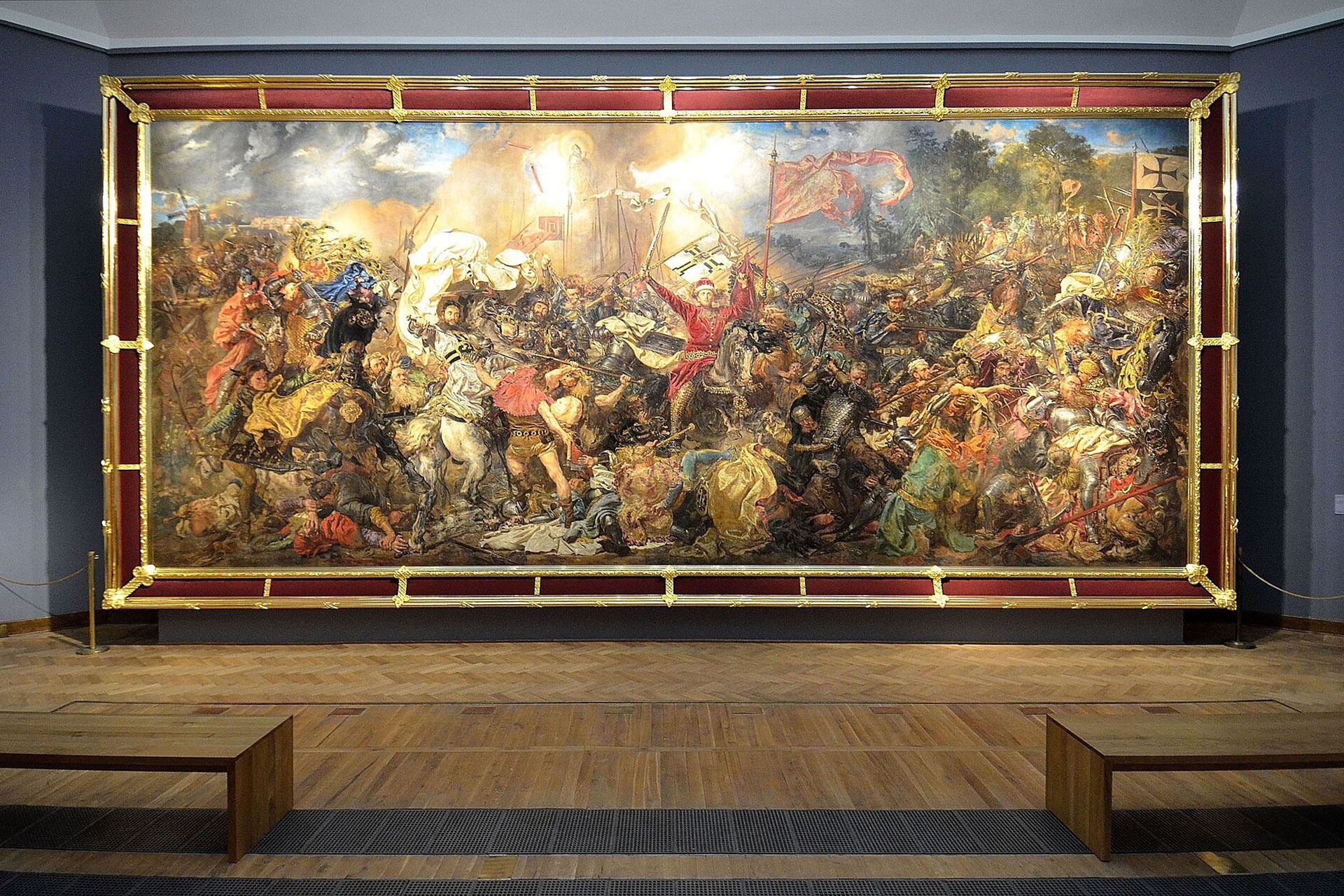
The main photo shows perhaps the most famous painting about the Battle of Grunwald—the epic eponymous canvas by Jan Matejko (1877). Source: Wikipedia
If you enjoyed this article, consider making a donation — one-time or, even better, monthly. Your support helps us motivate our authors and become better with every article.
Our organization is recognized by the Internal Revenue Service (IRS) as a 501(c)(3) tax-exempt, charitable organization, which means that all contributions made to us are tax-deductible to the fullest extent permitted by U.S. law. Individuals may generally deduct charitable contributions of up to 60% of their Adjusted Gross Income (AGI) for cash donations made to qualifying 501(c)(3) organizations. For donations of appreciated assets (such as stocks or other long-term capital assets), the deduction is typically limited to 30% of AGI, based on the fair market value of the asset. C-corporations may deduct charitable contributions of up to 10% of their taxable income for donations made to eligible charitable organizations.
By submitting a donation, you confirm that you have read and accept the following documents: Privacy Policy and User Agreement, and also give consent to the processing of your personal data.
If you would like to unsubscribe from a monthly donation, please email us at: [email protected]