“I see no reason why democratic, free, independent Karelia, Ingria, Smalandia, or Amberland (even if some of these names still sound fantastical to some) couldn’t become part of the European Union or NATO in the foreseeable future,” says Ukrainian politician Oleg Magaletsky. A participant in the Orange Revolution and the Revolution of Pride, in 2022 he founded the Forum of Free States Post-Russia — an international discussion platform whose participants aim for the breakup of the Russian Federation into several independent states. Most.Media publishes his conversation with Vadim Shtepa, editor-in-chief of the magazine Region.Expert.
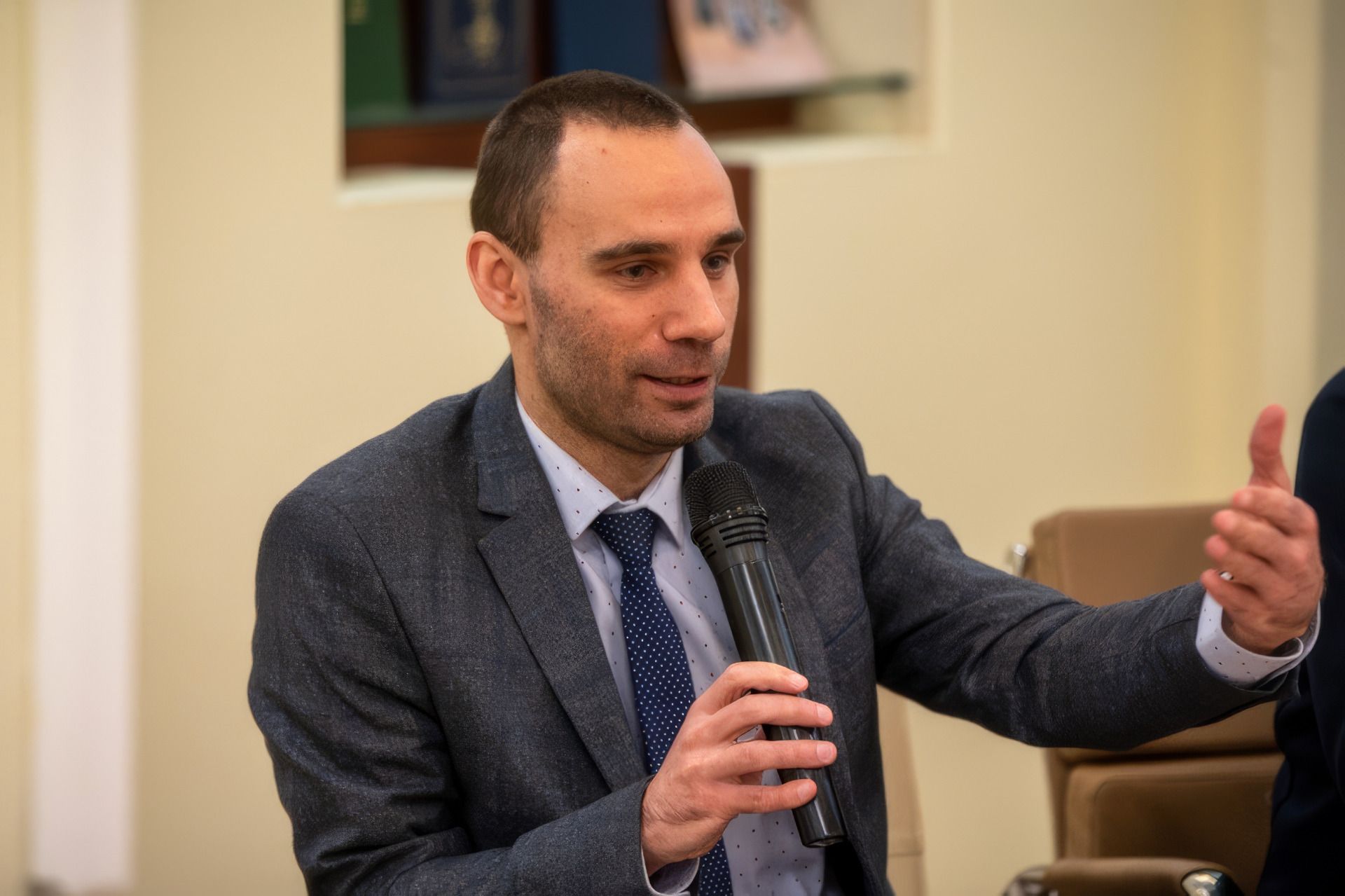
Oleg Magaletsky – Ukrainian socio-political figure, founder of the Forum of Free States Post-Russia. Photo from Oleg Magaletsky’s personal archive
- Probably we’ll speak informally since we’ve known each other for a long time. And, by the way, in April this year Russia listed both of us in the register of “terrorists and extremists” for our social activities and media publications. Of course, this is a global absurdity and a reversal of meanings. Russia itself behaves like an international terrorist with its imperial war against Ukraine and threats to the entire free world. And journalists and political analysts turn out to be terrorists for it. But the first question will be on a topical subject. In September, the post-Russian Forum organized a major tour across the Baltic and Scandinavian countries presenting Janusz Bugajski’s anthology “Free Peoples, New States”.
- The title also includes: “The Last Stage of Russian Colonialism.”
- How do you assess the results of the tour? Did this topic spark interest among politicians and public figures from different countries?
- We all see how Moscow is now preparing and already moving from the informational, sabotage, hybrid stage, essentially, to kinetic actions. Because violations of NATO airspace, drone attacks, fighter jets flying in — these are preludes to kinetic attacks. And, accordingly, the goal is finally to explain that it’s not about trying to shoot down all the arrows but about destroying the archer. That is, we must fight the cause, not the consequences. And this cause and threat to long-term peace and stability across Europe, the Arctic, the Atlantic, and even the Pacific region is the last imperialist formation in Europe, which is the so-called Russian “Federation,” but in essence, a classic imperial Muscovy.
What did the meetings in Northern Europe show? That this topic is not just relevant — it interests more and more policymakers, who were precisely the key target audience of our presentations. These are people who either make decisions themselves or have direct contact with those who shape state, international, and defense policies. These include politicians, diplomats, experts, military personnel, and journalists in Northern European countries.
There was varying interest across countries. You attended the presentation held in Tallinn within the walls of the Estonian parliament (which is quite telling itself). There was somewhat less audience in Vilnius, strange as it may seem. But first, we had recently held a large event there, and second, our presentation coincided with a parliamentary session, so not all interested deputies could attend. Yet the greatest interest in this topic was shown not by the Baltic countries but by Denmark and Norway. In Copenhagen, for example, not everyone who wanted could get into the hall. It was designed for 80 people, and a kind of waiting list had to be introduced. - Please briefly tell us about the history of the post-Russian Forum. Strangely enough, although it has existed for three years, many Russian-language media in Europe, supposedly free, seem to ignore it. Yet the Forum’s sessions are held at quite a high level: besides parliaments of various countries, as you said, there was even a session in the European Parliament.
- Free Nations Post-Russia Forum is our international name in English. Accordingly, in the Russian-speaking environment, we use the equivalent — Forum of Free States Post-Russia. It’s a platform for dialogue and communication working in two key directions. The first is essentially a think tank, a community exploring possible decolonization of Muscovy as the last colonial empire in Europe. It’s a necessary tool to achieve the main goal — long-term peace and stability in all spaces: post-Russian, European, and Atlantic.
Decolonization is not an end in itself; the main thing is reconstruction, helping normalize future independent states in the post-Russian spaces. That is, we speak of a visionary, if you will, foresight component. Since state-building is always complex and nonlinear, there will inevitably be pains of revanchism, phantom pains of empire, and populists’ desire to turn everything back, as has literally happened before our eyes in our modern life.
The dismantling of the Soviet Union caused in Russia a sharp resentment of imperial revival. We focus on how, through multi-scenario, concrete roadmaps, the process of de-imperialization can be made irreversible but as non-violent, constructive, and positive as possible.
The second direction is networking, establishing direct connections, building bridges for communication between representatives of national liberation and anti-colonial movements and stakeholders from free world countries: Japan, Taiwan, Canada, the USA, France, Germany, Ukraine, Poland, Lithuania, and so on. When they communicate directly, many myths of Moscow propaganda collapse immediately.
- Imperial opposition, as you have noted, is very similar to Russian power in its Moscow-centrism. But here, in my view, another danger arises, and one must navigate between Scylla and Charybdis. Some national movements, as I observe, are overly focused on ethnic themes, which limits their influence. We have discussed this in one of our previous talks. National movements can be called the “salt” of the decolonization process, but when they start blaming ethnic Russians for all their troubles, there comes a certain oversalting. Although, for example, in Bashkortostan and Buryatia, ethnic Bashkirs and Buryats don’t make up the majority. Therefore, it would be wiser to promote not ethnic but civic slogans of liberation from the Kremlin empire.
I am not “defending Russians” — I’m just reasoning rationally and pragmatically. Such an approach may lead not to proper regional self-governance but only to ethnic conflicts both within these republics and with neighboring Russian regions. The empire tries to exploit this. How do you think this problem should be solved?
- One must think, hear, and listen. It’s very important here to understand the context and realize that it’s hard to build a successful state if you have bad relations with neighbors. Our Central European friends show good models of interaction, for example, for future independent states in the Volga region, the Caucasus, or northeastern Europe. I admire the approach of the Visegrád Four, when in the early 1990s Poland, Czechia, Slovakia, and Hungary (at that time Hungary was, by the way, the most progressive Euro-Atlantic country, unlike what it has become today, unfortunately) — all four independent states agreed to coordinate and communicate on how to accelerate the transition from authoritarianism and a planned economy to a free market, European integration, and so on. This format works excellently now. I think future independent states in the North Caucasus and the Volga region can take it as a basis.
Regarding oversalts and excesses — there are different movements, different people, so it’s important to strive for dialogue, discussion, and inclusiveness. A consensus platform must be created within each movement. And practically all national movements understand the need to strive for the creation of a political nation and a secular state. It’s not about dividing into one ethnicity or another. There is a division between open-minded people who want change for the better and those who want to preserve the empire and destroy both their own people and others.
- One of the important declarations of the post-Russian Forum was the statement that representatives of national and regional movements strive for denuclearization of their future countries. This alleviates many Western observers’ fears that all these new states would immediately start settling disputes with nuclear weapons. There was also a very important declaration by Forum participants recognizing the inviolability of existing borders between their regions. But I think another important declaration is missing — that Forum participants demand truly free elections involving all regional parties currently banned in Russia. If we recall the Perestroika era, first all union republics freely elected local authorities, with chairpersons of Supreme Soviets in 1990 being people like Landsbergis and Gamsakhurdia, who then proclaimed independence. This authority was legitimately elected, so these countries quickly gained international recognition. But today all Russian regions are ruled by Kremlin appointees. How this power will change is unclear. What do you think about the prospects for free elections in the regions?
- I think elections are not held in a concentration camp. And one must understand that in a concentration camp you can only choose a “kapo”, but their influence on any policy quickly ends when the boss tells them what to do. Accordingly, I don’t believe in elections in a concentration camp or prison. I believe first in independence, then democratization. Yes, if we remember, in Estonia in 1991 the scenario you mentioned worked, but in 1918 independence was proclaimed first, then elections were held. At the end of the Soviet Union, there was indeed a process of democratization, a gradual transition from an authoritarian state to an almost democratic one. Now Russia follows a completely different trend.
And to speak about elections, we understand that it must not be a sham. Political parties must operate, civil society must revive, independent economic forces and competition must appear. Even if it’s some oligarchy, it shouldn’t be entirely dependent on the FSB or other security services as it is now. If this whole process continues within one state in Russia, it means the Center will soon regain strength and turn everything back into a sham.
I unequivocally support only open liberal systems, no dictatorships. But I don’t see the possibility in this system, under these conditions, to first hold elections and then proclaim independence.
Therefore, I agree with Paul Goble, who said at one of our forums that the next empire collapse scenario will be closer to 1918 than to 1991.
- In my opinion, we need to somehow consider the growing contrast between political emigration and the real situation in the regions. Because political emigrants can make any declarations, but unfortunately this does not affect the real situation in today’s Russia. Harsh repression against supporters of regional self-government continues there. For example, in Altai, the leader of the summer protests, Aruna Arna, was also declared a “terrorist.” How do you see the possibilities for strengthening the influence of movements in exile on the situation in Russia? For example, can PACE do something? Representatives of national regional movements, not only Moscow political emigrants, are supposed to join this emerging platform, right?
- Freedom is not free. Freedom and rights are never given; they are taken, if we speak not about a sham, not about rights that exist only on paper but not in reality. Therefore, yes, only on the ground, only realistically on the land, can real struggle and acquisition of self-determination and independence happen.
It amuses me when I read from Wikipedia to any media “self-proclaimed state” or “self-proclaimed independence.” When is independence not self-proclaimed? All states were self-proclaimed. The United States was not proclaimed by the British Empire but by the guys from Philadelphia. Poland, Germany, and France were “self-proclaimed” from the perspective of previous empires.
And here we are not talking about some theory but practice. This is very important because, unfortunately, every day of the Muscovite empire’s existence means hundreds of people it kills. These are truly destroyed lives, health, families, property, cities, and so on. Not only in my country, Ukraine, but also among Russian colonized peoples and regions that the empire turns into cannon fodder. It’s clear why I support the process of empire collapse with all the fibers of my soul.
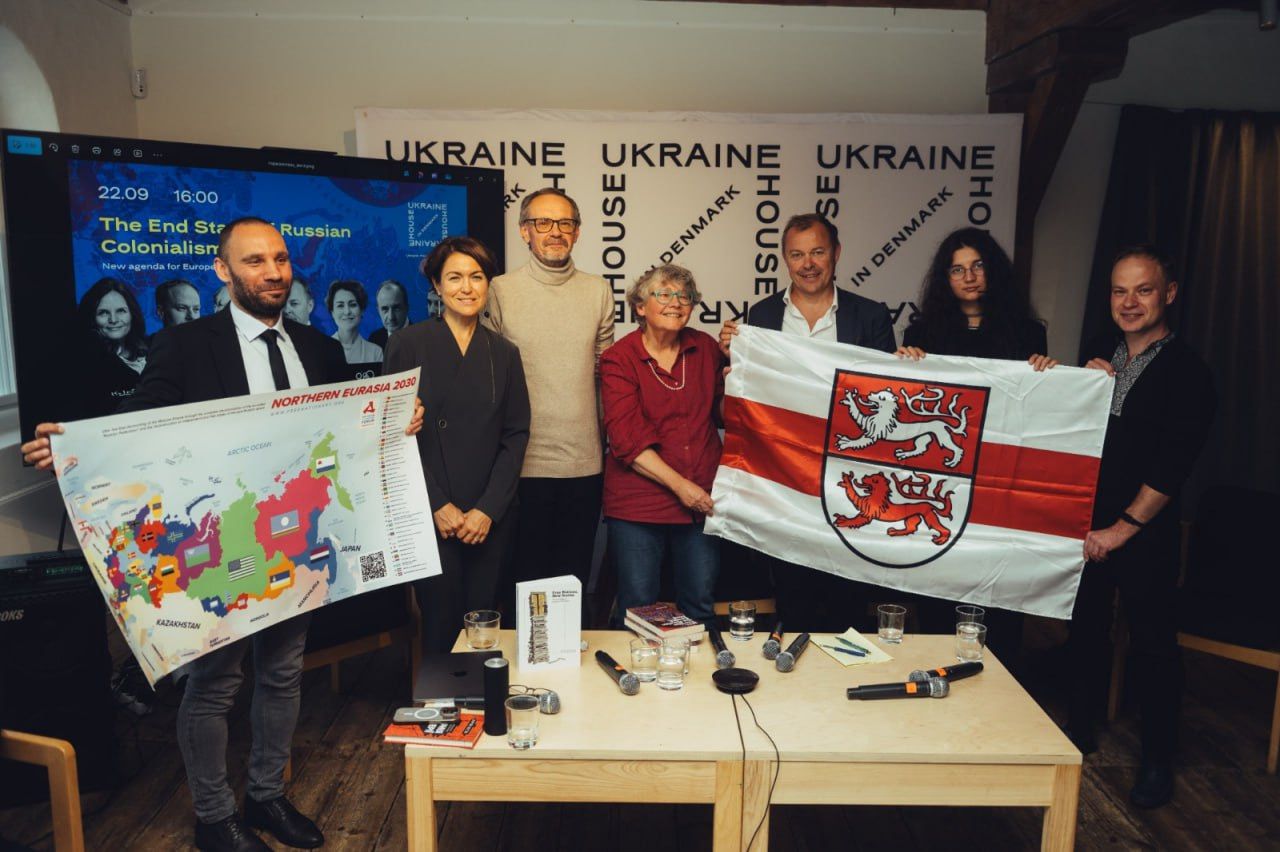
Oleg Magaletsky (first from the left) with a map of Northern Eurasia 2030 at the presentation of the Forum of Free States Post-Russia anthology in Copenhagen, September 22, 2025. On the right, participants hold the flag of the future Smolensk Republic. Photo from Oleg Magaletsky’s personal archive
What can and cannot emigration do? Emigration will never influence what happens on the ground. But it can give hope, orientation, and some understanding that there is an alternative. The task of emigration, while everything is bad and the window of opportunity has not yet opened, is to be this flagship. To act as a brand ambassador, essentially cultural diplomacy.
We must try so that when—not if, but when—it becomes truly possible to restore independence for Karelia, Siberia, Ingria, Bashkortostan, and Tatarstan, London, Berlin, Washington, Tokyo won’t have to search on a map where Bashkortostan or Sakha are located.
During our presentation tour in July in Central Europe (before Northern Europe we held presentations there), we had a meeting at the Czech Association of International Politics in Prague, with good experts who understand Europe. One of them asked: “If Yakutia becomes independent, how can such a small country be successful?” I said: “Before answering your question, may I ask mine? What is the area of the Czech Republic?” And although several representatives from the Czech Foreign Ministry and university were in the room, no one gave the exact figure, but about 100,000 square kilometers. “And what is the area of Sakha, what do you think?” No one knew it’s 3 million square kilometers!
The second point: what can emigration do when the situation changes or at least starts to change? Its leaders, if they really want to become founding fathers and mothers or restorers of independence, will have to come to their regions and fill the gaps caused by the so-called “Russian Federation” turning into a prison. It has either physically destroyed, imprisoned, pushed abroad, or forced into internal emigration all who fought for freedom for their people and region. But some from external emigration will come, and some won’t. Maybe there will be some — only positive, I hope this time — analog of Lenin on an armored car arriving in a sealed train car. Many political emigrants still maintain close ties with their compatriots. And I see no problem with people supporting, for example, the “Free Ingria” movement and wanting to make Ingria independent being able to come by bus from Riga to Saint Petersburg in five to six hours and get involved in changes on the ground.
- Naturally, these changes, as you understand, can only happen after a revolution in Russia itself. After all, Lenin himself probably wouldn’t have returned to Russia under the tsar because at least he would have been sent to penal servitude. So this contrast remains for now.
- The revolution started from nothing. No one expected it, and it began very quickly and unexpectedly for all sides, both opposition and tsar. History doesn’t repeat itself, but it shows certain patterns that can work. We can influence some moments, hardly others, but in any case, we must do everything possible and impossible to bring this day closer and faster and, most importantly, be ready for what comes after. If approached incorrectly, the revolution devours its children.
It won’t get worse than it already is in Russia, but it’s not guaranteed that the revolution will make things better. The task of the Free Nations Post-Russia Forum platform is to make sure it gets better.
So that we don’t all fall again into another cycle of Moscow revanchism, empire revival, and that at least some of the new independent states in the post-Russian spaces become successful, comfortable, liberal, with open societies and part of the global architecture. I see no reason why democratic, free, independent Karelia, Ingria, Smalandia, or Amberland (even if some names still sound fantastical to some) couldn’t become part of the European Union or NATO in the foreseeable future. Or why independent Buryatia and Sakha couldn’t become partners for Japan, South Korea, and Taiwan. All this is possible, and it’s very important to work systematically and be inclusive. We need to unite, not divide.
The full version of the conversation can be watched here.
If you enjoyed this article, consider making a donation — one-time or, even better, monthly. Your support helps us motivate our authors and become better with every article.
Our organization is recognized by the Internal Revenue Service (IRS) as a 501(c)(3) tax-exempt, charitable organization, which means that all contributions made to us are tax-deductible to the fullest extent permitted by U.S. law. Individuals may generally deduct charitable contributions of up to 60% of their Adjusted Gross Income (AGI) for cash donations made to qualifying 501(c)(3) organizations. For donations of appreciated assets (such as stocks or other long-term capital assets), the deduction is typically limited to 30% of AGI, based on the fair market value of the asset. C-corporations may deduct charitable contributions of up to 10% of their taxable income for donations made to eligible charitable organizations.
By submitting a donation, you confirm that you have read and accept the following documents: Privacy Policy and User Agreement, and also give consent to the processing of your personal data.
If you would like to unsubscribe from a monthly donation, please email us at: [email protected]