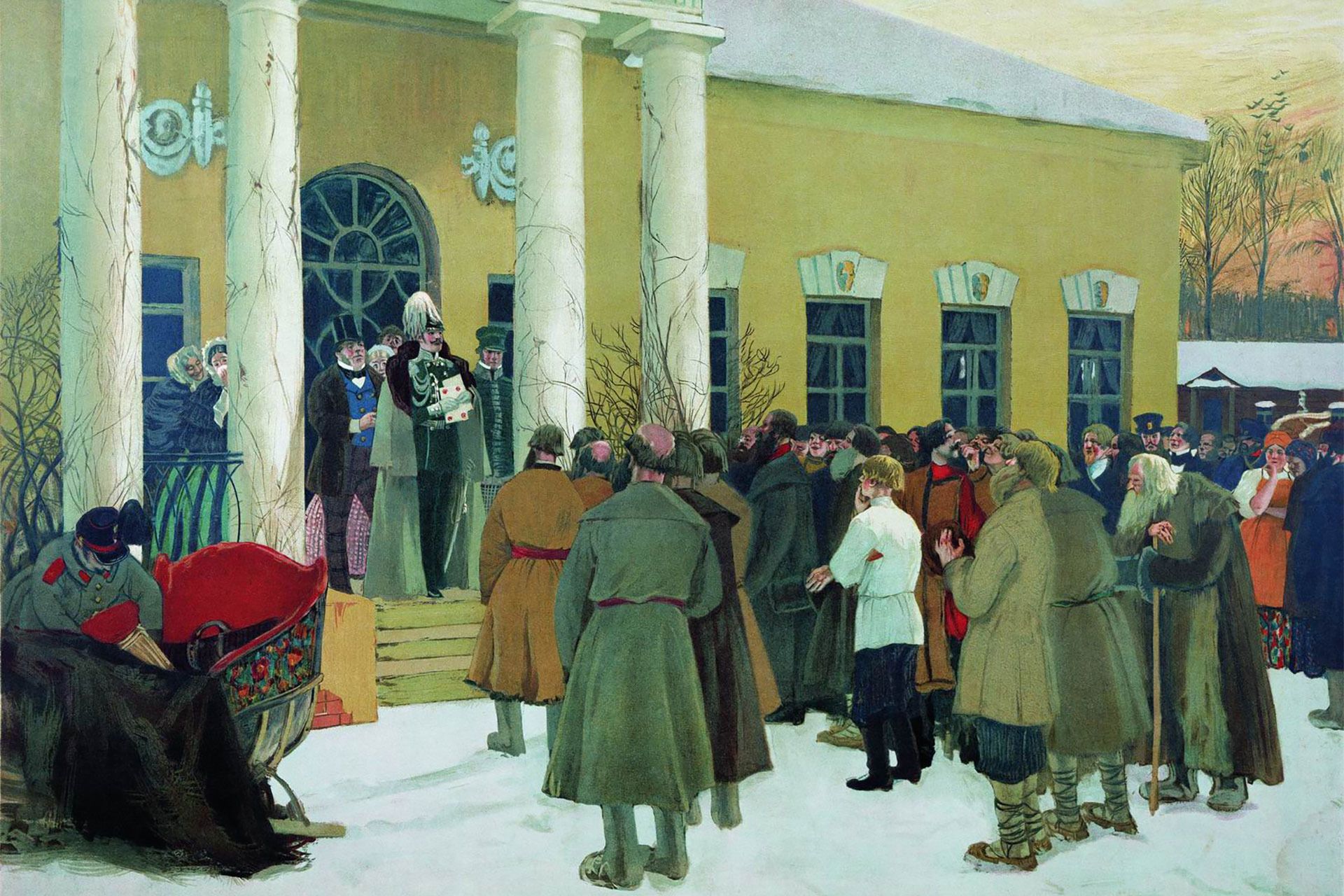
In addition to the anniversary of Alexander II's main reform, it was recently 145 years since his assassination. Yet in the Russian information space, there was hardly any mention of either the abolition of serfdom or the fate of the Tsar-Liberator: his policies do not align well with the beliefs of the current authorities.
Boris Kustodiev. “The Liberation of the Peasants (Reading the Manifesto).” Painting from 1907 (fragment)
Let's start with a bit of context. Most modern historians agree that the first of the “great reforms“ was the most thoroughly prepared in Russian history. Thousands of people—from surveyors to ministers—worked on its development and implementation, producing literally tons of documents (the collection of all materials from the editorial commissions alone consisted of 35 printed volumes). And during the planning of the reform, the most extensive statistical description of the Russian Empire up to that point was undertaken.
None of this happened because life was easy, nor did the reforms themselves. After a defeat in the Crimean War that was not so much heavy as it was humiliating (the Russian army did not win a single victory—except for the capture of the fortress of Kars), the country found itself in a situation that Lenin would later famously call a “revolutionary situation.”
Defeat in war almost inevitably leads either to reforms or to revolution. Yet the decision to abolish serfdom still had to be made, and above all, people had to be found who were ready to shoulder this heavy burden.
Contemporary American historian Paul Werth, in his book “1837: Russia's Hidden Transformation,” concludes that it was precisely during the reign of Nicholas I that the very professional bureaucracy was formed which made all the “great reforms” possible. Alexander I's famously pessimistic saying, “There is no one to do it,” became outdated. Now, such people existed. All that remained was to start moving in the right direction.
The Russian Empire was the last European state to abolish serfdom, but even this “delay” needs some explanation. The outstanding Russian historian and politician Pavel Milyukov wrote about this very well:
“For us, the very event of the abolition of serfdom should be what matters... That it happened on February 19, 1861, is not as important as the historical fact itself and its realization. Its significance cannot be overstated, because every day, week, or month—let alone a year—of delay would have led to ever more cruelty, injustice, victims, and loss of human life. Of course, the reform was far from perfect, but show me one that was carried out from beginning to end exactly as planned, conceived quickly and implemented clearly. Perhaps it is precisely the fact that the government and the emperor personally hurried in their intentions and actions that best shows that, for perhaps the first time in Russian history, they placed human life in its proper place.”
The leader of the Russian Cadets wrote these words already in exile, when he could see what the Russian revolution had actually brought.
One of the main criticisms of the authorities at the time was that the state essentially profited from a rather complicated and not always clear redemption operation for the peasants. There is a lot of truth in this criticism. But again, context is necessary: we are talking about the period of Russia's most rapid economic development before the Soviet era.
Contrary to popular belief, most of the money the state received from the redemption operation was directed toward industrialization and supporting other reforms. Economic historian Iosif Kulisher was the first to show this, needing in the 1920s to substantiate the view that state capitalism was strengthening in the Russian Empire. Understandably, this approach was, to put it mildly, not close to Soviet historians—nor would it make sense to deny the obvious property inequality in the countryside, which persisted until the revolution.
And yet: for the first time, peasants were granted all the basic rights on par with other estates in the Russian Empire. The entire population of the world's largest country became equal in rights—at least by law. Even if only on paper, the beginning was made. It is this social dimension of the abolition of serfdom that remains its least studied aspect to this day.
Another not-so-obvious and underrated aspect of the Great Reform was the formation of civil society (in Soviet historical science, this was called the “public movement”). Thousands of people poured into the countryside, and this was ten years before the narodniks. These were surveyors, agronomists, veterinarians, doctors, teachers. According to official and far from complete zemstvo reports, by 1871—ten years after the reform—about 30,000 young people had passed through the countryside, seeking to help the peasants.
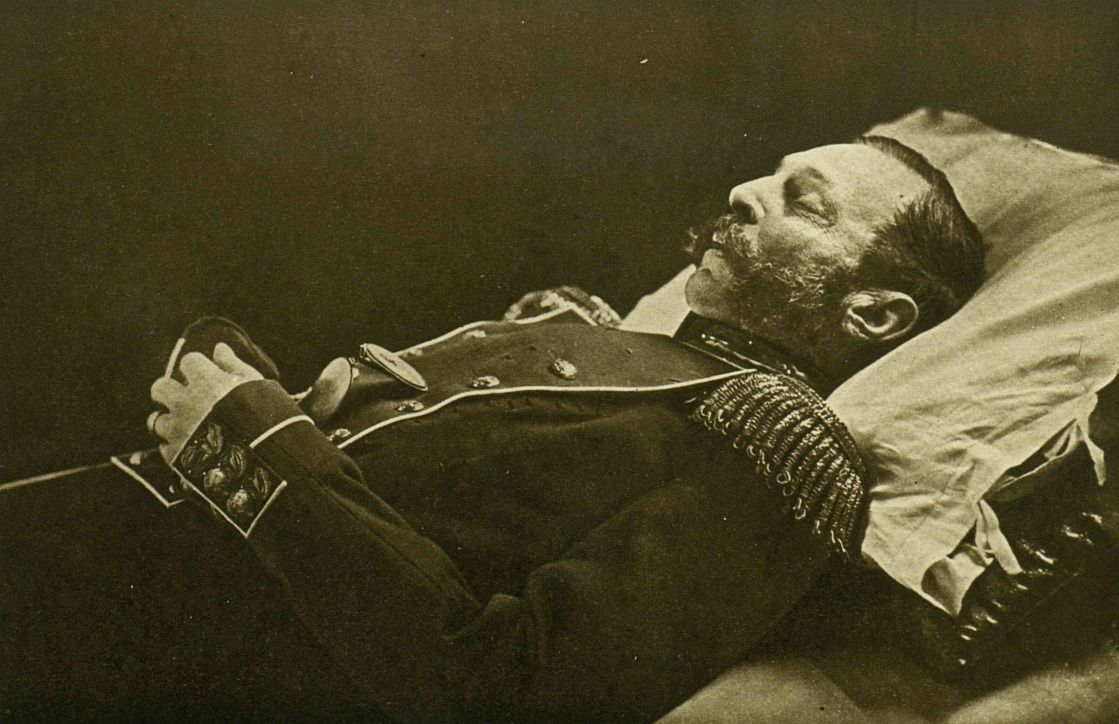
Emperor Alexander II on his deathbed. Photograph by S. Levitsky.
Now to the second—tragic—date: on March 1, 1881, Alexander II, the Tsar-Liberator, was assassinated. What place does he occupy in the historical policy of modern Russia?
In the two-volume work of the outstanding American historian Richard Wortman, “Scenarios of Power in the Russian Empire,” the subject is the political rituals through which power represents itself. Most often, unfortunately, these are connected with the state's military might. However, there were also more subtle scenarios, where the ruler sought to present himself as a patron of the arts and sciences—or, importantly, to promote a particular program for his reign. But the most interesting conclusion the American historian comes to is that Alexander II was perhaps the first Russian emperor without a scenario of power based on notions of the state's greatness and dominance. Indeed, there was only one full-scale war during his reign—the Russo-Turkish War—and he kept away from the theater of operations. Alexander II was also far from the power scenario of his father, Nicholas I, who was seen as a knight-monarch.
As a result, Alexander became the first of the Russian emperors who, during his reign, changed his policies several times in favor of the state's interests without being tied to any ideological goal. Liberal reforms were replaced by attempts to steer them in a conservative direction, and in his last years, the tsar, on the contrary, returned to the original program of his rule.
In fact, Alexander was the first Russian emperor who knew how to listen to and hear the public.
In many of his decisions, if not most, he was guided by the opinions of others as well. Even if this was not a conscious policy—some historians believe that the tsar was trying to maneuver between influential government and court factions—it is still something remarkable. An autocratic monarch who, to avoid worse, carries out an unprecedentedly large-scale and well-thought-out reform, and at the end of his reign wants to voluntarily limit his own power.
And of course, this ruler does not fit at all with the modern Russian ideas of strong power. Alexander III is preferred instead, with people forgetting that under the Tsar-Liberator, the Russian Empire's economy developed at record rates—and the peacemaker tsar tried to avoid conflict with Europe.
If you enjoyed this article, consider making a donation — one-time or, even better, monthly. Your support helps us motivate our authors and become better with every article.
Our organization is recognized by the Internal Revenue Service (IRS) as a 501(c)(3) tax-exempt, charitable organization, which means that all contributions made to us are tax-deductible to the fullest extent permitted by U.S. law. Individuals may generally deduct charitable contributions of up to 60% of their Adjusted Gross Income (AGI) for cash donations made to qualifying 501(c)(3) organizations. For donations of appreciated assets (such as stocks or other long-term capital assets), the deduction is typically limited to 30% of AGI, based on the fair market value of the asset. C-corporations may deduct charitable contributions of up to 10% of their taxable income for donations made to eligible charitable organizations.
By submitting a donation, you confirm that you have read and accept the following documents: Privacy Policy and User Agreement, and also give consent to the processing of your personal data.
If you would like to unsubscribe from a monthly donation, please email us at: [email protected]