American politician and diplomat Henry Kissinger would have turned 102 today (considering he lived to 100, this is quite a realistic assumption). His name is firmly associated with the concepts of “shuttle diplomacy” and Realpolitik. For his efforts to end the Vietnam War in 1973, he was awarded the Nobel Peace Prize. Despite being one of the architects of U.S. foreign policy aimed against the USSR during the Cold War, he later often spoke sympathetically about Russia, justified its foreign policy actions, and met with. Kissinger’s ideological legacy is especially interesting in light of the Russia-Ukraine war and Donald Trump’s attempts to stop it.
Today, many are trying to understand Trump’s policy toward Europe, Russia, and Ukraine. For months since Trump’s inauguration, we have observed how he courts Putin. Sometimes he defends him in a friendly manner, calling him a “very smart person,” other times he scolds him, saying he does not understand why Putin is bombing Ukraine while negotiations are ongoing. And on Monday, he even called him crazy. Now everyone is guessing what this means: the end of the flirting or some hidden signal?
But one thing is clear: what he promised – to end the Russia-Ukraine war quickly – he still hasn’t done. And the public still doesn’t understand: does Trump truly not understand Putin, or is he playing a subtle game?
One explanation is that Trump is allegedly trying to repeat the foreign policy once pursued by Richard Nixon and Henry Kissinger toward the Soviet Union. Only now the place of the USSR is taken by China, and the place of China – by Russia.
Here is how Andrey Korobkov, professor of political science and international relations at Tennessee State University and doctor of economics, explains Trump’s actions:
“For Trump, America’s opponent is China. Russia is secondary; it is important but as a country in the middle. For him, at least, it is important to ensure its neutrality in a potential conflict between the U.S. and China.”
Moreover, according to him, not only Trump but also his opponents—the Democrats—understand this. Only some believe that Russia should first be taken out of the game, and then China dealt with. Trump and his supporters think differently: “...we need to repeat the trick Nixon and Kissinger pulled in the 1970s, namely: use Russia as a counterweight to China. That is, do the opposite of what Nixon did when he set China against the Soviet Union, forcing the USSR to build a second line of defense and thus bear huge costs. People like Steve Bannon believe that good relations with Russia need to be established so that, at least, it does not enter into an alliance with China.”
Recall that Bannon became Trump’s foreign policy advisor back in 2016 when Trump was first elected president. During the same period, Kissinger met with Trump several times publicly and privately. The media reported that Kissinger became an unofficial foreign policy advisor in the White House and was guiding Trump to “befriend Russia against China”. And in October, there was another public meeting between Kissinger and Trump in the Oval Office. Trump said he had known Kissinger long before his election and has great respect for him; it was an honor that Dr. Kissinger, a man of great talent, experience, and knowledge, visited him.
So this policy did not arise a few months ago; there is a whole theory and practice behind it. Here we can recall one thesis Kissinger voiced to Nixon in 1972:
“Right now, we need the Chinese to correct and discipline the Russians.” If you swap “Russians” and “Chinese” in this quote, Trump’s policy seems understandable and reasonable.
But after Trump’s first term, Democrat Joe Biden became president and reshuffled the cards. As we know, Trump likes to answer journalists’ questions about the ongoing war by saying it is not his war but Biden’s war, and if he had been president at the time, it would never have started. But since the war is happening now and Trump has become president again, he is managing as best he can, trying to apply Kissinger’s approach to new realities.
The Ukrainian Question
Now let’s look at how Henry Kissinger himself changed his views on the Russia-Ukraine issue. Initially, he was against Ukraine joining NATO. Moreover, the American politician disagreed with those who criticized Putin for annexing Crimea and did not support sanctions against Russia.
Here is what he said in a 2014 interview with Der Spiegel: “Crimea is a symptom, not the cause. Moreover, Crimea is a special case. Ukraine was part of Russia for a long time. One cannot recognize the principle that any country can simply change borders and seize part of another country. But if the West is honest with itself, it cannot but admit that it also made mistakes. The annexation of Crimea was not a step toward global conquest. It was not like Hitler’s entry into Czechoslovakia.”
The former diplomat placed some blame on the West for the critical situation around Crimea. “Europe and America did not understand the consequences of certain events, starting with negotiations on Ukraine’s economic relations with the European Union and ending with demonstrations in Kyiv. All these issues and their consequences should have been the subject of dialogue with Russia,” he explained.
About sanctions, he said: “When we talk about the global economy and then use sanctions within this global economy, large countries thinking about their future are tempted to protect themselves from potential dangers. By doing so, they will create a world economy based on mercantilist principles.”
In short, to prevent a new cold war, reduce chaos and new conflicts, the West should understand Putin, understand Russia, give up Crimea, and calm down. Today we know where this led. But could Kissinger have foreseen it then? Probably not. He probably thought the Crimea issue would soon fade and be forgotten.
For him, something else was more important. “We must remember that Russia is an important part of the international system,” he emphasized, “so it is useful in resolving various crises, for example, the Iranian nuclear proliferation issue and the Syrian issue. This should take precedence over tactical escalation in each specific case. On the one hand, it is important that Ukraine remains an independent state and has the right to economic and trade associations of its choice. But I do not take it for granted that every state should have the right to be a NATO ally. You and I know that NATO will never unanimously vote to admit Ukraine to the alliance.”
And then came the fateful February 2022. It was time to reconsider his views. And Kissinger did just that.
True, not immediately. It took time to rethink. In May 2022, at the World Economic Forum in Davos, Kissinger said Ukraine should give part of its territory to Russia to end the war. Later, he clarified that he was misunderstood, journalists “shortened and simplified” his words. He meant a return to the status quo before February 24, before the start of the Russian operation and before Russia took control of part of Ukrainian territory. Most importantly, he warned against turning Ukraine’s war for freedom into a war for Russia’s future.
A few months before his death, Kissinger gave an interview to The Economist, reflecting on the likelihood of a Third World War, including the confrontation between Russia and the U.S. over the war in Ukraine. The former U.S. Secretary of State said Ukraine should be in NATO and called its president, Volodymyr Zelensky, an outstanding leader. He again stated that Europeans don’t understand. But this time, not Russia, but Ukraine.
“We have proven we can defend Ukraine. What Europeans say now, in my opinion, is dangerously insane. Because Europeans say: ‘We don’t want them in NATO because it’s too risky. So we will arm them to the hilt and give them the most modern weapons.’ And how will that work? <…> The result should be that Ukraine remains under Europe’s protection and is not a lonely state that takes care of itself,” he explained his position.
Additionally, he said that ultimately “Russia will lose many of its conquests but will keep Sevastopol.” As a result, the West will have “a dissatisfied Russia but also a dissatisfied Ukraine—in other words, a balance of dissatisfaction.” And that is why for Europe’s security it is better to have Ukraine in NATO, where it will not solve its territorial problems alone.
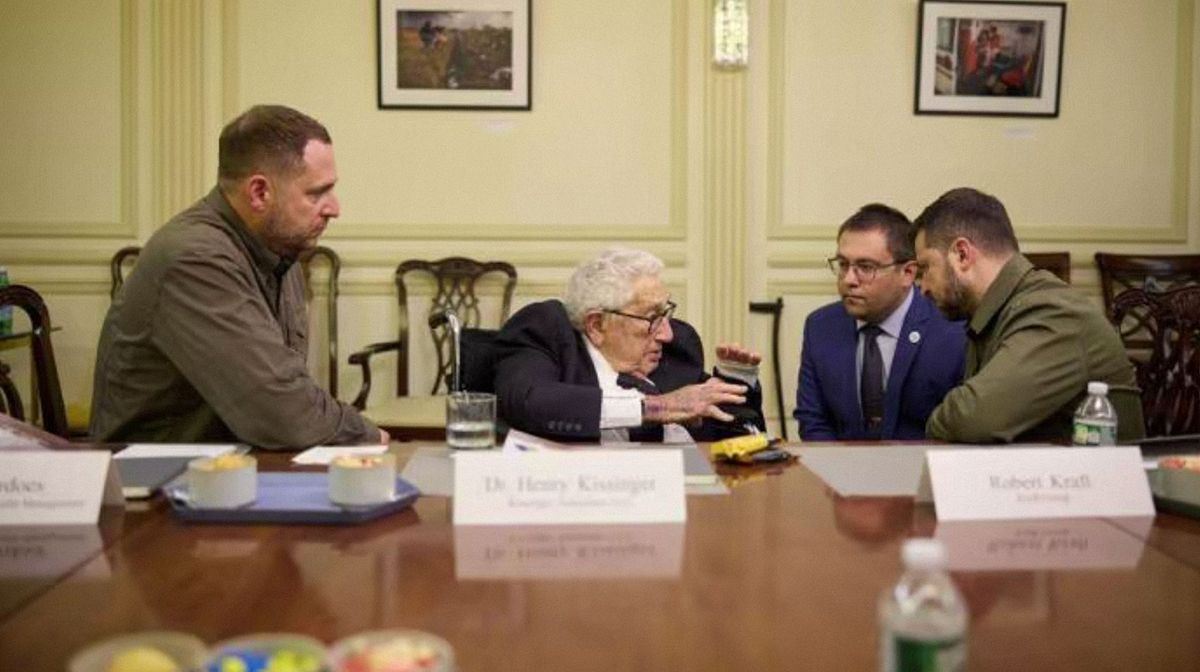
Meeting of Henry Kissinger with Volodymyr Zelensky, September 24, 2023. Photo: Andrey Yermak via Telegram
A few months later, Henry Kissinger met with Volodymyr Zelensky and once again laid out his vision for resolving the problem. And here is what he told him: “Before this war, I was against Ukraine’s NATO membership because I feared it would start exactly the process we see now. Now that the process has reached this level, the idea of a neutral Ukraine under these conditions no longer makes sense.”
The meeting took place in September, and in November the great diplomat passed away.
Would Kissinger Have Approved Trump’s Foreign Policy?
If we disregard Kissinger’s sharp change of views on the Ukrainian question shortly before his death, his quotes before 2022 could easily be put into the mouths of Trump and his supporters. But will such an approach work in Trump’s foreign policy?
In April, former U.S. ambassador to Russia and now political science professor Michael McFaul, co-authoring with professor Evan S. Medeiros, wrote an article “China and Russia Will Not Be Split: The Illusion of ‘Kissinger in Reverse’”. They believe the idea of somehow separating Russia and China to shift the balance of power in favor of the U.S. may seem attractive at first but is actually flawed. Most importantly, the analogy with the Cold War of the 1970s is mistaken:
“Putin has no reason to give up China’s extensive, concrete, and reliable support for Russia’s civilian economy and defense industry in exchange for ties with Washington that may not last beyond Trump’s term in 2028.”
Moreover, they are confident that rapprochement with the Kremlin will bring few real benefits to Americans and harm other U.S. interests. Putin will not help the U.S. contain China. Instead, he will use America’s desire to improve relations to pit Washington and Beijing against each other. Meanwhile, he will rebuild Russia’s economy and military.
Any favor the U.S. does for Russia will alienate Europe. Militarily, Russia can offer the U.S. much less than NATO. Moreover, it is a worse trade and investment partner compared to the European Union. Trying to woo Russia is exchanging strong, wealthy, and reliable allies for a weak, poor, and unreliable partner. The authors emphasize that had Kissinger lived until 2025, he, a convinced realist, would never have agreed to this.
Next, McFaul and Medeiros explain why it is wrong to view today’s Russia as analogous to 1970s China, with which the U.S. then sought rapprochement. By the late 1960s, China and the Soviet Union were effectively at war. Fighting on the northeastern border intensified, political leaders had to be evacuated from Beijing in August 1969. China itself was devastated by the Cultural Revolution. Thus, when Kissinger first arrived in Beijing in 1971, China was poor, isolated, troubled, and at war with the Soviets. Kissinger did not need to convince his Chinese colleagues to distance themselves from Moscow. The former partners had already split.
Does today’s situation resemble that in any way? The question is rhetorical. Therefore, Kissinger’s diplomacy toward Russia and China in the 1970s is hardly applicable to the current situation.
“There are no disagreements to exploit,” write McFaul and Medeiros. “Certainly, Beijing acted cautiously in response to Putin’s full-scale invasion of Ukraine in 2022: it abstained rather than voted against UN resolutions condemning the war; it never recognized Moscow’s annexation of Ukrainian territory; it still refuses to supply complete weapon systems to Russia; and it cautiously circumvents Western sanctions. These positions disappointed the Kremlin but did not lead to a serious split. Ultimately, what unites Putin and Xi far outweighs what divides them.”
The experts note another aspect: Putin and Xi are autocrats. They want to shape international rules, norms, and institutions to make autocracy the norm. To promote their vision, the two leaders act through various multilateral organizations that exclude the U.S.—BRICS and the SCO. Putin sees Xi as his most important partner in the world, and Xi, whose father led the Sino-Soviet alliance under Mao, feels a special sympathy for Russia.
It is hard not to see how much Russia-China economic cooperation has strengthened, especially since February 2022.
The study’s authors mention only the basics: energy resources, investment deals, weapons, defense projects. Russia’s economic dependence on China continues to grow. In 2023, bilateral trade exceeded $240 billion—the highest in history. Having lost European oil markets and exports, Russia depends on selling energy resources to China to finance its war. Russian defense companies receive critically important components from China to create new weapons. And China has rapidly increased exports of consumer goods to Russia, filling the gap left by Western products.
In short, as the authors emphasize, Putin has a stable ideological, military, and economic partner in Xi. He will not abandon these relations for some vague promise of improved ties with the United States. Putin’s perception of America as his greatest enemy has been shaped over decades and is unlikely to change now. Putin understands Trump will be president for only four years. Control of Congress might last just two years, while Xi may rule China for a decade or more. Besides, Trump is in the White House for his last term and will leave forever, while the U.S. political establishment remains, as does the foundation of American foreign policy.
“Putin knows Trump cannot offer him as much as Xi does,” write the authors. “Washington cannot fill the gaps Russia would have if it broke its strategic partnership with China. For example, the U.S. will not replace Chinese contracts for Russian energy resources because Russia is already self-sufficient. American politicians and defense companies will also be very reluctant to restore Russian military and defense-industrial capabilities.”
After all these arguments, the topic of Russian-American cooperation against China citing Kissinger can be closed.
“Establishing closer relations with Russia will come at a high cost to U.S. relations with more reliable and capable partners,” the scholars conclude. “Full acceptance of Moscow would shock U.S. allies in Europe and Asia, further undermining trust in these alliances at a time when many countries are already concerned about U.S. commitments. Allies might stop purchasing American weapons, end intelligence sharing, and reduce trade and investment with the U.S. European countries might even form a new alliance excluding Washington. Some non-nuclear countries, especially in Asia, might decide to create their own nuclear arsenals if they see strengthening U.S.-Russia ties as a sign that the U.S. no longer prioritizes the security of countries under its nuclear umbrella.”
The sooner American policymakers realize this strategy won’t work, the better for both U.S. interests and the integrity of American values. And there’s no need to stir up Kissinger’s ashes in vain.
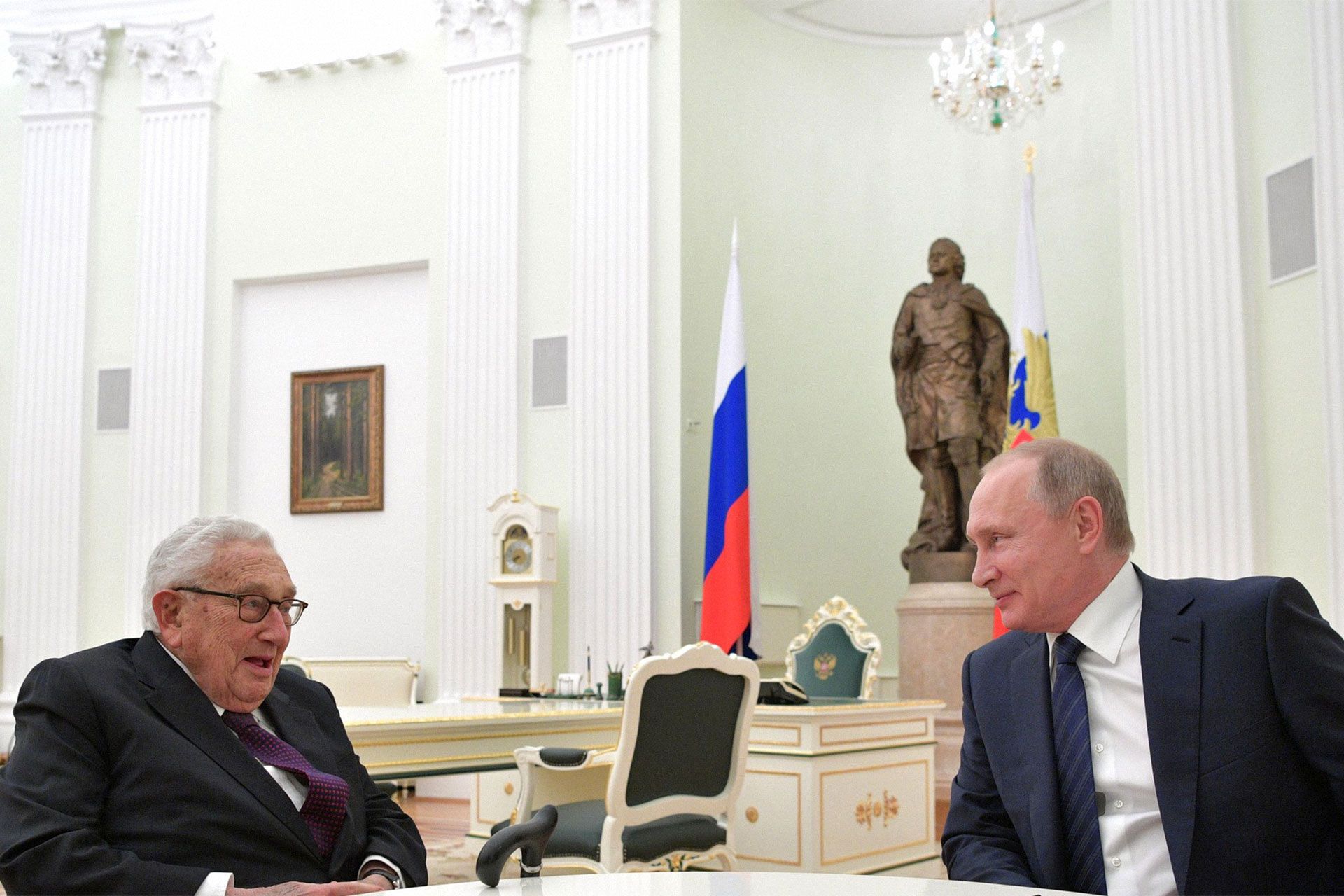
Main photo – Henry Kissinger and, June 29, 2017. Source: kremlin.ru
If you enjoyed this article, consider making a donation — one-time or, even better, monthly. Your support helps us motivate our authors and become better with every article.
Our organization is recognized by the Internal Revenue Service (IRS) as a 501(c)(3) tax-exempt, charitable organization, which means that all contributions made to us are tax-deductible to the fullest extent permitted by U.S. law. Individuals may generally deduct charitable contributions of up to 60% of their Adjusted Gross Income (AGI) for cash donations made to qualifying 501(c)(3) organizations. For donations of appreciated assets (such as stocks or other long-term capital assets), the deduction is typically limited to 30% of AGI, based on the fair market value of the asset. C-corporations may deduct charitable contributions of up to 10% of their taxable income for donations made to eligible charitable organizations.
By submitting a donation, you confirm that you have read and accept the following documents: Privacy Policy and User Agreement, and also give consent to the processing of your personal data.
If you would like to unsubscribe from a monthly donation, please email us at: [email protected]