On Monday, the State Duma held a joint committee session to consider the main directions of monetary policy through 2029. The head of the Central Bank, Elvira Nabiullina, spoke. The essence of her speech can be summed up as follows: Russian citizens will live badly and for a long time. That cannot be said about the military sector and the Kremlin’s friends. At first glance, what does this have to do with fighting inflation?
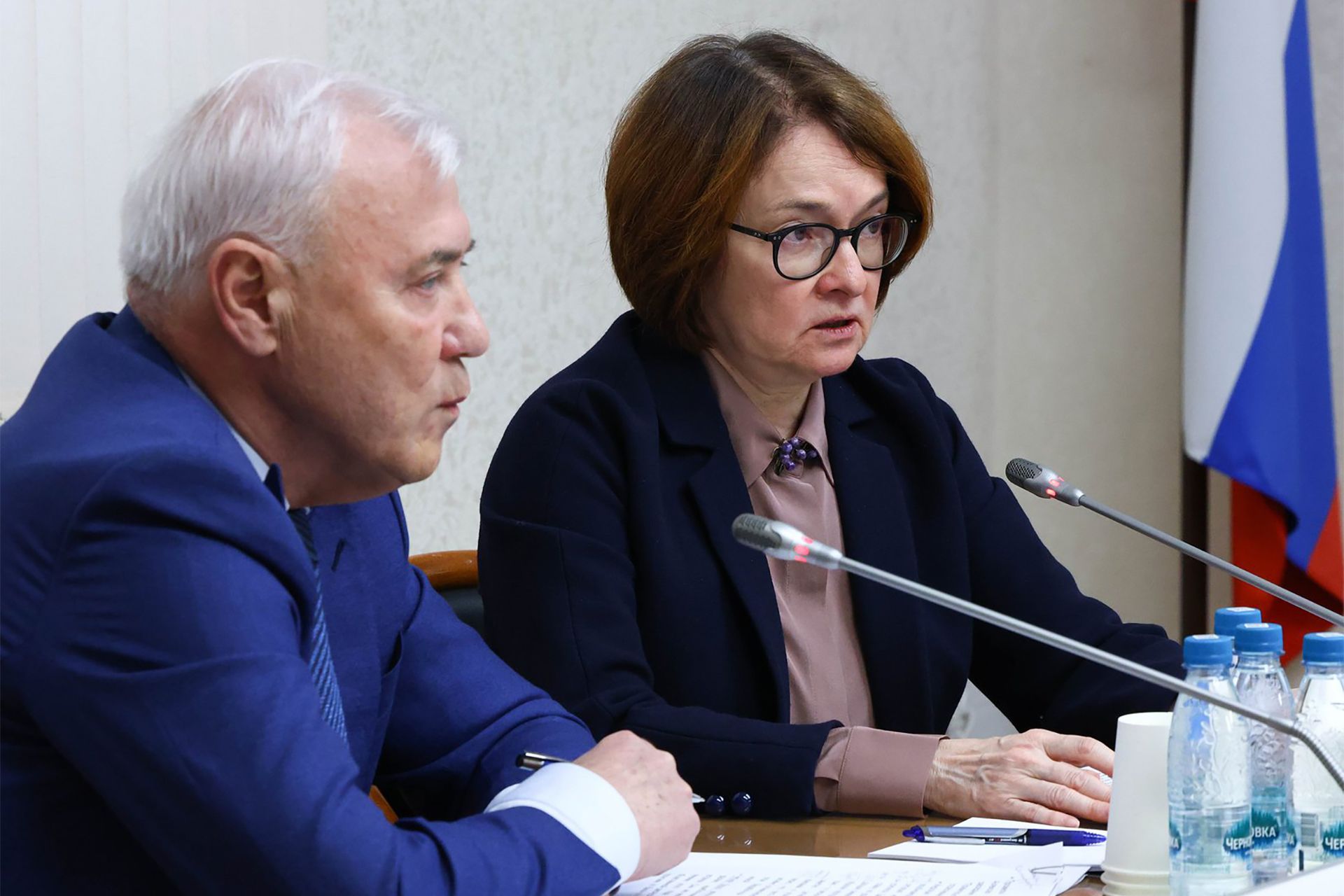
Chairman of the State Duma Committee on the Financial Market Anatoly Aksakov and Chair of the Central Bank of the Russian Federation Elvira Nabiullina, November 9, 2026. Photo: duma.gov.ru
“The period of tight monetary policy that we are currently going through is a necessary stage on the path to low inflation and on the path to moderate rates”, Elvira Nabiullina said in her speech. “This path must be completed to the end”. She cited the experience of other countries that defeated inflation through high interest rates. However, the question arises: to what end? And which other countries fought consumer inflation while simultaneously stoking the inflationary wheel through massive injections of liquidity to finance war?
And who here is stupid?
In fact, all of Nabiullina’s speech was an answer to a question from the head of the State Duma Committee on the Financial Market, Anatoly Aksakov. His question was quite natural: why is the gap between declared inflation (the Central Bank estimates the core rate at 5–6%) and the key rate (14%) so large? Usually the gap does not exceed 1–3 percentage points.
Because, Nabiullina replied, first of all, inflation expectations among the population and businesses are high. And usually what people expect is what they get. A bit illogical: high expectations among businesses and citizens have persisted for quite a long time, and all this time inflation, according to Rosstat, the Central Bank, and the Ministry of Economic Development, has been steadily declining.
So, stupid citizens and businessmen just can’t grasp that their forecasts are wrong? Then it would be interesting to know how they can become smarter thanks to the Central Bank’s high rate, which makes loans prohibitively expensive. Or are citizens and businesses not wrong after all — inflation in the civilian sector of the economy really is in double digits, while it is reduced by low inflation in the military sector, which gets loans at 2–5% per year and receives advance payments for state orders at the beginning of the year?
Nabiullina effectively answered this question by naming the second factor: an excessive number of subsidized loans. True, she did not specify who gets them. She simply noted that when someone is given a subsidized loan, someone else has to borrow at a high rate.
Well, thanks, now we know that high loan rates, which force businesses to raise prices and shut down, are the price of war. The only thing that remains unclear is how inflation is still supposed to be defeated, as Nabiullina promises?
According to the head of the Central Bank, everything is fine in the Russian economy. Loan rates are by no means prohibitive, banks are stable, everything is developing. Yes, “the picture is mixed” — in some sectors things are not going brilliantly, but still: “There are sectors that are developing, where both employment and investment and profits are growing. For example, things are not bad in non-ferrous metallurgy, in a number of machine-building sectors”.
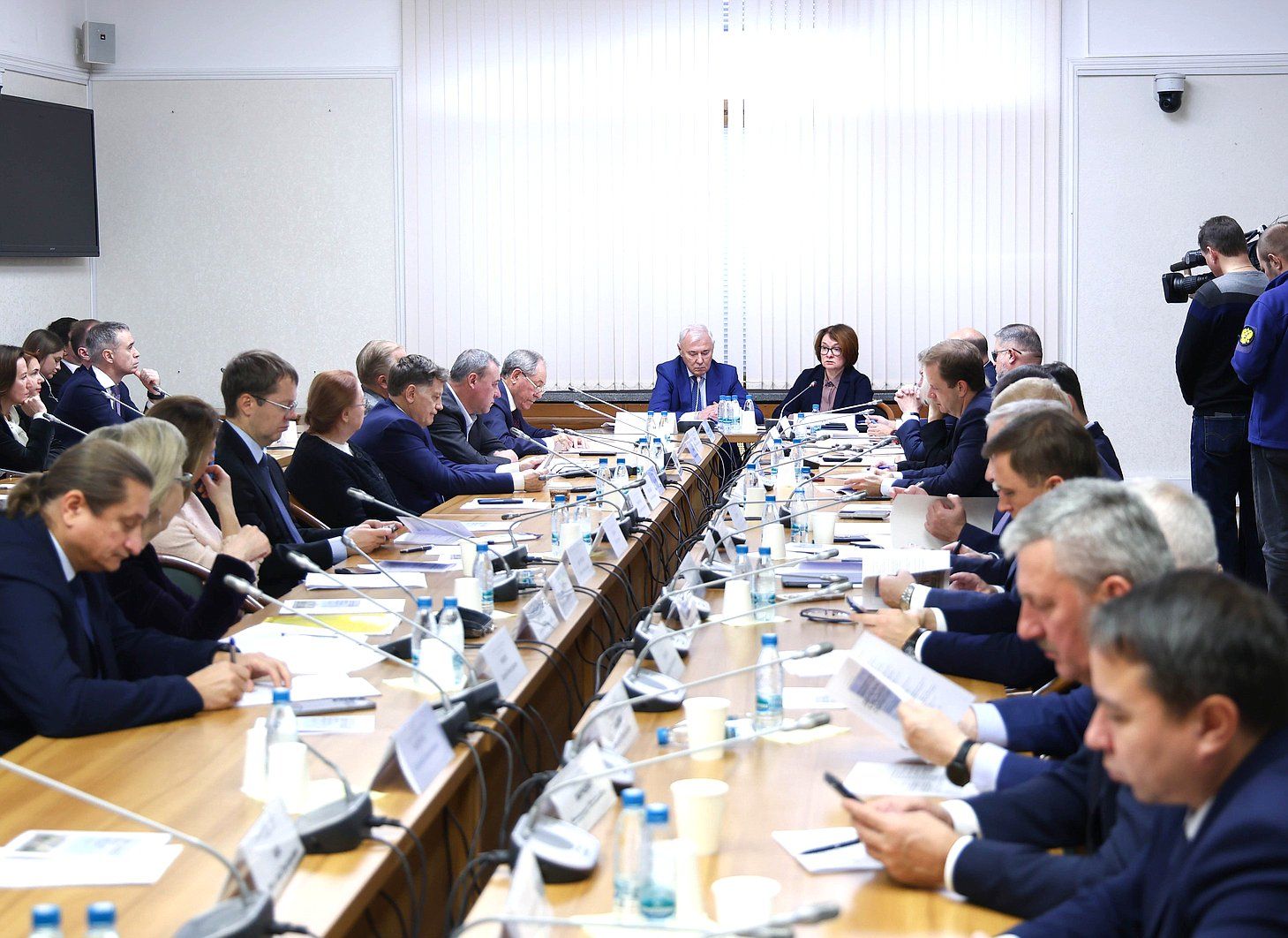
Joint meeting of the Committees on the Financial Market, on Budget and Taxes, and on Economic Policy to consider the “Main Directions of the Unified State Monetary Policy for 2027 and for the period of 2028 and 2029”, November 9, 2026. Photo: duma.gov.ru
Oh, if only I could have seen the faces of the deputies at that moment. They know very well which “number of machine-building sectors” are developing at unprecedented speed today. By the way, their loans are subsidized.
Still, I would make a clarification about the banks too.
It’s been a long time since the last default
According to the review of the banking sector by the same Central Bank, in September banks bought 77% of new OFZ issues — in total, the Finance Ministry issued 1.4 trillion rubles in bonds then. At the same time, banks, having pledged OFZs to the Central Bank (repo operation), received 1.7 trillion rubles from the regulator against that collateral. In effect, this is the notorious money printing: the Finance Ministry borrows by issuing OFZs, banks buy these bonds — and immediately pledge them to the Central Bank. The Central Bank injects liquidity into the market through banks — the actual “live” money appears at the moment when banks lend this money or otherwise inject it into the economy.
So, on the one hand, the Central Bank is fighting inflation. On the other, it is generously pouring money into the economy. You don’t need to be an economist to understand: when money is flowing like a river, it is hard to talk about saving, and when there is no saving, no one will spare the expense. There you have inflation.
But that’s not all. As a result, banks end up owing the Central Bank — and that debt has already reached 8.4 trillion rubles, having increased more than 2.4 times over the year. Add to this the fact that corporate problem loans are growing — although the Central Bank still classifies such loans as “restructured”, in reality many of them should long ago have been moved into the category of non-performing. What kind of restructuring, tell me, can help coal companies that have nowhere to sell coal? Forestry companies that consider it a blessing to sell their products from the northwest of the country to China, where logistics eat up all possible profit? Utilities companies — these bottomless barrels of Russia? And so on, and so on...
The stability of the banking system is hanging by a thread, warn experts Alexandra Prokopenko and Alexander Kolyandr. It is unlikely to end in the usual crisis, but the latent crisis is already here.
And on the other hand, the Finance Ministry is now spending up to 10% of the budget on servicing the public debt. An unimaginable figure. And given that the ministry has been allowed to increase borrowing by 1 trillion rubles this year already (6.5 trillion in total), this figure will only grow.
As a result, pro-government economist Vladimir Klimanov writes: “In this regard, proposals may be made to begin negotiations with holders of federal loan debt — predominantly financial institutions with state participation. Payments on these obligations are planned for 2027 in the amount of 4.5 trillion rubles or more, which exceeds the total spending on education, healthcare, culture, and physical education. Such a significant volume of interest payments could be revised — at least in terms of restructuring them by postponing payments to longer terms”.
Let me translate that into plain English: the economist is proposing a default on domestic debt. At the very least, a partial one — regarding debt owed to state banks. Something tells me that in this case the latent crisis could easily turn into a real, classic crisis on the model of 1998. Only this time, one should not expect such a quick recovery — the era is not the same.
Are you sure you’re fighting inflation?
But let’s return to Nabiullina’s speech. Defending the high rate (which, according to her, will remain in double digits next year as well), the head of the regulator said that high inflation is “the most unfair tax”, which hits the poorest first and foremost. It is hard to argue with that. However, how does that fit with her subsequent claims that the government plans to reduce inflation by cutting the budget deficit through savings?
I should remind you that this is not about saving on military spending at all — those expenses are growing and will continue to grow. But already next year, spending on social items will be cut by more than 15% — something unseen since the 1990s. In other words, the budget hole growing because of the war will be plugged precisely at the expense of those same poor people whom Ms. Nabiullina is so concerned about. Will that reduce inflation?
You know — yes, possibly. Consumer inflation, that is. People will buy less, and what they do buy, they will buy in smaller quantities (as studies show, Russians are already buying even less food). Possibly, but not necessarily — under specific Russian conditions.
For example, sales of laptops have already plunged by 20% this year. Cars too — by 20%. Have they become cheaper? Not at all. Because the main cause of the price increase was the higher recycling fee on cars and the technological fee on electronics introduced in December.
But defense-sector spending will rise! Not only are missiles and drones single-use products that produce nothing but explosions and destruction. In wartime, the military-industrial complex will not save on workers’ wages or lower prices for those same missiles and drones. And there are also payments to those fighting, which regional and federal budgets carve out by cutting payments to civilians (and the same poor people). And there is the endless theft and corruption — it cannot be otherwise in a non-transparent business where money flows like a river, and the regular arrests say the same thing.
So explain to us, Elvira Sakhipzadovna, what kind of fight against inflation are you talking about when you yourself admit that in the autumn it rose, including because of UAV attacks on oil refineries (and without the war this would not have happened), and that the main problem is not high demand but shrinking supply (and without sanctions this would not have happened)?
This is not a fight against inflation. It is shifting its burden onto citizens and peaceful businesses — and, in particular, onto the poorest citizens and the most defenseless businesses, first and foremost small ones. They will never be able to withstand your rates.
And yet, large businesses are no longer eager to expand production either. Nabiullina boasted that the Central Bank expects fixed capital investment to grow by 1–3% next year amid continued growth in consumer activity and real incomes. Let’s leave to her conscience the growth in consumer activity and real incomes — citizens can assess these parameters perfectly well for themselves. But a 1–3% increase in investment is not just negligible; in conditions of even the officially expected inflation of 6–7% (or even 5% or the target 4%), that means a decline in investment activity in comparable prices, not growth. And anyway, why would businesses invest if the state is taking the juiciest pieces “into temporary management” with a wide scoop, handing assets over to nominees of the Kremlin’s favorites? The ones who do not so much develop businesses as appropriate the fruits of others’ labor? If the consumer sector is shrinking anyway, and loans themselves are murderous? And without loans, where is business supposed to get money?
Among economists, the debate is constant — will the Russian economy collapse or not? Most tend to think it will not collapse — it will just quietly rot. Let me clarify: it will by no means rot quietly.
It has become common to compare the current situation either with the 1990s or with the 1980s. But I would choose another era: the mid-1920s, when the NEP was rolled back and the “Great Break” was declared. They really did break things thoroughly: the Holodomor, dekulakization, homeless children, forced labor, and other delights. But by the start of the war they had churned out tanks and airplanes. Only all of them burned in the very first days of the invasion, and they had to be churned out again — with a new overstrain of effort.
Now, of course, the pipe is lower and the smoke thinner. Citizens are hardly going to be herded into new collective farms (there is no one left to herd), and camp labor turned out to be economically inefficient. But the basis — robbing the people for a great goal (then — preparing for war, now — the war itself) — is the same. And the Central Bank in this break is de facto playing a crucial role as a redistributor of financial flows from civil society to the war machine. Yes, one can live like this for a long time. But badly.
If you enjoyed this article, consider making a donation — one-time or, even better, monthly. Your support helps us motivate our authors and become better with every article.
Our organization is recognized by the Internal Revenue Service (IRS) as a 501(c)(3) tax-exempt, charitable organization, which means that all contributions made to us are tax-deductible to the fullest extent permitted by U.S. law. Individuals may generally deduct charitable contributions of up to 60% of their Adjusted Gross Income (AGI) for cash donations made to qualifying 501(c)(3) organizations. For donations of appreciated assets (such as stocks or other long-term capital assets), the deduction is typically limited to 30% of AGI, based on the fair market value of the asset. C-corporations may deduct charitable contributions of up to 10% of their taxable income for donations made to eligible charitable organizations.
By submitting a donation, you confirm that you have read and accept the following documents: Privacy Policy and User Agreement, and also give consent to the processing of your personal data.
If you would like to unsubscribe from a monthly donation, please email us at: [email protected]