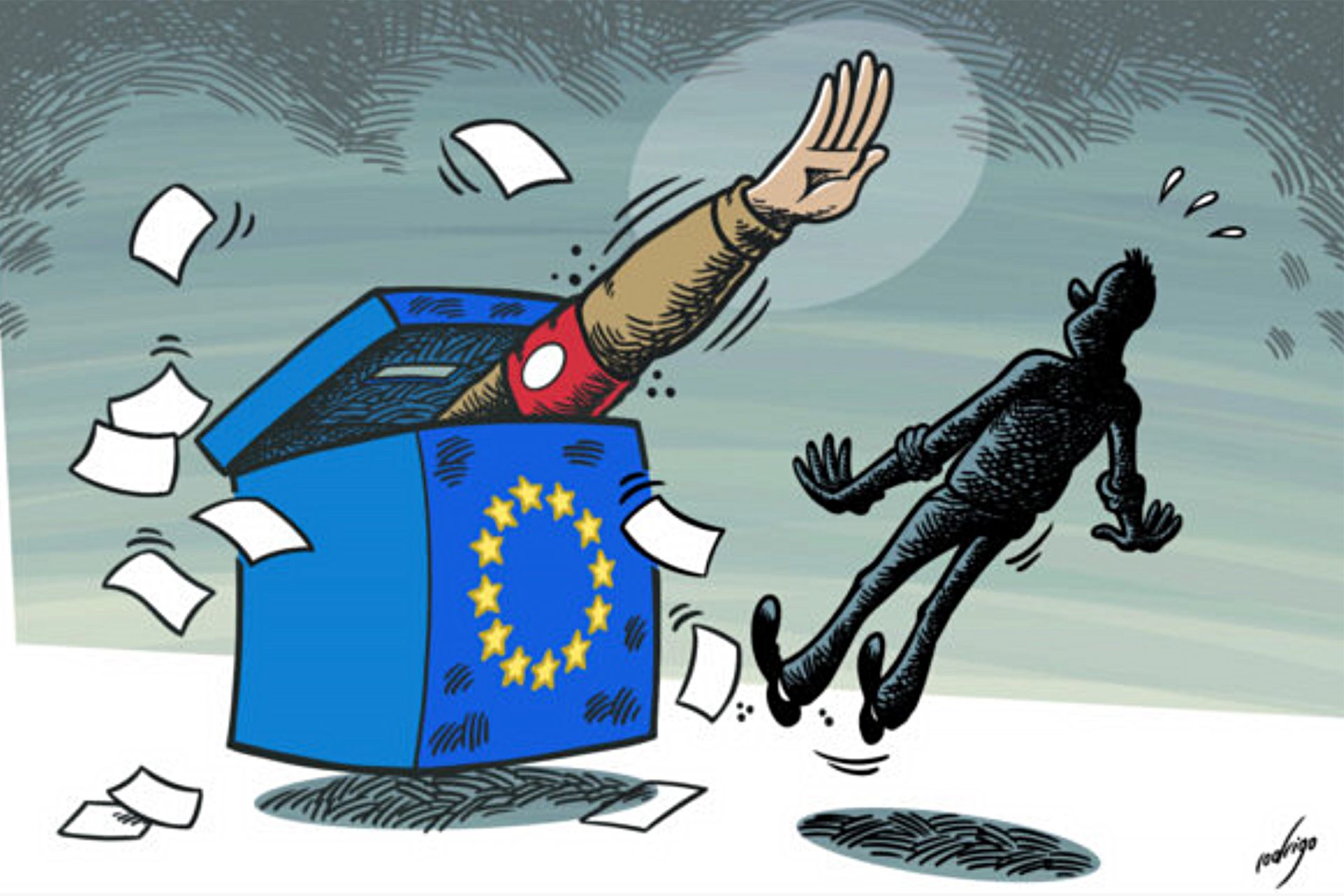
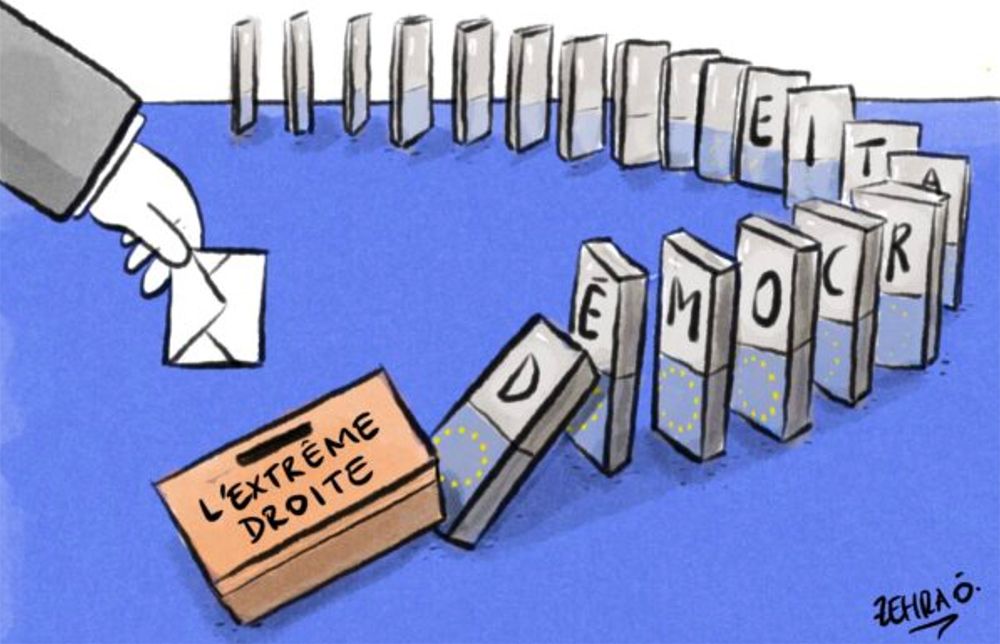
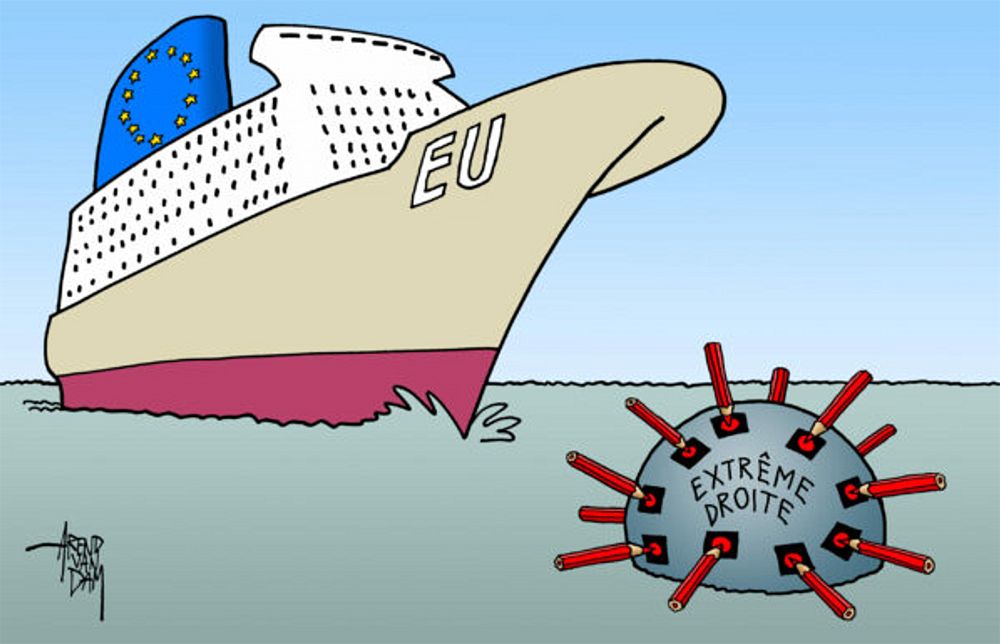
In 2026, the popularity of European parties from the right side of the political center became practically the norm. Should this be seen as the end of the old good world?
“Far-right forces are conquering Europe”. Image: Rodrigo (Portugal) / cartooningforpeace.org
The authorities talk about economic growth, but in reality the rich are getting richer, while the poor still barely make ends meet. People would gladly work, but at every step they are hindered by useless bureaucrats. And there is also the corrupt government: it brings into the country immigrants alien to us, while citizens do not have enough jobs. One does not even want to talk about foreign policy — the authorities have no will, they constantly grovel before foreigners. They invented some kind of “green agenda” to completely ruin the economy, they brainwash children in schools about some genders. We are sick and tired of enduring all this; the government needs new people, true patriots of our country!
All this reads like a summary of a joyless ride with a scruffy taxi driver or an equally stifling evening with elderly relatives. But if you run the text through a couple of suitable prompts in a neural network, add a few nice numbers, and hand it over for polishing to a middling PR specialist, the result will be a manifesto of a typical European national-populist party. A political segment that is gaining momentum better than others in the Old World of our days. As The Guardian recently calculated, over the past 30 years in Europe nationalists and right-wing populists have increased their electorate fivefold.
Such a steady expansion cannot be written off as a random whim of voters, the peculiarities of two or three specific countries, Kremlin hackers, or algorithms tweaked by Elon Musk on the social network “X”.
Only Malta held out
At the beginning of work on this article, I conducted a simple study. Armed with Google and Wikipedia, I looked at the results of the last ten parliamentary elections in the member states of the EU. I am talking about votes that, from October 2025 to October 2026, took place in Latvia, Sweden, Malta and Cyprus, as well as in Bulgaria, Hungary, Denmark, Slovenia, the Czech Republic and the Netherlands.
Naturally, I was interested in the successes of parties with a program to the right of the political center. In eight out of 10 cases, the electorate showed more than obvious sympathy for such forces: from 10–15% of the vote and above. In some countries, right-wing populists and nationalists became ruling parties; in others, they formed the core of the parliamentary opposition. Hungary stands out in particular, where in the April 12 election de facto only the right and the even further right competed: the openly ultra-nationalist Mi Hazánk, the right-wing populist Fidesz, and the future winner, the national-conservative TISZA.
The ninth, special case is Bulgaria. In the Balkan country, on April 19, local nationalists did not shine. Some far-right figures, from the “Revival” party, barely cleared the 4% threshold; others, “MECH“, did not enter parliament at all. But the government formed after the election by “Progressive Bulgaria” is left-of-center only on paper. The young party of former President Rumen Radev adheres to Euroscepticism and national-populism, so it is much closer to modern far-right forces than to the classic social democrats of Western Europe.
And only in Malta did the nationalists not succeed at all. Yes, the Nationalist Party came second in the May 30 election, but in essence it is the local Christian Democrats, and its name should not be taken literally.
Hard to believe, but even 15 years ago things were like this not on a single tiny island in the Mediterranean, cut off from the mainland agenda, but in almost all of Europe. Any politician who cautiously began to speak about national identity and restrictions on migration risked being accused of neo-Nazism.
One can recall what scandal in Germany in the late 2000s was triggered by Senator Thilo Sarrazin. In a series of interviews and publications, the politician from the Social Democratic Party argued that immigrants from Muslim countries integrate poorly into German society. Sarrazin also had questions about people from the Balkans, and he considered the best option to let people from East Asia and the former USSR into Germany, and even then with caution. In the end, the senator was subjected to the harshest ostracism, and his career collapsed. But now, both in Germany and in Europe as a whole, much more open anti-immigrant and Islamophobic rhetoric is going down without pain.
As early as the beginning of the 2010s, in Germany and other countries, especially those that had experienced the traumatic legacy of nationalist dictatorships (Spain, Portugal, etc.), it seemed that political culture itself would not allow a successful party to emerge to the right of the center. Now, however, we see the same Germans, Portuguese, and Spaniards massively moving under the banners of AfD, Chega and VOX. The rise of the far right to power in key European countries is now discussed not in terms of “if” but “when”. So what has changed in the Old World?
For everything one’s own against everything чужое
Nationalism is a broad and ambiguous concept. The general essence of its different interpretations boils down to the idea that the nation as a collective whole is proclaimed the basis for society and the state. But the question is: what is a nation? Some believe it is simply the citizens of one state, meaning that once you get a passport, you are already part of the nation. Others think it is people united by a common language, tradition, and culture. And still others believe it is some “original” group bound together by identical origin. In other words, members of one nation or another are not made, but born.
Originally, nationalists were called those who adhered to the third, the harshest approach. It is also called ethnic or primordial nationalism. But in the second half of the 20th century, primordialism began to look too toxic, so (far-)right forces drifted closer to civic nationalism. Roughly speaking, something in the spirit of the statements of the aforementioned Sarrazin: that without immigration, of course, there is no way now, only within reasonable limits and in the interests of the receiving side. And, of course, not every culture can become European.
However, political nationalism under parliamentary democracy cannot be reduced to just one national issue and the problem of immigration. Even the most xenophobic voters are concerned with other issues too: what will happen to taxes, tariffs, schools? And foreign policy, after all? Dutch political scientist Cas Mudde identifies three important pillars of the European new right: nativism (the conviction that political power in a state should remain with the titular ethnic group), an authoritarian style (belief in discipline, hierarchy, and dirigisme in the economy), and populism (the belief that politics should express the will of the “real people”).
At the same time, the main factor in the success of the new right in Europe was precisely the populist spirit, Mudde argues. This component’s role became especially strong in the mid-2010s, after the first successes of Donald Trump and his MAGA movement in the United States.
European fans of the American billionaire politician saw in his story a successful model to emulate and transplanted Trump-style populism onto their own soil.
Populism is not just when a politician lures voters with grand promises; it is a set of methods and corresponding rhetoric. Politicians of very different views can resort to them — socialists, “greens”, even libertarians. But in recent years, largely thanks to Donald Trump’s success, right-wing populism has become the trend. It can be reduced to three pillars: maximum simplification of complex problems, selective observance of written law, and constant appeal to the people.
“Populism is an ideology that considers society to ultimately be divided into two homogeneous and antagonistic groups: ‘the pure people’ versus ‘the corrupt elite.’ It claims that politics should be an expression of the general will of the people”.
It works roughly like this. Crime is rising in the country, apartment rents are going up, and the quality of medical services is falling. A politician of the old school will start analyzing statistics, consulting experts, and only then draw cautious conclusions. A right-wing populist will immediately blame migrants for everything: saying all sorts of people have come here and overloaded our infrastructure. And they do not want to work honestly either — hence the robberies, thefts, and hooliganism in the streets.
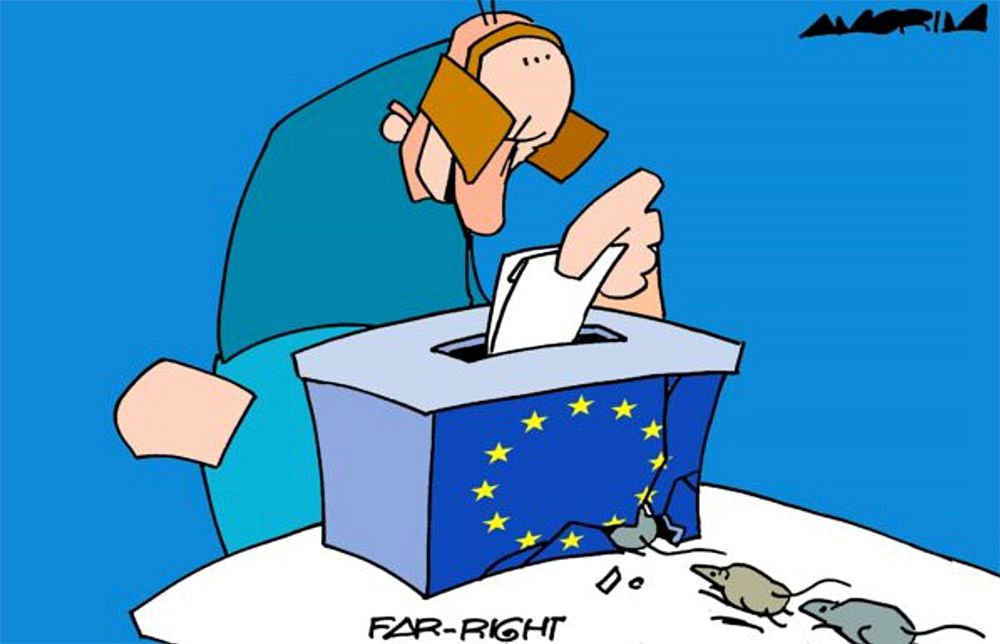
Next come calls to check all outsiders and, in the event of the slightest violation, expel them from the country. And in migration laws, populists will of course demand tightening the screws to the limit, and they do not care what conventions and declarations the government signed before. Of course, left-wing parties will be furious — but our heroes will simply declare that subversive elements and offspring of international NGOs who want to “replace” the native Europe are getting in their way.
Image: Amorim (Brazil) / cartooningforpeace.org
And this, in general, is not some abstract story pulled from thin air. This kind of plot has literally been unfolding in Finland over the past couple of years in Finland.
The Scandinavian republic, traditionally considered friendly to newcomers, after the victory of the right-wing coalition in the 2024 election, turned into one of the most anti-immigrant states in Europe.
This has already hit, among other things, many anti-war Russians who were counting on political asylum in Finland. However, what matters more here is something else: why did sophisticated European voters fall for right-wing populism?
No, you did not manage it
It is pointless to look for the reasons for the sharp rise in the popularity of nationalists in the dynamics of specific socio-economic indicators. For example, how much unemployment grew in the EU, how inflation jumped, or labor productivity declined. Here there is an entire knot where many threads of both objective and psychological trends intertwined — the refugee crisis of 2015.
Eleven years ago, about 1.5 million people flooded into Europe. These were people from various Asian and African countries, usually trying to escape endless wars and the absence of any life prospects at home: in Afghanistan, Iraq, Libya, Syria, etc. And united Europe turned out to be not so much institutionally as mentally unprepared for the largest migration crisis since World War II.
“The refugee crisis exposed differences that had long gone unnoticed — a kind of positive side effect. Just as after Trump’s election the American public suddenly realized that the population lives in two completely different Americas — a rural reactionary one and a cosmopolitan liberal one — Europe is also beginning to recognize its own polarization”
Pro-European authors responded to the events of 2015 with a number of studies written in an optimistic spirit. There, the authors using figuresproved that the migration crisis, contrary to nationalist claims, caused neither an immediate surge in crime nor massive public spending. And in general, the ability to accept such a number of foreigners and integrate them into one’s society rather speaks to the strength of united Europe. As then German Chancellor Angela Merkel said in those days: Wir schaffen das (“We can do this”).
However, this victory turned out to be Pyrrhic. The mass arrival of migrants split the European Union along two axes at once: “poor South versus rich North” and “post-socialist East versus dominant West”. It suddenly became clear that the troubled economies of the Mediterranean cannot pay for a pan-European festival of humanism, and the former members of the Warsaw Pact simply do not want to. In the words of Ivan Krastev already quoted, “these countries are ethnically extremely homogeneous, and they see multiculturalism as regression”. In Eastern Europe, it was precisely after the events of 2015 that Hungarian Prime Minister Viktor Orbán and his party Fidesz, for example, finally mutated into national-populists. Once liberal Westernizers turned into consistent fighters against the “dictate of Brussels” and Kremlin allies in the middle of Europe.
The disagreements that had formed were only worsened by the fact that European economies had barely recovered from the 2008–2009 crisis (and not even fully). Millions of citizens of different countries involuntarily and independently of one another felt: just as a return to normality loomed on the horizon, a new disaster entered their lives. Indeed, following the arrival of migrants, Europe was shaken by a whole series of tragedies involving unwelcome guests: the attack on Paris’s Bataclan on November 14, 2015, the New Year’s attacks on women in Cologne, the bombings of March 22, 2016 in Brussels and a number of other tragic episodes.
Instead of integration and openness, isolationism and rethought nationalism became the trends.
In that same 2016, continental Europe was shown an example by the second-largest economy of the then EU, the United Kingdom. The dangerous gamble of David Cameron’s Conservative cabinet with the Brexit referendum ended in an unexpected victory for Eurosceptics in the June 23 vote. Originally the desperate dream of British far-right forces, who at that time had exactly one seat in the House of Commons, it came true against all odds.
Finally, sociology worked in favor of the nationalists, which left-wing commentators later reluctantly acknowledged. As noted London School of Economics professor Jean-Paul Faguet, by the 2010s the familiar scheme had exhausted itself — social democrats and labor parties of all kinds were helped by the fact that the working class reliably voted for them. The proletariat in its classical form ceased to exist. People left factories and plants en masse for offices, small business, and the service sector. Left-wing parties took up defending the rights of immigrants and various minorities, and the heirs of their old electorate grew angry and moved to the explicitly anti-system far right. This trend was especially vivid in relatively disadvantaged regions in Western European countries: the English North, the French South, or the lands of the former GDR in reunified Germany.
But the turning point for the new European nationalism was precisely the events of 2015–2016. According to The Guardian, if in 1995–2015 the electorate of parties to the right of the center in Europe grew only from 5 to 10%, then in 2016–2025 its share jumped to 23%. The most noticeable was the surge of two such forces in key EU countries: France’s National Rally and Germany’s AfD, “Alternative for Germany”.
The far right and even farther right
The French “Rally” and the German “Alternative” often appear together in journalistic texts. Indeed, the programs of the two parties are similar in key points: Euroscepticism, economic nationalism, tougher immigration, criticism of “green energy”, and, to varying degrees, pro-Moscow sympathies. But there are also important differences between them. Roughly speaking, if AfD earned political capital by constantly slapping public opinion in its own country, then their French cousins succeeded thanks to their pronounced integration into the system of the Fifth Republic.
The predecessor of the “National Rally” — originally under the brand “National Front” — was founded back in 1972. Its founders were veterans of several French neo-fascist groups, including real veterans of the Waffen-SS from World War II. The old “Front” was in many ways a leader-centered movement built around an irreplaceable leader — former paratrooper and veteran of colonial wars Jean-Marie Le Pen. There is no point dwelling on this figure, I think. The “Devil of the Republic”, who died on January 7, 2025, is well remembered beyond France, primarily for his regular jokes about the Holocaust, analyses of the racial composition of the national football team, and other dubious statements.
Tens of thousands of supporters sincerely admired Le Pen, but far more French people hated him. And this, given the local specific system of two-round parliamentary voting, put an end to the “Front’s” electoral prospects on a national scale. Under any scenario, the popularity of the nationalists lagged behind their negative rating, and the average citizen kept away from the Le Pen camp. Then in 2011 the new head of the “Front”, the patriarch’s daughter Marine, launched “de-demonization” — a full rebranding of the party with a thorough revision of her father’s legacy.
Le Pen Sr. angrily protested, tried to derail the reforms, but in the end achieved only his own expulsion from the party. And the updated “National Rally” began to position itself as civic nationalists — no longer the republic’s “devils”, but its faithful defenders. Le Pen Jr. decisively threw the old antisemitism, racism, and nostalgia for the Vichy regime onto the trash heap of history. It cannot be said that scandals around the party disappeared entirely: Marine and her people were accused at one point of being financed from Moscow, and at another of misusing EU funds. However, the mass voter turned toward the “Rally” — in 2012–2024 the nationalists’ results in parliamentary elections rose from 13.6% to 33.2% of the vote.
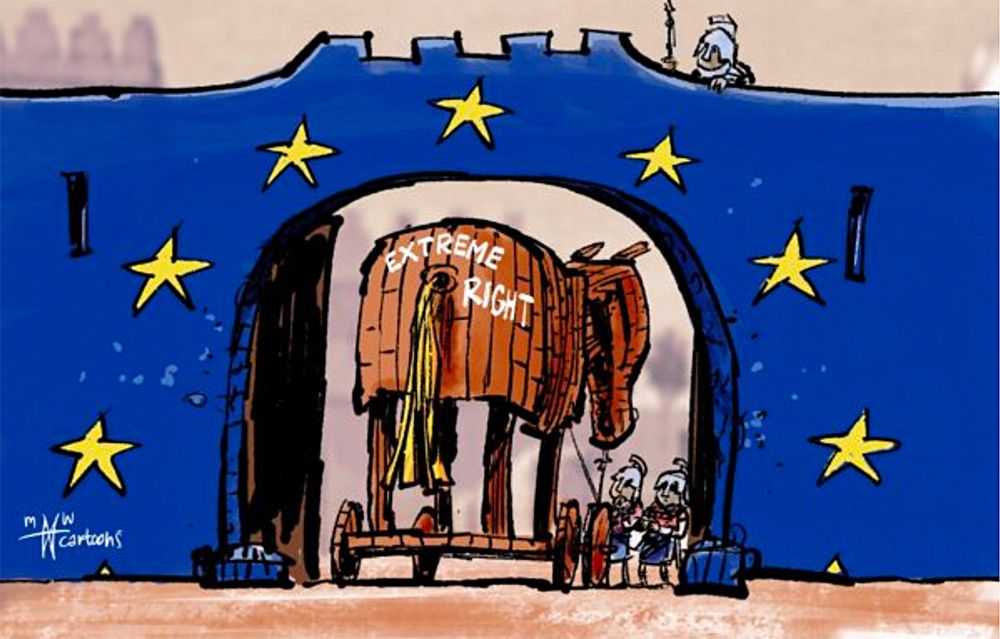
Image: Arend Van Dam (Netherlands) / cartooningforpeace.org
The history of “Alternative for Germany” developed quite differently, and it is much younger. In 2013, AfD was founded by a group of disillusioned CDU/CSU members led by economics professor Bernd Lucke. At that time, the core of the new force’s program was purely economic nationalism — the “alternativists” primarily advocated Germany’s exit from the eurozone. But a national-populist faction quickly grew stronger inside the party. On the wave of the 2015–2016 events, it defeated Lucke’s supporters in backstage infighting.
On September 24, 2017, the changes bore fruit in the Bundestag election. AfD, under far-right slogans, won a sensational 12.6% of the vote and 94 seats in the lower house. Yes, later the “Alternative” was hit by a crisis, but by the mid-2020s the party, under the leadership of the duo Alice Weidel and Tino Chrupalla, had made up all the lost ground and multiplied its former successes. Moreover, unlike other European nationalists, in AfD they never hid their ties to the Kremlin, and almost boasted about them. They said Moscow and Berlin’s friendship is our strategic line, and there is absolutely nothing to be ashamed of here. After all, Russia means a strong president, Christian values, and uninterrupted supplies of hydrocarbons.
Last September, the culmination of AfD’s triumphs was the election victory with 43.8% of the vote in the state parliament of Saxony-Anhalt — yes, the least populated, yes, the least economically successful, but nevertheless a full federal state. And, most importantly, this triumph was no longer perceived as a sensation by anyone. The only question was whether the “alternativists” would have enough votes to form a state government without a coalition with system parties like the CDU and SPD; for now the question is still up in the air. And the next intrigue is whether the “firewall” against AfD will hold at the federal level, and whether the Christian Democrats, who have barely managed to govern, will surrender to the victor’s mercy.
It is ironic that almost the only political force that somehow put the squeeze on the “Alternative” was the French “Rally”. At the beginning of the 2020s, the two parties in the European Parliament were part of the common “Identity and Democracy” alliance, but they pulled it in different directions. The French continued their “de-demonization”, while the Germans were drawn to Sieg Heil salutes. In 2023–2024, AfD got into a series of public scandals, above all because of its plans for “remigration” — the forcible expulsion of “extra” people from Germany.
In May 2024, the situation was aggravated by careless remarks from prominent “alternativist” Maximilian Krah about SS fighters: supposedly not all of them were criminals, there were plenty of decent people there too. Marine Le Pen used this as a pretext for a final break and insisted that the Germans be expelled from “Identity and Democracy”. But AfD also found allies, so in the end it all ended in split and collapse of the far-right alliance. This case is revealing: by the mid-2020s there were too many “nationalisms” in Europe, and they sometimes bite each other harder than direct ideological antagonists do.
They moved toward the center so much that they shifted it
Left-wing and liberal authors often classify as far-right or nationalist anyone whose ideology is to the right of the center — from the ruling “Brothers of Italy” of Prime Minister Giorgia Meloni in Rome to outright neo-Nazis like the aforementioned Bulgarian “Revival” and Hungarian Mi Hazánk.
But reality is much more complicated: over the past 6–8 years, the “lore” of European nationalists has become too heterogeneous, which led to its split into three camps. They can be judged by the corresponding factions in the European Parliament.
“European Conservatives and Reformists”. These are, so to speak, the least extreme of the extreme right. We are talking about national conservatives who partly retain populist techniques, but on the whole have broken with radicalism and are now closer to classic center-right forces. Euroscepticism and anti-migrant sentiment remain with the “Conservatives and Reformists”, but in a cautious form. After February 24, 2022, this faction unequivocally supported Ukraine and condemned the actions of Putin’s leadership of Russia. A vivid example of a party from the ECR is those same “Brothers of Italy” of Giorgia Meloni. Yes, this grouping has a dubious history; it carries indirect continuity from the neo-fascist “Italian Social Movement” created after World War II. But now Meloni’s government is only slightly to the right of the leadership of other major European countries. A similar evolution was undergone by the “Brothers’” partners in the faction: the True Finns, the Sweden Democrats, Poland’s Law and Justice, and a number of other movements.
“Patriots for Europe”. And this is already classic right-wing populists, with unconditional sympathies for American Trumpism and regular accusations of ties to the Kremlin. In this faction, anti-immigrant, anti-Islam, anti-Brussels, and quasi-authoritarian rhetoric sounds much louder. Almost all the troublemakers in the news of recent years are members of the Patriots: France’s National Rally, Orbán’s Hungarian Fidesz, Spain’s VOX, Portugal’s Chega, and two Freedom Parties: the Dutch and the Austrian. In short, not the most pleasant environment for people with left-wing or centrist views. At the same time, calling the Patriots dyed-in-the-wool nationalists is also impossible. Rather, they are weather vanes, swinging now toward radicalism, now toward the pan-European mainstream depending on the situation. Recently, these parties have been trying to distance themselves both from Vladimir Putin and from the losing-prestige Donald Trump — once their guiding stars.
“Europe of Sovereign Nations”.And this is already the pure far right, consistent critics of liberal democracy. Extreme Eurosceptics, supporters of conspiracy theories, and, finally, open sympathizers of the current Russian authorities. The marginality of the “Sovereign Nations” is underscored by their small numbers. There are only 27 Members of the European Parliament here, compared with 84 and 85 MEPs for the ECR and the Patriots, respectively. In essence, the ESN is built around Germany’s AfD, which accounts for more than half (15) of the faction’s members. The rest are members of like-minded parties, mostly from Eastern Europe, which is more prone to open isolationism and ethnonationalism.
Of course, the split among European nationalists is more of a good thing. As can be seen, most parties to the right of the center are getting used to playing by democratic rules and are generally distancing themselves from radical moods and outright xenophobia.
The programs of many right-wing populist forces are not so much about nationalism as about the desire to shut themselves off from change and progress. The ideology of the Czech AUTO is illustrative, as it rests on three postulates: hatred of “green energy”, defense of gasoline-powered cars, and refusal for the Czech Republic to join the eurozone.
The other thing is that the invisible “center” in European politics has also shifted noticeably to the right over the past 10 years. Above all, the demand to tighten control over entry into the EU has entered the mainstream. French Republicans and German Christian Democrats, who until recently were extremely liberal on migration, are now loudly championing it. By contrast, talk about a transition to “green energy” or strengthening European integration in today’s EU is becoming rarer and vaguer. It is also completely unclear what will happen to aid to Ukraine — especially if in 2027, in the French presidential election, Marine Le Pen finally wins on the fifth attempt, and for now things in the country seem to be heading exactly toward that outcome.
Historical experience shows that any openness, readiness for social progress, and talk about a beautiful future are, in essence, a luxury. Even the most prosperous countries can afford it only in moments of extraordinary economic growth and confidence in its strength. But pandemics, wars, and economic downturns naturally lead to a cult of tradition, closedness, and national egoism. The same thing happened in the Old World a century ago, and then Europeans needed the most terrible war in world history to break the trend. One wants to believe that this time the wars already underway will be enough.
If you enjoyed this article, consider making a donation — one-time or, even better, monthly. Your support helps us motivate our authors and become better with every article.
Our organization is recognized by the Internal Revenue Service (IRS) as a 501(c)(3) tax-exempt, charitable organization, which means that all contributions made to us are tax-deductible to the fullest extent permitted by U.S. law. Individuals may generally deduct charitable contributions of up to 60% of their Adjusted Gross Income (AGI) for cash donations made to qualifying 501(c)(3) organizations. For donations of appreciated assets (such as stocks or other long-term capital assets), the deduction is typically limited to 30% of AGI, based on the fair market value of the asset. C-corporations may deduct charitable contributions of up to 10% of their taxable income for donations made to eligible charitable organizations.
By submitting a donation, you confirm that you have read and accept the following documents: Privacy Policy and User Agreement, and also give consent to the processing of your personal data.
If you would like to unsubscribe from a monthly donation, please email us at: [email protected]