At the end of February 2025, journalist and film critic Ekaterina Barabash was detained in Moscow. For social media posts about the war in Ukraine, the Russian Investigative Committee accused her of spreading “fakes” about the Russian army out of hatred. In Russia, this charge carries a prison sentence of five to ten years. Fortunately, Ekaterina managed to escape from house arrest and reach Europe. Today, we can finally tell the story of how it happened.
Disclaimer: The identities of most sources in this story are hidden for their safety
- She needs to be rescued urgently. Don’t you understand that in Russia now, people are put under house arrest for political charges not so they can stay free? We need to act immediately. Once she’s truly arrested, nobody can help Katya. - But what about Katya’s mother? She’s 96... - Do you think it would be better for her mother if her daughter is in prison?
It was a chilly late April evening in Perugia. The bar where I went with an acquaintance after the International Journalism Festival events was already closing, and we sat talking on the terrace open to all the winds. The Sangiovese and Negroni warmed us up, but not much. Meanwhile, in Moscow, where my colleague and friend Ekaterina Barabash had been under house arrest for a month and a half awaiting her criminal trial, it was snowing.
***
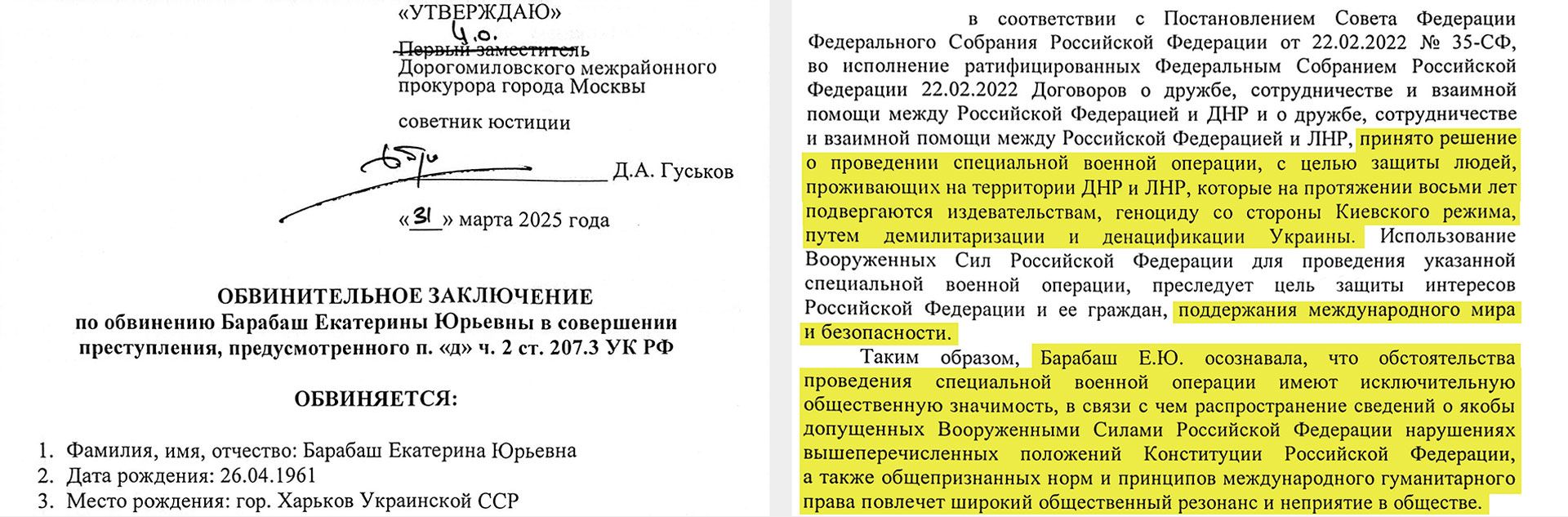
Katya was detained in Moscow on February 25, 2025, accused of spreading fakes against the Russian army. In the morning, masked security officers knocked on her door and conducted a search—which, as she later told me in a letter, was fairly neat, without any rampage. They confiscated her mobile phone and computer, both her internal and foreign passports, and took her for questioning at the nearest police station, where she spent the night. The next morning, the Investigative Committee announced that Ekaterina Barabash was charged under paragraph “d” of part 2 of article 207.3 of the Criminal Code. The maximum punishment is a fine of 3 to 5 million rubles, or up to five years of forced labor, or imprisonment for five to ten years.
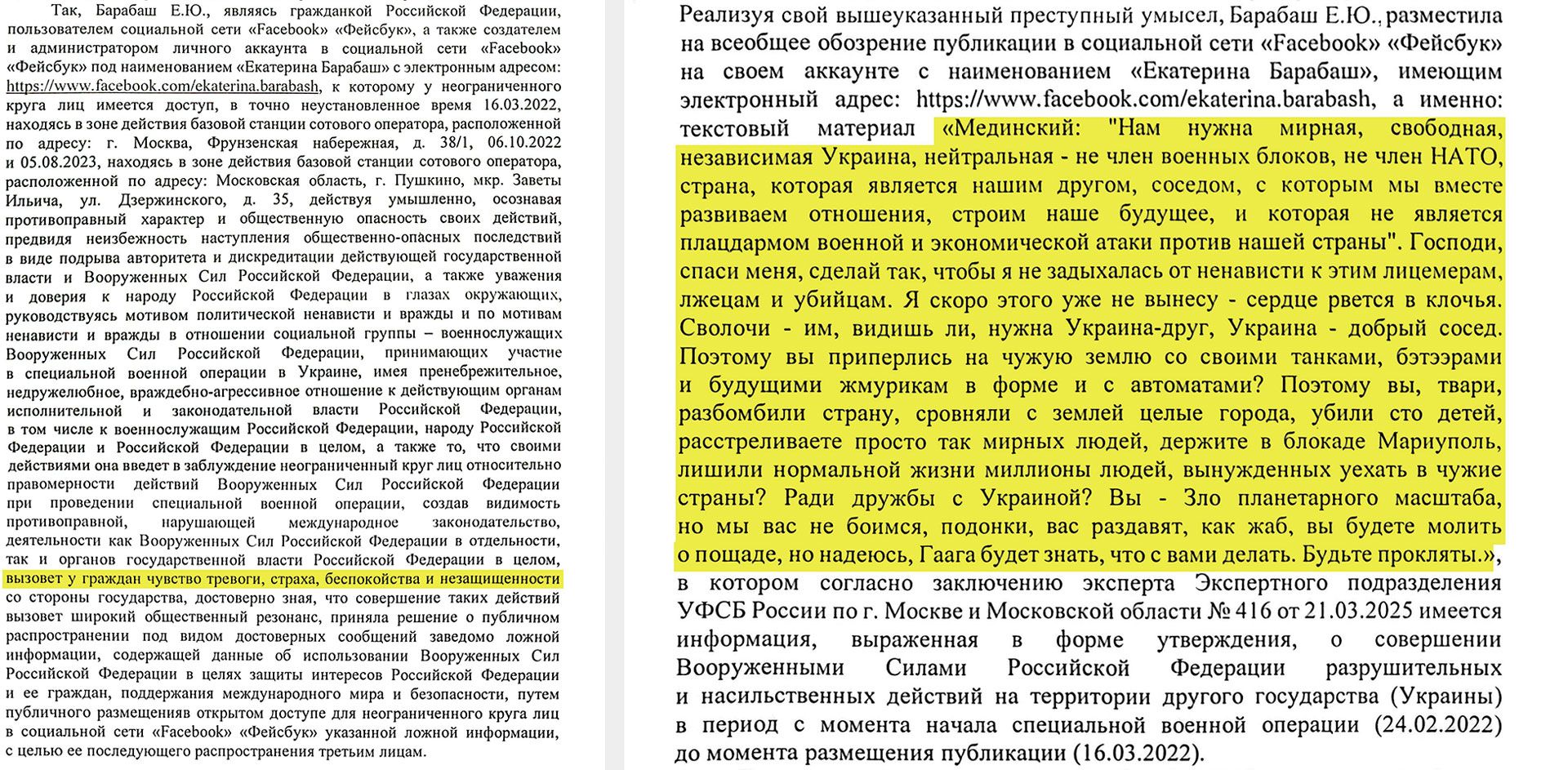
At that time, Katya and I were still working at Republic: she wrote about theater, cinema, and cultural policy, and I was deputy editor-in-chief. On the day of her detention, she published a column titled “And He Never Learned to Distinguish Defeat from Victory. Will Konstantin Bogomolov Stage a Play About Putin’s Successes?”, which was deeply irreverent toward both figures. However, as in many criminal cases against Russian journalists under article 207.3, the prosecution used not her media publications but her social media posts as evidence. During the February 25 interrogation, the investigator read aloud 27 Facebook posts in which Ekaterina wrote everything she thought about Russia’s war against Ukraine (three of them ended up in the indictment).
Indictment
Indictment
It became clear that Russian security services were watching Barabash as early as November of the previous year, when she started being stopped at border control in international airports. The first three stops lasted from 30 minutes to an hour. The fourth time, on February 22, when Katya was returning from the Berlinale, border guards held her for three hours. According to a well-known Russian human rights advocate, this usually happens when the FSB border service database contains a warning about a specific person—and the officer must contact the person’s handler for further instructions. And since FSB handlers are human too and may have personal matters (especially on a holiday weekend before Defender of the Fatherland Day), the wait can drag on.
When stopping Barabash at the border, the guards cited her birthplace—Kharkiv—as the reason. But her ties to Ukraine go beyond that. Her father, the well-known philologist and former first deputy minister of culture of the USSR, Yuri Barabash, specialized in the history of Ukrainian literature. In 2011, he received the Order of Merit, 3rd class, “for significant personal contribution to strengthening Ukraine’s international reputation, popularizing its historical heritage and modern achievements, and on the occasion of the 20th anniversary of Ukraine’s independence.” Yuri Yakovlevich died on November 28, 2024, at the age of 93. Katya’s son could not attend his beloved grandfather’s funeral, nor could Katya’s school-age grandson. They live in Kyiv.
“I think that if the investigator, the judge, or the prosecutor had children under shelling, they would curse the country trying to kill their children just the same. And it doesn’t matter what country it is—your own or any other. In such moments, every woman becomes a mother animal trying to protect her children however she can. If she can’t shield them with her body—then at least with words. I look at my father’s portraits and constantly try to imagine how he would react to all this. And you know—something tells me that, of course, he’s unhappy that I let Mom down, but at the same time he’s proud of me. I know him. And maybe it’s for the best that he didn’t live to see my arrest and likely imprisonment. Mom, that rock in a skirt, says that she and Dad are both proud of me“ (from Ekaterina Barabash’s letter, March 7, 2025).
***
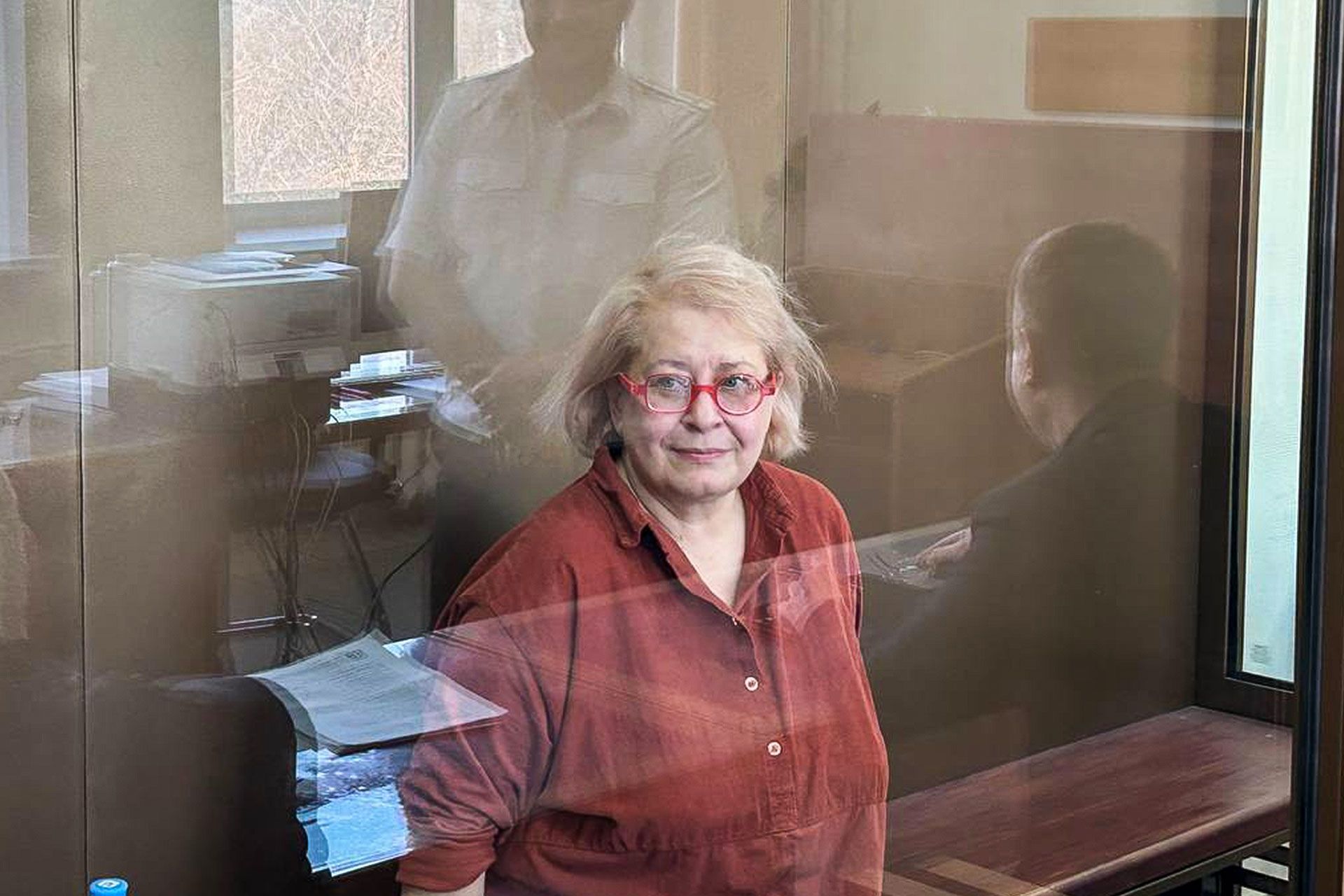
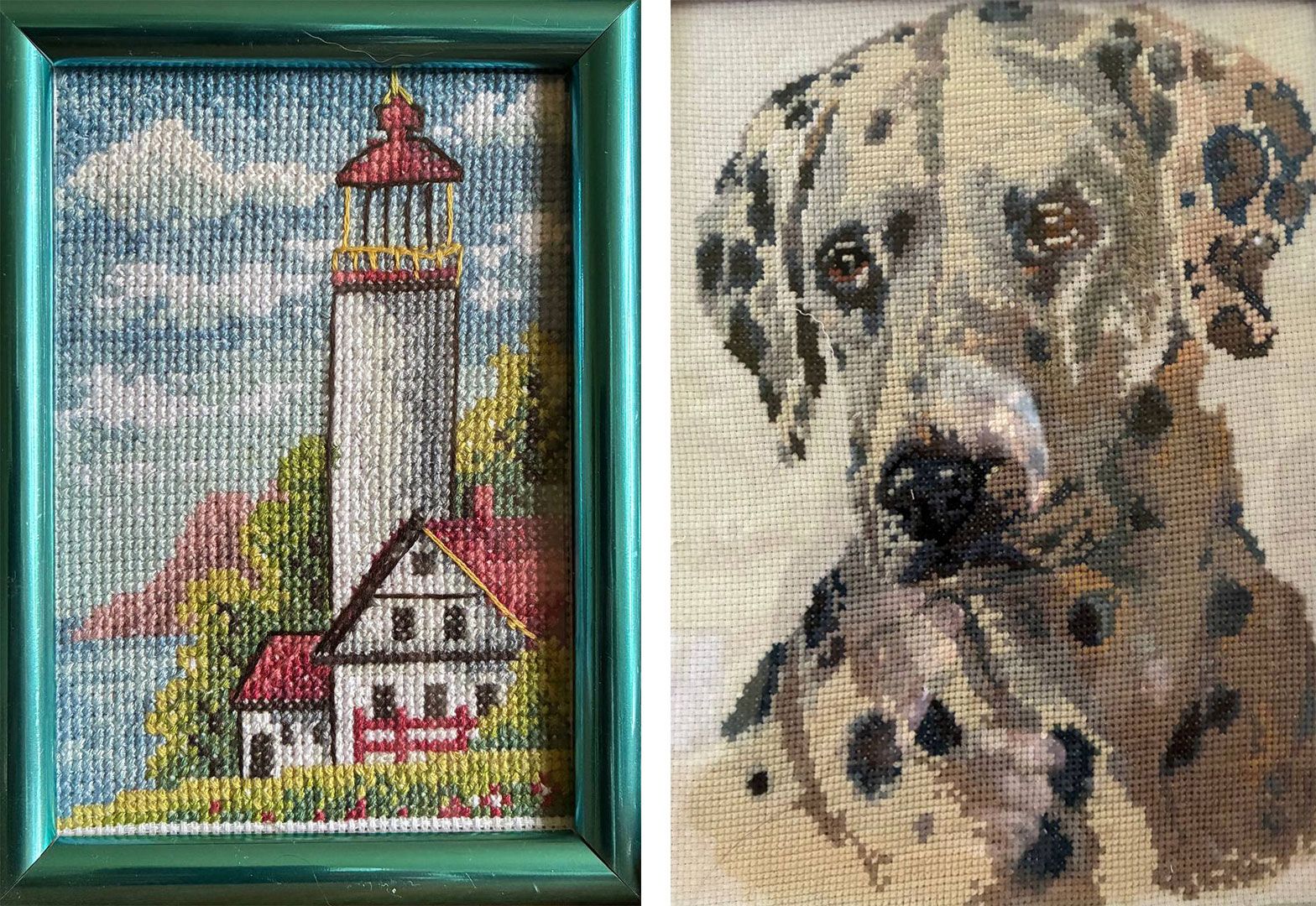
The Dorogomilovsky District Court chose house arrest as a preventive measure for Ekaterina Barabash during the preliminary investigation, until April 25. “At least I’ll have two months of freedom,” she rejoiced as she left the courtroom. The judge also banned her from going for walks, using the internet, or using a mobile phone. Barabash’s defense did not appeal the decision: according to her lawyer, Mikhail Biryukov, otherwise the soft regime of her house arrest could have become harsher. Yes, with the FSIN electronic bracelet on her ankle, she could only walk on the balcony, but at least she could receive guests without restrictions. Between guests and letters, she even managed to do a bit of embroidery.
Ekaterina Barabash’s embroidery
It’s funny, but I have no time at all for anything, even though you’d think… Friends keep coming by with useful groceries—candies, pastries, sausage, cakes, wine. Mom is happy, but I think she’s a bit overwhelmed by the endless parties in our once-quiet house. The cats seem to have gotten used to it and always join in the conversations with their annoying voices. I hope they haven’t said anything illegal. […] Given the surplus of useful food, I started doing physical exercises—though I feel like a rare Ukrainian breed of cow. On the spare smartphone left for me by the masked visitors (no SIM card), I found an old word game—you get a word and have to make other words from it. For some reason, I keep getting words like “prison term,” “denunciation,” “investigation.” I guess smartphones know something :)“ (from Ekaterina Barabash’s letter, March 7, 2025).
The preliminary investigation was completed fairly quickly—one month and two days. The final charges were brought on March 26 and again included the motive of hatred—the same paragraph “d,” which implies five to ten years in prison. Additionally, on April 4, the Ministry of Justice added Ekaterina Barabash to the list of foreign agents. The trial was scheduled for April 21. In short, events were rapidly moving in a bad direction.
Photo: Mikhail Biryukov’s Facebook
In this context, my colleague and I in Perugia discussed how to prevent Katya’s arrest. It was clear that we needed to contact “VyvozhuK“ as soon as possible—a civil initiative to evacuate people from Russia who are under political persecution. Less than two weeks remained before the trial, and Barabash’s passports had been confiscated—but we knew that VyvozhuK activists had successfully handled cases of varying complexity. It was very likely that the organizers would take Ekaterina out of Russia through one of the former Soviet republics bordering Russia—and her crossing into safe territory would be illegal.
The only thing left was to find a safe way to connect the activists with one of Katya’s close ones without putting her at risk. She had strictly followed the ban on using electronic communications since her arrest.
It’s wise to omit the details at this point.
***
Early Sunday morning, April 13, before heading to the airport, I opened my computer and wrote Katya a letter—telling her that at the Perugia festival I’d heard many new stories about journalists in prison and didn’t want her to be one of them. As it soon turned out, it was at that very moment that Ekaterina escaped from house arrest. She managed to do so without anyone noticing—not the authorities, her mother, her mother’s caregiver, or her lawyer.
Photo: Mikhail Biryukov’s Facebook / SotaVision
A few hours after Katya disappeared, police officers came to her apartment. They were looking for the cut-off electronic bracelet (it wasn’t there), read letters from relatives in Ukraine, claimed their colleagues had already found Katya, and showed printouts from street surveillance cameras—there was a woman with a wheeled suitcase, filmed from behind. The next day, police essentially offered Katya’s brother a deal: if she returned to her Moscow apartment within a week and came to court on April 21, the escape supposedly would have no consequences. Katya’s relatives and friends in Moscow could only shrug: they had no contact with her and didn’t know where she was.
Even VyvozhuK activists didn’t know. Some time after Katya disappeared, it turned out that another support group had organized her evacuation. The events during Katya’s escape from Russia unfolded according to the most risky scenario for her, worthy of a Netflix or AppleTV thriller. And Katya’s first message that she was safe came only on April 26—her birthday. Just like in the movies.
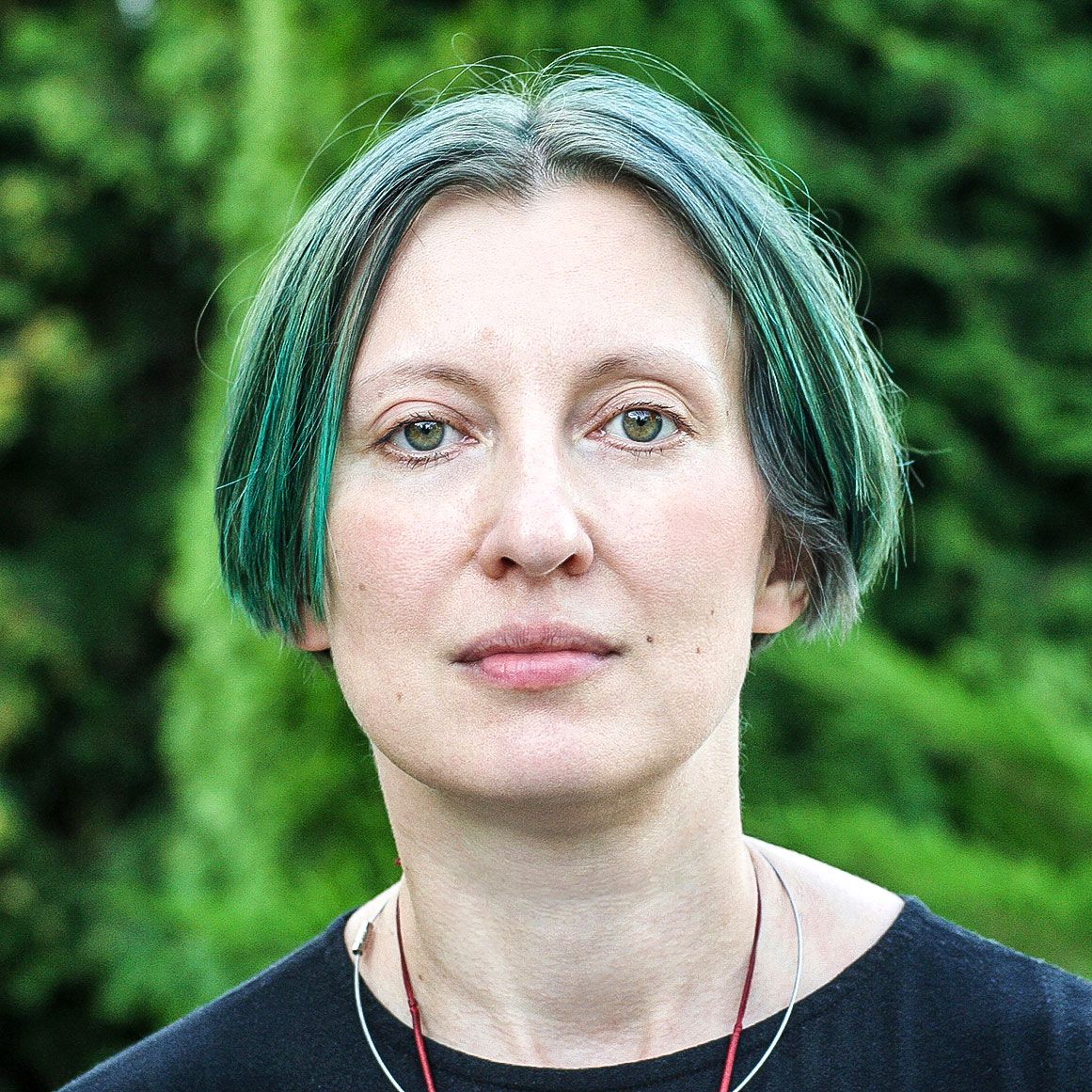
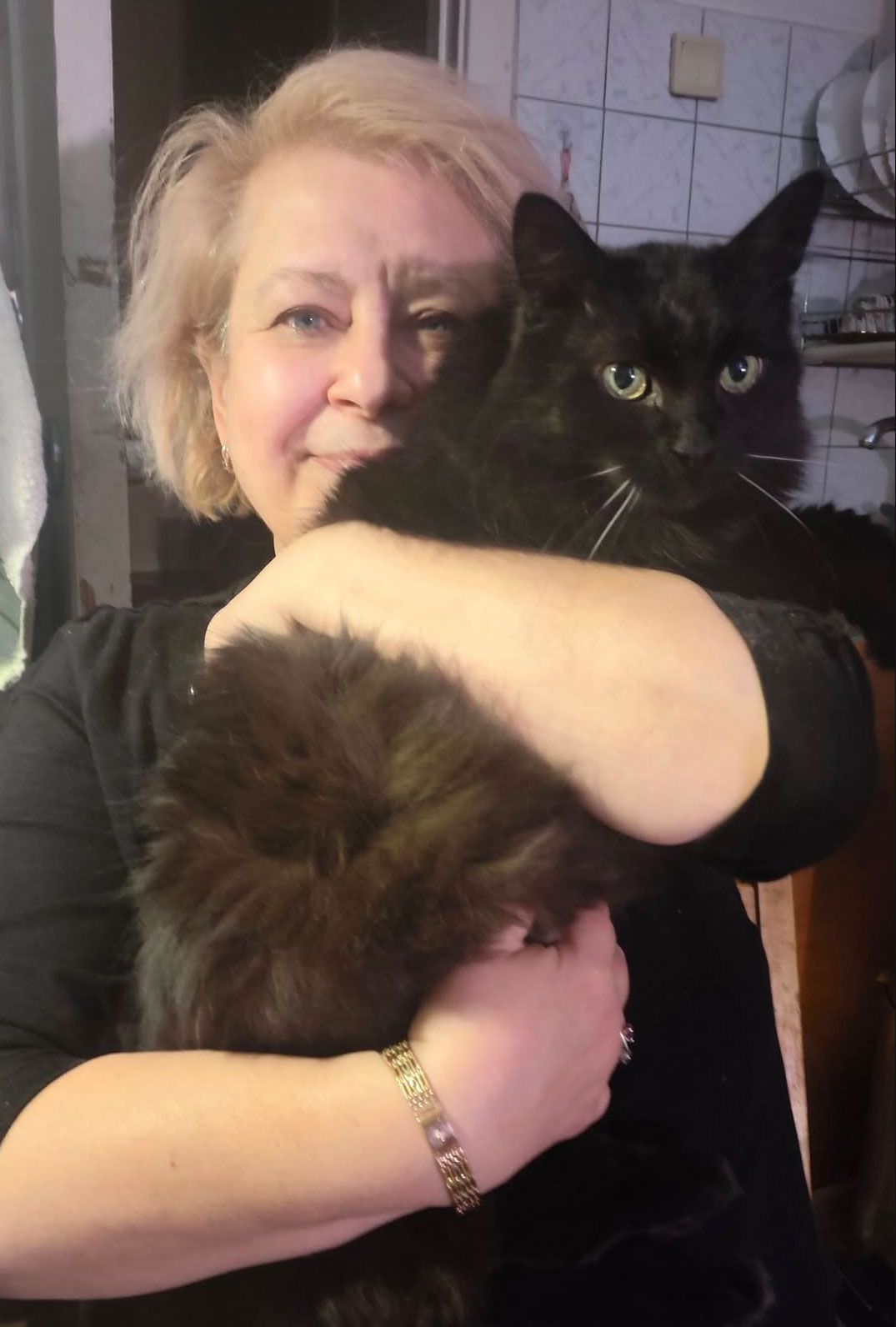
Ekaterina Barabash, first photo after the escape
I’m glad this story had a happy ending. Ekaterina Barabash is free and out of reach of the Russian authorities. Her new publications will soon be available on “Most.”
If you enjoyed this article, consider making a donation — one-time or, even better, monthly. Your support helps us motivate our authors and become better with every article.
Our organization is recognized by the Internal Revenue Service (IRS) as a 501(c)(3) tax-exempt, charitable organization, which means that all contributions made to us are tax-deductible to the fullest extent permitted by U.S. law. Individuals may generally deduct charitable contributions of up to 60% of their Adjusted Gross Income (AGI) for cash donations made to qualifying 501(c)(3) organizations. For donations of appreciated assets (such as stocks or other long-term capital assets), the deduction is typically limited to 30% of AGI, based on the fair market value of the asset. C-corporations may deduct charitable contributions of up to 10% of their taxable income for donations made to eligible charitable organizations.
By submitting a donation, you confirm that you have read and accept the following documents: Privacy Policy and User Agreement, and also give consent to the processing of your personal data.
If you would like to unsubscribe from a monthly donation, please email us at: [email protected]