In the performance House of Hopes, which opened the new season of Berlin’s Volksbühne theater, ten stories about hopes for change are woven into a route through the theater building. The audience moves from one story to another, switching between them like in a social media feed. But here you cannot simply scroll past something uncomfortable or pause life. Rimini Protokoll’s new production explores how our attention changes when other people’s stories unfold not on a phone, but beside us.
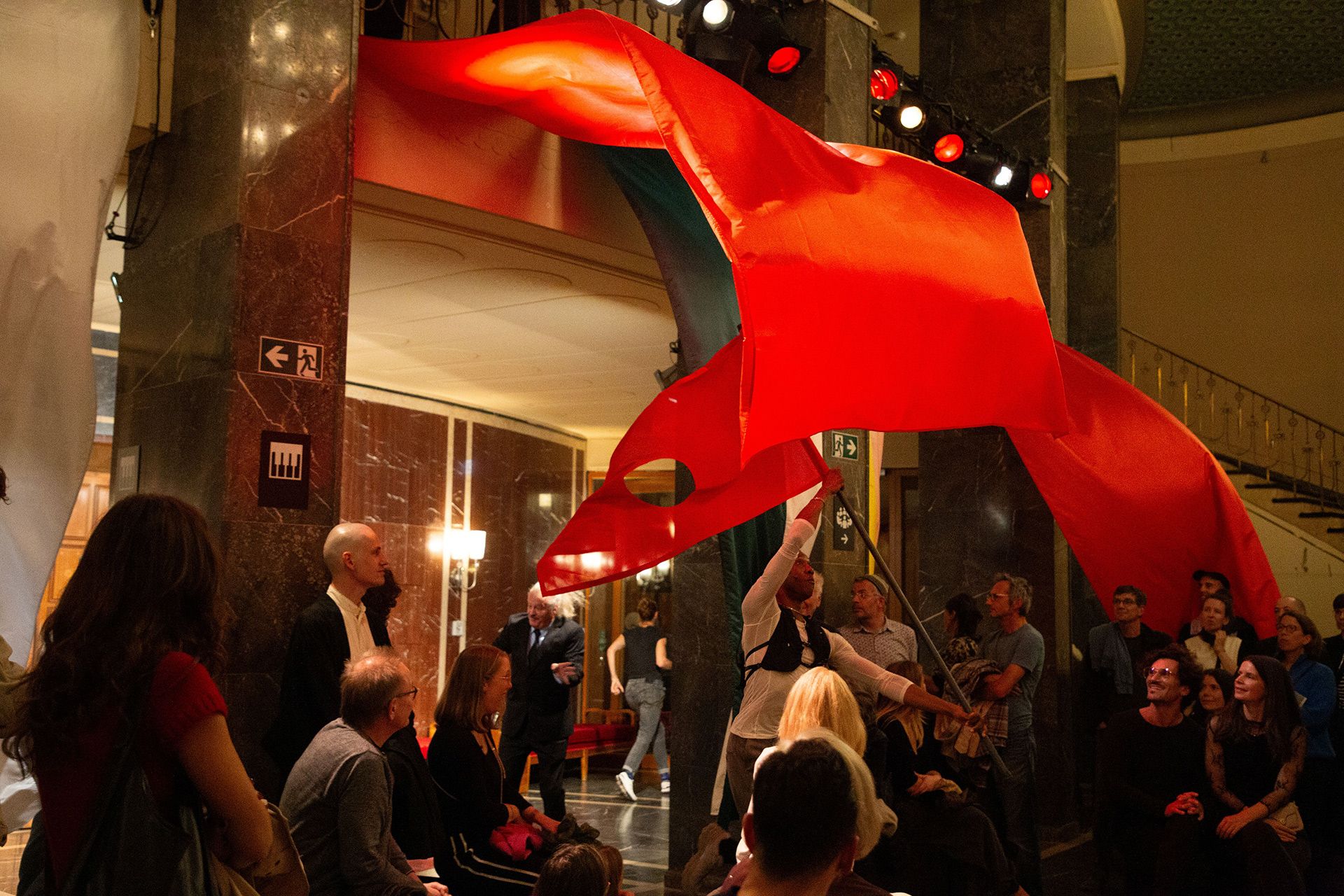
Photo from the premiere of House of Hopes, October 1, 2026. Photo: Bahar Kaygusuz
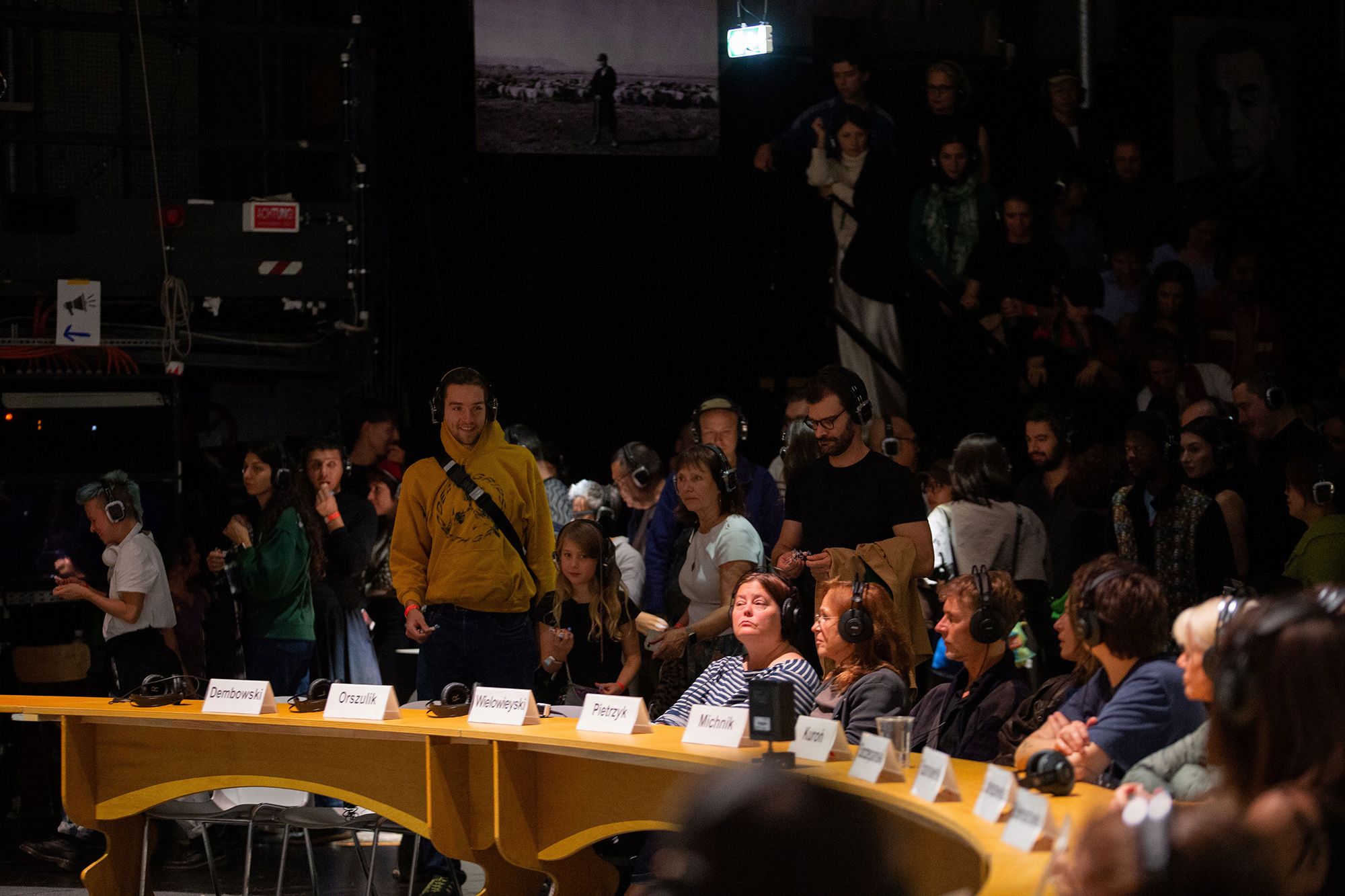
In one room, a person tells how their family survived a political coup. In another, they recall student protests that ended in tragedy. Somewhere, a song once sung at demonstrations is heard, and the audience repeats the movements of the person standing in front of them — behind them, from the neighboring space, another group of spectators is watching. No one sits in the dark in front of a stage. Everyone moves through the building, listens to stories through headphones, follows instructions, meets in corridors, and then parts again. A few minutes later the next scene begins, in another room and with other people. There are ten such stories in total, but each group manages to see only seven.
That is how House of Hopes is structured — a performance by Stefan Kaegi and Daniel Wetzel of Rimini Protokoll, which opened the new season of Berlin’s Volksbühne on October 1, 2026. Its starting point is 1989, when people in many countries around the world hoped for political change. The fall of the Berlin Wall exists here alongside the protests in Tiananmen Square, the struggle against Pinochet in Chile, democratic movements in South Korea, and changes in Eastern Europe. The story is told not by actors portraying historical figures, but by people whose biographies are connected to these events.
The most interesting thing about House of Hopes is the way theater invites the audience to experience its chosen theme. The performance, which lasts two hours and twenty minutes, consists of short episodes, each opening a separate window into someone else’s life. Between them, the spectator moves into a new space, switches to another story, and reconstructs the situation anew.
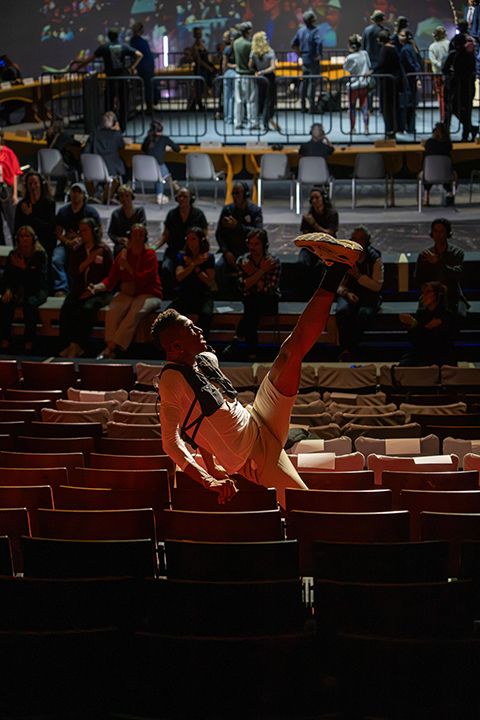
Photo from the premiere of House of Hopes, October 1, 2026. Photo: Bahar Kaygusuz
It is reminiscent of endless scrolling through a phone feed. Only here you cannot pause the story, skip an unpleasant moment, or return to the beginning with a swipe of a finger. You have your own body, limited time, and a route that does not always allow you to see everything. And unlike a digital feed, real people are nearby — people who also watch, listen, move, and sometimes become part of what is happening.
From Stage to Route
Promenade theater appeared long before the word “immersive” became a marketing label for productions that let audiences walk through sets, touch objects, and talk to performers. Later, the British company Punchdrunk turned this principle into vast theatrical worlds. In Sleep No More, a noir-style version of “Macbeth”, masked spectators freely explore a multi-story space and choose for themselves which characters to follow. Each person assembles their own performance, but no one sees it in full.
Immersive theater can offer free exploration of space, lead the audience along a predetermined route, or involve them directly in the action. Movement alone does not yet mean participation. However, architecture and audience behavior can become part of the dramaturgy, change the usual rules of perception, and confront the spectator with the question of what role they play in what is happening.
Rimini Protokoll has been exploring these possibilities since 2000. The collective was founded by German directors Helgard Haug, Stefan Kaegi, and Daniel Wetzel. Instead of professional actors, they brought onto the stage people whose biographies, professions, and knowledge became the material of the performance. This gave rise to “experts of the everyday” — participants who spoke about their own lives and presented their view of the world. From the very beginning, the collective’s theater was a way to explore reality through personal stories, social roles, and familiar patterns of behavior.
In 2008, the Berlin theater HAU hosted the premiere of 100% Berlin, the first version of the 100% City project. One hundred city residents, selected according to demographic characteristics, took to the stage. They answered questions and were divided into groups according to age, profession, political views, and other circumstances. Statistics acquired faces and voices. At the same time, the conditional nature of representation itself became apparent: one hundred people could form a portrait of a city, but not exhaust its diversity. Later, the project was staged in dozens of cities, each time responding to the specifics of the local community.
InRemote X (2013), the spectators themselves became participants in the experiment. Wearing headphones, the group set off along an urban route following a synthetic voice that gave instructions and directed attention to the surrounding environment. An ordinary walk turned into an exploration of collective behavior: participants moved together, watched one another, and gradually became part of a shared composition.
That same year saw the release of Situation Rooms — a multimedia production about the international arms trade. Spectators moved through a specially created space, following video accounts by people connected to the production, sale, and use of weapons. Different biographies came together into a picture of a global system where personal experience intersects with politics and economics. Later, in the project The Walksthe collective transferred this logic to city streets: audio walks turned familiar places into a theatrical experience.
House of Hopes continues this line, but turns to historical memory. Ten testimonies about hopes for change exist in parallel: the spectator does not receive a single chronology, but assembles their own sequence of events. The route determines which part of the story they will see. To imagine the whole, one must also take into account what others saw. In this way, the structure of the performance becomes a model of collective memory: no single person can contain the whole history; the overall picture is made up of partial testimonies.
Twelve Minutes for Someone Else’s Life
In one scene, a Chinese participant рассказывает about the protests in Tiananmen Square. In her memories there is both an atmosphere of hope and a relative’s participation in a hunger strike, as well as the later impossibility of speaking freely about what happened. Economic reforms continued, but democratic expectations were not fulfilled. The relative who took part in the protests later built a career in business and became wealthy; the narrator herself can speak about these events only under a pseudonym. At one point the image on the screen disappears, and all that remains is the admission: the photographs can be found on the internet, but she cannot show them here.
Photo from the premiere of House of Hopes, October 1, 2026. Photo: Bahar Kaygusuz
In another episode, the story of Iran passes through childhood memories, the father’s arrest, the revolution, and the cinema that helped make everyday life bearable. Hope for change after Khomeini’s death did not become reality; the narrator left the country. At the end of the episode, she dances choreography from an Indian film she watched as a child. Political history suddenly becomes bodily memory: a gesture learned many years ago survives regimes, borders, and emigration.
Such scenes show that a short format does not necessarily mean superficiality. Sometimes twelve minutes are enough to hear a story that cannot be reduced to a date in a textbook. But brevity works only when it is supported by a precise choice of details. Otherwise, a personal biography risks becoming an illustration for a predetermined thesis.
This is exactly what divided the critics of the performance. Some saw it as an emotionally precise, well-organized attempt to connect private memories with world history. Berliner Morgenpost noted that political change becomes understandable without intrusive moralizing; the critic from Deutschlandfunk Kultur called the production one of the most impressive theatrical works of recent times. Others felt that ten short stories oversimplify complex processes, and that calls for resistance add up to a comfortable worldview in which a noble opposition stands against purely evil regimes. Such objections were voiced, in particular, by Die Welt, Der Spiegel, and Süddeutsche Zeitung. A review roundup was published onNachtkritik.
This criticism matters: audience participation by itself does not make a performance complex, and emotional involvement does not replace historical analysis. At times, House of Hopes does indeed hurry from an individual fate to a universal conclusion about hope and resistance. Yet the value of the production lies not in offering a comprehensive history of 1989, but in making you feel the limits of your own perspective. You cannot see everything, cannot hear every story, and cannot remain a neutral observer when your gestures become part of someone else’s scene.
Not a Feed, but a Montage
The comparison with TikTok has its limits. In a social network, the algorithm decides what appears before you next, and the user can almost endlessly avoid what does not interest them. In the theater, the route is set by the creators, time is limited, and attention cannot be fully separated from the body and the people around you. In House of Hopes, the spectator does not choose only pleasant stories: they follow the group, hear instructions, find themselves in an unfamiliar space, and sometimes see what is happening from an unexpected angle.
So perhaps it is more accurate not to speak of theater that imitates short videos, but of theater that understands the modern habit of switching attention and uses it for other purposes. Rapid switching may be not a way to forget the previous story, but a way to discover the connection between different stories. Montage works not only in film: in theater it is created by the distance between rooms, the movement of people, changes in sound and light, and sometimes by several events happening at once.
Photo from the premiere of House of Hopes, October 1, 2026. Photo: Bahar Kaygusuz
In House of Hopes, this becomes especially noticeable when one group of spectators becomes the backdrop for the story another group is listening to. A gesture that in one episode expresses solidarity may, from another angle, look like a threat. Spectators do not always understand what role they play in someone else’s scene. They are simultaneously watching and being watched.
A similar principle exists in other contemporary theater formats. In promenade performances, audio routes, and projects at the intersection of performance and digital technologies, the spectator themselves becomes part of the composition. For example, the British company Punchdrunk builds entire worlds that audiences explore at their own pace, while Rimini Protokoll turns urban spaces into theatrical scenarios. At the same time, immersion does not necessarily mean grand sets or expensive technological effects: sometimes headphones, a voice, and a change in the usual route are enough.
What Remains After the Last Room
The flip side of this experience is that in House of Hopes, the transitions between rooms are sometimes so quick that the story ends before you have time to process what you heard. Some spectators may feel like participants in a carefully calibrated attraction, where it is more important to move from one point to another on time than to linger over a difficult question. In addition, such a route places physical demands on the audience: not all spaces of the Volksbühne are accessible to people with limited mobility. The theater provided video and a live stream for inaccessible sections, but the problem remains. An inclusive concept does not yet guarantee an inclusive experience.
And yet it seems important that House of Hopes does not try to hold attention with one grand story. It invites the spectator to assemble their own — from fragments of biographies, other people’s memories, chance encounters, and scenes they did not manage to see. It does not always work flawlessly, but the principle itself seems promising.
Photo from the premiere of House of Hopes, October 1, 2026. Photo: Bahar Kaygusuz
Perhaps the theater of the future will be neither fully digital nor fully immersive. It does not have to turn every performance into a quest, make spectators dance, or hand them headphones at the entrance. But it can abandon the idea that the audience’s attention automatically belongs to the stage for the entire evening. Performances can be built as routes, offer different perspectives, allow spectators to meet and part, make architecture part of the dramaturgy, and leave room for what happens between scenes.
At the end of House of Hopes, all the groups gather in one hall. After more than two hours spent in different parts of the building, the spectators are finally together. Each person carries their own set of stories, and no one has seen the performance in full. But only now does it become clear that all this time they were part of one event. That is the most interesting idea of the production. In an era when everyone watches their own feed, theater can offer not a return to a single screen, but an encounter between people with different experiences. Not necessarily agreement, not necessarily a shared opinion — but at least the chance to understand that your version of the story is not the only one.
If you enjoyed this article, consider making a donation — one-time or, even better, monthly. Your support helps us motivate our authors and become better with every article.
Our organization is recognized by the Internal Revenue Service (IRS) as a 501(c)(3) tax-exempt, charitable organization, which means that all contributions made to us are tax-deductible to the fullest extent permitted by U.S. law. Individuals may generally deduct charitable contributions of up to 60% of their Adjusted Gross Income (AGI) for cash donations made to qualifying 501(c)(3) organizations. For donations of appreciated assets (such as stocks or other long-term capital assets), the deduction is typically limited to 30% of AGI, based on the fair market value of the asset. C-corporations may deduct charitable contributions of up to 10% of their taxable income for donations made to eligible charitable organizations.
By submitting a donation, you confirm that you have read and accept the following documents: Privacy Policy and User Agreement, and also give consent to the processing of your personal data.
If you would like to unsubscribe from a monthly donation, please email us at: [email protected]